How Flexible Packaging Locks in the Delicious Flavor of Popcorn
Anna_Yu
How Flexible Packaging Locks in the Delicious Flavor of Popcorn
Popcorn is one of the world's most popular snack foods, valued for its crisp texture, distinctive aroma, and ability to carry a wide range of sweet, salty, savory, and flavored seasonings. From classic salted popcorn and caramel popcorn to cheese, chocolate, butter, and gourmet varieties, product quality depends heavily on maintaining the right balance of freshness, crunchiness, and flavor. However, popcorn is particularly sensitive to moisture, oxygen, light, and external odors. Without suitable packaging, even high-quality popcorn can quickly become soft, stale, or less flavorful.
Flexible packaging provides an effective solution for protecting popcorn throughout production, storage, transportation, and retail display. High-barrier films can limit moisture and oxygen transmission, while reliable heat seals help prevent air exchange and contamination. Flexible bags can also be customized with vibrant graphics, premium finishes, resealable closures, and convenient formats that improve both product presentation and consumer experience.
For popcorn manufacturers and snack brands, packaging is therefore much more than an attractive outer layer. It directly influences shelf life, texture, flavor retention, logistics efficiency, and brand perception. The right flexible packaging structure can help popcorn maintain its delicious taste and satisfying crunch from the production line to the moment the consumer opens the bag.
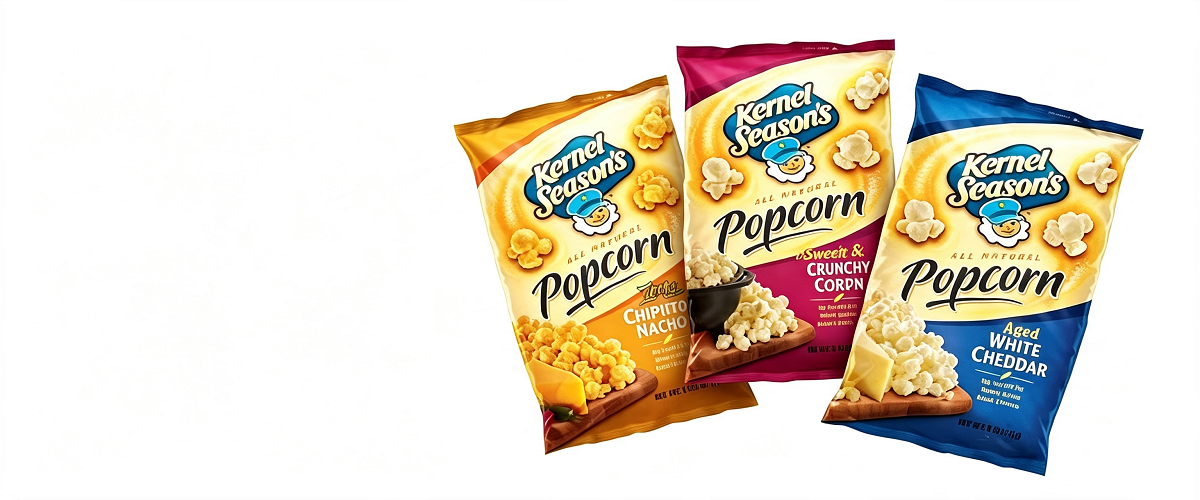
1. How Does Flexible Packaging Keep Popcorn Fresh, Crisp, and Flavorful?
Popcorn's characteristic crunch depends on maintaining a relatively low-moisture environment. When exposed to humid air, popcorn can absorb water vapor, causing its crisp structure to deteriorate. At the same time, oxygen exposure can contribute to flavor degradation, particularly in popcorn containing oils, butter flavors, cheese seasonings, nuts, or other oxidation-sensitive ingredients.
Flexible packaging helps create a more controlled environment around the product. By combining moisture-resistant layers, oxygen barriers, reliable heat seals, and suitable package formats, manufacturers can reduce the environmental factors that cause popcorn quality to deteriorate.
Protecting Popcorn from Moisture
Moisture is one of the biggest threats to popcorn freshness. Even when popcorn is properly processed, exposure to humid conditions during storage or transportation can gradually reduce its crispness.
A suitable flexible packaging structure helps minimize water vapor transmission and keeps external humidity away from the product. This is particularly important in regions with high humidity or when popcorn is transported through different climate zones.
Preserving Crisp Texture
Consumers generally expect popcorn to have a characteristic crunchy texture. Once popcorn becomes soft or chewy, its sensory quality can decline significantly.
High-barrier packaging helps maintain a stable internal environment and reduces moisture migration. Proper sealing is equally important because even an excellent film cannot provide effective protection if the finished package has weak or incomplete seals.
Retaining Flavor and Aroma
Popcorn can contain volatile flavor compounds that contribute to its characteristic aroma. Flavored products may also contain oils, caramel, cheese powder, spices, or other ingredients that require additional protection.
A well-designed package helps retain these aromas while reducing the risk of external odors entering the package. This is particularly important for products with distinctive flavor profiles that consumers expect to remain consistent throughout their shelf life.
Reducing Oxidation
Oxygen can accelerate the deterioration of oils and fats used in popcorn products. Oxidation may eventually contribute to undesirable flavors and aromas.
For oil-rich or premium flavored popcorn, an oxygen-barrier packaging structure can provide additional protection and help preserve the intended flavor profile.
2. Which Packaging Materials Provide the Best Barrier Protection for Popcorn?
The best material structure depends on the popcorn recipe, target shelf life, packaging equipment, distribution environment, and desired package appearance. There is no single material that is ideal for every popcorn application.
Common flexible packaging materials include PET, BOPP, PE, metallized films, aluminum foil, and high-barrier polymer structures.
PET Film
PET is widely used as an outer layer because it provides:
- Good mechanical strength
- Excellent printability
- Dimensional stability
- Attractive surface quality
- Resistance to handling and transportation
PET is commonly laminated with other materials rather than used alone when high moisture and oxygen barrier performance is required.
BOPP Film
BOPP is another popular material for snack packaging. It provides:
- Good moisture resistance
- Excellent printability
- Attractive appearance
- Good stiffness
- Efficient converting performance
BOPP-based structures can be suitable for standard popcorn applications where moderate-to-high moisture protection is required.
PE Film
PE is commonly used as the inner sealing layer. It provides:
- Reliable heat sealing
- Flexibility
- Good moisture resistance
- Food-contact suitability
PE can be combined with PET, BOPP, metallized film, or other barrier layers to create a complete packaging structure.
Metallized PET
Metallized PET, often referred to as MPET, provides enhanced barrier performance while maintaining a relatively lightweight structure.
It can help protect popcorn from:
- Moisture
- Oxygen
- Light
- External environmental conditions
MPET is especially useful for brands seeking a balance between barrier performance, visual appearance, and material efficiency.
Aluminum Foil Laminates
Aluminum foil provides extremely strong protection against moisture, oxygen, light, and external odors.
A typical high-barrier structure may use PET as the outer layer, aluminum foil as the barrier layer, and PE as the sealing layer.
This type of structure can be considered for premium popcorn, extended shelf-life products, or demanding export distribution conditions.
High-Barrier Polymer Structures
Some applications may benefit from advanced polymer-based barrier structures, including EVOH-containing laminates.
These structures can provide strong oxygen protection while offering opportunities for material simplification and recyclable packaging development, depending on the complete package design and applicable recycling infrastructure.
Comparison of Common Popcorn Packaging Structures
| Packaging Structure | Moisture Protection | Oxygen Protection | Typical Application |
|---|---|---|---|
| BOPP/PE | Good | Moderate | Standard snack popcorn |
| PET/PE | Good | Moderate | Retail popcorn |
| PET/MPET/PE | Excellent | Excellent | Premium and flavored popcorn |
| PET/AL/PE | Excellent | Excellent | Long shelf life and export |
| PE/EVOH/PE | Excellent | Excellent | Advanced and sustainability-focused applications |
The final choice should be based on actual product testing, required shelf life, filling conditions, and distribution environment rather than selecting a material solely because it has a higher theoretical barrier rating.
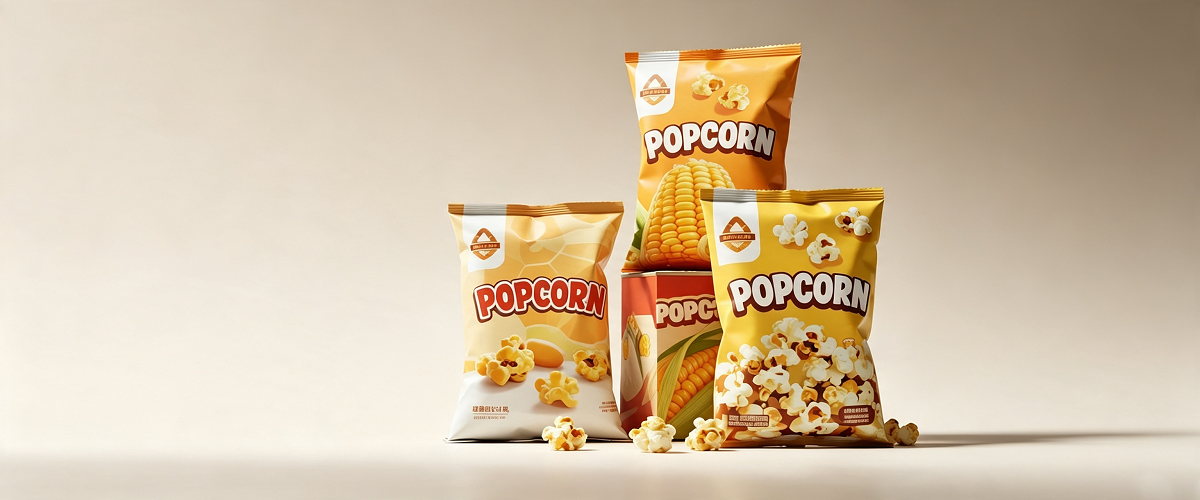
3. How Can Popcorn Packaging Prevent Moisture, Oxygen, and Flavor Loss?
Packaging performance depends on more than simply choosing a high-barrier film. The complete package system—including film structure, seals, filling conditions, headspace, package size, and storage environment—affects final product quality.
Moisture Barrier Performance
A good moisture barrier reduces the movement of water vapor through the packaging material.
This is especially important for popcorn because moisture absorption can quickly affect its crisp texture. Manufacturers should evaluate the water vapor transmission performance of the selected structure against the expected shelf-life requirements.
Oxygen Barrier Performance
Oxygen-barrier materials can help slow oxidation and preserve flavor quality.
For popcorn containing oils, butter ingredients, nuts, or sensitive seasonings, oxygen protection may become particularly important.
Reliable Heat Seals
The package seal is one of the most important components of the overall barrier system.
Even a high-performance laminate can fail to protect popcorn if:
- Seal temperature is incorrect
- Seal pressure is inconsistent
- Contamination occurs in the sealing area
- The seal width is insufficient
- The package is mechanically damaged
Proper seal design and quality control are therefore essential.
Nitrogen Flushing
Nitrogen flushing can be used for many popcorn applications to reduce oxygen in the package headspace and help protect the product.
It can provide additional benefits such as:
- Reduced oxidation
- Improved freshness retention
- Cushioning during transportation
- Reduced mechanical damage to fragile popcorn
The use of nitrogen should be matched to the product, packaging machine, and desired shelf-life target.
Protecting Against External Odors
Popcorn can absorb undesirable odors if packaging has insufficient barrier properties or if the package is damaged.
High-barrier structures can help protect the product from strong external odors during warehousing and transportation.
Optimizing Package Headspace
Packaging design and filling conditions should be optimized to limit unnecessary oxygen exposure while still providing adequate protection against crushing.
For fragile popcorn products, the correct balance between product protection and headspace is important.
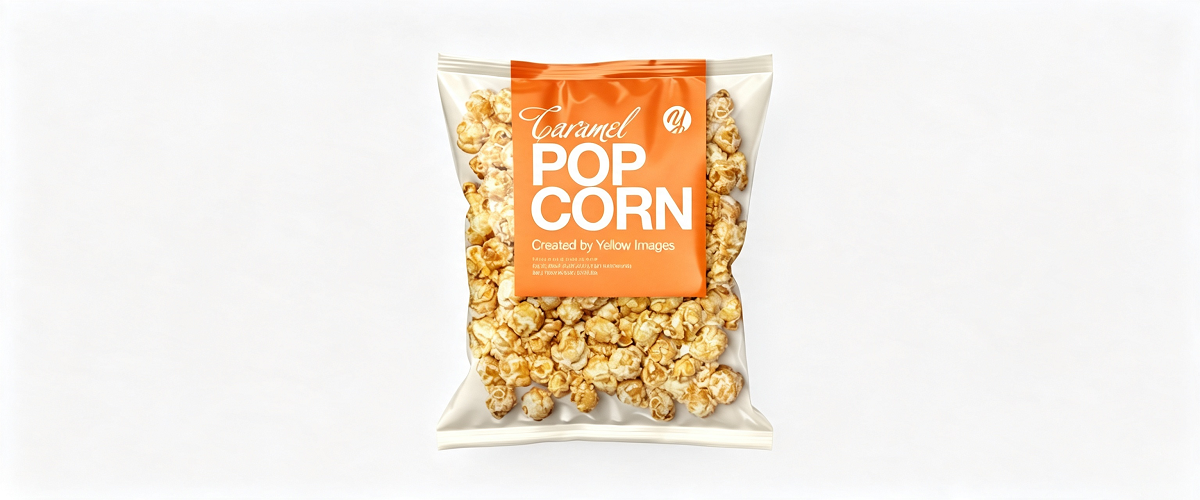
4. What Packaging Features Improve Popcorn Shelf Life and Consumer Convenience?
Modern popcorn packaging must balance technical performance with usability and visual appeal. Functional features can make a product easier to store, transport, open, and consume.
Resealable Zippers
Resealable stand-up pouches are useful for larger popcorn packages that may not be consumed in one sitting.
A zipper allows consumers to close the package after opening and helps reduce continued exposure to the surrounding environment.
Easy-Tear Notches
Easy-tear features allow consumers to open popcorn bags quickly without scissors.
This is particularly useful for snack products designed for:
- Travel
- Outdoor activities
- School lunches
- Office snacks
- Movie nights
Stand-Up Pouch Designs
Stand-up pouches provide a stable display format and offer a large printable surface.
They are suitable for premium popcorn brands seeking stronger shelf presence.
Pillow Bags
Pillow bags are widely used for high-volume snack production because they are compatible with efficient automated packaging systems.
They can provide an economical solution for standard popcorn products.
Gusseted Bags
Side-gusset or bottom-gusset designs can increase package capacity while maintaining a structured appearance.
These formats may be suitable for family-size or premium popcorn products.
Transparent Windows
A transparent window can allow consumers to see the popcorn inside the package.
However, the use of windows should be carefully evaluated because transparent sections may reduce overall light-barrier performance. For highly light-sensitive products, printed or opaque high-barrier packaging may provide better protection.
High-Quality Printing and Finishing
Popcorn is often purchased as an impulse snack, making visual presentation particularly important.
Packaging can use:
- High-resolution graphics
- Matte finishes
- Gloss finishes
- Metallic effects
- Spot effects
- Custom illustrations
- Strong brand typography
These features can help communicate flavor, product positioning, and brand identity at the point of purchase.
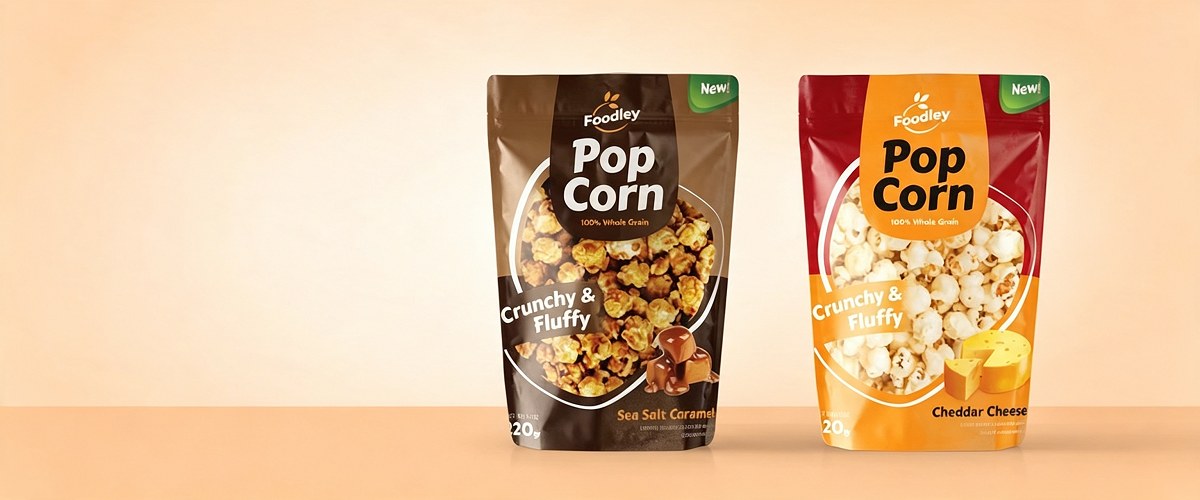
5. Flexible Popcorn Packaging: Key Factors for Freshness, Branding, and Distribution
Selecting popcorn packaging requires a balance between product protection, brand presentation, consumer convenience, and supply-chain efficiency.
Freshness and Shelf Life
The primary objective is to maintain the popcorn's crisp texture, flavor, aroma, and overall quality.
A suitable packaging structure should be selected according to the product's moisture sensitivity, oil content, seasoning composition, and intended shelf life.
Branding and Shelf Appeal
Popcorn packaging provides a valuable branding surface.
Brands can use packaging to communicate:
- Flavor
- Product quality
- Ingredients
- Nutritional information
- Brand story
- Product origin
- Serving suggestions
A distinctive package design can help products stand out in crowded snack aisles.
Distribution and Transportation
Flexible popcorn packaging is lightweight compared with many rigid packaging formats. This can reduce transportation weight and warehouse volume.
For fragile popcorn, package dimensions and structural design should also provide enough protection against crushing during distribution.
Packaging Cost
Material selection should balance barrier performance with commercial requirements.
A premium aluminum foil structure may offer exceptional protection, but it may not be necessary for every popcorn product. For products with shorter shelf lives or controlled distribution environments, a simpler laminate may provide sufficient performance at a lower cost.
Sustainability
Brands are increasingly evaluating recyclable flexible packaging options.
Potential approaches include:
- Mono-material PE structures
- Mono-material PP structures
- EVOH-containing recyclable structures
- Lightweighting
- Material reduction
- Optimized package dimensions
However, sustainability decisions should always consider actual barrier requirements and available recycling infrastructure. Reducing material at the expense of product shelf life may increase food waste rather than improve overall environmental performance.
Retail and E-Commerce Requirements
Retail packaging must perform well on shelves, while e-commerce packaging may face additional handling and transportation challenges.
Brands selling popcorn online should consider:
- Seal strength
- Puncture resistance
- Package dimensions
- Compression resistance
- Shipping conditions
- Secondary packaging requirements
6. FAQ
Why Does Popcorn Need High-Barrier Flexible Packaging?
Popcorn is highly sensitive to moisture, and moisture absorption can quickly reduce its characteristic crispness. High-barrier packaging helps control moisture and oxygen exposure while protecting flavor and aroma.
What Is the Best Material for Popcorn Packaging?
There is no universal best material. PET/PE, BOPP/PE, PET/MPET/PE, and PET/AL/PE are all possible structures depending on the required shelf life, barrier performance, product formulation, and distribution conditions.
Is Metallized Film Suitable for Popcorn Packaging?
Yes. Metallized films such as MPET can provide strong moisture, oxygen, and light protection while offering a lightweight alternative to some foil-based structures.
Should Popcorn Packaging Use Nitrogen Flushing?
Nitrogen flushing can be beneficial for many popcorn products because it reduces oxygen in the package headspace and can help protect flavor and freshness. The exact process should be validated according to the product and packaging system.
Are Resealable Popcorn Bags a Good Option?
Yes. Resealable stand-up pouches are particularly useful for larger popcorn packages because consumers can close the package after opening and reduce further exposure to the environment.
Can Popcorn Packaging Be Recyclable?
Potentially. Recyclable mono-material structures and certain high-barrier polymer designs can be considered where they provide sufficient product protection and are compatible with the relevant recycling infrastructure.
7. Conclusion
Flexible packaging plays a critical role in protecting popcorn's delicious flavor, crisp texture, and overall freshness. Because popcorn can quickly absorb moisture and may contain oils and flavor-sensitive ingredients, the packaging must provide appropriate moisture and oxygen protection while maintaining strong seals throughout storage and distribution.
Materials such as PET, BOPP, PE, metallized films, aluminum foil, and high-barrier polymer structures can be combined to create packaging solutions for different popcorn products and market requirements. Features such as nitrogen flushing, resealable zippers, easy-tear openings, strong heat seals, and high-quality printing can further improve product performance and consumer convenience.
For popcorn manufacturers and brands, the best packaging solution is not simply the material with the highest barrier performance. Instead, it is the structure that provides the right balance of freshness protection, shelf life, package durability, branding, cost efficiency, consumer convenience, and sustainability. By selecting flexible packaging according to the specific characteristics of the popcorn product and its distribution environment, brands can help ensure that every package delivers the crisp, flavorful experience consumers expect.