How to Create Flexible Packaging for Fruit Gummies
Anna_Yu
How to Create Flexible Packaging for Fruit Gummies
Fruit gummies are one of the most visually appealing and fast-growing categories in the confectionery and snack market. From traditional gummy bears and fruit-shaped gummies to sour gummies, vitamin gummies, functional gummies, and premium fruit-based treats, these products depend heavily on texture, appearance, flavor, freshness, and convenience. Unlike many dry snacks, gummies contain a meaningful amount of moisture and sugar, making them particularly sensitive to humidity, temperature changes, surface tackiness, and packaging conditions. When the wrong packaging is selected, gummies may stick together, lose their intended texture, absorb moisture, or develop an unattractive appearance.
For manufacturers and brands, flexible packaging provides an effective way to address these challenges while also creating a strong visual identity. Flexible pouches, pillow bags, stand-up bags, sachets, and other formats can be customized according to the gummy product, pack size, filling method, distribution environment, and target market. With the right material structure, flexible packaging can help create a controlled internal environment that protects gummies from moisture exchange, oxygen exposure, light, contamination, and physical handling.
Packaging also has an important commercial function. Gummies are highly visual products, and consumers often make purchasing decisions based on packaging appearance before they have an opportunity to evaluate the product itself. Bright colors, playful graphics, transparent windows, premium finishes, resealable closures, and distinctive bag shapes can transform flexible packaging into a powerful marketing tool. For brands competing in supermarkets, convenience stores, specialty candy shops, online marketplaces, and international markets, packaging can significantly influence shelf visibility and perceived product value.
However, creating flexible packaging for fruit gummies requires more than selecting an attractive printed pouch. The packaging must be designed around the product's water activity, moisture sensitivity, stickiness, fat content, flavor system, storage temperature, filling process, expected shelf life, and distribution conditions. A structure that works well for dry gummy candies may not be appropriate for softer or higher-moisture gummies. Similarly, packaging intended for humid tropical markets may require different barrier performance from packaging used in dry climates.
This comprehensive guide explains how to create flexible packaging for fruit gummies by examining suitable bag formats, moisture and sticking protection, material structures, functional features, and the most important design considerations for freshness, shelf life, branding, and distribution. By taking a product-specific approach, gummy manufacturers can develop packaging that protects product quality while delivering a strong consumer experience and competitive market presentation.
1. What Types of Flexible Packaging Are Best for Fruit Gummies?
The best flexible packaging format for fruit gummies depends on product texture, moisture content, pack size, consumption frequency, filling method, retail environment, and distribution requirements. Because gummies range from small firm candies to soft, high-moisture functional gummies, packaging should be selected according to the specific characteristics of the product.
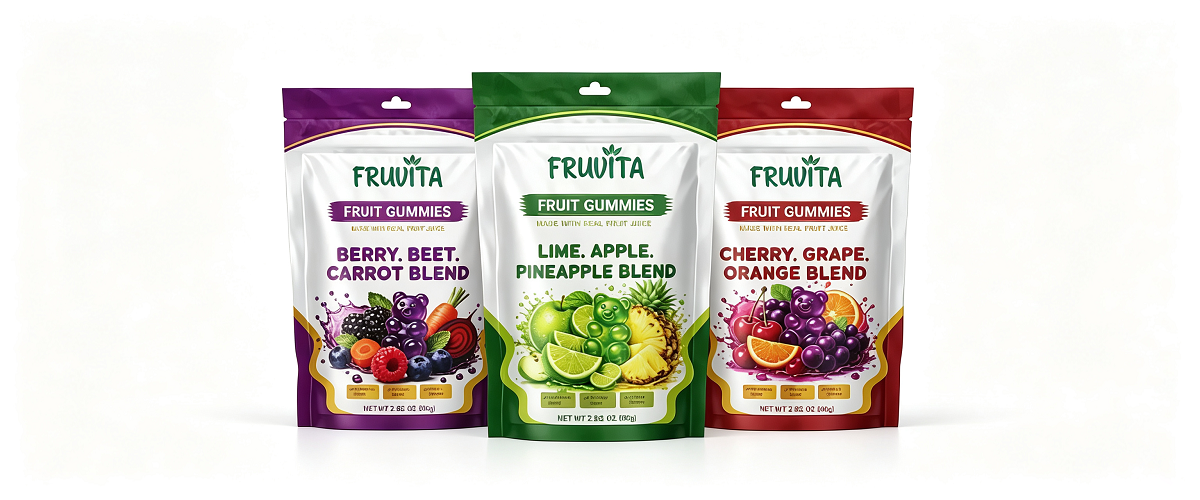
Stand-Up Pouches
Stand-up pouches are one of the most versatile flexible packaging options for fruit gummies.
They are suitable for:
- Gummy bears
- Fruit-shaped gummies
- Sour gummies
- Mixed gummy assortments
- Premium fruit gummies
- Functional gummy products
- Family-size gummy packs
The upright structure creates strong shelf visibility and provides a relatively large printable area for branding and product communication.
A resealable zipper can also be added for multi-serve products. This is particularly useful for larger bags that consumers open and consume over several occasions.
For premium gummy brands, stand-up pouches can be combined with:
- Matte finishes
- Gloss finishes
- Metallic effects
- Spot UV
- Transparent windows
- Custom shapes
- Tear notches
- Resealable zippers
This makes the format suitable for both functional and branding purposes.
Pillow Bags
Pillow bags are widely used in high-volume confectionery production because they are compatible with automated vertical or horizontal packaging systems.
They are commonly used for:
- Mass-market gummy candies
- Small snack-size packs
- Individual portions
- Promotional packs
- Convenience-store products
- Multipacks
One of the biggest advantages of pillow bags is production efficiency. They can be produced at high speeds while maintaining consistent seals and package dimensions.
For gummy manufacturers producing large volumes, pillow bags can therefore provide an attractive combination of cost efficiency, production speed, and adequate barrier protection.
Three-Side Seal Bags
Three-side seal bags provide a simple and flexible structure for gummy products.
They are suitable for:
- Small gummy packs
- Samples
- Specialty gummies
- Trial-size products
- Private-label products
- Limited-edition products
A tear notch can be added to make the bag easier to open.
For brands that require simple packaging without a large number of functional features, three-side seal bags can provide a practical solution.
Flat-Bottom Bags
Flat-bottom bags, also known as box pouches, provide a more structured appearance than conventional flexible bags.
They are especially suitable for:
- Premium fruit gummies
- Functional gummy supplements
- Large-volume packs
- Specialty candy products
- Export-oriented brands
The flat bottom allows the package to stand securely on shelves and provides several printable surfaces.
For premium products, the structure can be combined with high-quality graphics and sophisticated surface finishes to create a more upscale appearance.
Quad-Seal Bags
Quad-seal bags provide additional structural stability and can accommodate larger product volumes.
They may be suitable for:
- Family-size gummy packs
- Bulk gummies
- Foodservice products
- Export packs
- Large retail packages
The side panels also create additional areas for branding, ingredients, nutrition information, or product instructions.
Single-Serve Sachets
Single-serve packaging is particularly relevant for:
- Functional gummies
- Vitamin gummies
- Travel packs
- Hotel amenities
- Promotional samples
- Children's snack portions
Individual packaging can reduce repeated exposure to environmental conditions and provide accurate portion control.
Stick Packs
Stick packs may be used for certain gummy-related functional products, especially when portion control is important.
They can provide:
- Portable consumption
- Controlled serving sizes
- Convenient distribution
- Strong promotional potential
However, the specific geometry must be compatible with the shape and dimensions of the gummy product.
Packaging Format Comparison
| Packaging Format | Best Application | Main Advantage | Key Consideration |
|---|---|---|---|
| Stand-up pouch | Retail and premium gummies | Shelf visibility and resealability | Higher feature cost |
| Pillow bag | Mass-market gummies | High-speed production | Usually less resealable |
| 3-side seal bag | Small and specialty packs | Simple customization | Less structural stability |
| Flat-bottom bag | Premium gummies | Strong shelf presentation | More complex construction |
| Quad-seal bag | Large packs | Stability and capacity | Higher material usage |
| Sachet | Single-serve products | Portion control | More packaging per serving |
| Stick pack | Functional/portable products | Convenience | Limited product geometry |
The most appropriate format should be determined by the complete packaging system rather than appearance alone.
2. How Does Flexible Packaging Protect Fruit Gummies from Moisture and Sticking?
Moisture management is one of the most important challenges in fruit gummy packaging. Gummies contain sugar, gelatin, pectin, or other ingredients that can interact with environmental humidity. If moisture enters the package or migrates between the product and the surrounding environment, gummies may become sticky, softer, harder, or more likely to clump together.
Why Gummies Stick Together
Gummy sticking can result from several factors, including:
- High environmental humidity
- Excess surface moisture
- Temperature fluctuations
- High product moisture
- Inadequate packaging barrier
- Poor package sealing
- Insufficient anti-sticking treatment
- Product formulation characteristics
Packaging cannot solve every formulation issue, but a properly designed package can significantly reduce environmental exposure.
Moisture Barrier Performance
The first consideration is the package's ability to resist water vapor transmission.
A strong moisture barrier helps reduce the rate at which water vapor moves through the film.
This is especially important when gummies are:
- Soft
- High in moisture
- Sugar-coated
- Stored in humid environments
- Distributed internationally
- Expected to maintain texture for extended periods
Materials such as metallized films and aluminum foil laminates can provide strong moisture barrier performance when properly constructed.
Controlling Water Vapor Transmission
Water vapor transmission rate, commonly referred to as WVTR, is an important packaging performance parameter.
A lower WVTR generally indicates stronger resistance to moisture transmission.
However, the required WVTR depends on:
- Product moisture content
- Water activity
- Target shelf life
- Package size
- Headspace
- Storage humidity
- Distribution conditions
Therefore, packaging specifications should be selected according to actual product requirements rather than choosing the lowest possible transmission rate automatically.
Seal Integrity and Moisture Protection
Moisture does not necessarily enter through the main film.
A defective seal can become a major pathway for moisture ingress.
Potential causes include:
- Contamination in the sealing area
- Incorrect sealing temperature
- Insufficient sealing pressure
- Incorrect dwell time
- Incompatible sealing layers
- Film deformation
- Mechanical damage
For gummy products, strong and consistent seals are therefore just as important as barrier film selection.
Preventing Gummy-to-Gummy Contact
Packaging geometry can also influence sticking.
If gummies are tightly compressed together, their surfaces may remain in prolonged contact, increasing the likelihood of adhesion.
Package design can help by providing appropriate:
- Internal volume
- Product distribution
- Headspace
- Filling quantity
- Bag dimensions
For delicate gummies, the goal is to avoid unnecessary compression while also preventing excessive product movement.
Temperature Management
Temperature can significantly influence gummy texture and surface characteristics.
Higher temperatures may increase:
- Surface softness
- Tackiness
- Product deformation
- Adhesion between pieces
Packaging should therefore be considered together with the expected storage and transportation temperature.
A high-barrier bag cannot compensate for poor temperature control if the product itself becomes excessively soft.
Surface Treatments and Anti-Sticking Strategies
Some gummy products may use surface treatments or coatings to reduce sticking.
Examples can include:
- Sugar coating
- Oil coating
- Starch dusting
- Formulation-based anti-sticking systems
The packaging material should be compatible with the product surface.
For example, oily or coated gummies may require careful evaluation of seal contamination, coefficient of friction, and film interaction during filling and sealing.
Oxygen Protection
Although moisture is usually a major concern, oxygen can also affect certain gummy products.
Oxygen may contribute to:
- Flavor oxidation
- Color changes
- Degradation of sensitive ingredients
- Aroma loss
This becomes more important for gummies containing fruit flavors, natural colors, oils, vitamins, or other sensitive ingredients.
A suitable oxygen barrier can therefore help maintain product quality during extended storage.
Light Protection
Some gummy products contain ingredients that are sensitive to light.
Light exposure can contribute to:
- Color fading
- Flavor degradation
- Ingredient deterioration
Metallized and aluminum-based structures can provide strong light protection.
If a transparent window is required for marketing purposes, the window size and location should be carefully considered.
Mechanical Protection
Although gummies are generally more resistant to breakage than cookies or chips, they can still deform or become damaged during transportation.
Potential issues include:
- Compression
- Crushing
- Surface deformation
- Package puncture
- Seal damage
Flexible packaging should therefore provide adequate mechanical strength while maintaining appropriate flexibility.
Complete Protection System
The ideal gummy packaging system combines:
Moisture barrier + oxygen barrier + light protection + reliable seals + appropriate package geometry + suitable storage conditions
This integrated approach provides much more effective protection than relying on any single packaging feature.
3. Which Packaging Materials Provide the Best Barrier Protection for Fruit Gummies?
Material selection is one of the most important technical decisions in gummy packaging.
A flexible package usually consists of several layers, with each layer providing a different function.
For example:
- Outer layer → printing and mechanical strength
- Barrier layer → moisture, oxygen, and light protection
- Inner layer → heat sealing and product contact
PET
Polyester, or PET, is commonly used as an outer layer.
Its main advantages include:
- Good mechanical strength
- Excellent printability
- Dimensional stability
- Good heat resistance
- Attractive appearance
PET is usually combined with other layers when stronger barrier protection is required.
BOPP
Biaxially oriented polypropylene, or BOPP, is widely used in confectionery and snack packaging.
It can provide:
- Good moisture resistance
- Good stiffness
- Good printability
- Cost efficiency
- Attractive appearance
BOPP can be particularly useful for gummy packaging where moisture protection and production efficiency are important.
PE
Polyethylene is frequently used as a sealing layer.
It provides:
- Heat sealing
- Flexibility
- Food-contact suitability
- Good seal strength
- Useful mechanical performance
PE is often laminated with PET, BOPP, or other barrier layers.
CPP
Cast polypropylene can also function as an inner sealing layer.
It may provide:
- Heat-sealing performance
- Flexibility
- Good mechanical characteristics
- Suitable temperature performance
The final choice between PE, CPP, and other sealing materials depends on the packaging process and product requirements.
VMPET
Metallized PET is frequently used when stronger barrier protection is required.
It can provide significant resistance to:
- Moisture
- Oxygen
- Light
VMPET is therefore a popular choice for confectionery products requiring an improved barrier while maintaining a relatively lightweight structure.
Aluminum Foil
Aluminum foil offers one of the highest levels of barrier protection available in flexible packaging.
It provides excellent protection against:
- Oxygen
- Water vapor
- Light
- Aroma transmission
For gummies with demanding shelf-life requirements, sensitive ingredients, or international distribution, aluminum foil laminates may be considered.
However, foil structures can increase cost and may create additional considerations related to recycling and end-of-life management.
Typical Gummy Packaging Structures
| Gummy Product | Example Structure | Primary Benefit |
|---|---|---|
| Standard fruit gummies | BOPP/PE | Moisture protection and cost efficiency |
| Premium gummies | PET/VMPET/PE | Strong barrier and premium appearance |
| High-moisture gummies | PET/VMPET/PE | Enhanced moisture protection |
| Functional gummies | PET/VMPET/PE | Moisture, oxygen, and light protection |
| Long-shelf-life gummies | PET/AL/PE | Maximum barrier |
| Export gummies | PET/AL/PE or high-barrier laminate | Protection during long distribution |
| Individual gummies | BOPP/CPP | Efficient wrapping and sealing |
These structures are examples rather than universal specifications.
The final laminate should be validated according to:
- Water activity
- Moisture content
- Fat content
- Flavor system
- Color sensitivity
- Target shelf life
- Storage conditions
- Filling equipment
- Regulatory requirements
Clear vs. Metallized Packaging
Transparent packaging can provide an important marketing advantage.
Consumers can see:
- Gummy shape
- Color
- Texture
- Product quantity
- Fruit-inspired appearance
This may increase visual confidence.
However, transparent films generally provide less light protection than metallized or opaque structures.
For products requiring stronger light protection, brands can consider:
- Fully opaque packaging
- Metallized laminates
- Aluminum foil laminates
- Small controlled windows
Mono-Material Packaging
Sustainability is increasingly influencing flexible packaging development.
For gummy products, manufacturers may explore:
- PE-based mono-material structures
- PP-based mono-material structures
- Reduced-gauge films
- Recyclable packaging solutions where appropriate
However, recyclability depends on the complete package and local recycling infrastructure.
A package should not be labeled recyclable solely because it contains a recyclable polymer.
Factors such as:
- Barrier coatings
- Printing
- Adhesives
- Zippers
- Thickness
- Local collection systems
- Recycling technology
may all influence actual end-of-life performance.
Material Selection Matrix
| Packaging Requirement | Material Consideration |
|---|---|
| Strong printing | PET or BOPP |
| Moisture barrier | BOPP, metallized structures, foil structures |
| Oxygen barrier | VMPET or aluminum foil structures |
| Light protection | VMPET or aluminum foil |
| Heat sealing | PE or CPP |
| Flexibility | PE-based structures |
| Premium appearance | PET-based structures with special finishes |
| Maximum barrier | Aluminum foil laminate |
| Sustainability focus | Qualified mono-material structures |
The best material structure is therefore a balanced engineering solution, not simply the structure with the highest barrier.
4. What Packaging Features Improve the Shelf Life and Convenience of Fruit Gummies?
Modern gummy packaging needs to protect the product while also providing a convenient and attractive consumer experience.
Resealable Zippers
Resealable zippers are particularly useful for multi-serve gummy packs.
They allow consumers to:
- Open the package repeatedly
- Reseal the package
- Reduce environmental exposure
- Store remaining gummies more conveniently
For larger gummy bags, resealability can become an important product benefit.
Tear Notches
Tear notches provide an easy opening method without requiring scissors.
They are useful for:
- Snack-size gummy bags
- Retail packs
- Children's products
- On-the-go products
The tear design should be controlled so that the bag opens easily without causing excessive tearing.
Easy-Open Features
Packaging can be designed with opening features that improve accessibility.
These may include:
- Tear notches
- Easy-open seals
- Perforations
- User-friendly zipper systems
The correct option depends on package size and consumer use.
Transparent Windows
A window can showcase the product and reinforce the visual appeal of colorful gummies.
This can be particularly useful for:
- Premium gummies
- Artisan products
- Fruit-shaped gummies
- Natural or organic-positioned products
However, window size should be balanced against light protection and barrier performance.
Hang Holes
Small gummy packs can benefit from hang holes for retail display.
They can be used in:
- Convenience stores
- Candy shops
- Specialty stores
- Promotional displays
Custom Shapes
Custom-shaped pouches can make gummy packaging visually distinctive.
Examples include:
- Fruit-shaped packages
- Character-inspired packages
- Seasonal designs
- Gift-oriented packages
However, custom shapes may increase tooling, material waste, production complexity, and cost.
Matte and Gloss Finishes
Surface finish can strongly influence brand perception.
Matte finishes can create:
- Premium positioning
- Sophisticated appearance
- Modern visual identity
Gloss finishes can provide:
- Vibrant graphics
- Strong color saturation
- High shelf visibility
A combination of matte and gloss effects can create visual contrast.
Spot UV and Metallic Effects
Premium gummy brands can use special printing effects to highlight:
- Brand logos
- Fruit illustrations
- Product names
- Flavor indicators
- Premium claims
These features can help packaging attract attention in crowded retail environments.
QR Codes
QR codes can connect the package with digital content.
Potential applications include:
- Product stories
- Recipes
- Brand information
- Promotions
- Loyalty programs
- Ingredient information
- Traceability content
This can transform the package into a broader marketing channel.
Child-Friendly Considerations
If gummies are marketed toward children, packaging design should also consider:
- Easy handling
- Appropriate package size
- Clear product information
- Responsible visual communication
If the product contains functional ingredients or is positioned as a supplement, packaging should also follow the relevant regulatory requirements for claims and labeling.
Feature Selection Table
| Feature | Main Benefit | Suitable Application |
|---|---|---|
| Zipper | Resealability | Multi-serve gummies |
| Tear notch | Easy opening | Retail packs |
| Window | Product visibility | Premium gummies |
| Hang hole | Retail display | Small packs |
| Custom shape | Differentiation | Seasonal products |
| Matte finish | Premium image | Specialty gummies |
| Gloss finish | High visual impact | Mass-market products |
| Spot UV | Brand emphasis | Premium products |
| QR code | Digital engagement | Brand campaigns |
Not every package needs every feature. The best solution uses only the features that provide meaningful value to the product and consumer.
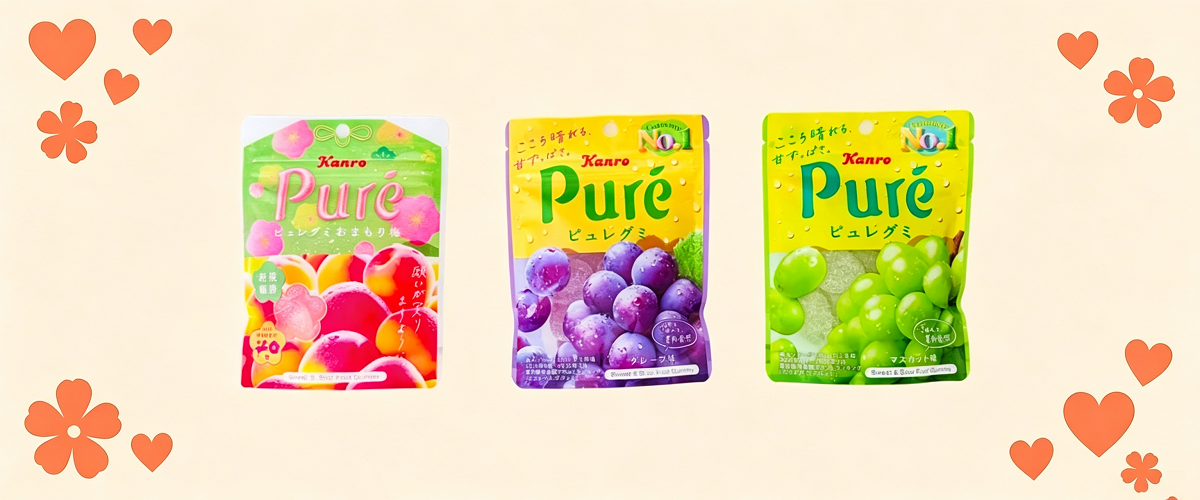
5. Fruit Gummy Packaging Design: Key Factors for Freshness, Branding, and Market Appeal
Creating successful flexible packaging for fruit gummies requires a balance between product protection, shelf-life performance, consumer convenience, brand identity, manufacturing efficiency, logistics, sustainability, and cost.
Product Characteristics
Before selecting packaging, manufacturers should understand the gummy itself.
Important variables include:
- Moisture content
- Water activity
- Sugar concentration
- Gelatin or pectin content
- Surface coating
- Acidity
- Fat content
- Flavor system
- Color sensitivity
- Product hardness
- Stickiness
These factors determine the packaging performance required.
Water Activity
Water activity is particularly important for gummy products because it describes how much water is available for chemical and biological processes.
Packaging selection should not rely solely on total moisture content.
The product's water activity, formulation, and intended storage conditions should all be considered when determining the required barrier level.
Shelf-Life Targets
Shelf life should be validated using the actual gummy formulation and final packaging.
Important quality indicators may include:
- Texture
- Stickiness
- Color
- Flavor
- Aroma
- Surface appearance
- Clumping
- Ingredient stability
Packaging trials should ideally evaluate the complete system rather than testing film alone.
Climate and Storage Conditions
Climate can have a major effect on gummy packaging performance.
Humid environments may increase moisture absorption, while high temperatures can influence texture and surface stickiness.
For international distribution, manufacturers should consider:
- Relative humidity
- Temperature variation
- Transportation duration
- Warehouse conditions
- Retail storage
- Seasonal changes
Distribution and E-Commerce
Gummies sold online may experience repeated handling and temperature changes.
Flexible packaging should therefore be designed to withstand:
- Vibration
- Compression
- Dropping
- Carton handling
- Warehouse stacking
For premium gummies, secondary packaging may provide additional protection during e-commerce transportation.
Packaging Equipment Compatibility
The selected film must work effectively with the filling and sealing equipment.
Important parameters include:
- Film thickness
- Coefficient of friction
- Heat-sealing temperature
- Seal strength
- Web handling
- Machine speed
- Cutting performance
- Registration accuracy
A high-barrier structure that cannot run efficiently on the production line may not be commercially practical.
Seal Integrity Testing
Seal performance should be evaluated carefully.
Potential tests may examine:
- Seal strength
- Leak resistance
- Burst performance
- Package integrity
- Visual seal quality
The exact testing program depends on the packaging format and application.
Branding and Shelf Appeal
Fruit gummies are highly visual products, making packaging design particularly important.
A successful package should quickly communicate:
- Fruit flavor
- Product type
- Brand identity
- Texture
- Premium or mass-market positioning
- Product quantity
Color is especially important in gummy packaging because consumers often associate package colors with specific fruit flavors.
Packaging Hierarchy
The front panel should establish a clear visual hierarchy.
A typical structure may include:
Brand → Product Type → Flavor → Key Benefit → Product Visual
This allows consumers to understand the product quickly.
Premium vs. Mass-Market Design
Different market positions require different visual strategies.
Premium gummies may benefit from:
- Minimalist graphics
- Matte finishes
- Metallic details
- High-quality product photography
- Sophisticated typography
Mass-market gummies may benefit from:
- Bright colors
- Large product images
- Strong flavor communication
- Bold typography
- Highly visible branding
The packaging should reflect the target consumer rather than simply following design trends.
Product Visibility vs. Protection
One of the most important design decisions is whether to use a transparent window.
A window provides:
- Product visibility
- Visual trust
- Color recognition
- Shape recognition
But it may reduce protection from light.
A small window or strategically positioned transparent area can provide a compromise between product visibility and barrier performance.
Sustainability
Gummy brands increasingly need to consider the environmental impact of their packaging.
Potential strategies include:
- Lightweighting
- Material reduction
- Mono-material structures
- Recyclable structures where supported
- Efficient package dimensions
- Reduced secondary packaging
- Responsible printing systems
However, sustainability should always be balanced with product protection.
If insufficient barrier protection causes gummies to spoil or lose quality, the environmental benefits of material reduction may be offset by increased product waste.
Cost Optimization
The lowest film price does not necessarily produce the lowest total cost.
Packaging cost can include:
- Film
- Printing
- Lamination
- Bag making
- Zippers
- Special finishes
- Machine efficiency
- Product losses
- Secondary packaging
- Shipping
- Storage
A slightly more expensive package may provide better overall economics if it reduces quality complaints, product waste, or transportation damage.
Export Considerations
International gummy distribution requires careful evaluation of:
- Destination climate
- Transportation time
- Customs and handling
- Regulatory requirements
- Labeling requirements
- Storage conditions
The packaging should be designed around the actual destination market.
Recommended Development Process
A structured development process can reduce packaging risks.
Step 1: Define the gummy product
Identify moisture content, water activity, texture, surface coating, flavor, and product dimensions.
Step 2: Establish the shelf-life target
Define how long the gummy must maintain acceptable sensory and physical quality.
Step 3: Analyze storage and distribution
Consider humidity, temperature, transportation duration, and handling.
Step 4: Select the package format
Choose between stand-up pouches, pillow bags, three-side seal bags, flat-bottom bags, sachets, or other suitable formats.
Step 5: Select the barrier structure
Determine the required moisture, oxygen, light, and mechanical protection.
Step 6: Select functional features
Add zippers, tear notches, windows, hang holes, or special finishes according to actual requirements.
Step 7: Test packaging-machine compatibility
Evaluate filling, sealing, cutting, forming, and production efficiency.
Step 8: Conduct product-package trials
Test the actual gummies inside the final packaging structure.
Step 9: Validate shelf life
Evaluate texture, sticking, color, flavor, and other relevant quality characteristics.
Step 10: Optimize the final design
Balance protection, appearance, sustainability, production efficiency, and cost before commercial launch.
Practical Selection Guide
| Factor | Key Question | Packaging Implication |
|---|---|---|
| Moisture | Are gummies sensitive to humidity? | Prioritize moisture barrier |
| Stickiness | Do pieces adhere during storage? | Optimize barrier and package geometry |
| Water activity | How stable is the formulation? | Validate barrier and shelf life |
| Light | Are colors or ingredients light-sensitive? | Consider opaque/metallized layers |
| Oxygen | Are flavors or ingredients oxidation-sensitive? | Consider oxygen barrier |
| Shelf life | How long must quality remain stable? | Select appropriate barrier |
| Package size | Single-serve or family-size? | Select suitable format |
| Consumer use | Single-use or multi-serve? | Consider zipper |
| Retail | How will the bag be displayed? | Consider stand-up or hang-hole formats |
| Branding | Premium or mass-market? | Customize graphics and finishes |
| Distribution | Local or export? | Adjust barrier and strength |
| Sustainability | What recycling infrastructure exists? | Evaluate complete structure |
| Production | What equipment is available? | Validate film compatibility |
| Cost | What is the total package cost? | Balance performance and economics |
FAQ
What is the best flexible packaging for fruit gummies?
Stand-up pouches, pillow bags, three-side seal bags, and other flexible formats can all be suitable. For many retail gummies, a moisture-resistant high-barrier laminate combined with reliable seals provides a strong starting point.
How do you stop gummies from sticking together in packaging?
Packaging can reduce environmental moisture exposure by using an appropriate moisture barrier and reliable seals. However, sticking also depends on formulation, surface coating, temperature, and water activity. Packaging should therefore be evaluated together with the product formulation.
What material is commonly used for gummy packaging?
Common materials include PET, BOPP, PE, CPP, VMPET, and aluminum foil. These materials can be combined into multilayer structures to provide printing, strength, moisture protection, oxygen protection, and heat sealing.
Do fruit gummies need high-barrier packaging?
Many gummies benefit from good moisture barrier protection, especially when they need to maintain a specific texture in humid environments. Products with sensitive flavors, colors, or functional ingredients may also require stronger oxygen and light barriers.
Is aluminum foil necessary for gummy packaging?
Not always. Aluminum foil provides excellent barrier protection, but metallized films and other high-barrier structures may provide sufficient performance for many gummy products at a lower material cost.
Are resealable gummy bags useful?
Yes. Resealable zippers are particularly useful for larger multi-serve gummy packs because they allow consumers to close the package after opening and reduce unnecessary environmental exposure.
Can gummy packaging have a transparent window?
Yes. A transparent window can help consumers see the gummy color, shape, and texture. However, the size of the window should be balanced against the product's light sensitivity and shelf-life requirements.
Is flexible packaging suitable for gummy exports?
Yes. Flexible packaging can be highly suitable for international gummy distribution when the material barrier, seal integrity, package strength, labeling, and secondary packaging are designed for the actual transportation and storage conditions.
Can gummy packaging be recyclable?
Potentially. Recyclability depends on the complete packaging structure and the recycling infrastructure available in the target market. Mono-material structures may offer advantages in some recycling systems, but the final package should be evaluated before making recyclability claims.
How can gummy packaging improve brand appeal?
Flexible packaging provides a large printable surface that can be customized with strong colors, fruit graphics, premium finishes, transparent windows, custom shapes, and digital engagement features. Effective design should communicate the product and brand identity quickly while maintaining the required barrier performance.
Conclusion
Creating flexible packaging for fruit gummies requires a combination of packaging engineering, product knowledge, moisture management, branding strategy, and supply-chain planning. Gummies are particularly sensitive to environmental humidity, temperature changes, and surface sticking, so packaging must be designed to create an appropriate protective environment throughout the product's intended shelf life.
For many gummy products, moisture barrier performance is one of the most important packaging considerations. Depending on the formulation and shelf-life target, materials such as BOPP, PET, PE, VMPET, CPP, and aluminum foil can be combined into different laminate structures. The correct structure should be determined by the actual product's water activity, moisture sensitivity, oxygen sensitivity, light sensitivity, storage environment, and packaging process.
Packaging format is equally important. Stand-up pouches provide strong shelf presence and can support resealable zippers, while pillow bags offer efficient high-speed production. Flat-bottom and quad-seal bags can create a more premium or structured presentation, while three-side seal bags and sachets provide practical solutions for smaller portions and specialty applications.
Functional features such as zippers, tear notches, transparent windows, hang holes, custom shapes, and premium printing finishes can further improve convenience and market appeal. However, every feature should serve a clear purpose. The best gummy package is not necessarily the package with the most features—it is the package that creates the right balance between product protection, consumer convenience, visual impact, manufacturing efficiency, and cost.
For brands targeting international markets, packaging development should also account for humidity, temperature, transportation time, handling, regulatory requirements, and local sustainability expectations. Product-package testing and shelf-life validation are essential before large-scale commercialization.
Ultimately, flexible packaging is more than a container for fruit gummies. It is a protective barrier, consumer interface, logistics solution, and brand communication platform. When material structure, package format, functional features, and visual design are developed together, flexible packaging can help fruit gummy brands maintain product quality, reduce packaging-related risks, strengthen shelf presence, and create a more competitive position in the growing confectionery market.