Anna_Yu
Why Mooncake Manufacturers Favor Flexible Packaging
Mooncakes are more than traditional seasonal pastries. They are increasingly positioned as premium food products, gift items, branded seasonal collections, and internationally distributed specialty foods. Whether a manufacturer produces traditional lotus seed mooncakes, salted egg yolk mooncakes, mixed-nut mooncakes, fruit-filled varieties, custard mooncakes, or modern low-sugar recipes, packaging plays a critical role in protecting product quality and communicating brand value.
For mooncake manufacturers, the packaging challenge is particularly complex because the product combines a relatively soft or delicate outer crust with fillings that may contain oils, nuts, eggs, seeds, fruits, or other ingredients. During storage and transportation, mooncakes can be affected by moisture migration, oxygen exposure, aroma loss, contamination, light, compression, and seal failure. At the same time, consumers expect attractive packaging that reflects the cultural significance and premium character of the product.
Flexible packaging has become an increasingly practical solution for these requirements. Compared with rigid boxes and containers, flexible bags and pouches can provide effective barrier protection while reducing packaging weight, improving space utilization, supporting high-quality printing, and simplifying transportation. Flexible packaging can also be customized into individual pouches, multi-piece bags, vacuum-compatible packs, or premium outer bags depending on the product and sales channel.
However, choosing flexible packaging for mooncakes is not simply a matter of selecting an attractive bag. The correct solution must consider moon cake formulation, water activity, oil content, expected shelf life, individual versus multi-piece packaging, filling equipment, transportation conditions, retail presentation, and destination-market requirements.
This guide examines why mooncake manufacturers favor flexible packaging, how different structures protect product quality, which material combinations are suitable for different mooncake applications, and which functional features can improve freshness, convenience, branding, and distribution efficiency.
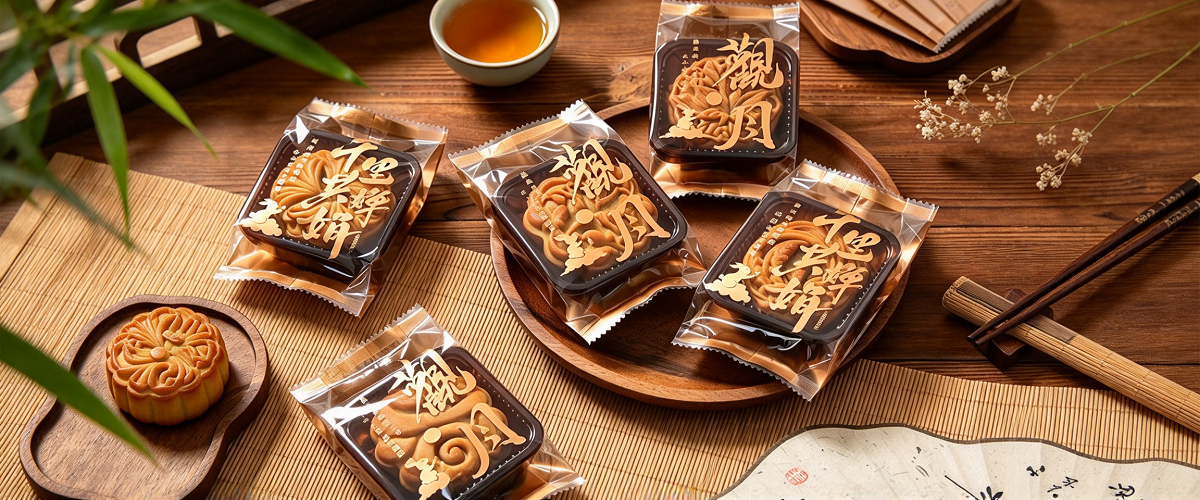
1. Why Is Flexible Packaging Suitable for Mooncake Products?
Flexible packaging is particularly suitable for mooncakes because it can combine barrier protection, lightweight construction, customizable dimensions, strong printing performance, and efficient logistics in one packaging format.
Mooncakes vary significantly in formulation and market positioning. A traditional mooncake sold individually through a premium gift channel may require a very different packaging solution from a family-size multipack sold through supermarkets or an export-oriented assortment shipped over long distances.
For manufacturers, this flexibility is one of the most important advantages.
Flexible Packaging Can Be Customized Around the Product
A mooncake package should fit the product closely enough to reduce unnecessary movement while leaving sufficient space for filling, sealing, and consumer handling.
Flexible packaging can be produced in many dimensions and configurations, including:
- Individual mooncake pouches
- Small multi-piece bags
- Stand-up pouches
- Flat pouches
- Three-side-seal bags
- Gusseted bags
- Vacuum-compatible pouches
- Custom-shaped packaging
- Outer bags for individually wrapped mooncakes
- Gift-set packaging components
This makes flexible packaging adaptable to different mooncake diameters, thicknesses, weights, and product combinations.
For manufacturers with several product lines, customized flexible packaging can also create a consistent visual identity while allowing different bag sizes to correspond to different SKUs.
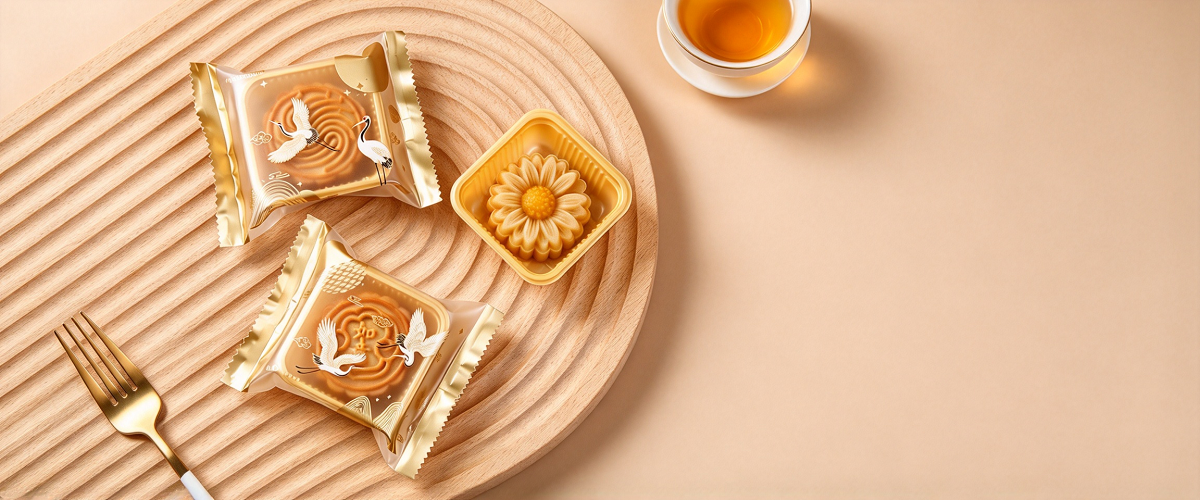
Individual Wrapping Provides an Additional Protection Layer
Individual wrapping is especially useful for mooncakes because it separates each product from the external environment.
An individually wrapped mooncake can receive protection against:
- External moisture
- Dust and handling contamination
- Odor transfer
- Direct contact with other products
- Abrasion during transportation
- Repeated consumer handling
Individual packaging is also convenient for gift boxes and assorted mooncake collections because each product can be packed separately before being placed into an outer carton or decorative box.
This layered approach can be particularly useful for premium products where both product protection and presentation are important.
Flexible Packaging Supports Different Sales Formats
Mooncakes are sold through a wide variety of channels, including:
- Supermarkets
- Specialty food stores
- Bakeries
- Hotels
- Restaurants
- Corporate gifting programs
- E-commerce platforms
- Cross-border e-commerce
- Duty-free retail
- Seasonal pop-up stores
- Direct-to-consumer websites
Each channel creates different packaging requirements.
For example, a mooncake sold individually in a bakery may prioritize easy opening and attractive printing. A multipack sold online may require stronger puncture resistance and more secure sealing. Export packaging may place greater emphasis on shelf life, transportation durability, and regulatory labeling.
Flexible packaging allows manufacturers to create different versions without completely changing the basic packaging concept.
Flexible Packaging Can Support Premium Positioning
Mooncake packaging has an important visual role because the product is frequently associated with gifting.
A flexible package can use:
- High-resolution printing
- Matte surfaces
- Gloss finishes
- Metallic effects
- Selective gloss effects
- Minimalist designs
- Traditional Chinese-inspired graphics
- Modern luxury designs
- Custom color systems
- Brand storytelling
The package therefore becomes part of the consumer experience rather than simply a protective layer.
For premium mooncakes, flexible packaging can also work as an inner protective layer inside a rigid gift box. This allows manufacturers to combine the structural appearance of a premium outer package with the barrier and sealing performance of flexible packaging.
Flexible Packaging Can Reduce Packaging Weight
Compared with many rigid packaging systems, flexible bags can use less material and occupy less space before and after filling.
This can provide practical advantages throughout the supply chain.
| Packaging consideration | Potential advantage of flexible packaging |
|---|---|
| Package weight | Lower structural weight for many applications |
| Storage before filling | Bags can be stored in compact rolls or bundles |
| Transportation | Efficient use of carton and pallet space |
| Printing | Large printable surface available |
| Custom sizing | Suitable for different mooncake dimensions |
| Seasonal production | Multiple SKUs can use customized bag sizes |
| E-commerce | Lightweight packaging can simplify parcel shipping |
| Consumer disposal | Less rigid structure to handle after use |
The actual material reduction depends on the package design and required barrier performance, so manufacturers should evaluate the complete packaging system rather than assuming that flexible packaging is always lighter or more sustainable.
Flexible Packaging Works Well With Seasonal Production
Mooncakes are strongly associated with seasonal demand, particularly around the Mid-Autumn Festival.
This creates a production challenge: manufacturers may need to produce large quantities within a limited period while managing multiple flavors, designs, and package sizes.
Flexible packaging can be integrated into efficient automated packaging operations, particularly for individually wrapped products and standardized bag formats.
Before production begins, manufacturers should confirm:
- Bag dimensions
- Film structure
- Seal specifications
- Printing requirements
- Filling-machine compatibility
- Opening characteristics
- Expected production speed
- Minimum order quantity
- Lead time
This planning is particularly important for seasonal products because packaging delays can directly affect the selling window.
Flexible Packaging Is Suitable for Both Traditional and Modern Mooncakes
The mooncake market has expanded beyond traditional recipes.
Manufacturers may produce:
- Lotus seed paste mooncakes
- Five-kernel mooncakes
- Red bean mooncakes
- Salted egg yolk mooncakes
- Custard mooncakes
- Chocolate mooncakes
- Fruit mooncakes
- Tea-flavored mooncakes
- Snow skin mooncakes
- Low-sugar mooncakes
- Vegan mooncakes
- Mini mooncakes
- Protein or functional mooncake concepts
These products can have different moisture and oxygen sensitivities.
Flexible packaging allows the package structure and format to be adapted to the product rather than forcing every SKU into the same packaging specification.
Flexible Packaging Can Be Combined With Rigid Gift Packaging
For premium mooncakes, flexible packaging does not necessarily replace rigid packaging.
A common packaging system can include:
Mooncake → Individual flexible pouch → Inner tray → Decorative gift box → Outer shipping carton
This layered approach provides different functions at different stages.
The flexible pouch protects the food product, while the rigid gift box provides visual presentation and physical structure.
This is particularly useful when manufacturers want to maintain a premium gifting experience without requiring the food-contact package itself to provide the entire visual presentation.
The Main Selection Principle
The most important reason flexible packaging suits mooncakes is not simply that it is lightweight or visually attractive.
It is that flexible packaging can be engineered around the actual preservation requirements of the mooncake.
A suitable package should answer five questions:
- What environmental conditions must be controlled?
- How long must the mooncake remain stable?
- How will the product be transported?
- How will the consumer open and store it?
- How should the package communicate the brand?
When these questions are answered together, flexible packaging becomes a packaging system rather than simply a bag.
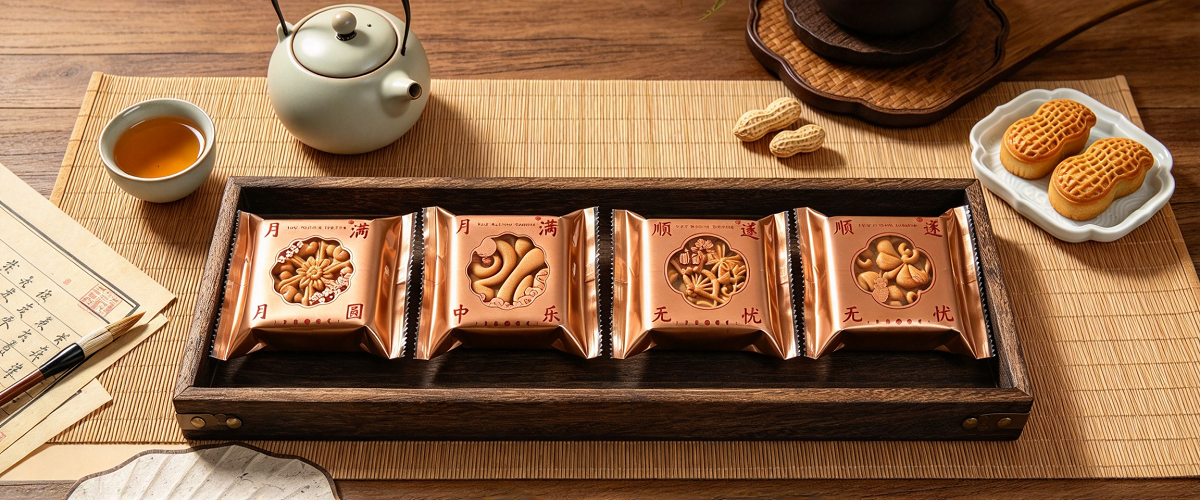
2. How Does Flexible Packaging Protect Mooncakes from Moisture, Oxygen, and Contamination?
For mooncake manufacturers, preservation performance is one of the most important reasons to choose flexible packaging.
Mooncakes are not uniform products. Their moisture distribution, filling composition, fat content, water activity, and formulation determine how they respond to the surrounding environment.
Packaging therefore needs to control the exchange of water vapor, oxygen, aromas, and external contaminants.
Moisture Control Is Critical
Moisture management is one of the most important packaging considerations for mooncakes.
A mooncake can contain several components with different moisture characteristics. The crust may interact with the filling during storage, while external humidity can affect the product from outside the package.
If moisture enters the package too easily, the product may experience:
- Texture changes
- Crust softening
- Loss of the intended eating quality
- Increased risk of microbial deterioration under unsuitable conditions
- Changes in appearance
- Shortened shelf stability
A strong moisture barrier helps isolate the product from external humidity.
However, packaging should not be selected solely on the basis of maximum moisture resistance. The formulation and intended storage conditions should be evaluated together.
Internal Moisture Migration Also Matters
Not all moisture-related changes come from outside the package.
Moisture can migrate between different components inside the mooncake itself.
For example, the crust and filling may have different moisture characteristics. Over time, moisture can redistribute between these components and change the texture of the product.
This means a package with an excellent external moisture barrier cannot independently solve every texture problem.
Manufacturers should therefore consider:
- Recipe formulation
- Baking conditions
- Cooling conditions
- Water activity
- Filling characteristics
- Packaging timing
- Storage temperature
- Expected shelf life
Packaging should be considered as part of the overall preservation system.
Oxygen Can Affect Flavor and Fat Stability
Many mooncake fillings contain oils, nuts, seeds, or other fat-containing ingredients.
Oxygen exposure can contribute to oxidation, which may eventually affect:
- Aroma
- Flavor
- Fat quality
- Color
- Overall sensory acceptance
This is particularly relevant for mooncakes containing nuts, seeds, egg yolks, or other oxidation-sensitive ingredients.
A package with strong oxygen barrier properties can reduce the rate at which oxygen reaches the product.
For longer shelf-life products, manufacturers may also evaluate:
- Initial oxygen concentration inside the package
- Headspace management
- Nitrogen flushing
- Oxygen scavenging systems where appropriate
- Seal integrity
- Storage temperature
The package should therefore be evaluated as a complete oxygen-control system rather than focusing only on the film's nominal barrier value.
Seal Integrity Is Just as Important as Barrier Performance
A high-barrier film cannot protect a mooncake if the package seal is defective.
Potential seal problems include:
- Incomplete sealing
- Contamination in the seal area
- Channel leaks
- Wrinkles crossing the seal
- Excessive heat damage
- Insufficient sealing pressure
- Inconsistent sealing temperature
- Mechanical damage after sealing
For mooncake production, this is particularly important because product particles, oil, or filling residues can sometimes interfere with heat-seal performance.
Manufacturers should establish appropriate sealing parameters for the selected film structure and filling process.
Testing can include:
- Visual seal inspection
- Seal-strength testing
- Leak testing
- Burst testing where appropriate
- Package integrity testing
- Transportation simulation
Contamination Protection
Flexible packaging creates a physical barrier between the mooncake and the external environment.
A properly sealed package helps protect the product from:
- Dust
- Handling contamination
- External particles
- Unwanted odors
- Moisture
- Contact with other products
This becomes increasingly important when products are distributed through multiple handling points.
For export and e-commerce shipments, the package may pass through factories, warehouses, distribution centers, transport vehicles, fulfillment centers, and retail environments before reaching the consumer.
A sealed individual pouch provides an additional layer of protection throughout this chain.
Aroma Retention Can Influence Perceived Quality
Mooncakes may contain ingredients with distinctive aromas, such as:
- Lotus seed paste
- Sesame
- Nuts
- Egg yolk
- Tea
- Fruit
- Chocolate
- Spices
Packaging can help retain these desirable aromas while reducing interaction with external odors.
This is important because packaging is not simply preventing oxygen and moisture movement. It also needs to help maintain the intended sensory profile of the product.
High-barrier structures can be selected when aroma retention is a major requirement.
Light Protection Can Be Important for Certain Products
Light exposure can contribute to quality degradation in foods containing fats, pigments, or sensitive flavor compounds.
Opaque, metallized, or foil-containing structures can reduce light exposure substantially.
However, a completely opaque structure may conflict with a brand's desire to display the product.
Manufacturers therefore need to decide whether visual product visibility or maximum light protection is more important for the specific SKU.
A small controlled window may be an option when product visibility is part of the marketing strategy, but the impact on overall barrier performance should be evaluated.
Nitrogen Flushing Can Complement Flexible Packaging
For selected mooncake applications, modified-atmosphere packaging may be considered.
Nitrogen flushing can help reduce oxygen concentration inside the package and can be particularly relevant when oxidation is an important concern.
However, nitrogen flushing is not a substitute for proper film selection.
The final package performance depends on the combination of:
Barrier film + gas management + sealing + product formulation + storage conditions.
Manufacturers should validate the complete system rather than assuming that gas flushing alone will deliver a specific shelf life.
Shelf-Life Validation Should Be Product Specific
A common mistake is to select a packaging structure based only on what worked for another food product.
Mooncakes can differ significantly in:
- Water activity
- Fat content
- Filling type
- Acidity
- Ingredients
- Processing method
- Baking conditions
- Target shelf life
Therefore, shelf-life testing should be conducted with the actual product and intended packaging.
A practical validation program may evaluate:
| Test area | What it can help determine |
|---|---|
| Moisture migration | Texture and weight changes |
| Oxygen exposure | Oxidation and flavor stability |
| Package integrity | Protection against external ingress |
| Sensory testing | Aroma, taste, texture, appearance |
| Microbiological testing | Product safety and stability |
| Transportation testing | Resistance to handling and distribution |
| Storage testing | Performance under intended conditions |
This approach gives manufacturers much more reliable information than choosing a film structure based solely on a generic specification.
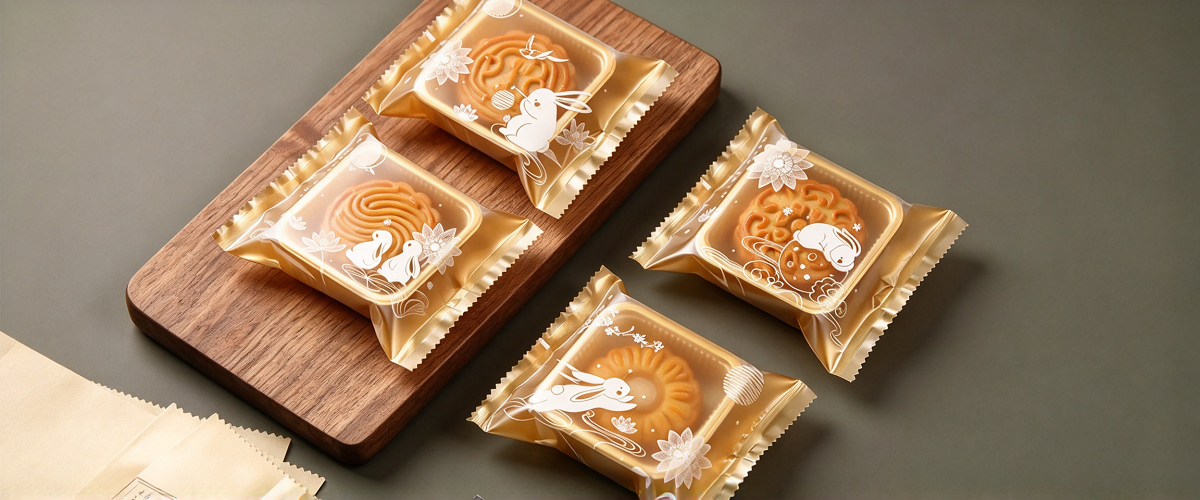
3. Which Flexible Packaging Materials Are Best for Different Types of Mooncakes?
There is no single flexible packaging material that is ideal for every mooncake.
The right structure depends on product formulation, target shelf life, packaging format, production conditions, distribution environment, and cost requirements.
Rather than repeatedly evaluating individual films in isolation, manufacturers should think in terms of the complete laminate structure.
PET-Based High-Barrier Structures
PET-based laminates are commonly considered when manufacturers need:
- Good mechanical strength
- High-quality printing
- Stable package construction
- Reliable conversion performance
- Moderate to high barrier protection
For many standard mooncake applications, a structure combining a printable outer layer, a barrier layer, and a suitable heat-sealing layer can provide a practical balance of performance and cost.
A metallized PET layer may be considered when improved oxygen, moisture, and light protection is required without moving directly to a foil-based structure.
Aluminum Foil Structures
Aluminum foil provides a very high barrier against:
- Oxygen
- Water vapor
- Light
- External aroma transfer
This makes foil-containing laminates useful for mooncakes requiring particularly strong environmental protection.
They can be considered for:
- Longer distribution cycles
- Export products
- Oxidation-sensitive fillings
- Premium products with demanding shelf-life targets
- Products exposed to challenging storage conditions
However, maximum barrier does not automatically mean maximum suitability.
Foil structures can increase material cost and may require careful consideration of sealing, forming, printing, and sustainability requirements.
PE and Other Heat-Sealing Layers
The inner sealing layer is critical because it comes into direct contact with the product and forms the package seal.
A suitable sealing layer should provide:
- Food-contact suitability
- Reliable heat sealing
- Appropriate seal strength
- Compatibility with filling equipment
- Resistance to the product's oils or other ingredients
- Suitable sealing performance across the expected production range
The sealing layer should be selected together with the packaging machine rather than independently.
Metallized Structures for Balanced Performance
Metallized structures can provide a useful middle ground between conventional transparent films and full aluminum foil laminates.
They may be suitable when a manufacturer needs:
- Improved barrier protection
- Strong light blocking
- Good appearance
- Controlled packaging cost
- High-quality printing
Their actual performance depends on the film specification, metallization quality, laminate construction, and package design.
Mono-Material Structures
Sustainability goals have encouraged manufacturers to investigate recyclable or simplified mono-material flexible packaging.
For mooncakes, a mono-material structure may be considered when the required:
- Oxygen barrier
- Moisture barrier
- Seal performance
- Mechanical strength
- Shelf life
- Printing performance
can all be achieved within the available material system.
However, recyclability is dependent on the exact structure and local recycling infrastructure. Manufacturers should avoid treating “mono-material” as an automatic guarantee of recyclability in every market.
Material Selection by Mooncake Application
| Mooncake application | Potential packaging approach | Main consideration |
|---|---|---|
| Standard baked mooncakes | High-barrier laminate | Balance protection and cost |
| Nut- or seed-rich mooncakes | High oxygen-barrier structure | Oxidation control |
| Long-distance export | High-barrier laminate or foil-containing structure | Transit and storage protection |
| Premium gift mooncakes | High-barrier printed pouch + outer gift box | Protection plus presentation |
| Individually wrapped mooncakes | Formable/sealable flexible film | Efficient high-speed packaging |
| Multipacks | Stand-up or flat pouch with suitable barrier | Convenience and branding |
| Seasonal mini mooncakes | Compact printed pouches | Portion control and shelf impact |
| Sustainability-focused SKU | Qualified mono-material solution | Barrier and recycling requirements |
These are starting points rather than universal specifications. Final material selection should be validated against the actual product.
Do Not Select Packaging Solely by Thickness
A thicker film is not necessarily a better packaging solution.
Performance depends on:
- Material chemistry
- Barrier layer
- Laminate structure
- Seal design
- Package geometry
- Manufacturing quality
- Storage conditions
A carefully engineered thinner structure can sometimes provide more appropriate performance than a thicker but poorly selected construction.
For this reason, packaging procurement should focus on measured performance and application suitability, not thickness alone.
Consider the Filling and Sealing Process
A film that performs well in laboratory testing may still create problems on the production line.
Manufacturers should confirm:
- Sealing temperature range
- Machine speed
- Film coefficient of friction
- Web handling
- Bag-forming performance
- Print registration
- Seal contamination tolerance
- Cutting performance
- Package appearance after sealing
Seasonal mooncake production can involve high production volumes, so packaging stability on the filling line is particularly important.
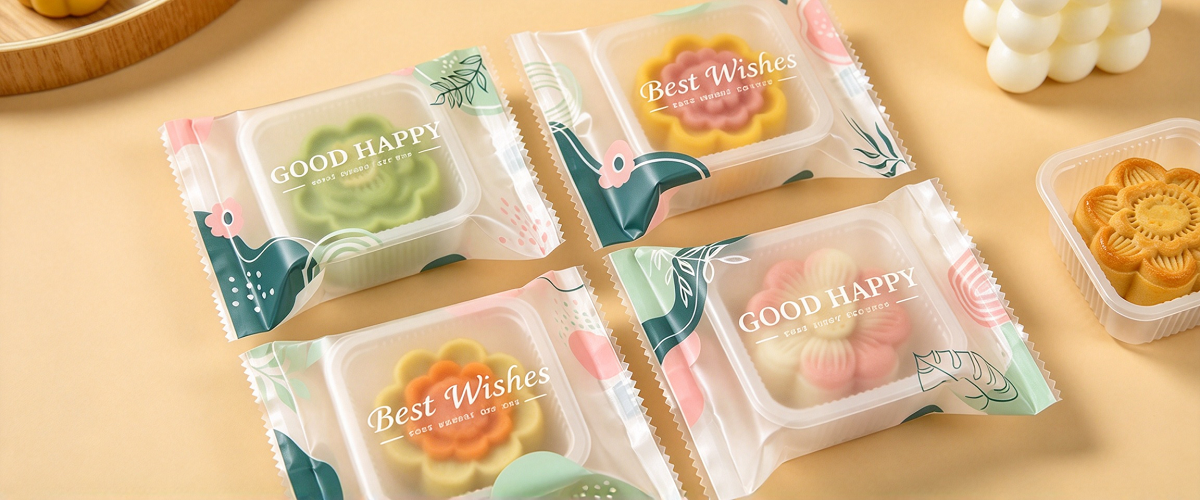
4. What Packaging Features Improve Mooncake Freshness, Protection, and Consumer Convenience?
The film structure protects the product, but packaging features determine how the package behaves during manufacturing, transportation, retail display, and consumer use.
For mooncakes, the right features should be selected according to the product format and sales channel rather than added simply for appearance.
Easy-Open Tear Notches
A tear notch can make individual mooncake packaging significantly easier to open.
This is especially useful for:
- Elderly consumers
- Gift recipients
- Individual serving packs
- Products sold in hospitality settings
- Packages without resealable closures
The notch should provide controlled opening without compromising seal integrity during transportation.
Resealable Zippers
Zippers are particularly useful for multi-piece mooncake packs.
They allow consumers to:
- Open the package gradually
- Store remaining mooncakes
- Reduce exposure after opening
- Handle the product more conveniently
For individually wrapped mooncakes, a zipper is usually unnecessary because the individual pack is intended for single-product use.
This illustrates an important principle: the best packaging feature depends on the consumption pattern.
Wide Opening Designs
A wider opening can make it easier to remove mooncakes without damaging the product.
This is particularly relevant for:
- Larger mooncakes
- Soft-textured mooncakes
- Multi-piece packages
- Premium products where appearance matters
A package that is difficult to open or remove can create unnecessary product damage after purchase.
Stable Stand-Up Construction
For retail multipacks, stand-up pouches can improve:
- Shelf visibility
- Product organization
- Storage convenience
- Front-panel display area
A stable base can also reduce the likelihood of the package tipping over during retail presentation.
Flat Bottom Bags for Premium Presentation
Flat-bottom or box-style flexible bags can create a more structured appearance while retaining many advantages of flexible packaging.
They may be suitable for:
- Premium mooncake assortments
- Larger multipacks
- Specialty gift products
- Boutique bakery brands
The format also creates multiple printable surfaces for branding and information.
Controlled Transparent Windows
A window can allow consumers to see the product, which may be useful when visual appearance is an important purchasing factor.
However, the window should be designed carefully.
Manufacturers should consider:
- Window size
- Light exposure
- Barrier reduction
- Product visibility
- Brand aesthetics
For highly light-sensitive products, an opaque package may be preferable.
High-Quality Printing
Mooncake packaging has unusually strong visual and cultural significance.
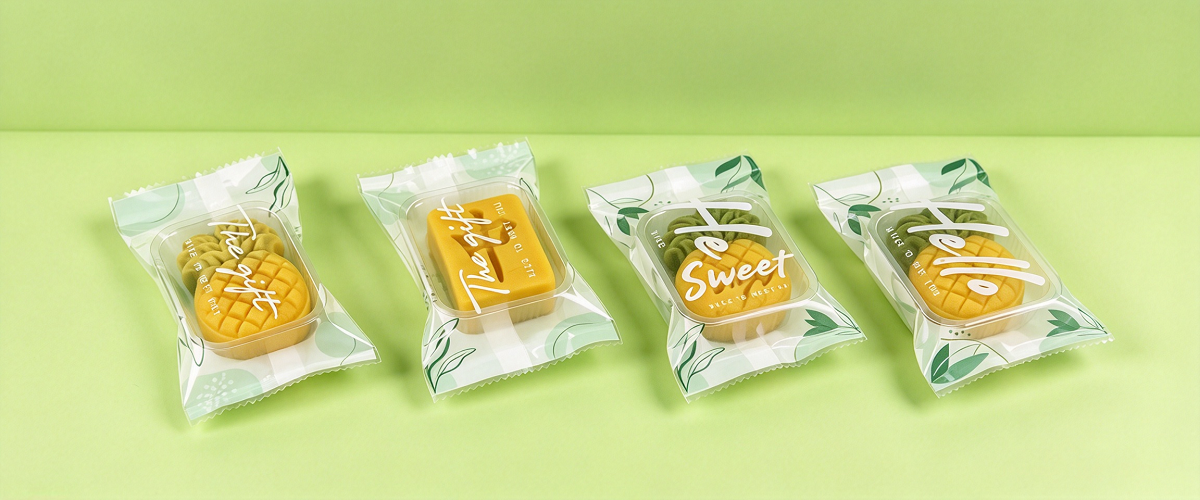
Flexible packaging can support detailed graphics such as:
- Festival-inspired artwork
- Brand logos
- Traditional patterns
- Modern minimalist designs
- Product photography
- Ingredient illustrations
- Origin information
- Serving suggestions
Because flexible packaging offers a large printable surface, the package can communicate brand identity without requiring excessive secondary packaging.
QR Codes and Digital Brand Experiences
A QR code can connect the physical package to digital content such as:
- Product information
- Brand story
- Preparation suggestions
- Ingredient details
- Manufacturing information
- Promotional campaigns
- Customer service
- Seasonal greetings
For premium mooncake brands, this can help connect traditional cultural products with modern digital marketing.
Custom Sizes for Different Mooncake Weights
Packaging dimensions should correspond to the actual product.
Common product variations may include:
- Mini mooncakes
- Individual standard mooncakes
- Large mooncakes
- Assorted packs
- Family-size packs
Custom sizing helps reduce unnecessary empty space and can improve product presentation.
It can also reduce movement inside the package during transportation.
Puncture and Abrasion Resistance
Mooncakes may contain hard ingredients such as:
- Nuts
- Seeds
- Dried fruit
- Egg yolk
These ingredients can create localized stress on the package.
A suitable structure should therefore be evaluated for puncture resistance and handling durability, especially for products shipped through parcel networks.
Anti-Slip and Handling Considerations
For e-commerce and gift packaging, packages may be handled repeatedly before reaching the consumer.
Surface properties can influence:
- Stacking
- Carton packing
- Automated handling
- Retail display
- Consumer grip
These details may appear minor, but they can influence real-world packaging performance.
Tear Resistance Should Match the Consumer Experience
A package should not be so difficult to open that consumers struggle with it.
At the same time, uncontrolled tearing can cause:
- Product spillage
- Damaged graphics
- Sharp edges
- Poor presentation
The objective is controlled opening, not simply maximum tear strength.
Features by Packaging Format
| Feature | Individual pouch | Multipack pouch | Premium gift pack |
|---|---|---|---|
| Tear notch | High relevance | High relevance | High relevance |
| Resealable zipper | Usually unnecessary | Useful | Optional |
| Transparent window | Optional | Optional | Selective |
| Stand-up base | Usually unnecessary | Useful | Useful |
| QR code | Useful | Useful | Highly useful |
| Premium printing | Important | Very important | Essential |
| Custom shape | Optional | Optional | Potentially useful |
| Handle | Rare | Optional | Possible for larger sets |
The objective should always be to match the feature to the product and consumer journey.
5. Flexible Packaging for Mooncakes: Key Benefits for Shelf Life, Branding, Cost Efficiency, and Distribution
Flexible packaging provides mooncake manufacturers with advantages that extend beyond basic food protection.
The strongest benefits come from considering packaging as part of the entire commercial system—from production to final consumption.
Shelf-Life Management
Shelf life is one of the most important commercial factors for mooncake manufacturers.
A seasonal product has a limited sales window, but manufacturers may need to produce, warehouse, transport, and distribute products well before peak consumer demand.
Packaging can help maintain quality during this period by controlling:
- Moisture ingress
- Oxygen exposure
- Light exposure
- Aroma transfer
- Package contamination
However, the packaging should not be treated as the sole determinant of shelf life.
Shelf life is influenced by the interaction of:
Formulation + processing + water activity + packaging + storage + distribution.
This is why packaging validation should be performed using the actual finished product.
Branding and Shelf Appeal
Mooncakes are frequently purchased as gifts, so visual presentation can influence purchase decisions.
Flexible packaging offers a large design area for:
- Brand recognition
- Seasonal campaigns
- Product differentiation
- Flavor identification
- Premium visual effects
- Cultural storytelling
A manufacturer can maintain a consistent brand identity across multiple flavors while using color, graphics, and product names to differentiate individual SKUs.
For example:
| Product line | Packaging strategy |
|---|---|
| Traditional series | Cultural graphics and classic visual language |
| Premium series | Minimalist design and refined finishes |
| Modern flavors | Bold colors and contemporary graphics |
| Mini mooncakes | Compact, playful packaging |
| Corporate gifting | Brand-forward customization |
| Export series | Multilingual information and market-specific labeling |
Cost Efficiency
Flexible packaging can contribute to cost control in several ways.
Material Efficiency
Flexible structures can achieve required functionality without the same rigid structural components required by many containers.
Transportation Efficiency
Lower package weight and compact dimensions can improve logistics efficiency.
Storage Efficiency
Unfilled flexible packaging can be stored efficiently compared with rigid containers.
Printing Efficiency
Large film webs can support efficient repeat printing for multiple units.
Customization
Packaging can be optimized around specific product dimensions instead of using oversized generic containers.
Nevertheless, the lowest packaging cost is not always the best commercial choice.
A package that causes:
- Seal failures
- Product damage
- Excessive waste
- Shortened shelf life
- High return rates
can ultimately be more expensive than a slightly higher-performance structure.
Distribution Efficiency
Mooncakes may travel through complex distribution networks.
A typical route can involve:
Factory → Warehouse → Regional Distributor → Retailer → Consumer
Export products may involve additional stages.
Flexible packaging can reduce packaging volume while providing protection against common handling conditions.
For e-commerce, the package should also be tested for:
- Compression
- Vibration
- Drops
- Abrasion
- Temperature variation
- Repeated handling
The individual pouch should remain intact throughout the distribution process.
E-Commerce Considerations
Online mooncake sales have expanded the importance of packaging durability.
An attractive retail package is not automatically suitable for e-commerce.
Online orders may experience:
- Parcel sorting
- Conveyor handling
- Multiple transfers
- Compression inside cartons
- Drops
- Longer transportation periods
Packaging should therefore be evaluated together with the shipping carton and internal cushioning system.
A flexible inner pouch can protect the food product while the outer carton provides structural protection.
Export and International Distribution
Export markets can introduce additional challenges.
Manufacturers may need to consider:
- Longer transit times
- Different climates
- Higher humidity
- Temperature fluctuations
- Customs handling
- Multilingual labeling
- Destination-market food-contact requirements
- Local packaging regulations
A high-barrier flexible structure can be particularly useful when products must remain stable throughout a long supply chain.
However, manufacturers should confirm the applicable requirements for each destination rather than relying on a single generic compliance statement.
Seasonal Demand Requires Better Packaging Planning
Mooncakes are strongly seasonal, so packaging procurement should begin well before the production peak.
A practical development schedule can include:
Product confirmation → Packaging specification → Artwork approval → Sampling → Performance testing → Production approval → Mass production → Final inspection
Early planning reduces the risk of:
- Printing delays
- Material shortages
- Machine compatibility problems
- Late design changes
- Seasonal production interruptions
This is especially important for customized printed flexible packaging because printing cylinders, plates, or digital production arrangements may require additional lead time depending on the selected printing method.
Packaging Standardization Across Multiple SKUs
Manufacturers with many mooncake flavors can sometimes reduce complexity by standardizing certain packaging specifications.
For example, a brand may use:
- One common bag width
- A limited number of bag heights
- Consistent sealing specifications
- Shared outer material structures
- Color-coded artwork for flavors
This can simplify procurement and production while preserving SKU differentiation through printing.
Standardization should not compromise the actual packaging requirements of different recipes.
Quality Control Should Be Defined Before Production
A professional packaging specification should identify measurable requirements.
Depending on the application, specifications may cover:
- Film structure
- Thickness
- Bag dimensions
- Seal strength
- Barrier performance
- Print accuracy
- Color tolerance
- Tear-notch position
- Zipper performance
- Package appearance
- Food-contact compliance
- Odor characteristics
For critical seasonal products, incoming material inspection and finished-package testing can reduce production risk.
Flexible Packaging and Sustainability
Sustainability is increasingly relevant to mooncake packaging because seasonal gift products can involve multiple layers of primary and secondary packaging.
Manufacturers can explore:
- Material reduction
- Right-sized packaging
- Recyclable structures where technically and locally appropriate
- Reduced secondary packaging
- Efficient shipping configurations
- Digital printing for appropriate production quantities
- Reusable outer gift packaging
However, sustainability should be assessed across the complete packaging system.
A structure that uses less material but causes shorter shelf life or increased product waste may not provide the intended environmental benefit.
The better approach is to balance:
Product protection + material efficiency + logistics efficiency + end-of-life considerations.
A Practical Packaging Selection Framework
Before finalizing a flexible mooncake package, manufacturers can evaluate the following questions:
| Decision area | Key question |
|---|---|
| Product | What are the moisture, fat, and aroma characteristics? |
| Shelf life | How long must the product remain stable? |
| Package format | Individual pouch, multipack, or gift-set inner bag? |
| Barrier | What level of oxygen and moisture protection is required? |
| Sealing | Which sealing conditions are compatible with the production line? |
| Features | Is a zipper, notch, window, or QR code necessary? |
| Branding | How important are premium finishes and large print areas? |
| Distribution | Retail, e-commerce, domestic, or export? |
| Sustainability | Can a simplified structure meet performance requirements? |
| Testing | Has the complete package been validated with the actual product? |
This framework helps prevent packaging decisions from being based only on appearance or unit price.
Why Manufacturers Favor Flexible Packaging
Ultimately, flexible packaging gives mooncake manufacturers a combination of capabilities that is difficult to achieve with a single rigid format.
It can provide:
- Barrier protection against moisture, oxygen, light, and external odors
- Individual product protection for premium and retail applications
- Custom dimensions for different mooncake sizes
- High-quality printing for seasonal branding
- Consumer-friendly features such as tear notches and zippers
- Efficient transportation through lightweight construction
- Production compatibility with automated packaging systems
- Scalability for seasonal manufacturing
- Customization for domestic and international markets
The result is a packaging solution that can support both product protection and commercial performance.
FAQ
What is the best flexible packaging for mooncakes?
The best flexible packaging depends on the mooncake formulation, target shelf life, package format, and distribution environment. For many individually wrapped baked mooncakes, a high-barrier heat-sealable pouch is a practical starting point. Products with higher oxidation sensitivity or longer distribution requirements may require a stronger barrier structure.
Do mooncakes need high-barrier packaging?
Many mooncakes benefit from good moisture and oxygen barrier protection, particularly when the product has a long intended shelf life or contains oxidation-sensitive ingredients. The required barrier level should be validated against the actual recipe and storage conditions.
Is aluminum foil suitable for mooncake packaging?
Yes. Aluminum foil laminates can provide very high protection against oxygen, moisture, and light. They may be particularly useful for demanding shelf-life or export applications, although the additional cost and material requirements should be evaluated.
Are stand-up pouches suitable for mooncakes?
Stand-up pouches can work well for multipacks, mini mooncakes, assorted products, and retail formats. Individual mooncakes are often better suited to flat heat-sealed pouches or flow-wrap-style packaging.
Should mooncake packaging have a zipper?
A zipper is useful when the package contains multiple mooncakes and consumers are expected to open and close the package over several occasions. It is generally unnecessary for individually wrapped mooncakes intended for single consumption.
Can flexible packaging be used for premium mooncake gift sets?
Yes. Flexible packaging can serve as the food-contact inner package while a rigid decorative box provides the premium gifting presentation. This combination can provide both strong food protection and a high-end visual experience.
Can mooncake packaging be customized with windows?
Yes, but windows should be used selectively. A transparent area can improve product visibility, but it may reduce light protection compared with an opaque or metallized structure. The window size should therefore reflect the product's sensitivity and shelf-life requirements.
Is nitrogen flushing suitable for mooncakes?
Nitrogen flushing can be considered for products where reducing oxygen exposure is beneficial. It should be used together with an appropriate barrier structure and reliable sealing system. Final performance should be validated using the actual mooncake product.
What packaging features are useful for e-commerce mooncakes?
For e-commerce, useful features can include strong seals, suitable puncture resistance, compact dimensions, tear notches, durable printing, and appropriate secondary shipping protection. The complete package should be tested against compression, vibration, drops, and repeated handling.
Can flexible mooncake packaging be recyclable?
Some flexible packaging systems can be designed around recyclable or simplified structures, but recyclability depends on the exact material construction and the recycling infrastructure available in the target market. Manufacturers should verify local requirements before making recycling claims.
How should manufacturers test mooncake packaging before mass production?
A practical validation program should combine product shelf-life testing with package integrity testing. Depending on the product, this can include moisture and oxygen performance, seal strength, leak testing, sensory evaluation, microbiological testing, and transportation simulation.
How far in advance should mooncake packaging be developed?
Because mooncakes are seasonal products, packaging development should begin well before peak production. Artwork approval, material procurement, sampling, testing, and production scheduling should all be completed early enough to leave time for corrections before the seasonal manufacturing period.
Can one packaging structure be used for every mooncake flavor?
Not necessarily. Similar products may share a packaging structure, but significant differences in moisture, fat, filling composition, shelf-life requirements, or processing conditions may require different packaging specifications. Standardization is useful only when it does not compromise product protection.
Conclusion
Flexible packaging has become an important solution for mooncake manufacturers because it combines food protection, customization, production efficiency, branding flexibility, and logistics advantages in a versatile format.
The most effective packaging strategy starts with the product itself. Manufacturers should evaluate the mooncake's formulation, moisture characteristics, fat content, target shelf life, storage environment, distribution route, and consumer usage pattern before selecting the film structure or bag format.
For individual mooncakes, high-barrier heat-sealed pouches can provide practical protection against moisture, oxygen, contamination, and external odors. For multipacks, stand-up and flat-bottom pouches can add convenience and stronger retail presentation. For demanding export or long-shelf-life applications, higher-barrier or foil-containing structures may be appropriate. Features such as tear notches, zippers, windows, premium printing, and QR codes can then be added according to the actual consumer and branding requirements.
The key is not to choose the most complex or highest-barrier package by default. Instead, manufacturers should choose the right level of protection and functionality for the specific mooncake.
When packaging materials, bag design, sealing performance, production equipment, shelf-life requirements, and distribution conditions are evaluated together, flexible packaging can do far more than simply contain a mooncake. It can help manufacturers maintain product quality, simplify seasonal production, improve transportation efficiency, create stronger brand presentation, and deliver a more convenient experience to consumers.
For a product category where tradition, freshness, gifting, and visual presentation are closely connected, flexible packaging provides manufacturers with a practical way to protect the product while adapting the package to the demands of modern food markets.