Anna_Yu
Recommendations for Flexible Bread Packaging Bags
Bread is one of the most widely consumed bakery products worldwide, but it is also highly sensitive to changes in moisture, temperature, oxygen exposure, and storage conditions. From sliced sandwich bread and burger buns to baguettes, toast, tortillas, and specialty artisan loaves, different bread products require different packaging solutions to maintain freshness, texture, appearance, and overall product quality. Without suitable packaging, bread can quickly become stale, lose its softness, dry out, or develop mold under unfavorable storage conditions.
For bakeries, commercial bread manufacturers, supermarkets, and private-label food brands, packaging is more than a way to contain and transport baked products. It plays an important role in protecting bread during distribution, communicating product information, improving shelf presentation, and supporting consumer convenience. As bakery products move through increasingly complex supply chains, flexible packaging bags have become an important choice because they offer lightweight protection, adaptable moisture control, efficient storage, cost-effective production, and flexible branding options.
However, choosing the right bread packaging is not simply a matter of selecting a plastic bag. Different bread types have different moisture levels, crust characteristics, shapes, weights, and shelf-life requirements. Soft sandwich bread needs packaging that helps retain moisture without creating excessive condensation, while crusty artisan bread requires a different balance between moisture retention and crust preservation. Products such as tortillas and flatbreads also have specific requirements related to flexibility, stacking, and resealability.
Flexible bread packaging must therefore be designed around the product itself. Material selection, bag structure, ventilation, sealing performance, printing, and package dimensions all influence how effectively the packaging performs throughout storage and distribution.
This guide explores the most important considerations when selecting flexible bread packaging bags. It covers suitable bag types, freshness protection, moisture management, material structures, functional features, and the key factors affecting shelf life, branding, and cost efficiency. By understanding these requirements, bread manufacturers and bakery brands can choose packaging that protects product quality while meeting the practical demands of modern retail and food distribution.
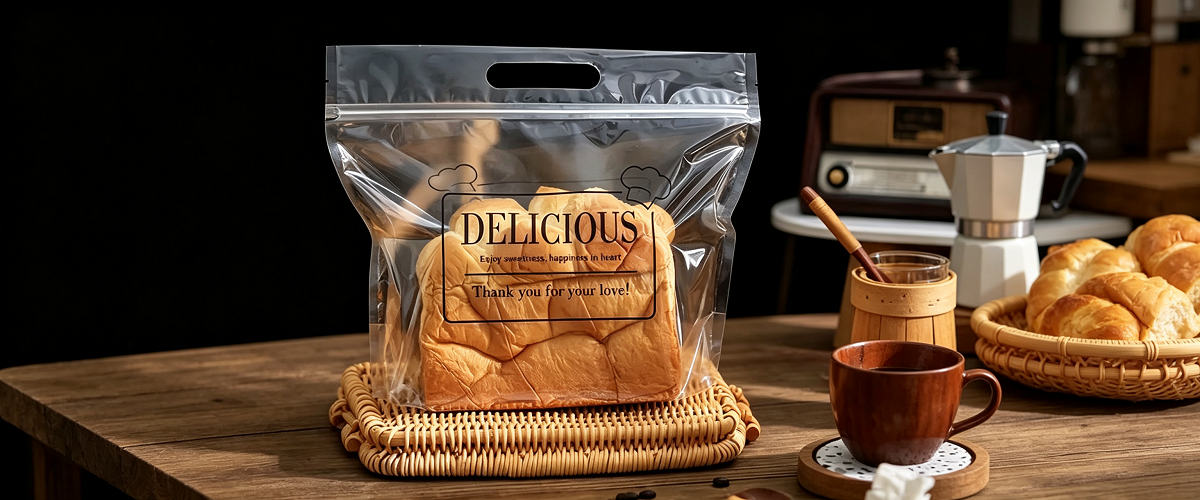
1. What Types of Flexible Packaging Bags Are Best for Different Bread Products?
The best flexible packaging format for bread depends on bread type, product dimensions, moisture content, crust characteristics, serving size, and distribution channel. A soft sliced loaf requires different packaging from a crusty baguette, while tortillas and burger buns need packaging that supports convenient handling and storage.
Selecting the right bag format helps manufacturers protect bread, improve filling efficiency, and create packaging that meets consumer expectations.
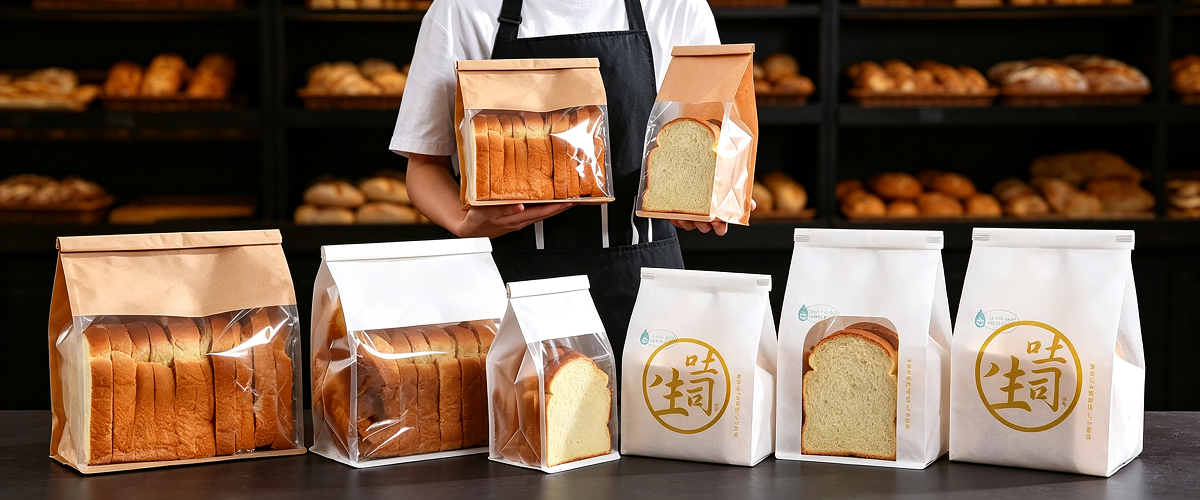
Bread Bags for Sliced Sandwich Bread
They are typically made from flexible plastic films such as polyethylene (PE), polypropylene (PP), or other suitable food-contact materials.
Common applications include:
- White sandwich bread
- Whole wheat bread
- Multigrain bread
- Milk bread
- Toast bread
- Soft sliced bakery loaves
The primary function of a bread bag is to help retain moisture and reduce the rate at which bread loses softness during storage.
Typical bread bags may include:
- Flat-bottom or gusseted structures
- Open-top designs with twist ties or clips
- Heat-sealable closures
- Printed branding and product information
- Customized dimensions for different loaf sizes
For high-volume bakery production, bags must be easy to open, fill, and close. Their dimensions should provide enough room for the loaf without excessive empty space that makes the package look poorly fitted or increases material usage unnecessarily.
For sliced sandwich bread, a flexible bag with suitable moisture-retention properties is generally more important than an extremely high oxygen barrier. Bread staling is influenced by several factors, including moisture redistribution and starch retrogradation, so simply blocking oxygen does not prevent the bread from becoming stale.
### Stand-Up Pouches for Specialty Bread and Bakery Products
Stand-up pouches are more commonly associated with snacks and dry foods, but they can also be considered for selected specialty bakery applications.
They may be suitable for:
- Mini bread rolls
- Small packaged bread portions
- Bread crisps
- Toasted bread snacks
- Specialty bakery bites
- Certain shelf-stable bread products
The bottom gusset allows the pouch to stand upright, improving shelf visibility and providing a convenient retail presentation.
Stand-up pouches offer several advantages:
- Large printable surfaces for branding
- Flexible sizing and customization
- Compatibility with resealable zippers
- Convenient storage and display
- Potential use of transparent windows
However, stand-up pouches are not necessarily the best choice for every fresh bread product. Soft loaves and delicate bakery items may be difficult to load into narrow pouch openings, and the package structure may not provide enough protection against crushing unless additional design considerations are included.
For products that need repeated opening and closing, resealable pouches can be useful. For bread crisps and dry bakery snacks, moisture-barrier performance becomes especially important because these products can lose crispness when exposed to humidity.
### Side-Gusset Bags for Large Bread Loaves
Side-gusset bags are a practical option for larger bread products because their expandable sides provide additional capacity without requiring an oversized flat bag.
They are suitable for:
- Large sandwich loaves
- Family-size bread
- Specialty sliced bread
- Larger bakery products
- Some bulk bakery applications
The gusseted structure allows the bag to expand around the bread, improving fit and helping the package accommodate different loaf dimensions.
Key advantages include:
- Greater filling capacity
- Efficient storage before use
- Flexible package dimensions
- Suitable presentation for larger loaves
- Opportunities for customized printing
Side-gusset bags can be manufactured using different film structures depending on the required flexibility, strength, and moisture-control performance.
For large bread products, manufacturers should pay attention to the bag's opening size, gusset depth, and overall dimensions. The bag should accommodate the loaf without compressing it or creating excessive empty space.
### Pillow Bags for Burger Buns and Small Bread Rolls
Pillow bags are widely used for bakery products sold in multiple-piece packs.
They are suitable for:
- Hamburger buns
- Hot dog buns
- Dinner rolls
- Small bread rolls
- Slider buns
- Packaged mini loaves
The pillow-bag format is commonly produced using horizontal or vertical form-fill-seal equipment. It is practical for high-speed packaging lines and allows manufacturers to adjust package length according to product quantity.
Its advantages include:
- Cost-effective material usage
- Efficient automated filling
- Flexible package sizing
- Good suitability for multipacks
- Large printable areas
For burger buns and soft rolls, packaging should help retain the moisture needed to maintain softness while avoiding conditions that encourage excessive condensation.
The film should also provide sufficient strength to withstand stacking, handling, and transportation without tearing.
### Three-Side Seal Bags for Flatbread and Portion-Controlled Bread
Three-side seal bags are suitable for flat or relatively thin bakery products that need compact packaging.
Typical applications include:
- Tortillas
- Pita bread
- Flatbread
- Roti
- Naan
- Small bread portions
- Specialty bakery samples
These bags can be designed with different widths and lengths to accommodate product dimensions and stacking requirements.
Their advantages include:
- Simple package construction
- Flexible portion sizes
- Convenient storage
- Good compatibility with printed laminates
- Potential for resealable features
For tortillas and similar products, packaging should help prevent excessive moisture loss while maintaining enough flexibility to reduce cracking during handling.
If multiple flatbreads are packed together, the bag should also provide enough space to avoid excessive compression or damage to the edges.
### Perforated Bags for Selected Fresh Bread Products
Some fresh bread products benefit from controlled ventilation rather than a completely sealed package.
Perforated bread bags contain small openings that allow limited air exchange. They are sometimes used for bakery products where retaining a crisp crust is more important than maximizing moisture retention.
Potential applications include:
- Crusty bread rolls
- Baguettes
- Some artisan breads
- Fresh bakery products sold over short distribution periods
The main purpose of perforation is to allow excess moisture to escape, reducing the risk of condensation inside the package.
However, perforation creates a trade-off. Increased ventilation can help preserve crust texture but may also accelerate moisture loss and cause the bread interior to dry out more quickly.
Perforation size, number, distribution, and location should therefore be tested for the actual bread product.
### Choosing the Right Bag Format for Different Bread Products
| Bread Product | Recommended Packaging Format | Main Packaging Considerations |
|---|---|---|
| Sliced sandwich bread | Flat or gusseted bread bag | Moisture retention, easy closing, loaf fit |
| Whole wheat bread | Gusseted bread bag | Moisture control, seal or closure performance |
| Burger buns | Pillow bag or gusseted bag | Softness retention, stacking, package strength |
| Hot dog buns | Pillow bag | Flexible sizing, filling efficiency |
| Baguettes | Long bread bag or perforated bag | Length, crust protection, ventilation |
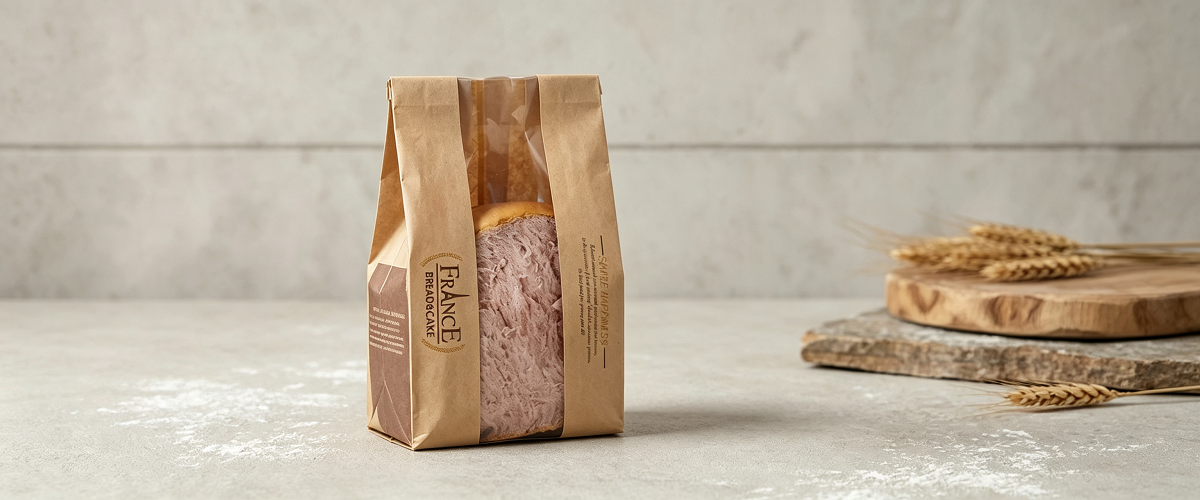
| Artisan bread | Paper-based or suitable ventilated flexible bag | Crust preservation, moisture balance |
| Tortillas | Three-side seal or resealable pouch | Flexibility, moisture retention, stacking |
| Pita bread | Three-side seal or flat bag | Moisture control, package dimensions |
| Bread crisps | High-barrier stand-up pouch | Moisture barrier, crispness, resealability |
| Toasted bread snacks | Pillow bag or stand-up pouch | Moisture protection, product visibility |
The best packaging format should be selected according to the bread's physical characteristics and expected shelf life. A package that works well for soft sandwich bread may not be appropriate for crusty artisan bread or dry toasted snacks.
---
[](https://sfpouch.com/wp-content/uploads/2026/11/修改图片比例生成-6-1.png)
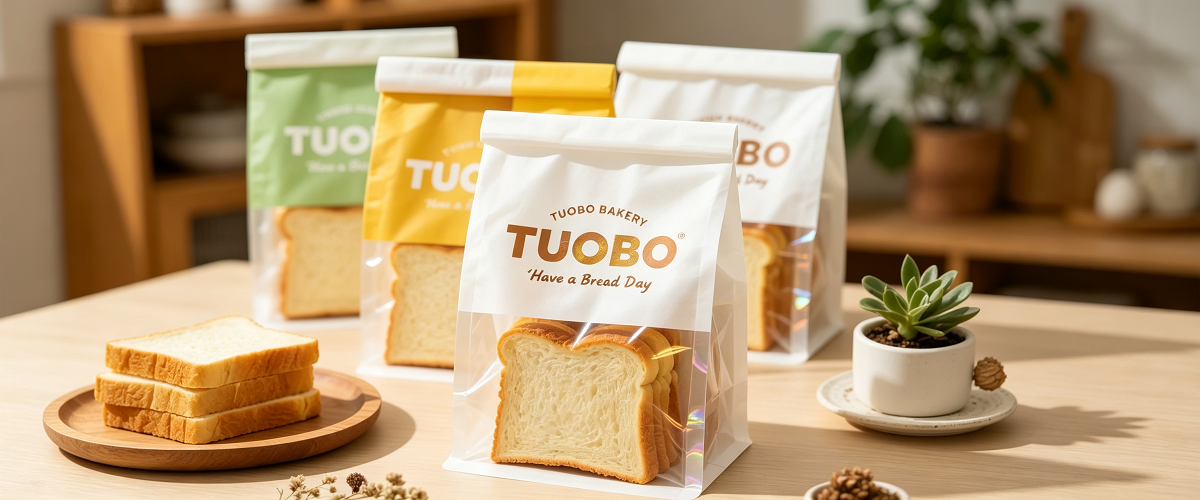
## 2. How Do Flexible Bread Packaging Bags Help Maintain Freshness and Prevent Staling?
Bread freshness is influenced by several interconnected factors, including moisture loss, starch retrogradation, storage temperature, formulation, and microbial activity.
Flexible packaging helps manage the environment around the bread, but it does not stop every process responsible for staling. Understanding how bread changes during storage is essential for choosing the right packaging structure.
### Moisture Retention: Reducing Drying and Hardening
Moisture loss is one of the most visible causes of bread quality deterioration.
When bread is exposed to dry air, water gradually moves from the crumb toward the surrounding environment. This can cause:
- Dry or hard crust and crumb
- Reduced softness
- Crumbling during slicing
- Less pleasant mouthfeel
- Lower consumer acceptance
A suitable flexible bread bag helps slow moisture loss by creating a physical barrier between the bread and the surrounding environment.
PE-based films are commonly used in bread bags because they can provide useful moisture-barrier performance while remaining flexible and economical.
The required moisture barrier depends on the bread type. Soft sandwich bread generally benefits from moisture retention, while crusty bread may require controlled ventilation to avoid excessive moisture accumulation.
Manufacturers should therefore avoid applying the same packaging strategy to every bakery product.
### Understanding Bread Staling and Starch Retrogradation
Bread staling is not simply the result of bread drying out.
One of the major mechanisms involved is **starch retrogradation**, a process in which starch molecules gradually reorganize after baking. This changes the structure of the crumb and contributes to a firmer texture.
As bread cools and is stored, starch components—particularly amylopectin—can recrystallize over time. This contributes to the familiar sensation of bread becoming less soft, even when the package prevents substantial moisture loss.
Flexible packaging helps by limiting moisture exchange with the external environment, but it cannot completely stop starch retrogradation.
Other factors that influence staling include:
- Flour composition
- Bread formulation
- Added fats and emulsifiers
- Baking conditions
- Cooling conditions
- Storage temperature
- Packaging time after baking
For this reason, packaging should be considered part of a broader freshness-management strategy rather than the only method for preventing staling.
### Temperature Management and Bread Freshness
Temperature affects bread quality during storage, but the relationship is more complicated than simply keeping bread as cold as possible.
Refrigeration can accelerate certain staling processes in many types of bread, even though lower temperatures may slow mold growth. Freezing, when performed correctly, can help preserve bread quality for longer storage periods.
Flexible packaging supports temperature management by protecting bread from direct environmental exposure and helping maintain package integrity during storage.
However, packaging material alone cannot control the temperature of the bread.
Manufacturers should consider:
- Cooling bread adequately before packaging
- Avoiding condensation caused by packing warm bread
- Selecting appropriate storage conditions
- Using suitable freezing and thawing procedures where relevant
- Maintaining temperature consistency during transportation
For fresh commercial bread, the timing between baking, cooling, and packaging is especially important.
### Condensation Control: Preventing Excess Moisture Inside the Bag
Condensation is a common challenge in fresh bread packaging.
When warm bread is packed before it has cooled sufficiently, water vapor can accumulate inside the bag and condense on the inner surface.
Excessive condensation may lead to:
- Wet package surfaces
- Soft or soggy crusts
- Uneven texture
- Conditions that encourage mold growth
- Poor visual presentation
A moisture-resistant film does not solve condensation by itself. In fact, a highly sealed package can retain moisture that would otherwise escape.
To reduce this risk, manufacturers should establish suitable cooling conditions before packaging.
Important measures include:
**Adequate cooling**
Bread should be cooled sufficiently before entering the packaging line. The required cooling time depends on loaf size, formulation, production speed, and environmental conditions.
**Controlled packaging-room conditions**
Temperature and humidity in the packaging area can influence condensation behavior.
**Appropriate film selection**
The film should provide a moisture balance suited to the bread product. Highly ventilated structures may be appropriate for some crusty products, while soft bread usually needs better moisture retention.
**Production trials**
Manufacturers should observe the finished package under realistic storage conditions to identify condensation problems.
### Ventilation and Air Exchange for Crusty Bread
Not every bread product benefits from a completely sealed package.
Crusty bread, such as baguettes and artisan loaves, has a different moisture profile from soft sandwich bread. The crust is intended to remain relatively dry and crisp, while the crumb should remain soft.
When hot or insufficiently cooled crusty bread is sealed in a low-permeability bag, moisture can migrate from the crumb toward the crust. This may soften the crust and reduce its characteristic texture.
Ventilated or perforated packaging can help release some moisture and maintain a better crust texture during short-term storage.
However, ventilation must be balanced carefully because too much air exchange can dry out the crumb.
The packaging strategy should consider:
- Crust thickness
- Bread size
- Moisture content
- Time between baking and packaging
- Expected retail holding period
- Distribution temperature and humidity
For products intended to remain crisp for extended periods, manufacturers may need to use packaging and distribution approaches specifically validated for that purpose.
### Mold Prevention and Shelf-Life Management
Bread is a high-moisture food and can be susceptible to mold growth, particularly when stored under warm and humid conditions.
Flexible packaging can reduce exposure to external contaminants when the package is properly handled and sealed. However, a sealed bag does not automatically prevent mold.
Mold development depends on several factors, including:
- Initial microbial load
- Baking and cooling hygiene
- Ingredient quality
- Moisture availability
- Storage temperature
- Packaging conditions
- Use of permitted preservatives or other shelf-life technologies
A suitable bread bag should be clean, food-contact compliant, and compatible with the intended packaging process.
Manufacturers should also ensure that bread is not packaged while excessive heat or moisture remains inside the product.
For longer shelf-life products, packaging may be combined with validated preservation technologies, modified-atmosphere packaging, or other suitable food-safety measures. These approaches must be evaluated for the specific bread formulation and regulatory market.
### Oxygen Management: Understanding Its Role in Bread Packaging
Oxygen is important in bread packaging, but its role differs from that in many high-fat foods.
For ordinary fresh bread, moisture management, microbial control, and product formulation are often more important than achieving an extremely low oxygen transmission rate.
For some packaged bakery products, oxygen management may still contribute to quality preservation, particularly when the product contains fats, oils, seeds, or other oxidation-sensitive ingredients.
For example:
- Bread containing nuts or seeds may be more sensitive to fat oxidation.
- Toasted bread snacks may require stronger oxygen and moisture barriers.
- Long-life packaged bakery products may use modified-atmosphere systems.
Nitrogen flushing or oxygen-reduction techniques may be considered for selected applications, but they are not necessary for every fresh bread bag.
The correct strategy depends on the product's formulation, target shelf life, and storage environment.
### How Packaging Influences Freshness Across Different Bread Types
| Freshness Challenge | Soft Sandwich Bread | Crusty Artisan Bread | Tortillas and Flatbread | Bread Crisps |
|---|---|---|---|---|
| Moisture loss | Major concern | Must be balanced | Major concern | Usually less relevant than moisture uptake |
| Condensation | Important | Can soften crust | Important | Generally controlled through moisture exclusion |
| Starch retrogradation | Important | Important | Important | Less central after drying or toasting |
| Crust texture | Not usually applicable | Critical | Not usually applicable | Crispness is critical |
| Oxygen exposure | Product-dependent | Product-dependent | Usually secondary | May affect fat-containing products |
| Mold control | Important | Important | Important | Depends on water activity and formulation |
| Resealability | Useful for large packs | Product-dependent | Useful | Important for multi-serve packs |
The main lesson is that flexible bread packaging should be designed around the product's freshness profile. Moisture retention is valuable for many soft breads, but controlled ventilation may be more appropriate for selected crusty products.
---
[](https://sfpouch.com/wp-content/uploads/2026/11/修改图片比例生成-7-1.png)
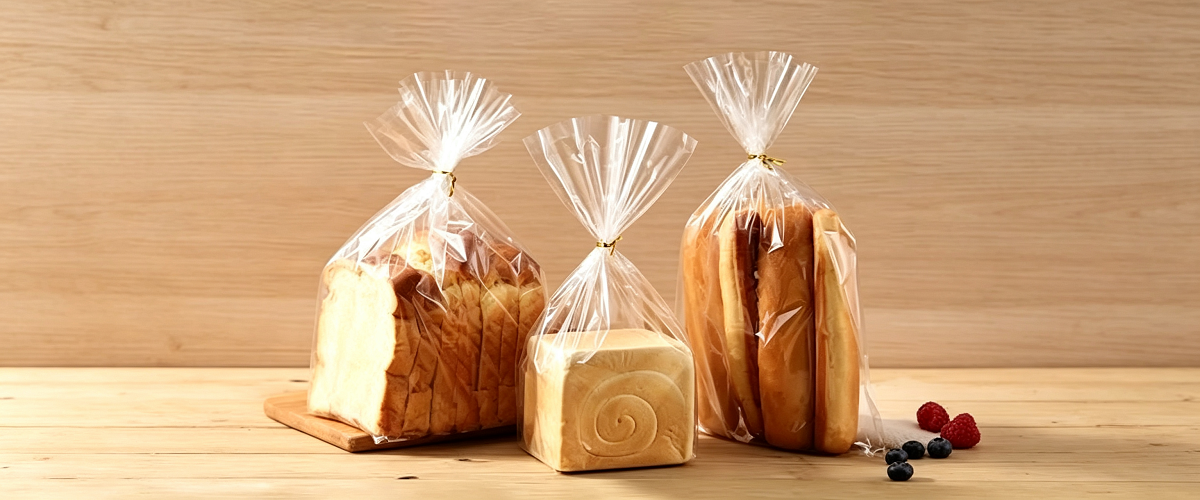
## 3. Which Packaging Materials Offer the Best Moisture Control and Protection for Bread?
Material selection is a major factor in flexible bread packaging because different films offer different levels of moisture resistance, flexibility, transparency, mechanical strength, and heat-sealing performance.
For many fresh bread products, the primary material requirement is suitable moisture management rather than the highest possible oxygen barrier.
The ideal structure depends on whether the product needs to retain softness, maintain a crisp crust, protect a dry texture, or withstand long distribution periods.
### Polyethylene (PE): A Common Choice for Bread Bags
Polyethylene is one of the most widely used materials for flexible bread packaging.
It is available in different grades and forms, including LDPE, LLDPE, and other PE-based films.
Its advantages include:
- Good flexibility
- Useful moisture-barrier performance
- Good heat-sealing properties
- Lightweight construction
- Cost efficiency
- Compatibility with many bread packaging formats
PE films are commonly used for:
- Sliced sandwich bread
- Burger buns
- Hot dog buns
- Bread rolls
- Family-size loaves
- General bakery bags
LDPE is often selected for its flexibility and softness, while LLDPE can contribute to strength and puncture resistance depending on the film construction.
PE films can also be produced with different thicknesses and optical properties to suit product requirements.
For ordinary fresh bread, a PE bag may provide sufficient moisture protection without requiring a complex multilayer laminate.
However, film specifications should be evaluated according to the product's storage conditions and desired shelf life.
### Polypropylene (PP): Clarity and Stiffness for Bakery Packaging
Polypropylene is another material used in flexible food packaging.
BOPP, or biaxially oriented polypropylene, is particularly known for its clarity, stiffness, and printing performance.
It can be suitable for:
- Bread rolls
- Bakery multipacks
- Toasted bread products
- Specialty bakery snacks
- Selected bread packaging applications
PP-based films may offer good presentation because their clarity allows consumers to see the product.
They can also provide useful stiffness for packaging products that benefit from a more structured appearance.
However, standard BOPP and other PP films do not automatically provide the same moisture performance as every PE grade. Their suitability depends on film specifications, sealing requirements, and the complete package construction.
For products that need stronger moisture protection or reliable heat sealing, PP films may be combined with other functional layers.
### CPP: Heat-Sealable Film for Flexible Bakery Packaging
Cast polypropylene (CPP) is commonly used as a heat-sealable film in flexible packaging.
It can be used in selected bakery applications where sealing performance, transparency, and mechanical properties are important.
Potential applications include:
- Bakery multipacks
- Flatbread packaging
- Toasted bread products
- Laminated bakery pouches
CPP can be incorporated as an inner sealing layer in multilayer structures.
Its suitability depends on the required sealing temperature, filling speed, film thickness, and compatibility with the packaging equipment.
For fresh bread bags, manufacturers should confirm that the selected CPP grade provides the desired flexibility and moisture performance.
### PET: Strength and Printing Support for Laminated Bread Pouches
PET is commonly used as an outer layer in laminated flexible packaging.
Its main advantages include:
- Good mechanical strength
- Excellent printability
- Dimensional stability
- Resistance to handling damage
- Compatibility with different lamination structures
PET is often used when bread packaging requires higher-quality graphics, improved package strength, or a more premium presentation.
A possible structure is:
**PET/PE**
In this structure:
- PET provides strength and printing support.
- PE provides the inner heat-sealing layer.
This type of laminate may be considered for specialty bread products, premium bakery pouches, or products requiring printed packaging with additional structural support.
However, ordinary sliced bread does not necessarily require a PET-based laminate. A simple PE bag may be more economical and technically appropriate for many applications.
### Metallized PET (VMPET): Enhanced Barrier for Dry Bakery Products
VMPET is a metallized polyester film that provides improved barrier properties compared with many standard uncoated plastic films.
It can be considered for bakery products that require stronger protection from moisture, oxygen, or light.
Potential applications include:
- Bread crisps
- Toasted bread snacks
- Dry bakery snacks
- Specialty bread-based snack mixes
- Products containing seeds or other oxidation-sensitive ingredients
A common laminate structure is:
**PET/VMPET/PE**
The layers provide:
- PET for strength and printing
- VMPET for enhanced barrier properties
- PE for heat sealing
VMPET is generally more relevant to dry bakery snacks than to ordinary fresh sandwich bread.
For fresh bread, a very high moisture barrier can sometimes be counterproductive if it contributes to moisture retention and crust softening.
The correct structure should therefore be selected according to the desired texture and shelf-life characteristics.
### Aluminum Foil: High Barrier for Selected Dry Bakery Products
Aluminum foil provides excellent protection against moisture, oxygen, light, and many external odors when incorporated into a suitable laminate.
It may be useful for:
- Long-life dry bread snacks
- Toasted bread crisps
- Specialty bakery products
- Products with sensitive ingredients
- Selected export-oriented bakery snacks
A possible structure is:
**PET/AL/PE**
PET provides mechanical support and printing quality, aluminum foil provides the main barrier, and PE provides heat-sealing performance.
However, aluminum foil is not usually necessary for ordinary fresh bread bags. Its higher cost and stronger barrier may not deliver meaningful benefits for products that primarily require simple moisture retention and convenient packaging.
Foil laminates should also be evaluated for pinholes, flex cracking, and mechanical performance after converting.
### Breathable and Micro-Perforated Films
Some bread products require controlled ventilation rather than maximum barrier performance.
Micro-perforated films contain small openings that allow air and water vapor to pass through.
They may be considered for:
- Crusty rolls
- Fresh baguettes
- Selected artisan bread products
- Bakery items where condensation control is important
The main advantage is that they allow moisture to escape from the package, which may help maintain crust characteristics.
However, the perforation pattern must be matched to the product.
Too much ventilation can accelerate drying, while too little may allow moisture to accumulate inside the bag.
Manufacturers should test different perforation sizes and patterns under the actual storage conditions.
### Typical Material Recommendations for Different Bread Products
| Bread Product | Potential Material | Main Performance Requirement |
|---|---|---|
| Sliced sandwich bread | LDPE or suitable PE film | Moisture retention and flexibility |
| Whole wheat bread | PE-based film | Moisture control and bag strength |
| Burger buns | LDPE or LLDPE | Softness retention and flexibility |
| Hot dog buns | PE film | Moisture management and sealing |
| Baguettes | Perforated PE or suitable ventilated film | Controlled moisture release |
| Artisan bread | Breathable or product-specific flexible structure | Crust preservation |
| Tortillas | PE-based film or suitable laminate | Moisture retention and flexibility |
| Pita bread | PE-based film | Moisture control and package integrity |
| Bread crisps | PET/VMPET/PE | Moisture and oxygen protection |
| Toasted bread snacks | PET/VMPET/PE or other high-barrier laminate | Crispness retention |
These recommendations are starting points for evaluation. Final material selection should be based on the actual film specifications, product testing, and packaging equipment.
### Understanding Moisture Barrier Performance
For bread packaging, water vapor transmission is one of the most useful material properties to evaluate.
**Water Vapor Transmission Rate (WVTR)** measures how much water vapor passes through a packaging material under specified conditions.
A lower WVTR generally indicates stronger moisture barrier performance.
However, the lowest possible WVTR is not automatically the best choice for every bread product.
For soft sandwich bread, reducing moisture loss may help maintain softness. For crusty artisan bread, excessive moisture retention may contribute to a softer crust.
The ideal WVTR should therefore be determined according to the bread's intended texture and storage conditions.
Manufacturers should compare test data under equivalent temperature and humidity conditions because WVTR values can change significantly with environmental conditions.
### Material Thickness and Mechanical Performance
Film thickness influences package strength, flexibility, transparency, and material consumption.
A thicker film may provide improved puncture or tear resistance, but it also increases material usage and cost.
A thinner film can reduce packaging weight and cost, but it must still withstand filling, sealing, transportation, and retail handling.
When selecting film thickness, manufacturers should evaluate:
- Bread weight and dimensions
- Bag size
- Product sharp edges or crust characteristics
- Filling speed
- Sealing equipment
- Transportation conditions
- Required package appearance
The goal is to use the minimum practical material thickness that consistently meets the product's performance requirements.
### Food-Contact Compliance and Material Safety
Bread packaging materials must comply with applicable food-contact requirements in the target market.
Depending on the destination, manufacturers may need to consider:
- U.S. FDA food-contact requirements
- European Union food-contact legislation
- Local national food packaging regulations
- Requirements for inks, adhesives, coatings, and additives
Packaging suppliers should provide relevant technical documentation and compliance information for the complete packaging structure.
Manufacturers should also consider odor and sensory compatibility. Bread can absorb unwanted odors, so films, inks, adhesives, and printing processes should be suitable for the intended food application.
### How to Select the Right Material Structure
A practical selection process should begin with the bread product rather than a preferred material name.
For example:
- Soft sandwich bread may need a flexible PE bag with suitable moisture retention.
- Burger buns may need a stronger gusseted PE bag that supports multipack handling.
- Baguettes may need controlled ventilation to protect crust texture.
- Bread crisps may require a high-barrier laminate to prevent moisture uptake.
- Premium flatbread may benefit from a printed laminate with a resealable feature.
By matching material performance to the product's actual needs, manufacturers can avoid unnecessary material complexity while maintaining product quality.
---
[](https://sfpouch.com/wp-content/uploads/2026/11/修改图片比例生成-8-1.png)
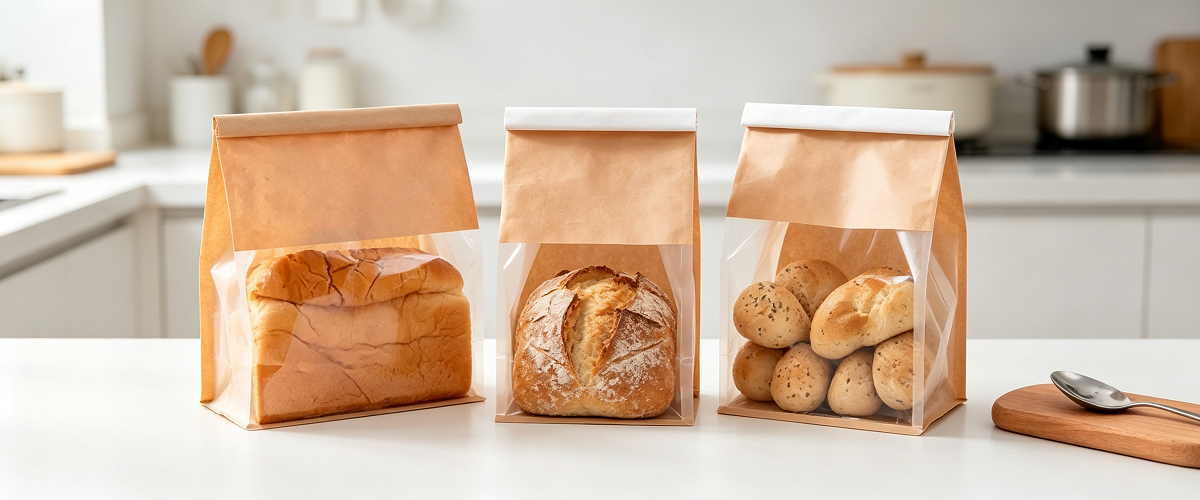
## 4. What Packaging Features Improve Bread Shelf Life, Sealing Performance, and Consumer Convenience?
Flexible bread packaging is not defined by material selection alone. Bag dimensions, closure systems, perforation, printing, and other functional features also influence product protection and user experience.
The right features can improve packaging efficiency, reduce handling problems, and make bread easier for consumers to store and use.
### Heat Sealing for Reliable Package Closure
Heat sealing is widely used in flexible bakery packaging.
It creates a closed package by applying controlled heat and pressure to compatible sealing layers.
For bread manufacturers, reliable sealing helps:
- Reduce unwanted moisture exchange
- Protect products from external contamination
- Maintain package consistency
- Support automated packaging
- Improve distribution reliability
However, not every bread bag needs a heat-sealed closure.
Some traditional bread bags are closed using twist ties, clips, or other mechanical closures. These systems may be more convenient for bakery operations where the bag is opened during filling and closed afterward.
The choice depends on production equipment, retail requirements, and expected product storage conditions.
### Twist Ties and Bread Clips for Easy Reclosing
Twist ties and bread clips are common closure options for sliced bread and soft bakery products.
They allow consumers to reopen the bag and close it again after removing a few slices.
Their advantages include:
- Simple operation
- Low additional packaging complexity
- Compatibility with common bread bags
- Convenient repeated access
- Familiar consumer experience
Twist ties are flexible and can be adjusted to different bag openings. Plastic bread clips provide a more standardized closure and are commonly used in commercial bread packaging.
However, neither option creates a hermetic seal. They are intended mainly for convenience and reducing unnecessary exposure after opening.
For products requiring stronger protection, a heat-sealed initial closure combined with a resealable feature may be considered.
### Resealable Zippers for Tortillas and Multi-Serve Bakery Products
Resealable zippers can improve consumer convenience for bakery products sold in multi-piece packs.
They are particularly suitable for:
- Tortillas
- Pita bread
- Flatbread
- Bread crisps
- Toasted bread snacks
- Specialty bakery bites
The zipper allows consumers to close the package after opening, helping reduce exposure to surrounding air and humidity.
For soft flatbreads, this can support convenient storage between uses. For dry bread snacks, it can help reduce moisture uptake and preserve crispness.
A zipper should be positioned where consumers can open and close the package easily without damaging the product.
The initial heat seal remains important because the zipper itself is not a substitute for the original sealed closure.
### Tear Notches for Easy Opening
Tear notches provide a convenient way for consumers to open flexible bakery packaging.
They can be incorporated into:
- Stand-up pouches
- Three-side seal bags
- Flatbread pouches
- Bread snack bags
- Small bakery portions
A well-designed tear notch allows consumers to open the package with controlled force.
It should be positioned away from the product where possible and should not cause the bag to tear through an unintended area.
For multi-serve products, tear notches work particularly well when combined with a resealable zipper.
### Perforation for Controlled Ventilation
Perforation is an important feature for selected fresh bakery products.
It allows controlled air exchange and can help reduce moisture accumulation inside the package.
Perforated bags may be suitable for:
- Baguettes
- Crusty rolls
- Selected artisan breads
- Bakery products intended for short-term storage
The perforation design should be matched to the product's moisture profile.
If the openings are too large or too numerous, bread may dry out quickly. If ventilation is insufficient, moisture may accumulate and soften the crust.
Testing under realistic storage conditions is necessary to determine the appropriate perforation pattern.
### Gussets for Better Capacity and Package Stability
Gussets are folded sections that allow a bag to expand and accommodate larger or bulkier products.
They are useful for:
- Large sandwich loaves
- Family-size bread
- Multipacks of buns
- Large flatbread portions
- Specialty bakery products
Gusseted bags can improve package fit and provide more efficient use of material.
For bread products, gusset dimensions should be selected carefully so that the bag can accommodate the loaf without excessive compression.
The package should also remain stable during stacking and transportation.
### Transparent Windows for Product Visibility
Transparent windows allow consumers to see the bread before purchasing.
This can be useful for products where appearance is an important selling point, such as:
- Multigrain bread
- Seeded bread
- Artisan rolls
- Specialty flatbread
- Bread crisps
A window can communicate product texture, color, and visible ingredients.
However, transparent sections should be designed carefully if the bread is sensitive to light or requires strong moisture protection.
For many fresh bread products, a transparent PE bag already provides visibility, so a separate window may not be necessary.
### Printing and Surface Finishes for Brand Recognition
Flexible bread packaging offers a large printable area for brand communication.
Important design elements include:
- Brand logo
- Bread variety
- Ingredient information
- Net weight
- Nutritional information
- Allergen declarations
- Storage instructions
- Production and expiry information
- Barcode and regulatory details
Printing can help bakery brands distinguish products and create a consistent appearance across different bread varieties.
For premium bakery products, matte finishes, glossy effects, and carefully designed color combinations may strengthen perceived value.
For mass-market bread, clarity, readability, and cost efficiency may be more important than complex finishes.
### Package Dimensions and Easy Product Handling
The dimensions of a bread bag influence filling efficiency, product protection, and shelf presentation.
A bag that is too small may compress the bread or make filling difficult. A bag that is too large may look poorly fitted and increase material consumption.
Manufacturers should consider:
- Bread length and width
- Loaf height
- Product weight
- Number of slices or pieces
- Bag opening size
- Gusset depth
- Required headspace
- Filling equipment
A practical sample-making and fitting process can help determine the correct dimensions before mass production.
### Packaging Features by Bread Product
| Feature | Suitable Bread Applications | Main Benefit |
|---|---|---|
| Twist tie | Sliced sandwich bread | Easy repeated closing |
| Bread clip | Loaves and buns | Convenient package closure |
| Heat seal | Retail bread and bakery pouches | Initial package integrity |
| Resealable zipper | Tortillas, flatbread, bread snacks | Convenient repeated access |
| Tear notch | Pouches and bakery snack bags | Easy opening |
| Micro-perforation | Selected crusty bread | Controlled moisture release |
| Side gusset | Large loaves and bun multipacks | Additional capacity |
| Transparent film | Most retail bread bags where suitable | Product visibility |
| Printed surface | Branded bakery products | Brand recognition and product information |
The most useful features are those that address a specific product or consumer requirement. Adding unnecessary closures or finishes may increase cost without improving bread quality.
---
[](https://sfpouch.com/wp-content/uploads/2026/11/修改图片比例生成-9-1.png)
## 5. Flexible Bread Packaging Bags: Key Factors for Freshness, Product Protection, Branding, and Cost Efficiency
Selecting the right flexible bread packaging requires a complete understanding of the product, manufacturing process, storage environment, distribution channel, and brand strategy.
A packaging solution that works well for sliced sandwich bread may not be suitable for crusty baguettes or dry bread snacks. Manufacturers should therefore evaluate packaging as part of the entire bakery production and distribution system.
### Bread Type and Product Characteristics
The first step is to understand the bread itself.
Different bread products have different physical and chemical characteristics that influence packaging decisions.
**Soft sandwich bread**
Soft sandwich bread generally requires packaging that limits excessive moisture loss and helps maintain crumb softness. Flexible PE bags are commonly used because they offer practical moisture protection and are suitable for high-volume packaging.
**Whole wheat and multigrain bread**
These products may contain seeds, grains, and other inclusions. Packaging should provide suitable moisture retention and enough mechanical strength to protect the loaf during handling.
**Burger buns and hot dog buns**
These products are often packed in multipacks. Their packaging should accommodate several buns without excessive compression and should support convenient opening and closing.
**Baguettes and artisan bread**
These products often require a balance between moisture release and crumb protection. Ventilated or product-specific packaging may be more appropriate than a fully sealed low-permeability bag.
**Tortillas and flatbread**
These products need packaging that helps maintain flexibility and reduce drying. Resealable pouches can improve convenience for products consumed over several occasions.
**Bread crisps and toasted snacks**
These products require strong moisture protection because moisture uptake can quickly reduce crispness. High-barrier laminates and resealable pouches may be suitable.
Understanding these differences is essential before selecting the material structure or bag format.
### Shelf-Life Targets and Distribution Conditions
Shelf-life requirements vary widely across the bakery industry.
Fresh bread sold locally may have a relatively short distribution cycle, while packaged flatbread, toast products, and dry bakery snacks may require longer storage periods.
Before choosing packaging, manufacturers should define:
- Target shelf life
- Storage temperature
- Relative humidity
- Transportation distance
- Retail display conditions
- Expected time before consumption
- Whether the product will be frozen or refrigerated
- Whether the package will be opened and resealed
The package should be tested under conditions that represent the actual supply chain.
For example, a bag that performs well in a controlled warehouse may behave differently in a hot and humid distribution environment.
### Cooling and Packaging Timing
The time between baking and packaging is an important factor in bread quality.
Bread should generally be cooled sufficiently before being packed to reduce the risk of condensation.
Packaging too early can trap excess moisture and create conditions that contribute to poor appearance, soggy surfaces, and mold-related quality problems.
Manufacturers should optimize:
- Cooling time
- Cooling-room airflow
- Product temperature at packaging
- Packaging-room humidity
- Production-line speed
- Bag material and closure system
A consistent cooling and packaging process helps improve the performance of the finished package.
### Production-Line Compatibility
Flexible bread packaging must be compatible with the manufacturer's filling and sealing equipment.
For large-scale bread manufacturers, packaging performance directly affects production efficiency.
Important considerations include:
**Bag opening and feeding**
The bag should open consistently and allow bread to enter without excessive manual adjustment.
**Film handling**
The material should run smoothly through the equipment without excessive static, slipping, wrinkling, or tearing.
**Sealing or closure performance**
The closure method should work reliably at the required production speed.
**Package dimensions**
Bag width, length, and gusset depth should match the product and packaging machine.
**Printing registration**
Printed designs should align properly with the finished package.
**Production waste**
Material that frequently tears, jams, or fails during packaging can increase operational costs.
Manufacturers should conduct machine trials before approving a new packaging structure for large-scale production.
### Branding and Retail Shelf Appeal
Bread packaging has an important role in helping products stand out in supermarkets, convenience stores, and specialty bakery outlets.
Consumers often make quick purchasing decisions based on product appearance, brand recognition, ingredient information, and perceived freshness.
Flexible packaging supports branding through:
**Clear product identification**
The bread variety should be immediately recognizable. Clear product naming helps consumers distinguish white bread, whole wheat bread, multigrain bread, milk bread, and specialty varieties.
**Color and visual hierarchy**
Consistent color systems help consumers identify different product lines while reinforcing brand identity.
**Product imagery**
Images of bread slices, grains, seeds, and baked textures can communicate product characteristics.
**Transparent packaging**
Visibility can help consumers inspect the loaf and evaluate its appearance.
**Consistent brand design**
Using the same logo, typography, and visual elements across multiple bread products strengthens recognition.
For premium bakery brands, packaging can also communicate artisan positioning, specialty ingredients, and product quality.
### Consumer Convenience and Storage After Opening
Consumers expect bread packaging to be easy to open, close, and store.
For sliced bread, twist ties and clips remain practical because they are familiar and easy to use.
For tortillas, flatbread, and bread snacks, resealable zippers can offer better convenience.
Package size is also important. Large family packs may need stronger closure systems because consumers are likely to open the package repeatedly.
Manufacturers should consider how consumers actually use the product rather than adding features simply because they are available.
### Food Safety and Regulatory Compliance
Bread packaging must meet food-contact requirements in the markets where the product is sold.
Regulatory considerations may include:
- Material suitability for direct food contact
- Migration requirements
- Ink and adhesive compliance
- Applicable food-contact declarations
- Labeling and allergen information
- Local packaging and recycling regulations
The complete packaging structure should be assessed for its intended use.
Suppliers should provide appropriate technical documents, material specifications, and compliance information.
For bread, odor compatibility is also important. Packaging materials should not introduce unwanted smells that affect the product's natural aroma.
### Sustainability and Material Reduction
Sustainability is becoming an increasingly important consideration for bakery brands and retailers.
Flexible bread packaging can offer opportunities to reduce material use because it is generally lightweight and can be designed around the product's actual dimensions.
Potential strategies include:
**Optimizing film thickness**
Reducing unnecessary film thickness can lower material consumption, provided the package still meets strength and performance requirements.
**Right-sizing the bag**
A bag that closely matches the bread dimensions can reduce excess material and improve presentation.
**Evaluating mono-material structures**
PE-based or PP-based packaging structures may offer recycling opportunities in markets with suitable collection and recycling systems.
**Reducing packaging waste**
Improving machine compatibility and sealing consistency can reduce production rejects and wasted material.
**Reviewing end-of-life options**
Recyclability depends on the complete material structure, local collection systems, sorting capabilities, and recycling infrastructure.
Brands should avoid making broad environmental claims without confirming the actual properties and disposal options of the packaging.
For fresh bread, packaging performance must remain a priority. A package that allows excessive moisture loss or increases product spoilage may create more food waste and reduce the overall environmental benefit.
### Cost Efficiency and Total Packaging Value
Packaging cost should be assessed alongside product protection, manufacturing efficiency, transportation, and consumer experience.
A lower-cost film may be suitable for ordinary bread bags, but it may not be appropriate for products requiring stronger protection or more sophisticated branding.
Manufacturers should evaluate:
- Film cost per unit
- Material thickness
- Printing costs
- Bag conversion costs
- Minimum order quantities
- Production speed
- Packaging waste
- Storage and transportation costs
- Product damage and rejection rates
For example, a large bread manufacturer may prioritize a simple PE bag that runs efficiently on automated equipment.
A premium bakery brand may accept a higher packaging cost for a printed laminate with better presentation and customized features.
A manufacturer of bread crisps may need a higher-barrier pouch because maintaining crispness is central to product quality.
The best packaging solution is therefore the one that delivers the required performance at an appropriate total cost.
### How to Work with a Flexible Packaging Supplier
A reliable flexible packaging supplier should understand the bakery product and its manufacturing requirements before recommending a material structure.
Before requesting a quotation, manufacturers should prepare the following information:
| Information to Provide | Why It Matters |
|---|---|
| Bread type | Determines freshness and moisture requirements |
| Bread dimensions | Helps determine bag size |
| Product weight | Influences film strength and package capacity |
| Number of pieces per bag | Determines package format and dimensions |
| Target shelf life | Guides material and barrier selection |
| Storage conditions | Helps determine moisture-management requirements |
| Distribution environment | Identifies transportation and handling risks |
| Packaging format | Determines converting and production requirements |
| Closure preference | Helps select clips, ties, heat seals, or zippers |
| Printing design | Supports artwork preparation and cost estimation |
| Order quantity | Influences production planning and unit price |
| Target sales market | Helps identify relevant compliance requirements |
It is also useful to request samples, technical specifications, food-contact documentation, and information about the supplier's printing and converting capabilities.
Before mass production, manufacturers should confirm:
- Bag dimensions
- Material structure
- Film thickness
- Printing quality
- Opening and closing performance
- Heat-sealing performance, if applicable
- Machine compatibility
- Finished-package performance during storage
A structured sampling and approval process can reduce production risks and help ensure that the final packaging meets the bakery's requirements.
### Final Checklist for Selecting Flexible Bread Packaging
Before approving a flexible bread packaging solution, manufacturers can use the following checklist:
- [ ] Identify the exact bread type and product characteristics.
- [ ] Determine whether the bread needs moisture retention or controlled ventilation.
- [ ] Select a suitable bag format.
- [ ] Define the target shelf life and distribution conditions.
- [ ] Evaluate the required moisture barrier.
- [ ] Consider oxygen and light protection where relevant.
- [ ] Choose a suitable film material and thickness.
- [ ] Confirm bag dimensions and gusset requirements.
- [ ] Select an appropriate closure system.
- [ ] Check compatibility with the packaging machine.
- [ ] Confirm food-contact compliance.
- [ ] Evaluate printing and branding requirements.
- [ ] Test the finished package under realistic storage conditions.
- [ ] Compare total packaging cost rather than material price alone.
By following these steps, bread manufacturers can make more informed packaging decisions and reduce the risk of selecting a bag that does not match the product's actual requirements.
---
[](https://sfpouch.com/wp-content/uploads/2026/11/修改图片比例生成-10-1.png)
## FAQ
**What is the best flexible packaging material for bread bags?**
PE-based films, such as LDPE or suitable LLDPE structures, are commonly used for fresh bread bags because they offer flexibility, moisture protection, and practical heat-sealing performance. The best material depends on the bread type and required shelf life.
**Do bread packaging bags need high oxygen barrier properties?**
Not necessarily. For many fresh bread products, moisture management and mold control are more important than achieving an extremely low oxygen transmission rate. High oxygen barrier structures may be more relevant for dry bakery snacks or products containing oxidation-sensitive ingredients.
**How do flexible bread bags help keep bread fresh?**
Flexible bread bags help reduce moisture loss and protect bread from direct environmental exposure. They can slow drying and help maintain softness, but they cannot completely prevent starch retrogradation or mold growth.
**Should bread bags be perforated?**
Perforated bags may be useful for selected crusty bread products because they allow moisture to escape and can help preserve crust texture. However, excessive ventilation may cause the bread to dry out faster. Soft sandwich bread generally requires a different moisture-management approach.
**Are resealable zippers suitable for bread packaging?**
Yes. Resealable zippers are useful for tortillas, flatbread, bread crisps, and other multi-serve bakery products. For ordinary sliced bread, twist ties and bread clips are often more practical and economical.
**What is the difference between PE and PP bread packaging?**
PE is commonly used for bread bags because of its flexibility and heat-sealing properties. PP and BOPP films offer clarity and stiffness and may be used in selected bakery packaging applications. The best choice depends on the required barrier, package design, and production equipment.
**Can flexible packaging prevent bread from becoming stale?**
Flexible packaging can slow moisture loss, which helps maintain bread softness. However, bread staling also involves starch retrogradation and other internal changes that packaging alone cannot completely prevent.
**What packaging is best for tortillas and flatbread?**
PE-based bags, three-side seal pouches, and suitable resealable pouches are common options. The package should help maintain flexibility, reduce moisture loss, and accommodate the product without excessive compression.
**Is aluminum foil packaging necessary for fresh bread?**
Usually not. Ordinary fresh bread bags generally do not need the very high barrier performance of aluminum foil. Foil laminates are more relevant to selected dry bakery products that require stronger protection against moisture, oxygen, or light.
**What should manufacturers test before approving bread packaging bags?**
Manufacturers should evaluate film specifications, moisture transmission, seal performance, bag strength, package dimensions, machine compatibility, and storage performance. For fresh bread, condensation, moisture loss, texture, and mold development should also be monitored during shelf-life testing.
---
## Conclusion
Choosing the right flexible bread packaging bags requires a balance between **freshness retention, moisture management, product protection, packaging functionality, branding, and cost efficiency**. Different bakery products have different packaging requirements, so manufacturers should avoid using a single material structure or bag format for every type of bread.
PE-based bread bags are practical for many soft bread products because they provide flexibility, useful moisture protection, and cost-effective packaging performance. Gusseted bags and pillow bags are suitable for larger loaves and multipacks, while three-side seal pouches and resealable bags can improve convenience for tortillas and flatbread. Selected crusty bread products may benefit from controlled ventilation, whereas bread crisps and toasted snacks often require stronger moisture barriers.
Beyond material selection, manufacturers should pay close attention to cooling before packaging, condensation control, closure performance, bag dimensions, and compatibility with automated production lines. These factors can have a significant impact on the finished package and the quality of the bread throughout distribution.
It is also important to understand that flexible packaging cannot independently prevent every cause of bread staling or spoilage. Moisture loss, starch retrogradation, microbial activity, and storage temperature all influence bread quality. Effective packaging must therefore work together with suitable formulation, production hygiene, cooling, and storage practices.
Ultimately, the best flexible bread packaging solution is one that matches the bread's physical characteristics, maintains the desired texture, supports the required shelf life, and runs reliably on the production line. By selecting suitable materials, bag structures, and functional features, bakery manufacturers can improve product presentation, reduce packaging waste, and deliver a more consistent experience to consumers.