A Detailed Guide to Vacuum Packaging Bags for Meat Preservation
Anna_Yu
A Detailed Guide to Vacuum Packaging Bags for Meat Preservation
Meat is highly sensitive to oxygen, moisture, temperature changes, microbial contamination, and physical damage. Whether the product is fresh beef, pork, poultry, lamb, cured meat, smoked meat, or another processed meat product, appropriate packaging plays an important role in maintaining product quality throughout storage and distribution. Vacuum packaging bags are widely used because they remove much of the air surrounding the product and create a tightly sealed barrier between the meat and the external environment.
A well-designed vacuum packaging system can help reduce oxygen exposure, minimize moisture loss, protect against contamination, and extend the practical shelf life of many meat products when combined with appropriate refrigeration and food-handling practices. However, choosing the right vacuum bag requires more than selecting a bag that can simply hold the product. Film structure, oxygen barrier, puncture resistance, seal performance, thickness, package format, and compatibility with the vacuum equipment all influence the final packaging performance.
For meat processors, retailers, foodservice companies, and brands, the ideal vacuum packaging bag should provide a balance between product protection, processing efficiency, transportation durability, consumer convenience, and presentation. Understanding these factors can help businesses select flexible packaging that protects meat quality while supporting efficient and reliable distribution.
1. What Types of Vacuum Packaging Bags Are Best for Meat Preservation?
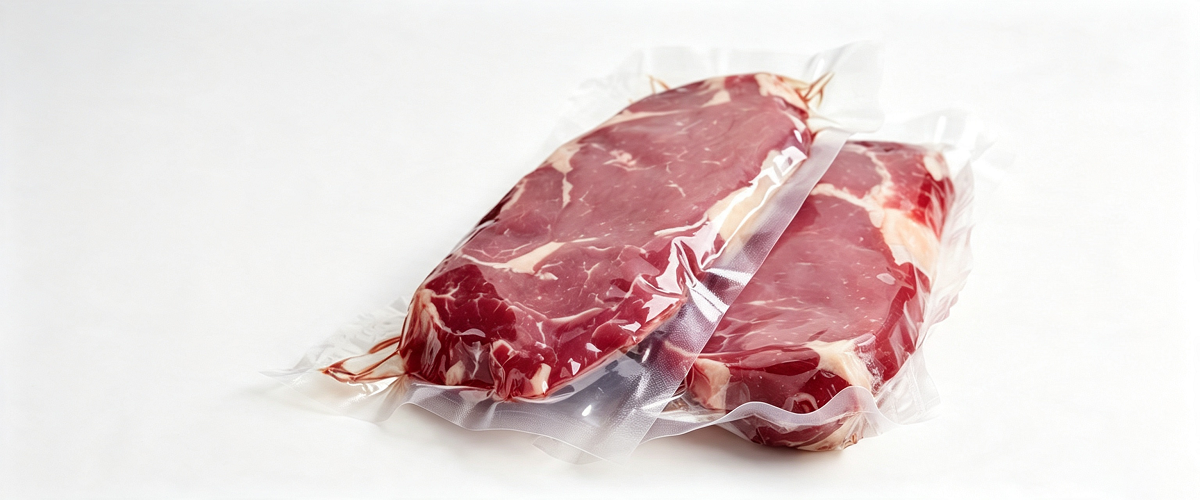
Different meat products have different packaging requirements. A soft and boneless cut of beef may require a different structure from sharp-boned poultry, processed ham, frozen meat, or cured meat products. The best vacuum packaging bag is therefore determined by the product characteristics, processing conditions, storage temperature, distribution period, and required shelf life.
Common vacuum packaging formats include vacuum pouches, high-barrier vacuum bags, shrink vacuum bags, bone-guard-compatible structures, and larger vacuum bags for bulk or foodservice applications.
Vacuum Pouches
Vacuum pouches are among the most common formats for meat packaging. The product is placed inside the pouch, air is removed using a vacuum machine, and the opening is heat-sealed.
They can be used for:
- Fresh beef
- Pork
- Lamb
- Poultry
- Seafood
- Processed meat
- Marinated meat
- Ready-to-cook products
Vacuum pouches are available in different thicknesses and barrier structures according to the product requirements.
Shrink Vacuum Bags
Shrink vacuum bags are designed to contract around the meat after vacuum sealing and exposure to controlled heat.
This creates a close-fitting package that can:
- Improve product presentation
- Reduce excess package volume
- Provide strong product protection
- Minimize liquid movement inside the package
- Improve transportation efficiency
Shrink vacuum packaging can be particularly attractive for fresh meat cuts and products where appearance is important.
High-Barrier Vacuum Bags
High-barrier vacuum bags are designed to provide strong resistance to oxygen and moisture transmission.
They are particularly useful when the product requires extended refrigerated storage or distribution across longer supply chains.
Typical structures may combine materials such as:
- PET
- PA/nylon
- PE
- EVOH
- Other high-barrier polymer layers
The exact combination depends on the desired barrier performance and packaging process.
Bone-Guard Vacuum Packaging
Bone-in meat can create a special packaging challenge because sharp bone edges may puncture ordinary films during vacuuming, handling, or transportation.
For these products, manufacturers may use:
- Higher-strength films
- Thicker structures
- Abrasion-resistant layers
- Bone-protection inserts or secondary protection
The packaging should be selected based on the sharpness and geometry of the product rather than relying only on nominal film thickness.
Bulk Vacuum Bags
Large-format vacuum bags are commonly used for:
- Foodservice meat
- Industrial meat processing
- Wholesale distribution
- Large cuts
- Bulk portions
These bags prioritize seal strength, puncture resistance, and handling efficiency.
Comparison of Common Vacuum Packaging Formats
| Packaging Type | Main Advantage | Typical Meat Application | Key Consideration |
|---|---|---|---|
| Standard Vacuum Pouch | Flexible and economical | Fresh and processed meat | Requires suitable barrier |
| Shrink Vacuum Bag | Close-fitting appearance | Premium meat cuts | Requires shrink process |
| High-Barrier Vacuum Bag | Strong oxygen protection | Extended refrigerated storage | Higher material requirements |
| Heavy-Duty Vacuum Bag | High puncture resistance | Bone-in meat and large cuts | May require thicker film |
| Large Vacuum Bag | Efficient for bulk packaging | Foodservice and wholesale | Seal strength is critical |
The ideal format should be selected according to the product's physical characteristics and the complete packaging process.
2. How Do Vacuum Packaging Bags Extend the Shelf Life of Fresh and Processed Meat?
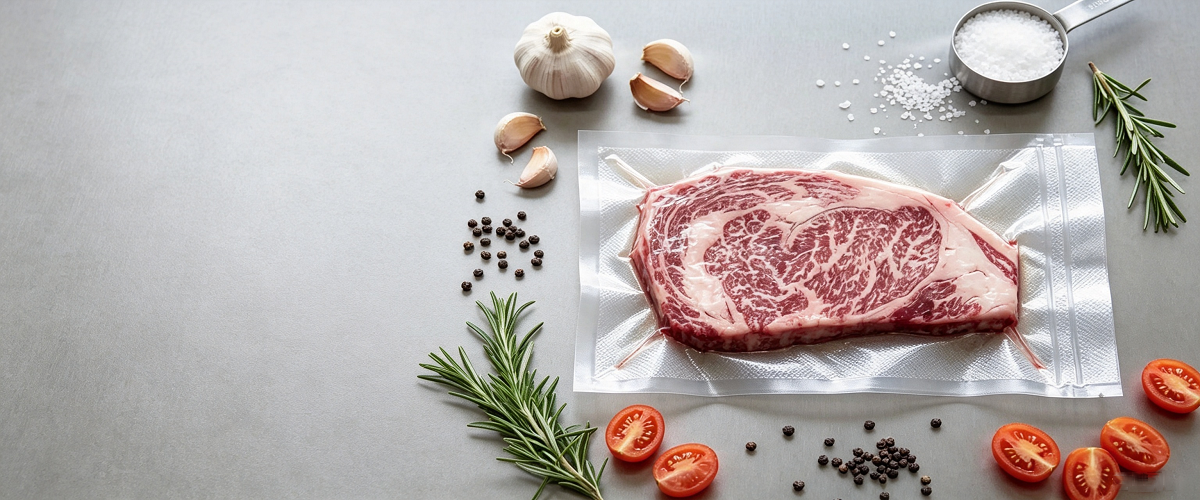
Vacuum packaging works primarily by reducing the amount of air surrounding the meat before sealing. This significantly changes the atmosphere inside the package and can reduce exposure to oxygen.
However, vacuum packaging should not be considered a substitute for refrigeration, sanitation, or appropriate food-safety controls. Its main role is to provide an additional packaging barrier that supports product quality when the overall cold-chain system is properly managed.
Reducing Oxygen Exposure
Oxygen can contribute to several quality changes in meat.
It can promote oxidation of fats and other components, potentially affecting flavor and aroma. Oxygen exposure can also influence the appearance of fresh meat by affecting pigment chemistry.
By removing most of the air before sealing, vacuum packaging reduces the amount of oxygen available inside the package.
Helping Reduce Oxidative Quality Loss
Meat products containing fats can be vulnerable to oxidation during storage.
High-barrier vacuum packaging can help reduce oxygen transmission from the external environment. This is particularly valuable for products with longer storage requirements.
The effectiveness depends on the complete packaging structure, seal integrity, storage temperature, and residual oxygen level.
Minimizing Moisture Loss
Meat can lose moisture during refrigerated or frozen storage.
A suitable flexible packaging film provides a moisture barrier that helps retain product juices and reduces unwanted moisture transfer.
This can be important for maintaining:
- Product weight
- Texture
- Appearance
- Eating quality
- Consumer perception
Reducing External Contamination
Once the package is properly sealed, the packaging creates a physical barrier between the product and the surrounding environment.
This can reduce exposure to external contaminants during:
- Storage
- Transportation
- Retail handling
- Refrigerated display
However, the packaging itself must be manufactured and handled under appropriate food-safety conditions.
Supporting Longer Distribution Chains
Vacuum packaging can be particularly useful when meat needs to travel through multiple stages of the supply chain.
A typical supply chain may include:
- Meat processing
- Vacuum packaging
- Cold storage
- Transportation
- Distribution
- Retail or foodservice
- Consumer storage
A high-performance package helps maintain product quality throughout these stages when temperature control is properly maintained.
Fresh Meat Versus Processed Meat
Different products may have different packaging requirements.
Fresh beef may require high oxygen and puncture resistance, while cured or processed meat may require additional protection against moisture and aroma migration.
Marinated meat may also require stronger seals and chemical resistance because sauces or acidic ingredients can contact the packaging layer.
For this reason, packaging specifications should always be matched to the actual product formulation.
3. Which Materials Provide the Best Oxygen, Moisture, and Puncture Resistance for Meat Packaging?
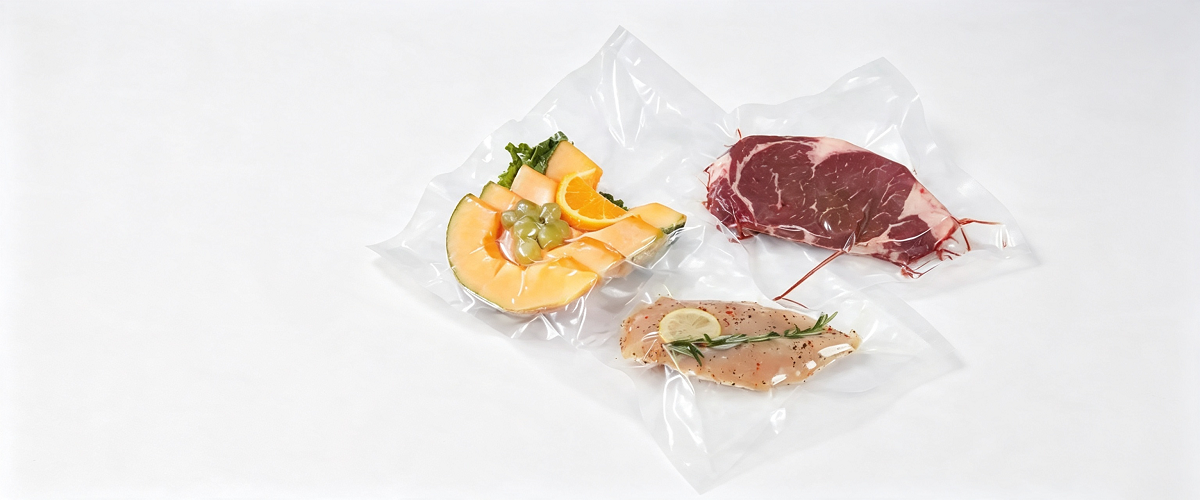
Material selection is one of the most important decisions when designing vacuum packaging bags for meat. No single material provides every desired property at the same level, so multilayer structures are commonly used.
PE: Flexible and Heat-Sealable
Polyethylene is widely used as the inner sealing layer of vacuum packaging structures.
Its advantages include:
- Good heat sealing
- Flexibility
- Moisture resistance
- Good toughness
- Food-contact suitability
However, PE alone may not provide the oxygen barrier required for demanding meat applications.
PA/Nylon: Strength and Puncture Resistance
Polyamide, commonly known as nylon or PA, is widely used in vacuum packaging because of its mechanical strength and puncture resistance.
It can provide:
- Good toughness
- High puncture resistance
- Good tensile strength
- Resistance to handling damage
This makes PA particularly useful for meat products with irregular shapes or sharp edges.
PET: Strength and Printability
PET can provide excellent dimensional stability, mechanical strength, and printability.
It is commonly used as an outer layer in laminated structures.
For branded meat products, PET can provide a high-quality surface for graphics and product information.
EVOH: High Oxygen Barrier
EVOH is commonly used as a barrier layer in high-performance flexible packaging.
It can provide strong oxygen barrier performance, making it useful when oxygen-sensitive meat products require extended protection.
Its performance can be affected by humidity, so it is generally incorporated into a multilayer structure where other layers protect and support the barrier layer.
Multilayer Structures
A multilayer vacuum packaging film combines different materials so each layer contributes a specific function.
For example:
PET/PA/PE
may provide a combination of:
- Printability
- Mechanical strength
- Puncture resistance
- Heat sealing
- Moisture protection
A higher-barrier structure may incorporate EVOH or other barrier technologies.
Example Material Comparison
| Material | Oxygen Barrier | Moisture Barrier | Puncture Resistance | Heat Sealing | Typical Role |
|---|---|---|---|---|---|
| PE | Moderate | Good | Good | Excellent | Inner seal layer |
| PA | Moderate | Moderate | Excellent | Limited as standalone seal layer | Strength layer |
| PET | Moderate | Good | Good | Usually laminated | Outer layer |
| EVOH | Excellent | Depends on structure | Moderate | Usually laminated | Oxygen barrier |
| PA/PE | Moderate | Good | Excellent | Excellent | General vacuum packaging |
| PA/EVOH/PE | Excellent | Good | Excellent | Excellent | High-barrier meat packaging |
These values are general comparisons rather than universal specifications. Actual performance depends on grade, thickness, processing conditions, humidity, laminate design, and manufacturing quality.
Choosing Film Thickness
Thickness should not be selected simply by choosing the thickest available film.
A thicker structure may provide greater puncture resistance, but it can also increase material consumption and packaging cost.
The better approach is to determine:
- Product weight
- Product geometry
- Presence of bones
- Sharp edges
- Vacuum pressure
- Transportation conditions
- Required shelf life
- Sealing equipment
Testing should then determine the minimum practical structure that provides reliable performance.
4. What Packaging Features Should You Consider for Vacuum-Sealed Meat Products?
A high-quality vacuum bag needs more than good barrier properties. Its physical design and compatibility with the packaging process can have a major impact on production efficiency and final product quality.
Strong and Reliable Seals
The heat seal is one of the most critical parts of a vacuum package.
A seal must remain intact during:
- Vacuuming
- Handling
- Stacking
- Refrigeration
- Transportation
- Retail display
Seal performance can be affected by temperature, pressure, dwell time, contamination, film composition, and machine settings.
Packaging suppliers should therefore consider the customer's specific sealing equipment when developing a vacuum bag.
Puncture Resistance
Meat products can have sharp bones, edges, or irregular shapes.
Puncture resistance becomes especially important for:
- Bone-in beef
- Bone-in pork
- Poultry
- Lamb cuts
- Large meat portions
- Frozen meat
A package that develops a small puncture can lose its vacuum and significantly reduce the effectiveness of the packaging system.
Flexibility and Conformability
The film should conform appropriately around the product after vacuuming.
Good conformability can:
- Reduce excess package volume
- Improve appearance
- Reduce trapped air
- Improve storage efficiency
- Support better product presentation
Shrink vacuum films can provide particularly strong conformity after the appropriate shrink process.
Vacuum Performance
Not every flexible film behaves identically during vacuum packaging.
The film should be compatible with the customer's:
- Vacuum level
- Machine type
- Sealing temperature
- Production speed
- Bag dimensions
Poor compatibility can result in wrinkles, incomplete seals, excessive residual air, or package leakage.
Easy Opening
Consumer-facing meat packaging should balance strong sealing with reasonable opening convenience.
Features such as tear notches can help consumers open the package without scissors.
However, easy-open features should not compromise the integrity of the primary seal.
Package Size and Shape
The bag should be appropriately sized for the meat product.
An oversized bag can increase material consumption and packaging volume, while an undersized bag may create excessive mechanical stress during vacuuming.
Correct dimensions can improve both material efficiency and production speed.
Transparency
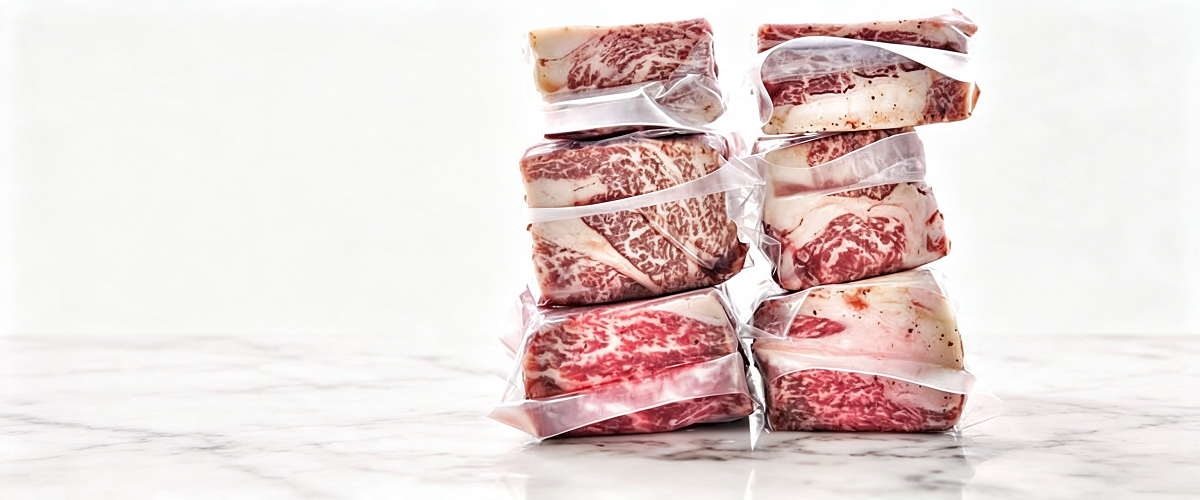
Clear vacuum bags allow consumers to see the meat inside.
This can be useful for retail products because consumers can evaluate:
- Color
- Cut
- Quantity
- Product appearance
- Fat distribution
For premium products, transparent packaging combined with high-quality labeling can create a clean and professional presentation.
Printing and Branding
For branded meat products, the vacuum bag can become an important marketing surface.
Packaging can communicate:
- Brand identity
- Product name
- Meat origin
- Cooking instructions
- Storage instructions
- Nutritional information
- Certifications where applicable
High-quality printing can help differentiate products in competitive refrigerated displays.

5. Vacuum Packaging Bags for Meat: Key Factors for Food Safety, Storage, Transportation, and Branding
Selecting vacuum packaging for meat requires a comprehensive approach. A bag that performs well during the initial packaging process may still fail if it cannot withstand transportation, refrigeration, retail handling, or consumer use.
Food Safety
Food safety should always be the first consideration.
Packaging materials intended for meat should be suitable for the intended food-contact application and comply with the relevant regulatory requirements in the target market.
Important considerations include:
- Food-contact compliance
- Clean manufacturing conditions
- Migration requirements
- Seal integrity
- Packaging hygiene
- Appropriate cold-chain handling
Vacuum packaging should complement—not replace—proper sanitation, temperature control, and food-safety management.
Cold Storage
Meat is typically stored under controlled refrigerated or frozen conditions, depending on the product.
The packaging structure should maintain its mechanical and sealing performance at the intended storage temperature.
Some films may become less flexible or more susceptible to mechanical stress at low temperatures, so cold-condition testing is important for frozen products.
Transportation
Meat packaging may experience considerable mechanical stress during transportation.
Packages can be exposed to:
- Compression
- Vibration
- Abrasion
- Stacking pressure
- Temperature fluctuations
- Handling impacts
Puncture resistance and seal strength are therefore critical for maintaining package integrity.
Export Distribution
International meat distribution can involve longer transportation times and multiple handling stages.
For export products, packaging should be evaluated according to:
- Expected transit time
- Temperature conditions
- Refrigeration or freezing requirements
- Package dimensions
- Pallet configuration
- Handling conditions
- Required shelf life
High-barrier vacuum packaging can be particularly useful when longer distribution periods require stronger oxygen protection.
Branding
Vacuum packaging does not need to look purely functional.
Modern flexible packaging can combine technical performance with strong visual branding.
Brands can use:
- Custom colors
- Product photography
- Premium typography
- Matte finishes
- Gloss effects
- Transparent areas
- Printed logos
- QR codes
- Product storytelling
A well-designed package can help transform a basic meat product into a recognizable branded offering.
Sustainability
Flexible packaging can offer opportunities to reduce packaging weight compared with some rigid formats.
Manufacturers may also explore:
- Lightweight structures
- Material optimization
- Reduced film thickness where technically possible
- Recyclable structures
- Mono-material solutions
- More efficient package dimensions
However, sustainability should not be evaluated only by material weight. Product protection, food waste, recyclability infrastructure, manufacturing requirements, and actual end-of-life conditions should all be considered.
Cost Efficiency
The lowest-cost bag is not necessarily the most economical solution.
A package failure can lead to:
- Product loss
- Returns
- Repacking
- Quality complaints
- Transportation problems
- Brand damage
A better strategy is to optimize the total packaging cost while maintaining sufficient barrier performance, mechanical strength, and sealing reliability.
Recommended Selection Framework
| Selection Factor | Key Question |
|---|---|
| Product Type | Is the meat fresh, frozen, cured, smoked, marinated, or processed? |
| Product Shape | Is it boneless, bone-in, irregular, or sharp-edged? |
| Barrier | What oxygen and moisture protection is required? |
| Strength | What puncture and abrasion resistance is necessary? |
| Storage | Will the product be refrigerated or frozen? |
| Shelf Life | How long must the product maintain quality? |
| Equipment | What vacuum and sealing equipment will be used? |
| Package Format | Pouch, shrink bag, bulk bag, or another format? |
| Branding | Does the bag require custom printing or premium finishes? |
| Sustainability | Is a recyclable or lightweight structure required? |
| Distribution | Will the product be sold locally or exported? |
6. FAQ
Why Are Vacuum Packaging Bags Used for Meat?
Vacuum packaging bags remove much of the air surrounding the meat before sealing. This reduces oxygen exposure and creates a physical barrier against the external environment, helping support product quality and shelf life when combined with appropriate refrigeration and food-safety practices.
What Is the Best Material for Vacuum Meat Packaging?
There is no single material that is best for every meat product. Multilayer structures combining PE, PA, PET, EVOH, or other barrier materials can provide different combinations of sealing performance, puncture resistance, oxygen protection, and moisture resistance.
Are Vacuum Bags Suitable for Bone-In Meat?
Yes, but bone-in meat generally requires stronger puncture-resistant packaging. Heavy-duty structures, thicker films, or additional bone protection may be necessary depending on the product geometry and handling conditions.
Is PA/PE Suitable for Meat Vacuum Packaging?
PA/PE is a commonly used structure because PA provides mechanical strength and puncture resistance while PE provides heat sealing and moisture resistance. For applications requiring stronger oxygen protection, an EVOH-containing structure may be considered.
Can Vacuum Packaging Extend Meat Shelf Life?
Vacuum packaging can help extend the practical shelf life of many meat products by reducing oxygen exposure and protecting against external contamination and moisture transfer. The actual shelf life depends on the meat type, processing conditions, temperature, microbial controls, packaging performance, and applicable food-safety requirements.
Are Vacuum Packaging Bags Suitable for Frozen Meat?
Yes. Vacuum packaging can be used for frozen meat, but the packaging structure should be tested for low-temperature flexibility, puncture resistance, seal integrity, and resistance to handling damage during freezing and transportation.
Can Vacuum Meat Bags Be Custom Printed?
Yes. Custom printing can be incorporated into suitable multilayer flexible packaging structures. Brands can use custom graphics, logos, product information, and premium finishes to improve retail presentation.
What Makes a Good Vacuum Packaging Bag for Export Meat?
A good export-oriented vacuum bag should provide reliable oxygen and moisture protection, strong seals, high puncture resistance, suitable low-temperature performance, and compatibility with the expected packaging equipment and distribution conditions.
7. Conclusion
Vacuum packaging bags are an important flexible packaging solution for protecting meat products throughout processing, storage, transportation, and retail distribution. By removing much of the air from the package and creating a strong protective barrier, vacuum packaging can help reduce oxygen exposure, minimize moisture loss, protect against external contamination, and support longer product quality retention.
However, successful meat packaging depends on selecting the right combination of materials and package features. PE can provide reliable heat sealing and moisture resistance, PA can improve puncture resistance and mechanical strength, PET can support structural performance and high-quality printing, while EVOH and other barrier technologies can provide enhanced oxygen protection. These materials can be combined into multilayer structures designed around specific meat products and processing requirements.
For meat processors and brands, the ideal vacuum packaging bag should provide a balanced combination of food-contact suitability, oxygen barrier, moisture protection, puncture resistance, seal strength, storage performance, transportation durability, consumer convenience, branding, and cost efficiency.
Ultimately, the best solution is not simply the thickest or highest-barrier bag. It is the packaging structure that meets the actual requirements of the meat product while maintaining reliable performance throughout the complete supply chain. Careful material selection, package testing, sealing optimization, and cold-chain management can work together to deliver safer, more attractive, and more efficient meat packaging.