Are There Flexible Packaging Options Suitable for Pet Food?
Anna_Yu
Are There Flexible Packaging Options Suitable for Pet Food?
Pet food packaging must do much more than make a product attractive on a retail shelf. It needs to protect the food from moisture, oxygen, light, contamination, and physical damage while maintaining product quality throughout storage, transportation, and consumer use. As pet owners increasingly pay attention to ingredients, nutrition, freshness, and convenience, packaging has become an important part of the overall pet food experience.
Flexible packaging offers manufacturers a wide range of solutions for dry pet food, treats, freeze-dried products, wet food, and other pet nutrition products. Stand-up pouches, flat pouches, gusseted bags, zipper bags, and other flexible formats can be customized according to the product's physical characteristics and distribution requirements. Different film structures can also provide different levels of barrier protection, strength, sealability, and visual appeal.
For pet food brands, the challenge is to select a packaging solution that balances product protection, convenience, shelf life, branding, sustainability, and cost efficiency. A package that looks attractive but cannot withstand transportation or protect the product from moisture may create quality problems, while an over-engineered structure may increase costs unnecessarily.
Understanding the available flexible packaging options and matching them to the specific requirements of each pet food product can help manufacturers create more reliable packaging systems. The following guide explores the main flexible packaging formats, materials, protective properties, and functional features that can support modern pet food products.
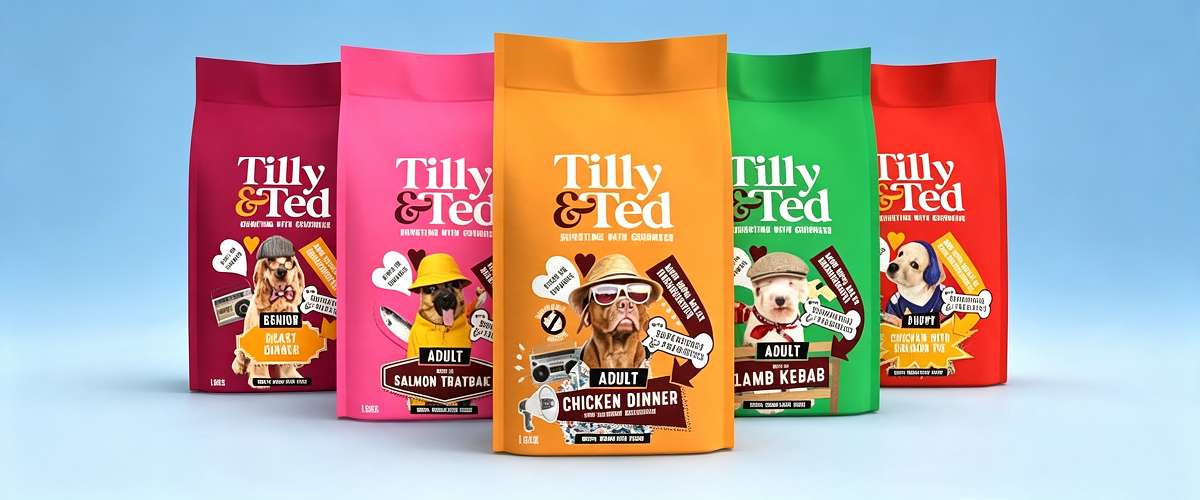
1. What Types of Flexible Packaging Are Best for Pet Food Products?
There is no single flexible packaging format that is suitable for every type of pet food. The best choice depends on the product's moisture content, fat content, particle size, aroma sensitivity, expected shelf life, filling process, transportation conditions, and consumer usage habits.
Flexible packaging can be designed in different structures to meet these requirements.
Stand-Up Pouches
Stand-up pouches are one of the most versatile flexible packaging formats for pet food.
They can be used for:
- Pet treats
- Dry food
- Freeze-dried pet food
- Dental chews
- Functional pet snacks
- Specialty pet products
The bottom gusset allows the package to stand upright on shelves, creating good retail visibility while providing a relatively large printable surface.
Stand-up pouches can also incorporate features such as:
- Zippers
- Tear notches
- Handles
- Rounded corners
- Transparent windows
- High-barrier films
These features make them suitable for both premium and mass-market pet food products.
Flat Pouches
Flat pouches provide a compact packaging format and can be useful for smaller portions.
They are particularly suitable for:
- Pet treats
- Single-serve products
- Trial packs
- Small snack portions
- Sample packaging
Because they generally require less material and storage space than larger rigid containers, flat pouches can be attractive for brands looking for lightweight packaging options.
Side-Gusset Bags
Side-gusset bags provide additional capacity and can accommodate larger volumes of dry pet food.
They are suitable for:
- Dry dog food
- Dry cat food
- Large-volume treats
- Bulk pet nutrition products
The gusseted structure can provide stability and efficient use of packaging volume.
Flat-Bottom Bags
Flat-bottom bags can provide a more structured appearance while retaining many advantages of flexible packaging.
They can stand securely on retail shelves and provide several large printable surfaces.
This format can be especially useful for premium pet food brands seeking a modern and high-end appearance.
Resealable Pet Food Pouches
Resealable packaging is particularly valuable for products that are consumed over multiple occasions.
A zipper can help consumers close the package after opening, reducing unnecessary exposure to the surrounding environment.
This can be useful for:
- Dry kibble
- Treats
- Freeze-dried food
- Dental treats
- Functional snacks
The zipper does not replace the primary package seal or barrier structure, but it can improve consumer convenience after the package has been opened.
Packaging Format Comparison
| Flexible Packaging Format | Suitable Pet Food Applications | Main Advantages |
|---|---|---|
| Stand-Up Pouch | Treats, dry food, freeze-dried food | Good shelf display and customization |
| Flat Pouch | Small portions and treats | Compact and lightweight |
| Side-Gusset Bag | Dry food and larger packs | Higher capacity and stability |
| Flat-Bottom Bag | Premium dry food | Strong shelf presence and structure |
| Zipper Pouch | Treats and dry food | Resealability and convenience |
| Individual Sachet | Supplements, snacks, samples | Portion control and portability |
The right format should be selected according to the product rather than visual appearance alone.
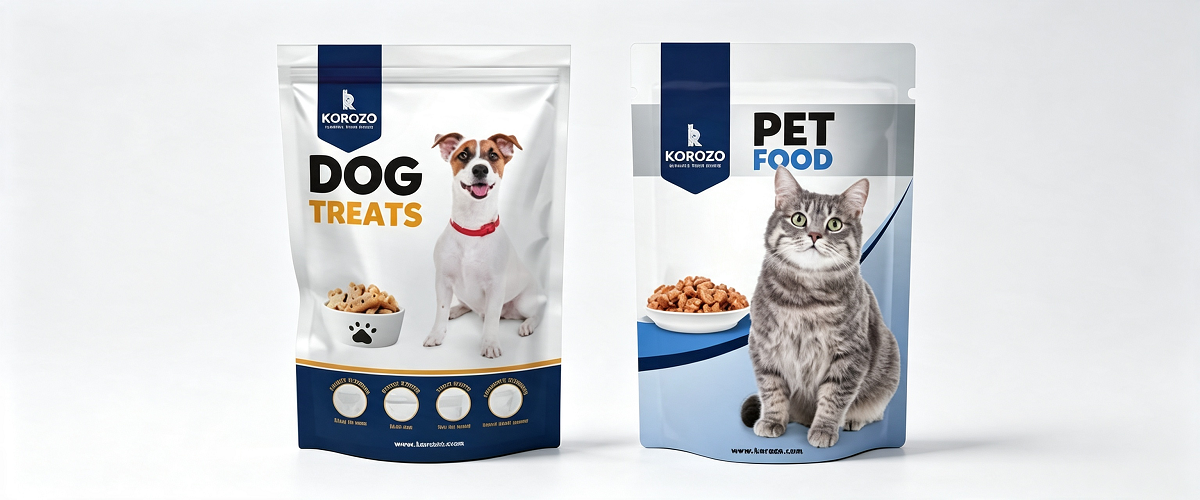
2. How Does Flexible Packaging Protect Pet Food from Moisture, Oxygen, and Contamination?
Pet food can experience quality changes when exposed to environmental conditions during storage and transportation.
Moisture, oxygen, light, odors, and contaminants can affect different products in different ways. Flexible packaging can be engineered with multiple layers to address these risks.
Moisture Protection
Moisture can be particularly problematic for dry pet food and treats.
Excess moisture may contribute to:
- Loss of crispness
- Texture changes
- Clumping
- Reduced palatability
- Quality deterioration
For dry products, the packaging structure should provide an appropriate moisture barrier.
The actual barrier requirement depends on:
- Product formulation
- Water activity
- Desired shelf life
- Storage conditions
- Distribution environment
A high-quality inner sealing layer can also help reduce the risk of moisture entering through package seams.
Oxygen Protection
Oxygen can contribute to oxidation, particularly in pet food products containing fats and oils.
Oxidation may affect:
- Flavor
- Aroma
- Nutritional quality
- Product stability
Barrier materials such as metallized films, aluminum foil, and specialized high-barrier polymer structures can help reduce oxygen transmission.
The appropriate oxygen barrier should be determined through product testing and shelf-life requirements rather than assuming that the highest possible barrier is always necessary.
Light Protection
Light exposure can affect certain food ingredients and contribute to quality degradation.
For products that are light-sensitive, packaging can incorporate:
- Aluminum foil
- Metallized film
- Opaque polymer layers
- Printed outer structures
Light protection can be especially relevant when packaging contains ingredients that are sensitive to oxidation or photodegradation.
Odor Protection
Pet food often contains strong aromas from meat, fish, fats, and other ingredients.
Packaging needs to help contain product odors while also limiting the migration of external odors into the package.
This can be important during:
- Warehouse storage
- Transportation
- Retail display
- Home storage
A suitable high-barrier laminate can help create a more controlled internal environment.
Contamination Protection
Flexible packaging can create a sealed barrier between the product and its external environment.
When properly designed and sealed, the package can help protect pet food from:
- Dust
- Dirt
- Humidity
- Handling contamination
- Foreign particles
Seal integrity is therefore just as important as the film structure itself.
Barrier Protection Overview
| Environmental Factor | Potential Product Impact | Packaging Response |
|---|---|---|
| Moisture | Texture and quality changes | Moisture barrier |
| Oxygen | Oxidation and flavor changes | Oxygen barrier |
| Light | Degradation of sensitive components | Opaque or light-barrier layer |
| External Odors | Aroma contamination | Odor-resistant structure |
| Physical Handling | Punctures and leakage | Strong outer layers |
| Contamination | Food safety and quality risks | Reliable seals and barrier structure |
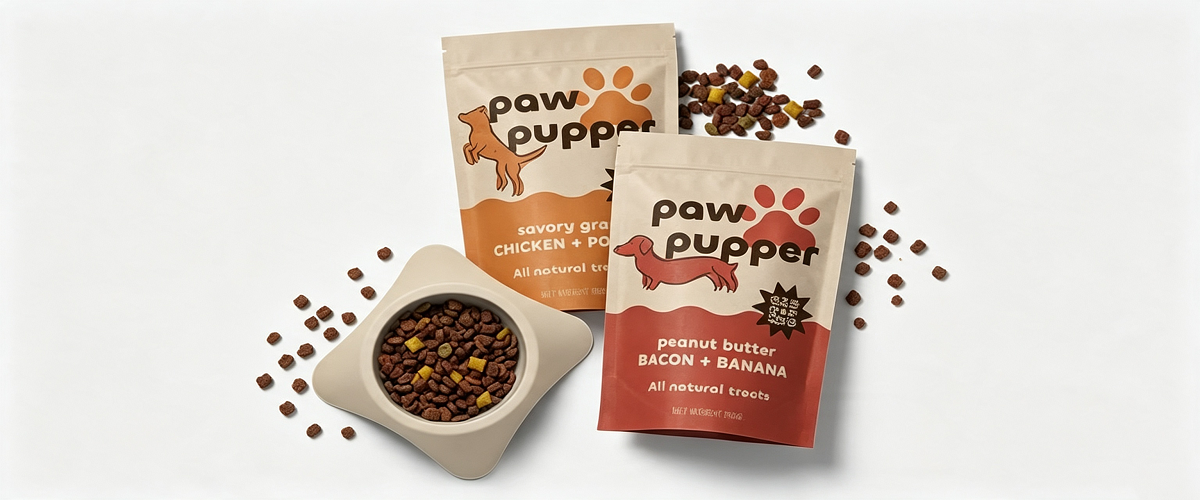
3. Which Packaging Materials Provide the Best Barrier Protection for Pet Food?
Pet food packaging often uses multilayer flexible structures because different materials provide different functional properties.
One material may provide printability, another may provide mechanical strength, while another provides sealing or barrier performance.
PET
Polyester, commonly used as PET, is frequently selected as an outer layer.
Its advantages include:
- Good mechanical strength
- Good dimensional stability
- High-quality printing
- Good appearance
- Resistance to handling damage
PET alone may not provide all the barrier properties required for every pet food application, so it is often combined with other layers.
PE
Polyethylene is widely used as a heat-sealable inner layer.
It can provide:
- Good sealing performance
- Moisture resistance
- Flexibility
- Good toughness
PE-based structures can be useful for many pet food applications, especially when combined with suitable barrier layers.
Metallized PET
Metallized PET can provide enhanced protection against:
- Oxygen
- Moisture
- Light
It also creates a distinctive metallic visual effect.
This can be attractive for premium pet food packaging where both barrier performance and shelf appearance are important.
Aluminum Foil
Aluminum foil offers a very high barrier against:
- Oxygen
- Moisture
- Light
- External odors
Foil laminates may be suitable for pet food products requiring particularly strong protection.
However, foil structures should be evaluated according to the package's sustainability objectives, cost targets, and intended recycling pathway.
High-Barrier Polymer Films
High-barrier polymer structures can provide strong protection without necessarily relying on aluminum foil.
These materials may be considered when brands are exploring:
- Recyclable packaging
- Mono-material structures
- Reduced material complexity
- Specific sustainability goals
The actual barrier performance depends on the specific polymer structure and processing technology.
Paper-Based Structures
Paper can provide a natural visual appearance and support certain branding strategies.
However, paper alone generally does not provide sufficient moisture and oxygen protection for many pet food products.
It may therefore be combined with polymer or barrier layers.
Material Comparison
| Material | Moisture Barrier | Oxygen Barrier | Printability | Typical Role |
|---|---|---|---|---|
| PET | Good | Moderate | Excellent | Outer layer |
| PE | Good | Limited to Moderate | Good | Seal layer |
| Metallized PET | Excellent | Excellent | Good | Barrier layer |
| Aluminum Foil | Excellent | Excellent | Good | High-barrier layer |
| High-Barrier Polymer | Good to Excellent | Good to Excellent | Good | Advanced barrier structure |
| Paper-Based Layer | Limited | Limited | Excellent | Appearance and branding |
The final laminate should be selected based on the actual pet food formulation, shelf-life target, filling process, and distribution conditions.
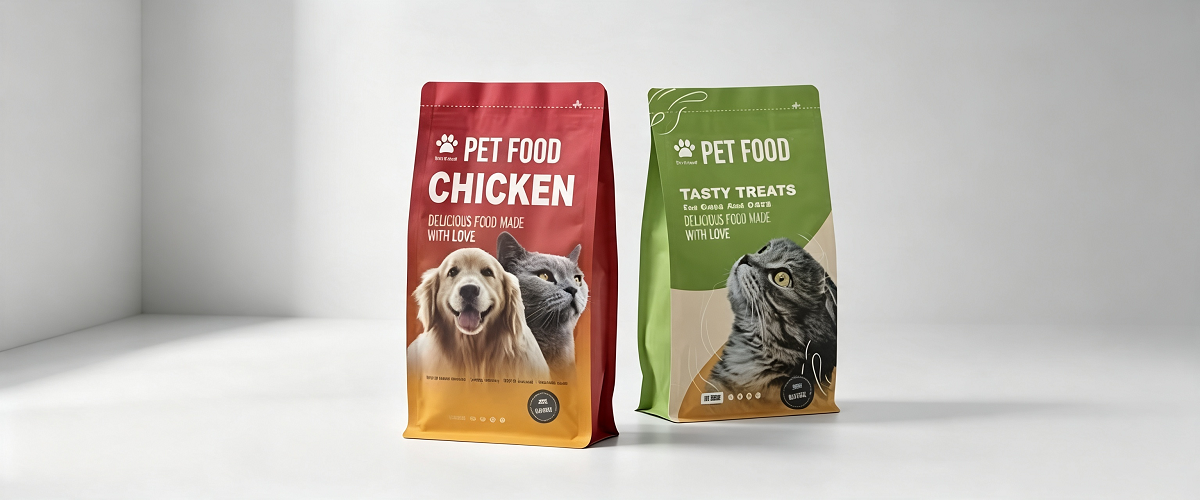
4. What Packaging Features Improve Pet Food Freshness, Convenience, and Shelf Life?
Pet owners often open pet food packages repeatedly rather than consuming the entire package immediately. As a result, packaging features can have a significant impact on the consumer experience.
Resealable Zippers
A zipper allows consumers to close the package after opening.
This can help:
- Reduce exposure to humidity
- Limit exposure to external odors
- Improve storage convenience
- Keep the package organized
For larger bags of dry food or treats, resealability can be particularly valuable.
Easy-Tear Notches
Easy-tear notches can simplify package opening without requiring scissors.
This is useful for:
- Small treat bags
- Single-serve products
- Trial packs
- Lightweight pouches
The tear feature should be designed to provide predictable opening performance.
Strong Heat Seals
Heat seals are essential for maintaining package integrity.
A strong seal can help prevent:
- Leakage
- Moisture entry
- Product loss
- Contamination
Seal performance should be tested under realistic production and transportation conditions.
Handles
Larger pet food bags may benefit from integrated handles.
Handles can make carrying the product easier, especially for larger packages.
However, the handle structure should be designed carefully to avoid creating stress concentrations that could damage the package.
Rounded Corners
Rounded corners can help reduce the risk of sharp package edges and may also improve the visual appearance of premium pet food packaging.
Transparent Windows
Some brands may choose transparent windows to allow consumers to see the product.
This can be attractive for treats or visually distinctive pet food.
However, transparent areas can reduce light protection, so they should only be used when they are compatible with the product's storage requirements.
Packaging Size and Portion Options
Offering multiple package sizes can help brands meet different consumer needs.
For example:
- Trial size
- Small retail pack
- Medium household pack
- Large value pack
Smaller portions can support convenience and freshness, while larger packages may improve cost efficiency for frequent consumers.
Consumer-Friendly Features
| Feature | Consumer Benefit | Suitable Applications |
|---|---|---|
| Zipper | Resealing | Dry food and treats |
| Tear Notch | Easy opening | Small pouches |
| Handle | Easier carrying | Large pet food bags |
| Window | Product visibility | Treats and specialty products |
| Stand-Up Structure | Better storage | Retail pouches |
| Portion Pack | Controlled usage | Treats and supplements |
| High-Integrity Seal | Product protection | Most pet food formats |
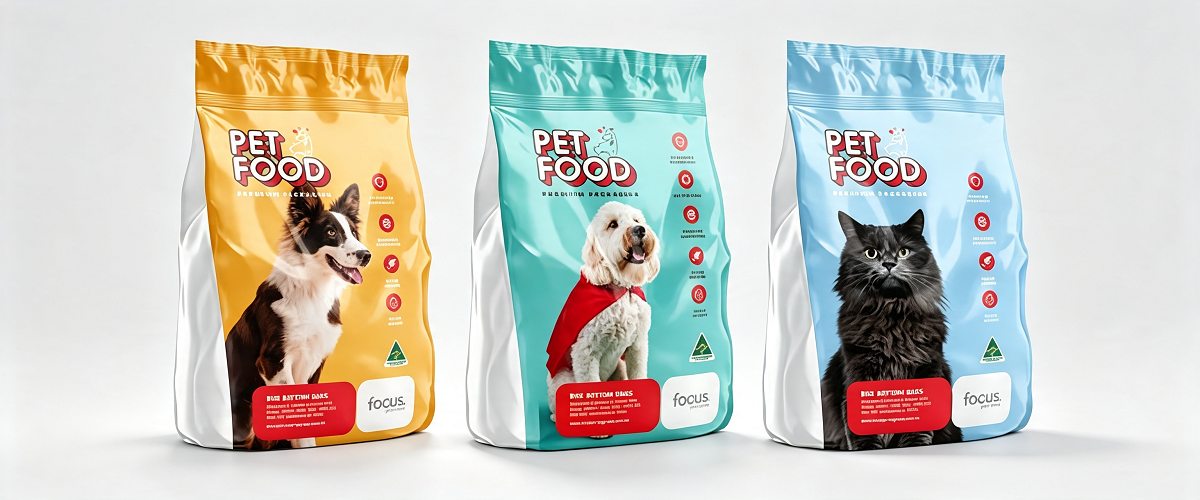
5. Flexible Pet Food Packaging: Key Factors for Product Protection, Branding, and Distribution
Selecting flexible packaging for pet food requires a balance between technical performance and commercial requirements.
The package needs to protect the product while also communicating brand value and remaining efficient throughout the supply chain.
Product Protection
The first priority should be product quality.
Brands should evaluate:
- Moisture barrier
- Oxygen barrier
- Light protection
- Aroma retention
- Puncture resistance
- Seal strength
- Shelf-life requirements
The packaging structure should be validated against the specific formulation.
Branding and Shelf Appeal
Pet food is highly competitive, and packaging is often one of the first elements consumers see.
A flexible pouch provides substantial space for:
- Logos
- Pet photography
- Product names
- Flavor information
- Nutritional positioning
- Brand stories
- Feeding instructions
High-quality printing and finishing can help products create stronger shelf presence.
Premium Positioning
Premium pet food brands can use flexible packaging to communicate quality through:
- Matte finishes
- Metallic effects
- Minimalist graphics
- Sophisticated typography
- High-resolution imagery
- Structured pouch formats
However, design should remain consistent with the actual product positioning.
Sustainability
Sustainability is becoming increasingly relevant to packaging decisions.
Brands may evaluate:
- Lightweight structures
- Recyclable films
- Mono-material solutions
- Reduced material usage
- Efficient package dimensions
- Reusable or resealable formats
The sustainability strategy should be based on the actual material structure and available collection and recycling systems in the target market.
Transportation Efficiency
Flexible packaging can be lightweight and compact compared with some rigid packaging formats.
Potential benefits include:
- Lower packaging weight
- Efficient pallet utilization
- Reduced empty space
- Easier warehouse storage
- Potentially lower transportation requirements
However, flexible bags must still have sufficient mechanical strength to withstand filling, stacking, transportation, and retail handling.
Export and Distribution
For pet food brands selling internationally, packaging must account for longer supply chains.
Important factors may include:
- Transportation duration
- Temperature variation
- Humidity
- Compression
- Puncture risks
- Warehouse conditions
- Regulatory requirements
- Labeling requirements
Packaging should be tested under conditions representative of the intended distribution environment.
Packaging Selection Checklist
| Factor | Key Question |
|---|---|
| Product Type | Is it dry, wet, freeze-dried, semi-moist, or a treat? |
| Moisture | How sensitive is the product to humidity? |
| Oxygen | Is oxidation a major quality concern? |
| Aroma | Does the product require strong odor protection? |
| Shelf Life | How long must the product remain stable? |
| Package Size | What quantity will consumers purchase and use? |
| Opening | Does the package need easy-open functionality? |
| Resealing | Will consumers use the product over multiple occasions? |
| Durability | Can the structure withstand transportation and handling? |
| Branding | How much printable surface is required? |
| Sustainability | What material and recycling goals apply? |
| Cost | Does the solution fit the target product economics? |
6. FAQ
Is Flexible Packaging Suitable for Pet Food?
Yes. Flexible packaging can be suitable for many pet food categories, including dry food, treats, freeze-dried products, dental chews, and other pet nutrition products. The appropriate structure depends on the product's moisture, oxygen, aroma, and mechanical protection requirements.
What Is the Best Flexible Packaging for Dry Pet Food?
Stand-up pouches, side-gusset bags, flat-bottom bags, and other resealable flexible formats can be suitable for dry pet food. The best choice depends on package size, filling process, shelf-life requirements, and consumer usage.
Does Pet Food Need High-Barrier Packaging?
Many pet food products benefit from appropriate moisture and oxygen barriers. The exact barrier level depends on the formulation, fat content, water activity, desired shelf life, and storage conditions.
Why Is a Zipper Useful for Pet Food Packaging?
A zipper allows consumers to reseal the package after opening. This can improve convenience and help limit repeated exposure to the surrounding environment.
Are Aluminum Foil Bags Suitable for Pet Food?
Aluminum foil laminates can provide excellent protection against oxygen, moisture, light, and external odors. They may be appropriate for pet food products requiring high barrier performance, although material cost and sustainability objectives should also be considered.
Can Pet Food Packaging Be Recyclable?
Some flexible pet food packaging solutions can be designed with recyclable or mono-material structures. However, recyclability depends on the exact material construction and the collection and recycling infrastructure available in the target market.
What Packaging Features Are Most Important for Pet Food?
Important features can include strong barrier protection, reliable heat seals, puncture resistance, resealable zippers, easy-open features, suitable package dimensions, and durable construction.
Can Flexible Pet Food Packaging Be Customized?
Yes. Flexible packaging can be customized in terms of size, structure, printing, graphics, finishes, zipper systems, handles, tear notches, and other features.
7. Conclusion
Flexible packaging provides pet food manufacturers with a versatile way to combine product protection, convenience, branding, and distribution efficiency. From stand-up pouches and flat pouches to side-gusset and flat-bottom bags, different formats can be selected according to the product type, package size, and consumer usage requirements.
The material structure is equally important. PET, PE, metallized films, aluminum foil, high-barrier polymers, and paper-based structures can perform different functions within a flexible laminate. The right combination can help protect pet food from moisture, oxygen, light, external odors, and physical damage while maintaining package integrity throughout the supply chain.
Functional features can further improve the consumer experience. Resealable zippers, easy-tear openings, handles, strong seals, convenient package sizes, and customized printing can make pet food packaging easier to use while helping brands stand out in competitive retail environments.
Ultimately, there is no universal flexible packaging solution for every pet food product. The ideal package should be developed around the product's formulation, moisture and oxygen sensitivity, shelf-life target, filling process, distribution conditions, consumer habits, and branding objectives. By balancing barrier performance, durability, convenience, aesthetics, sustainability, and cost efficiency, pet food brands can create packaging that protects product quality while supporting long-term market growth.