Choosing Flexible Packaging Pouches for Body Wash Refills
Anna_Yu
Choosing Flexible Packaging Pouches for Body Wash Refills
Body wash refills are becoming an increasingly important part of the personal care packaging market. As consumers look for more convenient ways to replenish products while reducing the amount of rigid packaging they purchase repeatedly, refill systems have become an attractive option for body wash brands. Instead of buying a completely new bottle every time, consumers can reuse a dispenser or durable bottle and purchase a flexible refill pouch containing the same product.
For brands, however, creating an effective body wash refill pouch requires much more than simply replacing a plastic bottle with a flexible bag. Body wash products can contain surfactants, fragrances, oils, active ingredients, preservatives, salts, and other formulation components that may interact with packaging materials. The pouch must therefore provide reliable chemical compatibility, seal strength, puncture resistance, leakage prevention, and long-term product protection.
Consumer experience is equally important. A refill pouch that is difficult to open, difficult to pour, or prone to dripping can quickly reduce the perceived benefits of a refill system. Spout size, cap design, pouch shape, stiffness, and pouring control all influence how easily consumers can transfer body wash from the refill pouch into a reusable bottle.
Flexible packaging also creates opportunities for improved sustainability and logistics efficiency. Compared with many conventional rigid containers, refill pouches can potentially use less material and occupy less space during transportation and storage. However, sustainability performance depends on the complete packaging design, including material structure, pouch weight, recyclability, reuse system, product protection, and available recycling infrastructure.
This guide explains how to choose flexible packaging pouches for body wash refills by examining suitable pouch formats, material compatibility, leakage prevention, spout and closure design, sustainability considerations, and the key factors brands should evaluate when developing refill packaging for modern personal care products.
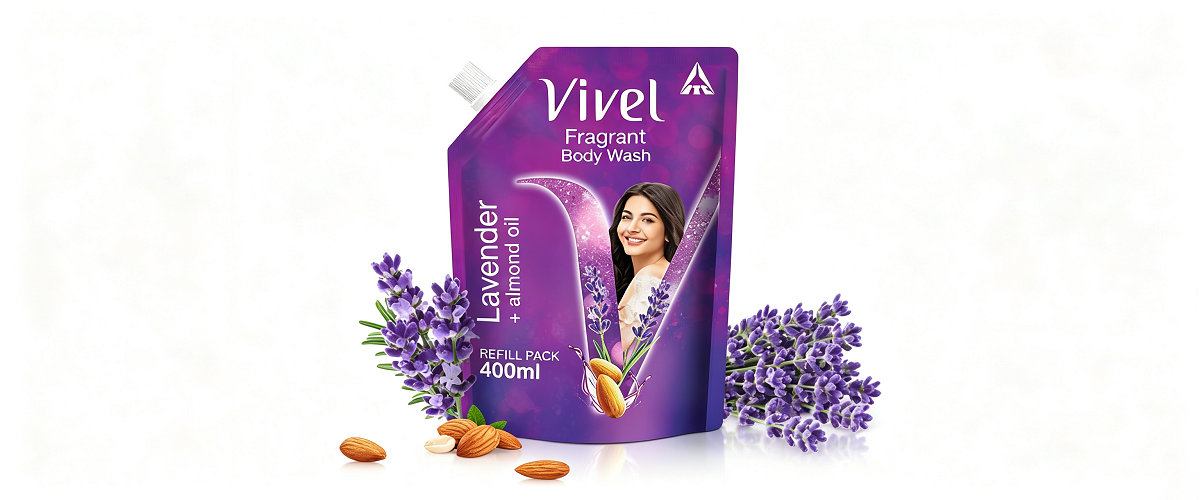
1. What Types of Flexible Packaging Pouches Are Best for Body Wash Refills?
The most suitable flexible packaging pouch for body wash refills depends on product viscosity, filling volume, refill method, target consumer, distribution channel, and brand positioning.
Because body wash is a liquid or semi-viscous personal care product, the packaging must provide stronger leakage protection than packaging designed for dry products.
Spout Pouches
Spout pouches are one of the most practical packaging formats for body wash refills.
They are suitable for:
- Liquid body wash
- Shower gel
- Moisturizing body wash
- Premium personal care products
- Large-volume refill products
- Family-size refill packs
The integrated spout allows consumers to pour the product into a reusable bottle with greater control.
Spout pouches can also be designed in different sizes and configurations, including:
- Corner spouts
- Top-center spouts
- Side spouts
- Large-diameter spouts
- Refill-oriented pouring spouts
For body wash refills, the spout design should match the viscosity of the product and the opening of the bottle being refilled.
Stand-Up Spout Pouches
Stand-up pouches combine the stability of a bottom gusset with the convenience of a dispensing spout.
They are particularly suitable for:
- Retail body wash refills
- Premium refill products
- Larger refill volumes
- E-commerce products
The pouch can stand upright on shelves and provide a large printable area for branding and instructions.
Flat Pouches
Flat refill pouches can provide an efficient and lightweight option.
They are commonly considered for:
- Smaller refill packs
- Promotional products
- Travel-oriented refills
- Subscription-based products
However, because flat pouches do not stand independently, they may provide less shelf visibility than stand-up formats.
Shaped Refill Pouches
Custom-shaped pouches can help a brand create a more distinctive refill product.
For example, the pouch can be designed to:
- Improve grip
- Guide pouring
- Reinforce brand identity
- Differentiate product categories
However, highly customized pouch shapes can increase production complexity and cost.
Large-Capacity Refill Pouches
For family-size products, larger refill pouches may offer better value and reduce the frequency of purchasing refills.
These may be suitable for:
- Multi-person households
- Subscription services
- Bulk retail
- Hospitality applications
Larger pouches require additional attention to:
- Seal strength
- Spout strength
- Handle design
- Drop resistance
- Pouch stability
Pouch Format Comparison
| Pouch Type | Best Application | Main Advantage | Key Consideration |
|---|---|---|---|
| Spout pouch | Standard body wash refills | Controlled pouring | Spout seal integrity |
| Stand-up spout pouch | Retail refills | Shelf stability | More complex structure |
| Flat pouch | Lightweight refills | Material efficiency | Less shelf stability |
| Shaped pouch | Premium products | Brand differentiation | Higher production complexity |
| Large refill pouch | Family-size products | Reduced refill frequency | Higher load requirements |
The ideal format should be selected according to the complete consumer refill experience rather than appearance alone.
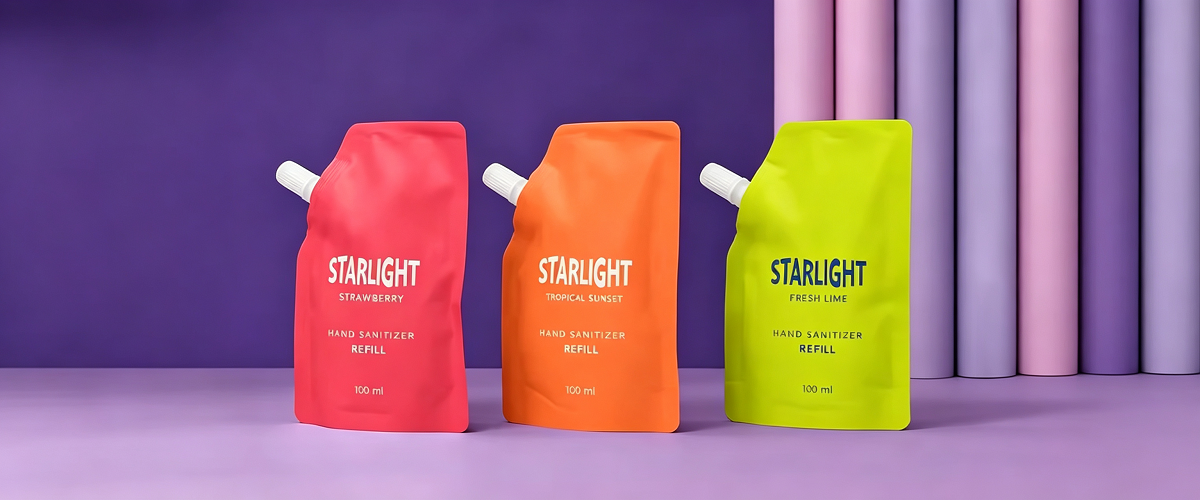
2. How Do You Choose Packaging Materials That Resist Leakage and Product Formulation Damage?
Material selection is one of the most important technical decisions in body wash refill packaging.
Unlike dry products, body wash remains in direct contact with the package during storage. The formulation may contain ingredients that influence the performance of the packaging structure.
Understanding Product Formulation Compatibility
Body wash formulations can include:
- Water
- Surfactants
- Fragrance compounds
- Essential oils
- Moisturizing ingredients
- Preservatives
- Salts
- Acids
- Botanical extracts
- Active ingredients
Different ingredients may interact differently with packaging materials, adhesives, inks, or seals.
For this reason, packaging compatibility testing is an important part of pouch development.
Polyethylene as a Sealing Layer
PE is commonly used as an inner layer in flexible liquid packaging.
It can provide:
- Heat-sealing performance
- Flexibility
- Good liquid containment
- Chemical resistance for many applications
Different PE formulations can be selected depending on the product and processing requirements.
PET for Strength and Printability
PET is frequently used as an outer layer because it provides:
- Mechanical strength
- Dimensional stability
- High-quality printing
- Good appearance
It is often combined with other materials to create a multilayer flexible packaging structure.
Nylon for Puncture Resistance
Nylon, also known as PA, can be used in certain structures where additional puncture resistance or mechanical strength is required.
This can be particularly useful for larger refill pouches that experience greater stress during transportation.
Barrier Layers
Depending on the body wash formulation, additional barrier layers may be considered to protect:
- Fragrance
- Sensitive ingredients
- Product stability
- Aroma quality
The required barrier level should be determined according to the specific product formulation and shelf-life target.
Typical Flexible Packaging Structures
| Packaging Requirement | Possible Material Approach |
|---|---|
| Standard body wash refill | PET/PE |
| Improved durability | PET/PA/PE |
| Enhanced barrier | PET/high-barrier layer/PE |
| Premium refill pouch | Printed PET/barrier layer/sealing layer |
| Recyclability-focused design | Qualified mono-material PE structure |
These are general examples. The final structure should always be validated against the actual body wash formulation.
Chemical Compatibility Testing
Before large-scale production, the body wash should be tested with the final packaging structure.
Testing may evaluate:
- Film appearance
- Seal integrity
- Delamination
- Pouch swelling
- Material softening
- Stress cracking
- Odor changes
- Product color stability
This helps identify potential problems before commercial production.
Adhesive and Ink Considerations
Packaging compatibility is not limited to the film itself.
The complete packaging structure may include:
- Laminating adhesives
- Printing inks
- Coatings
- Barrier coatings
These components should be suitable for the intended application.
Seal Strength
For liquid products, seal strength is critical.
The pouch must withstand:
- Filling pressure
- Product weight
- Transportation
- Consumer handling
- Temperature changes
- Accidental compression
Weak seals can result in leakage even when the main packaging film is strong.
Drop and Compression Resistance
Body wash refill pouches may be dropped or compressed during transportation.
Larger pouches experience greater force because of the weight of the liquid.
Packaging development should therefore consider:
- Film thickness
- Seal width
- Seal strength
- Puncture resistance
- Spout attachment strength
Packaging Material Selection Checklist
| Factor | Key Question |
|---|---|
| Product formulation | Is the film chemically compatible? |
| Product viscosity | Can the pouch and spout handle pouring pressure? |
| Fill volume | Can the seals support the liquid weight? |
| Shelf life | Is the required barrier sufficient? |
| Fragrance | Does the structure protect product aroma? |
| Transportation | Is puncture resistance sufficient? |
| Filling equipment | Can the structure run efficiently? |
| Sustainability | Is there a practical material-reduction opportunity? |
The correct packaging structure should therefore be based on real product testing rather than assumptions about material performance.

3. Which Spout and Closure Features Improve Refilling Convenience for Body Wash Products?
The spout is one of the most important functional components of a body wash refill pouch.
A poorly designed spout can cause:
- Dripping
- Product spillage
- Slow pouring
- Difficult opening
- Consumer frustration
A well-designed spout can make the refill process faster, cleaner, and more intuitive.
Spout Diameter
Spout diameter should be selected according to the product viscosity.
A thicker body wash may require a larger opening to improve flow.
A smaller opening may provide greater pouring control for lower-viscosity products.
The goal is to balance:
Flow rate + pouring accuracy + consumer control
Corner Spouts
Corner spouts are commonly used because they allow consumers to tilt the pouch and direct the product into another container.
They can provide:
- Controlled pouring
- Efficient pouch geometry
- Good consumer familiarity
Top-Center Spouts
A center-positioned spout may provide a symmetrical design and can be suitable for certain refill systems.
However, the pouring behavior should be tested carefully according to pouch shape and product viscosity.
Refill-Specific Spouts
Some refill systems may benefit from specialized spouts designed to:
- Align with reusable bottles
- Improve flow direction
- Reduce dripping
- Control pouring speed
For brands developing a complete refill ecosystem, pouch and bottle design can be developed together.
Screw Caps
Screw caps are widely used for body wash refill pouches.
They provide:
- Reliable closure
- Repeated opening and closing
- Consumer familiarity
- Protection during transportation
The cap and spout must be securely attached and properly tested for leakage.
Tamper-Evident Features
Tamper-evident features can provide visible confirmation that the product has not been opened before purchase.
Depending on the product and market requirements, these may include:
- Tear rings
- Breakable bands
- Sealed caps
- Protective membranes
Anti-Drip Design
An anti-drip design can significantly improve consumer experience.
This is especially important because body wash may have a relatively high viscosity and can remain on the spout after pouring.
The spout design should help minimize:
- Residual product
- Dripping
- Product waste
- Mess during refilling
Easy-Grip Pouch Design
The pouch itself should also support convenient pouring.
For larger refill packs, useful features may include:
- Reinforced gripping areas
- Ergonomic pouch shapes
- Integrated handles
- Controlled stiffness
Consumer Refill Experience
An effective refill process should ideally follow this sequence:
Open → Position → Pour → Control → Close → Store
Every stage should be evaluated during packaging development.
Spout and Closure Selection Guide
| Feature | Main Benefit |
|---|---|
| Larger spout | Faster flow for viscous products |
| Smaller spout | Greater pouring control |
| Corner spout | Natural pouring angle |
| Screw cap | Repeated closure |
| Tamper evidence | Product integrity |
| Anti-drip design | Cleaner refill experience |
| Easy-grip area | Better handling |
| Reinforced spout seal | Improved leak resistance |
The best spout is not necessarily the largest or most complex option. It should match the product viscosity, refill bottle design, and intended consumer experience.
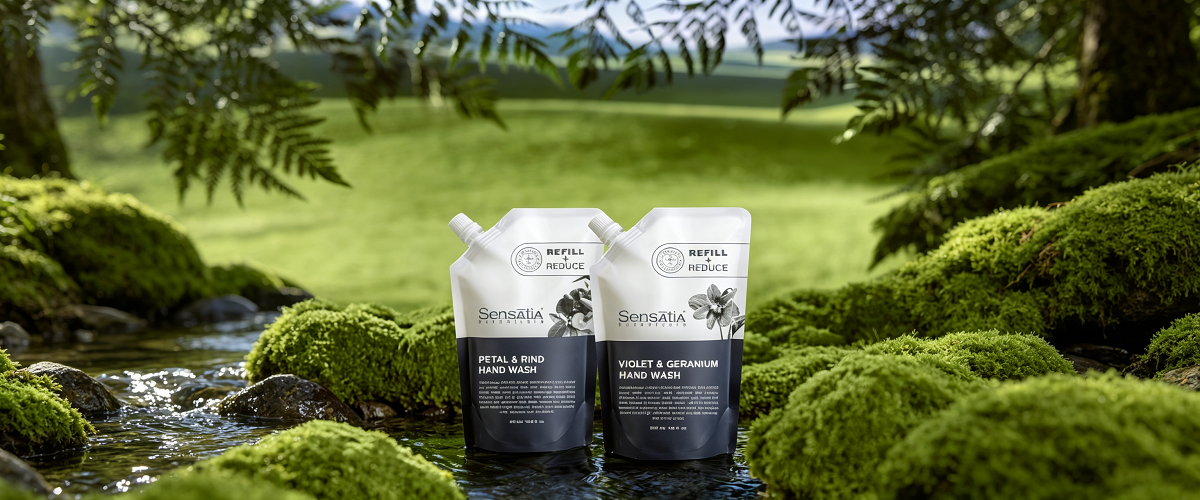
4. How Can Refill Pouches Help Brands Reduce Packaging Material Use and Improve Sustainability?
One of the major reasons brands are adopting refill systems is the opportunity to reduce repeated use of rigid packaging.
A reusable bottle can remain in the consumer's home while flexible refill pouches are used to replenish the product.
Reduced Material Use
Flexible pouches can potentially use less packaging material than repeatedly purchasing a new rigid bottle.
This can reduce the amount of material required per refill cycle.
However, the actual environmental benefit depends on:
- Pouch weight
- Bottle weight
- Number of bottle reuse cycles
- Product size
- Transportation
- End-of-life management
Transportation Efficiency
Empty flexible pouches can generally occupy less space than empty rigid bottles.
This can improve:
- Warehouse efficiency
- Transportation efficiency
- Storage density
The final benefit depends on the complete supply-chain system.
Lightweight Packaging
Flexible packaging is generally lightweight.
For refill products, this can help reduce:
- Material consumption
- Shipping weight
- Storage requirements
Reusable Bottle Systems
The greatest refill benefits may be achieved when the reusable bottle is designed for repeated use.
A successful system requires the bottle to remain functional over multiple refill cycles.
The refill pouch should also be compatible with the bottle opening and dispensing system.
Mono-Material Development
Some brands are exploring mono-material pouch structures to improve compatibility with certain recycling streams.
Examples may include:
- PE-based structures
- PP-based structures
However, actual recyclability depends on the complete packaging design and the recycling systems available in the market.
Material Reduction vs. Product Protection
Reducing material thickness can lower material use.
However, excessive downgauging may reduce:
- Puncture resistance
- Seal strength
- Drop resistance
- Leakage protection
The goal should be optimized material use, not simply the thinnest possible package.
Sustainability and Product Waste
Product protection is also part of sustainability.
If a pouch leaks or fails before the body wash is used, both the product and packaging may be wasted.
Therefore, a sustainable packaging design should balance:
Material efficiency + product protection + logistics efficiency + realistic end-of-life options
Sustainability Strategy Comparison
| Strategy | Potential Benefit | Key Challenge |
|---|---|---|
| Refill pouch | Reduced repeated rigid packaging | Consumer adoption |
| Lightweighting | Less material use | Maintaining durability |
| Mono-material design | Potential recycling advantages | Barrier and performance requirements |
| Reusable bottle | Reduced repeated packaging | Bottle reuse behavior |
| Efficient pouch shape | Improved logistics | Manufacturing design |
| Material optimization | Lower resource use | Technical validation |
Avoiding Unsupported Sustainability Claims
Environmental claims should be based on the actual packaging system.
Terms such as:
- Recyclable
- Reduced plastic
- Sustainable
- Eco-friendly
should be used carefully and supported by appropriate evidence and applicable regulations.
A packaging design may be technically recyclable but not practically recycled in every market.
Brands should therefore consider local collection and recycling infrastructure when communicating environmental benefits.

5. Body Wash Refill Pouches: Key Factors for Product Protection, Consumer Convenience, and Branding
A successful body wash refill pouch must balance technical performance with consumer expectations and brand strategy.
Product Protection
The first priority is preventing:
- Leakage
- Pouch failure
- Chemical incompatibility
- Product contamination
- Fragrance degradation
- Product instability
The package should maintain integrity throughout filling, storage, transportation, retail handling, and consumer use.
Consumer Convenience
A refill pouch should be easy to:
- Open
- Hold
- Position
- Pour
- Control
- Close
- Store
If the refill process is inconvenient, consumers may be less likely to purchase refills again.
Packaging Size
The right pouch size depends on:
- Household usage
- Reusable bottle capacity
- Product price point
- Distribution channel
Common strategies may include:
- Single-bottle refills
- Value-size refills
- Family-size refills
- Subscription refill packs
Branding Opportunities
Flexible refill pouches provide a large printable surface for brand communication.
The packaging can communicate:
- Brand identity
- Product fragrance
- Skin-care benefits
- Refill instructions
- Sustainability information
- Product usage information
Clear visual hierarchy is important because consumers should quickly understand that the product is a refill.
Refill Instructions
The package should clearly explain how to use the refill.
Instructions can include:
- Open the pouch.
- Position the spout above the reusable bottle.
- Pour slowly and control the flow.
- Close the reusable bottle.
- Reseal or dispose of the refill pouch according to local instructions.
Simple graphics can make the process easier to understand.
Premium Refill Packaging
Refill products do not need to look inexpensive.
Premium refill pouches can use:
- High-quality printing
- Matte finishes
- Metallic effects
- Soft-touch surfaces
- Sophisticated typography
- Minimalist design
A strong visual design can help consumers view refills as part of a premium product system.
E-Commerce Considerations
Body wash refill pouches sold online require additional attention to transportation.
The packaging should withstand:
- Carton compression
- Temperature changes
- Long-distance shipping
- Repeated handling
- Accidental impacts
Secondary packaging may provide additional protection where necessary.
Packaging Equipment Compatibility
The pouch structure should be compatible with the production process.
Important factors include:
- Filling temperature
- Product viscosity
- Spout insertion
- Sealing performance
- Production speed
- Film handling
A packaging structure should be validated under actual manufacturing conditions.
Cost Optimization
Packaging cost should be evaluated as part of the complete product system.
Relevant costs include:
- Film
- Printing
- Spouts
- Caps
- Pouch production
- Filling efficiency
- Product loss
- Secondary packaging
- Transportation
A lower-cost film may create higher total costs if it leads to leakage, production downtime, or consumer complaints.
Development Process for Body Wash Refill Pouches
Step 1: Analyze the body wash formulation
Understand viscosity, chemical composition, fragrance system, and storage requirements.
Step 2: Define the refill format
Determine whether the pouch will refill a specific bottle or support a more universal refill system.
Step 3: Select the pouch size
Match the product volume with consumer usage and bottle capacity.
Step 4: Choose the material structure
Evaluate chemical compatibility, mechanical strength, sealing, and barrier requirements.
Step 5: Select the spout and cap
Match the design to product viscosity and consumer pouring behavior.
Step 6: Conduct compatibility testing
Test the actual body wash inside the proposed packaging.
Step 7: Test package integrity
Evaluate seal strength, leakage resistance, drop performance, and compression resistance.
Step 8: Conduct consumer usability testing
Evaluate how easily consumers can open, pour, and close the pouch.
Step 9: Optimize sustainability and logistics
Evaluate material use, transportation efficiency, and realistic end-of-life options.
Step 10: Finalize branding and regulatory information
Ensure the pouch communicates product information clearly and complies with applicable labeling requirements.
Key Selection Matrix
| Factor | Main Consideration | Packaging Impact |
|---|---|---|
| Product viscosity | How easily does the body wash flow? | Spout diameter |
| Formulation | Does the product affect packaging materials? | Material compatibility |
| Fill volume | How much liquid is contained? | Seal and pouch strength |
| Transportation | How much handling will occur? | Puncture resistance |
| Refill bottle | What opening must be filled? | Spout geometry |
| Consumer use | How often will consumers refill? | Convenience features |
| Shelf life | How long must the product remain stable? | Barrier selection |
| Branding | Premium or value positioning? | Printing and finishes |
| Sustainability | What environmental strategy is realistic? | Material optimization |
| Cost | What is the total packaging cost? | Structure and feature selection |
FAQ
What is the best flexible packaging for body wash refills?
Spout pouches are one of the most practical options because they provide controlled pouring and can be designed for different refill volumes.
Can flexible pouches safely hold body wash?
Yes, provided the packaging structure is compatible with the body wash formulation and has been properly tested for seal integrity, chemical compatibility, and leakage resistance.
What material is commonly used for body wash refill pouches?
Flexible refill pouches often use multilayer structures that may include PET, PE, PA, or specialized barrier layers. The final structure should be selected according to the actual formulation.
Why is a spout important for body wash refills?
A spout can improve pouring control and reduce the risk of product spillage when transferring body wash into a reusable bottle.
Can body wash refill pouches be recyclable?
Some refill pouch structures may be designed to improve compatibility with recycling systems. However, actual recyclability depends on the complete package design and the infrastructure available in the target market.
Are refill pouches more sustainable than buying new bottles?
Refill systems can potentially reduce repeated rigid packaging and improve transportation efficiency. The overall environmental benefit depends on factors such as material use, bottle reuse cycles, logistics, and end-of-life management.
How do you prevent leakage in a body wash pouch?
Leak prevention requires compatible materials, strong seals, secure spout attachment, appropriate film strength, and testing under realistic transportation and handling conditions.
What pouch size is best for body wash refills?
The ideal size depends on the capacity of the reusable bottle, household consumption, and brand strategy. Single-bottle refills and larger family-size refills can both be effective.
Can body wash refill pouches be used for e-commerce?
Yes. However, the pouch should be tested for leakage, compression, and transportation stresses, especially for long-distance shipping.
How can refill pouch design improve branding?
Flexible pouches provide a large printable area for product information, fragrance communication, refill instructions, sustainability messaging, and premium visual design.
Conclusion
Choosing flexible packaging pouches for body wash refills requires a careful balance between product compatibility, leakage prevention, consumer convenience, sustainability, manufacturing performance, and branding. Because body wash formulations may contain surfactants, fragrances, oils, and other active ingredients, the packaging structure must be selected according to the actual product rather than relying on a generic pouch specification.
For many applications, spout pouches and stand-up spout pouches provide an effective solution because they combine liquid containment with controlled pouring and strong retail presentation. Material structures may incorporate layers such as PET, PE, PA, or specialized barrier materials to provide the required mechanical strength, chemical compatibility, and product protection.
Spout and closure selection is equally important. The diameter, position, flow characteristics, cap design, and attachment strength should all be matched to the body wash viscosity and the refill bottle system. A successful refill pouch should allow consumers to open, pour, control, and close the product with minimal mess.
Refill pouches can also support packaging reduction strategies by reducing the need to repeatedly purchase rigid bottles. Lightweight flexible packaging may improve transportation and storage efficiency, while reusable bottles can extend the value of the original packaging system. However, sustainability performance should always be evaluated across the complete package and supply chain.
Ultimately, body wash refill packaging is more than a flexible container. It is part of a broader product protection system, consumer refill experience, sustainability strategy, and brand ecosystem. By carefully selecting pouch formats, material structures, spout features, and visual design, brands can create refill packaging that protects body wash products while making the refill process convenient, reliable, and attractive to modern consumers.