Finding the Right Spout Pouch for Laundry Detergent
Anna_Yu
Finding the Right Spout Pouch for Laundry Detergent
Laundry detergent packaging needs to do more than simply contain a liquid product. It must withstand chemical exposure, prevent leakage, protect the detergent during transportation, and provide consumers with a convenient way to pour or refill their washing products. As household cleaning products continue to diversify into liquid detergents, concentrated formulas, fabric-care products, and refill solutions, packaging has become an increasingly important part of product performance and consumer experience.
Spout pouches have emerged as a practical alternative to conventional detergent bottles for many laundry-care applications. Their flexible construction combines a pouch body with a spout and closure, creating a lightweight package that can be squeezed, poured, carried, and resealed. Compared with rigid bottles, flexible pouches can also offer opportunities for reducing packaging weight and improving transportation efficiency.
However, not every spout pouch is suitable for laundry detergent. Detergent formulations may contain surfactants, solvents, fragrances, enzymes, builders, preservatives, or other ingredients that can interact with packaging materials over time. The package must therefore be selected according to the chemical characteristics of the formulation, filling conditions, storage environment, and expected shelf life.
A well-designed laundry detergent spout pouch should provide chemical resistance, moisture protection, reliable seals, strong spout connections, convenient dispensing, and sufficient mechanical durability. At the same time, it should provide enough printable surface for branding and accommodate the sustainability and cost requirements of the target market.
This guide explains the key considerations when selecting spout pouches for laundry detergent, from material structures and leakage prevention to closure design, transportation, branding, sustainability, and cost efficiency.
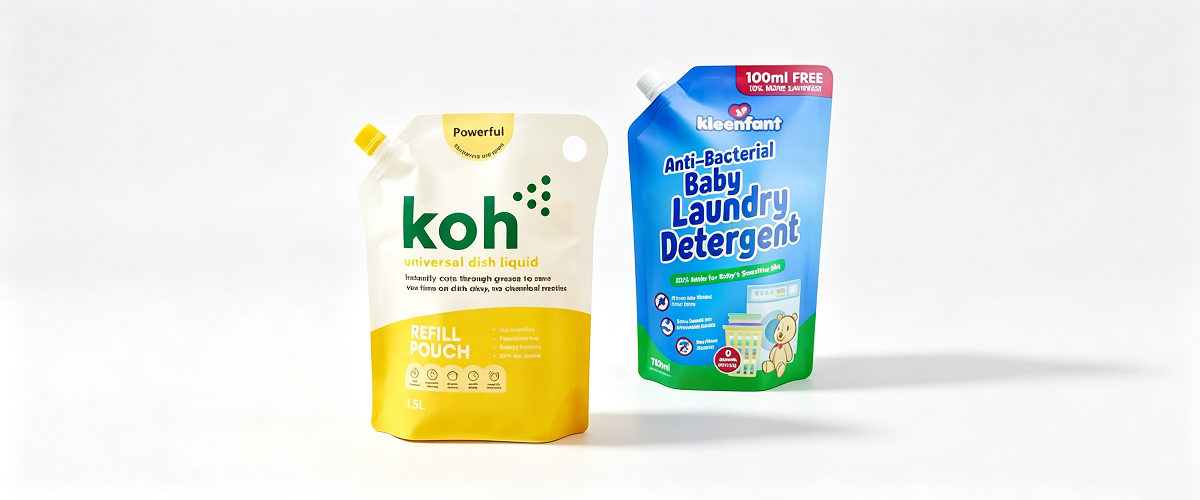
1. What Types of Spout Pouches Are Best for Laundry Detergent Products?
The right spout pouch depends on the detergent formulation, package capacity, dispensing method, distribution environment, and consumer usage habits. Liquid detergents can vary considerably in viscosity, concentration, and chemical composition, so the pouch should be designed around the specific product.
Stand-Up Spout Pouches
Stand-up spout pouches are one of the most practical formats for retail laundry detergent.
The bottom gusset allows the pouch to remain upright while providing a relatively large printable surface.
They can be suitable for:
- Liquid laundry detergent
- Concentrated detergent
- Fabric softener
- Laundry additives
- Household cleaning liquids
- Detergent refill products
Their upright structure also helps improve retail presentation and makes the package easier to store at home.
Refill Spout Pouches
Refill pouches are particularly relevant to laundry detergent packaging.
A consumer can purchase a durable detergent bottle or container and then use a flexible spout pouch to refill it.
This approach can help brands:
- Reduce reliance on rigid containers
- Provide lightweight refill options
- Improve transportation efficiency
- Encourage repeat purchases
- Create a differentiated packaging strategy
The pouch should be designed with a spout that makes refilling clean and controlled.
Large-Capacity Spout Pouches
Larger spout pouches can be designed for household or commercial users who purchase detergent in greater quantities.
These packages require particular attention to:
- Handle design
- Film strength
- Spout strength
- Seal integrity
- Drop resistance
- Transportation stability
As package volume increases, the mechanical load placed on the pouch and spout also increases.
Small Spout Pouches
Smaller pouches can be suitable for:
- Trial products
- Travel-size detergent
- Concentrated detergent
- Promotional packs
- Specialty laundry-care products
The smaller format can improve portability while allowing brands to introduce products to new consumers.
Flat and Custom-Shaped Spout Pouches
Depending on the product positioning, brands may choose a more distinctive pouch shape.
Custom structures can help create a recognizable package while maintaining the functional benefits of flexible packaging.
However, unusual shapes should still provide sufficient stability and allow efficient filling, sealing, secondary packaging, and transportation.
Spout Pouch Format Comparison
| Pouch Type | Suitable Application | Main Advantage |
|---|---|---|
| Stand-Up Spout Pouch | Retail detergent | Stability and shelf appeal |
| Refill Spout Pouch | Detergent refills | Convenient refilling |
| Large-Capacity Pouch | Family-size products | High product capacity |
| Small Spout Pouch | Trial and travel products | Portability |
| Custom-Shaped Pouch | Premium or specialty products | Brand differentiation |
The best format should balance product capacity, dispensing convenience, package strength, manufacturing requirements, and transportation conditions.
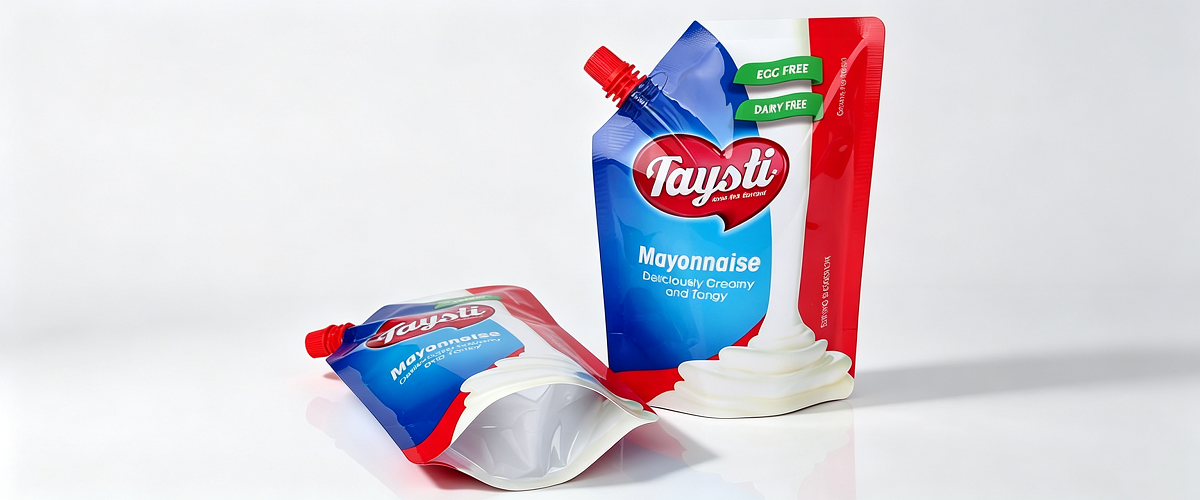
2. How Can Spout Pouches Prevent Leakage and Protect Laundry Detergent During Storage?
Leakage is one of the most serious problems in liquid detergent packaging. A small failure can damage secondary packaging, contaminate other products, and create significant problems during transportation and retail handling.
For this reason, leakage prevention must be considered at the level of the film, seal, spout connection, cap, and overall pouch design.
Strong Heat Seals
The heat-sealed areas need to withstand the pressure generated by the detergent inside the pouch.
Seal performance can be affected by:
- Film structure
- Seal temperature
- Sealing pressure
- Dwell time
- Product contamination during filling
- Film thickness
- Storage temperature
A properly engineered sealing process can help reduce the risk of seal failure.
Reliable Spout-to-Pouch Connection
The connection between the spout and pouch body is another critical area.
The spout should be securely integrated into the pouch structure to withstand:
- Internal pressure
- Repeated opening and closing
- Pouring
- Squeezing
- Transportation vibration
- Drops and impacts
For larger detergent pouches, this connection becomes especially important because the weight of the liquid places additional stress on the spout area.
Secure Closure Caps
A reliable cap helps prevent leakage after opening.
Depending on the product, packaging may use different screw-cap designs to provide:
- Tight closure
- Controlled dispensing
- Resealing
- Easy opening
- Improved handling
The cap should also be compatible with the detergent formulation.
Puncture Resistance
Laundry detergent pouches can experience abrasion and compression during distribution.
A suitable outer film structure should therefore provide sufficient puncture and tear resistance.
Potential causes of damage include:
- Contact with cartons
- Pallet compression
- Rough handling
- Sharp edges
- Transportation vibration
- Stacking pressure
Drop Resistance
Finished detergent pouches should be evaluated under realistic handling conditions.
Drop testing can help identify weaknesses in:
- Film structure
- Seals
- Spout connections
- Cap systems
- Pouch geometry
Testing should reflect the expected package size and distribution environment.
Secondary Packaging
Primary pouch performance is only part of the distribution system.
Cartons, shrink wrapping, dividers, and other secondary packaging can help protect pouches during transportation.
For export products, the entire packaging system should be evaluated rather than focusing only on the individual pouch.
Leakage Prevention Checklist
| Risk | Packaging Consideration |
|---|---|
| Seal failure | Optimize heat-sealing conditions |
| Spout leakage | Use a reliable spout connection |
| Cap leakage | Select a secure closure |
| Puncture | Use sufficient film strength |
| Drop damage | Conduct drop testing |
| Compression | Evaluate pouch and carton strength |
| Product contamination | Control filling and sealing processes |
A leak-resistant pouch is the result of coordinated material, structural, and manufacturing decisions.
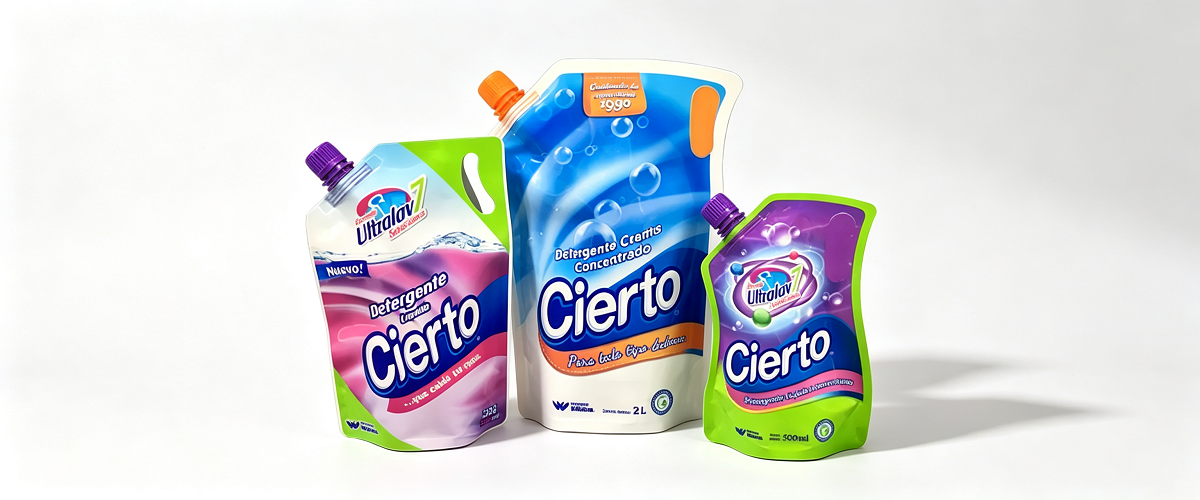
3. Which Flexible Packaging Materials Offer the Best Chemical and Moisture Resistance?
Material selection is especially important for laundry detergent because the product may contain chemically active ingredients that can interact with packaging components.
The exact material structure should therefore be selected based on compatibility testing with the actual detergent formulation.
PE
Polyethylene is widely used as a sealing layer in flexible packaging.
It offers:
- Good flexibility
- Good moisture resistance
- Heat-sealing performance
- Toughness
- Good processability
Different PE grades can be selected depending on the required mechanical and sealing properties.
PET
PET is often used as an outer layer because it provides:
- Mechanical strength
- Good dimensional stability
- High-quality printing
- Surface durability
PET can contribute to the overall strength and appearance of the pouch but is generally combined with other materials for a complete detergent packaging structure.
BOPA / Nylon
Nylon can be considered when additional mechanical performance is required.
It can provide:
- Puncture resistance
- Flexibility
- Good mechanical strength
This can be useful for detergent pouches exposed to demanding transportation and handling conditions.
EVOH and Other High-Barrier Layers
For products requiring enhanced barrier protection, specialized barrier layers may be incorporated into the structure.
The choice depends on the detergent formulation and shelf-life requirements.
Not every laundry detergent requires the highest possible oxygen barrier, so material selection should be based on actual product requirements rather than simply maximizing the number of layers.
Metallized Films
Metallized films can provide strong barrier performance while creating a distinctive visual appearance.
They may be considered when the product requires additional protection from:
- Moisture
- Oxygen
- Light
However, the complete structure should be evaluated for chemical compatibility, sealing performance, appearance, and sustainability objectives.
Aluminum Foil Laminates
Aluminum foil can provide very high barrier protection.
It may be considered for specialized detergent products with demanding storage or shelf-life requirements.
However, foil-based multilayer structures can introduce additional considerations regarding material complexity and recyclability.
Material Comparison
| Material | Main Function | Key Property |
|---|---|---|
| PE | Inner sealing layer | Flexibility and moisture resistance |
| PET | Outer layer | Strength and printability |
| BOPA/Nylon | Reinforcement | Puncture and mechanical resistance |
| EVOH | Barrier layer | High barrier performance |
| Metallized Film | Barrier layer | Moisture, oxygen, and light protection |
| Aluminum Foil | High-barrier layer | Very strong barrier performance |
Chemical Compatibility Is Essential
A material that performs well with one detergent formulation may not perform identically with another.
Compatibility testing should consider:
- Detergent concentration
- Surfactant composition
- Fragrance oils
- Solvents
- Enzymes
- Preservatives
- Storage temperature
- Contact duration
Potential issues can include swelling, brittleness, delamination, odor migration, or deterioration of seals.
Therefore, the final laminate should be validated with the actual detergent formulation before mass production.
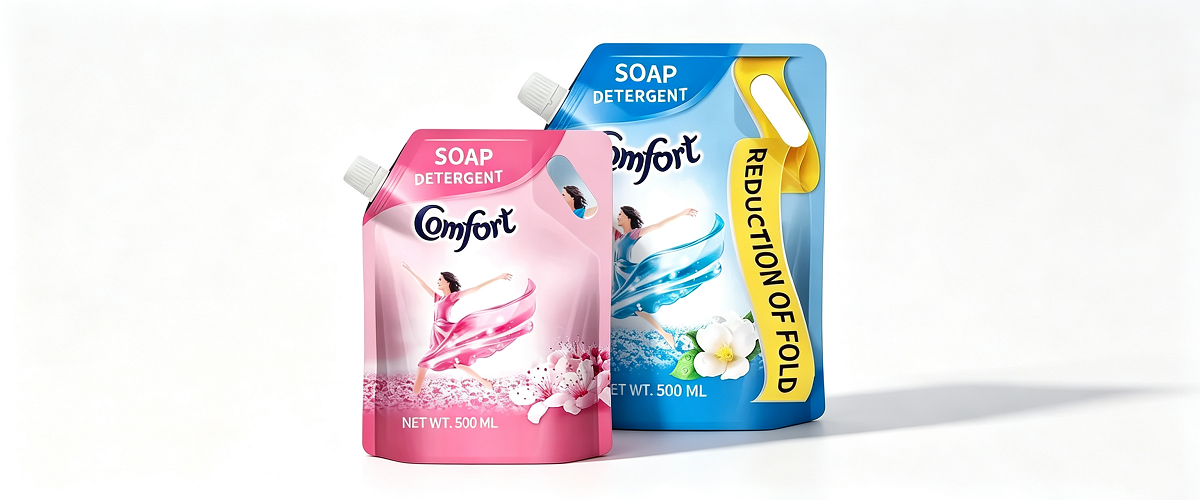
4. What Spout and Closure Features Improve Pouring, Refilling, and Consumer Convenience?
The spout is not merely an attachment to the pouch. It directly influences how consumers interact with the detergent.
A well-designed spout should make dispensing controlled, clean, and intuitive.
Appropriate Spout Diameter
The required spout opening depends partly on detergent viscosity.
A thin liquid may work well with a relatively small opening, while thick or concentrated detergent may require a larger opening.
The spout should allow the product to flow without excessive squeezing or splashing.
Screw Caps
Screw caps are commonly used because they provide:
- Resealability
- Controlled opening
- Familiar operation
- Good leakage protection
The cap size and thread design should be matched to the pouch and product.
Flip-Top Closures
For some detergent applications, flip-top closures may provide quick access.
They can be useful when consumers open and close the package frequently.
However, the closure should still provide sufficient sealing performance during storage and transportation.
Controlled Pouring
The spout should be designed to minimize uncontrolled product flow.
This can help reduce:
- Spillage
- Product waste
- Mess during refilling
- Consumer frustration
The pouch shape also affects pouring behavior. A stable base and appropriately positioned spout can make dispensing easier.
Refill-Friendly Design
For refill applications, the spout should be easy to position over the receiving bottle.
A suitable design can help consumers:
- Open the cap
- Position the spout
- Pour or squeeze the detergent
- Stop dispensing
- Reseal the pouch
The package should be stable enough to minimize accidental tipping during this process.
Handles and Grip Features
Large detergent pouches may benefit from integrated handles or ergonomic grip areas.
These features can improve:
- Carrying
- Lifting
- Pouring
- Storage
- Consumer control
The handle must be strong enough for the intended filled weight.
Consumer Convenience Comparison
| Feature | Consumer Benefit |
|---|---|
| Screw Cap | Secure resealing |
| Flip-Top | Quick opening |
| Large Spout | Better flow for viscous products |
| Small Spout | More controlled dispensing |
| Ergonomic Handle | Easier carrying |
| Stable Base | Safer pouring |
| Refill-Friendly Spout | Easier bottle refilling |
The best combination depends on the detergent's viscosity, package size, and intended usage.
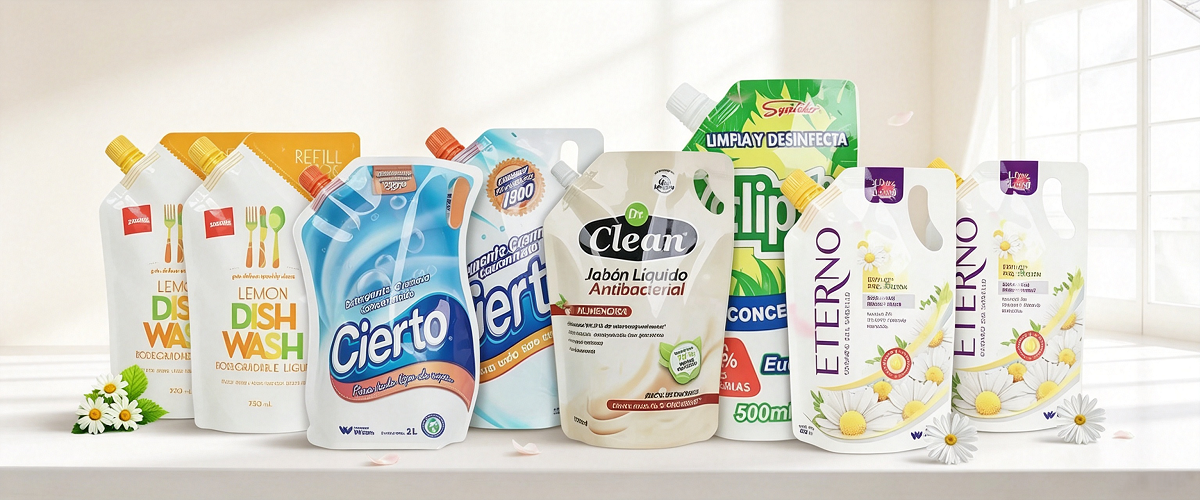
5. Laundry Detergent Spout Pouches: Key Factors for Durability, Branding, Sustainability, and Cost Efficiency
A successful laundry detergent spout pouch needs to balance technical performance with commercial objectives.
Durability
Detergent packages may experience significant mechanical stress during transportation.
Brands should evaluate:
- Film thickness
- Tear resistance
- Puncture resistance
- Seal strength
- Spout connection strength
- Cap performance
- Drop resistance
Larger packages generally require stronger structures because the weight of the detergent creates greater stress.
Branding
Flexible pouches provide a large printable surface compared with many conventional detergent containers.
Brands can use the surface to communicate:
- Brand identity
- Product benefits
- Fragrance information
- Usage instructions
- Dosage information
- Safety information
- Certifications
- Sustainability messaging
High-quality printing can also create a distinctive shelf presence.
Premium Finishes
Laundry care is a competitive category, and packaging appearance can influence consumer perception.
Brands may consider:
- Matte finishes
- Gloss finishes
- Metallic effects
- Spot effects
- High-resolution graphics
- Transparent elements
The selected finish should remain compatible with the film structure and intended production process.
Sustainability
Spout pouches can support packaging reduction strategies because their flexible body can be lightweight and compact.
Potential approaches include:
- Material downgauging
- Lightweight spouts
- Refill pouch systems
- Recyclable structures
- Mono-material designs
- Efficient transportation
However, the sustainability performance of the complete package must be considered.
A pouch may use less material than a rigid container but still contain multiple material types or components that complicate recycling.
Brands should therefore evaluate:
- Film composition
- Spout material
- Cap material
- Adhesives
- Recycling infrastructure
- Local regulations
Cost Efficiency
The cost of a detergent spout pouch depends on more than film price.
Important cost factors include:
- Film structure
- Film thickness
- Spout type
- Cap design
- Pouch dimensions
- Printing
- Filling process
- Production volume
- Secondary packaging
- Transportation
A lower-cost film is not necessarily the most economical solution if it results in higher leakage or damage rates.
Distribution Efficiency
Flexible pouches can offer logistical advantages because they are lightweight and can use transportation space efficiently.
Potential benefits include:
- Lower package weight
- Compact secondary packaging
- Efficient pallet utilization
- Reduced empty-package storage
- Easier handling
For export markets, however, the package must be tested for long-distance transportation and variable environmental conditions.
Laundry Detergent Spout Pouch Selection Checklist
| Factor | Key Question |
|---|---|
| Formulation | Is the detergent chemically compatible with the film? |
| Viscosity | What spout size is appropriate? |
| Capacity | What package volume is required? |
| Durability | Can the pouch withstand handling and transportation? |
| Leakage | Are seals, spout, and cap sufficiently secure? |
| Barrier | What moisture and chemical protection is required? |
| Convenience | Should the pouch pour, squeeze, or refill another container? |
| Branding | What printing and finishing are required? |
| Sustainability | Can recyclable or reduced-material structures be used? |
| Cost | Does the complete package meet the target cost? |
| Distribution | Can it withstand domestic or international shipping? |
6. FAQ
Are Spout Pouches Suitable for Laundry Detergent?
Yes. Spout pouches can be suitable for liquid laundry detergent, concentrated detergent, fabric softener, and certain other household cleaning liquids when the packaging structure is compatible with the formulation.
What Is the Best Material for Laundry Detergent Spout Pouches?
There is no single universal material. PE is commonly used as a sealing layer, while PET, nylon, barrier films, metallized films, or other layers may be combined according to the detergent's chemical compatibility and mechanical requirements.
How Do Spout Pouches Prevent Laundry Detergent Leakage?
Leakage prevention depends on the combined performance of the pouch film, heat seals, spout connection, and closure cap. Drop, compression, seal-strength, and leakage testing can help validate the finished package.
Are Laundry Detergent Spout Pouches Good for Refills?
Yes. Refill spout pouches can provide a convenient way to transfer detergent into a reusable bottle or container. The spout should be designed for controlled pouring and easy positioning.
Can Large Laundry Detergent Pouches Have Handles?
Yes. Large-capacity pouches can incorporate handles or ergonomic grip areas to improve carrying and pouring. The handle design should be tested according to the filled package weight.
Are Spout Pouches More Sustainable Than Detergent Bottles?
They can provide potential advantages through lower packaging weight, compact transportation, and refill applications. However, sustainability depends on the complete material structure, components, recycling infrastructure, and local regulations.
Can Laundry Detergent Spout Pouches Be Customized?
Yes. Brands can customize pouch size, film structure, printing, spout position, spout diameter, cap style, handle design, finishes, and other functional features.
Can Spout Pouches Be Used for Concentrated Detergent?
They can be, but concentrated formulations may require careful compatibility and dispensing evaluation. Higher viscosity and stronger chemical concentrations can influence film selection, spout size, seal performance, and consumer handling.
7. Conclusion
Finding the right spout pouch for laundry detergent requires a balance between chemical compatibility, leakage resistance, mechanical durability, dispensing convenience, branding, sustainability, and cost efficiency.
Spout pouches can provide an attractive alternative to conventional detergent bottles because they combine a lightweight flexible structure with a practical dispensing system. Stand-up pouches, refill pouches, large-capacity formats, and smaller specialty packages can all be developed according to different product and market requirements.
Material selection is particularly important for detergent applications. Structures incorporating PE, PET, nylon, barrier films, metallized layers, or aluminum foil may be considered depending on the formulation and required performance. However, the correct material should always be validated against the actual detergent because chemical compatibility can vary significantly between formulations.
Leak prevention is equally critical. Strong heat seals, reliable spout-to-pouch connections, secure caps, puncture resistance, and appropriate drop performance all contribute to package reliability throughout transportation and storage.
From a consumer perspective, resealable caps, appropriate spout diameters, controlled pouring, ergonomic handles, and refill-friendly designs can make detergent packaging easier and more convenient to use.
For brands, spout pouches also create opportunities for visual differentiation through custom printing, finishes, shapes, and package configurations. At the same time, lightweight structures and refill applications can support packaging-efficiency and sustainability strategies where appropriate.
Ultimately, the best laundry detergent spout pouch is not simply the package with the lowest material cost. It is the solution that provides reliable protection and dispensing performance while meeting the brand's requirements for durability, convenience, appearance, transportation efficiency, sustainability, and total packaging cost.