Guide to Cocoa Powder Packaging Bags
Anna_Yu
Guide to Cocoa Powder Packaging Bags
Cocoa powder is a widely used ingredient in chocolate manufacturing, bakery products, beverages, confectionery, desserts, and foodservice applications. From natural cocoa powder and alkalized cocoa powder to premium drinking chocolate blends and industrial cocoa ingredients, different products require packaging that protects quality throughout storage, transportation, and distribution. Although cocoa powder is a dry food ingredient, it is particularly sensitive to moisture absorption, aroma changes, oxidation of residual cocoa butter, and contamination during handling. The right packaging bag helps manufacturers preserve product consistency while delivering the appearance, convenience, and reliability that customers expect.
Choosing packaging for cocoa powder involves more than selecting a bag size or printing an attractive design. Cocoa powder can vary considerably in fat content, particle size, flowability, bulk density, and intended application. A low-fat cocoa powder intended for industrial baking may have different storage requirements from a higher-fat premium cocoa powder sold directly to consumers. Drinking chocolate blends containing sugar, milk powder, or other ingredients may also have different moisture-control requirements from pure cocoa powder. These differences affect the required barrier performance, sealing method, package strength, and functional features.
Flexible packaging has become an important option for cocoa powder brands because it offers a broad range of formats, material structures, printing possibilities, and filling configurations. Stand-up pouches, flat-bottom bags, side-gusseted bags, pillow bags, and three-side-seal sachets can serve different market segments, from premium retail products to large-volume food manufacturing ingredients. Depending on the application, these formats can incorporate resealable zippers, tear notches, carrying handles, transparent windows, and high-barrier laminates.
However, not every cocoa powder product needs the same packaging structure. A high-barrier foil laminate may be justified for a product with demanding shelf-life requirements, while another product may perform adequately in a less complex structure if its moisture protection, seal integrity, and storage conditions are properly validated. Packaging decisions should therefore reflect the actual product formulation, expected shelf life, distribution environment, production equipment, and target cost.
This guide explains how to select cocoa powder packaging bags by examining bag formats, moisture and oxygen protection, material selection, anti-clumping strategies, functional features, branding, and distribution requirements. Whether you are a cocoa processor, chocolate manufacturer, food brand, ingredient distributor, or packaging buyer, understanding these factors can help you choose a flexible packaging solution that protects product quality and supports long-term commercial performance.

1. What Types of Packaging Bags Are Best for Cocoa Powder?
The best packaging bag for cocoa powder depends on its fat content, intended use, package weight, storage conditions, and sales channel. Retail cocoa powder sold in supermarkets requires a different presentation from cocoa powder supplied in bulk to bakeries, beverage manufacturers, or chocolate factories. Likewise, premium drinking chocolate blends may benefit from convenience features that are unnecessary for industrial ingredient packaging.
Before choosing a bag format, manufacturers should consider how the powder will flow during filling, how much headspace is required, whether consumers will reopen the package, and how the finished bags will be transported. Cocoa powder is fine and dusty, so package design must also account for powder accumulation around filling and sealing areas.
Stand-Up Pouches for Retail Cocoa Powder
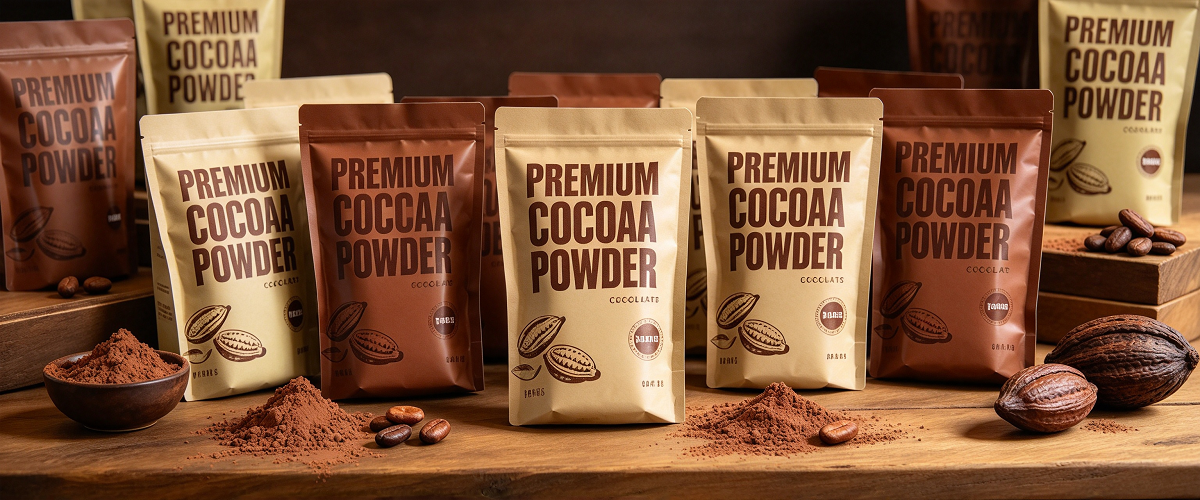
Stand-up pouches, also known as doypacks, are a practical option for retail cocoa powder and drinking chocolate products. Their bottom gusset allows the filled package to stand upright, improving shelf visibility and creating space for product information and branding.
Stand-up pouches are particularly suitable for products sold in smaller and medium-sized quantities, such as 100-gram, 200-gram, 250-gram, 500-gram, and 1-kilogram packs. Actual pack sizes depend on the powder's bulk density, bag dimensions, and intended market.
For cocoa powder brands, stand-up pouches offer several advantages:
- Retail presentation: The front panel provides space for product names, cocoa imagery, preparation suggestions, and brand graphics.
- Flexible sizing: Manufacturers can develop multiple package sizes using a consistent design system.
- Resealability: A zipper can make repeated use more convenient for household consumers.
- Barrier customization: Multilayer structures can be selected according to moisture, oxygen, light, and aroma protection requirements.
- Convenient storage: The stand-up format can be easier to organize in kitchen cupboards than some irregularly shaped packages.
However, the pouch must be designed for the actual powder weight and filling process. Fine cocoa powder can accumulate in gusset folds or sealing areas, and a poorly controlled sealing process may produce weak seals or contamination channels.
For this reason, manufacturers should test the complete package using the actual powder and filling equipment. The pouch should be assessed for standing stability, opening convenience, seal reliability, and resistance to damage during transport.
Stand-up pouches are most appropriate when retail appearance, moderate package sizes, and household convenience are important purchasing factors.
Flat-Bottom Bags for Premium Cocoa Powder
Flat-bottom bags, sometimes called box pouches, have a structured base and relatively flat panels. They are suitable for premium cocoa powder, specialty baking ingredients, artisan chocolate brands, and higher-value drinking chocolate products.
The format provides several surfaces for branding and product information. A brand can use these panels to communicate cocoa origin, flavor profile, intended applications, preparation instructions, and other relevant product details.
Flat-bottom bags can also accommodate resealable closures and high-barrier laminates, depending on the design. Their stable base helps the package remain upright on retail shelves, while the larger printable area can create a more substantial visual presence than a simple sachet.
For premium products, the packaging design may emphasize origin, processing method, cocoa intensity, or suitability for baking and beverage preparation. The bag structure should support these brand objectives without compromising the powder's protection.
Potential limitations include higher construction complexity and potentially greater unit cost than simpler packaging formats. Whether the additional cost is justified depends on order volume, material structure, design requirements, and retail positioning.
Flat-bottom bags are a strong candidate when a brand needs a premium presentation and sufficient space for detailed product information.
Side-Gusseted Bags for Bulk and Industrial Cocoa Powder
Side-gusseted bags expand along the sides, allowing them to accommodate relatively large quantities of cocoa powder while maintaining an efficient overall shape. They are commonly used for food ingredients, coffee, powders, and other products supplied to commercial customers.
For cocoa powder, side-gusseted bags may be suitable for:
- Bakery and confectionery ingredients.
- Chocolate and beverage manufacturing.
- Foodservice and catering supplies.
- Larger retail or wholesale packs.
- Ingredients distributed to industrial customers.
Their capacity and familiar form can make them practical for high-volume applications. They may also be compatible with automated filling and sealing processes, depending on the specific design.
Bulk cocoa powder packages require careful attention to mechanical strength. Powder weight, handling methods, stacking pressure, and transportation conditions can place stress on the bag's seals and gusset folds. A construction designed for a small consumer pouch should not automatically be used for a much heavier package.
For large-format applications, buyers should specify the required fill weight, dimensions, material structure, seal design, and handling conditions. The finished bag should then be tested with the actual product and distribution configuration.
Side-gusseted bags are most useful when capacity, storage efficiency, and practical handling are more important than a highly structured retail appearance.
Pillow Bags for High-Volume Cocoa Powder Packaging
Pillow bags are commonly produced using form-fill-seal equipment and can be an economical choice for high-volume packaging operations. The film is formed around the product and sealed to create the finished bag.
They may be suitable for:
- Mainstream retail cocoa powder.
- Drinking chocolate mixes.
- Foodservice products.
- High-speed automated filling lines.
- Single-use or smaller portion packs.
The main advantage is production efficiency. When the bag structure and filling equipment are well matched, pillow bags can support consistent, high-volume production.
They also provide flexibility in film selection, printing, and bag dimensions. The actual level of barrier protection depends on the selected film or laminate rather than the pillow-bag shape itself.
Cocoa powder creates a particular challenge during filling because fine particles can become airborne or settle near the sealing area. If powder becomes trapped between the sealing layers, it can interfere with seal formation and create potential leak paths.
A successful pillow-bag operation therefore requires appropriate filling control, powder management, and validated sealing parameters. The package should be inspected for seal consistency, leakage, and handling damage.
Pillow bags are often worth evaluating for mainstream products where cost efficiency and production speed are major priorities.
Three-Side-Seal Bags for Samples and Single-Serve Portions
Three-side-seal bags are formed by sealing three edges of a flexible material structure, leaving one side available for filling before final closure. They are well suited to compact cocoa powder packages and controlled portions.
Common applications include:
- Small cocoa powder samples.
- Single-serving drinking chocolate.
- Hotel and foodservice portions.
- Promotional packs.
- Trial sizes for new product launches.
- Portion-controlled baking ingredients.
The format can help brands introduce new products without committing to large consumer packs. It can also provide consistent portion sizes for beverage preparation or foodservice applications.
For small sachets, the opening size, fill accuracy, and sealing area are particularly important. Fine powder can escape during filling or become trapped in the seal if the filling process is not properly controlled.
Manufacturers should evaluate the package's dimensions, film structure, tear behavior, and compatibility with the intended filling equipment. The small size of the bag does not eliminate the need for adequate barrier performance or reliable sealing.
Three-side-seal bags are a practical choice when portion control, compact packaging, and efficient distribution are important.
Stick Packs for Single-Serve Cocoa Beverages
Stick packs are narrow, elongated sachets designed for controlled portions of powders or granules. They are particularly suitable for instant cocoa beverages, drinking chocolate mixes, and selected cocoa-based powdered products.
Their main benefits include:
- Consistent single-serving quantities.
- Compact storage and transport.
- Convenient distribution in multipacks.
- Suitability for vending, hospitality, and travel applications.
- Compatibility with automated high-speed filling systems.
Stick packs are not necessarily the best choice for pure cocoa powder intended for baking because the narrow opening may make dispensing larger quantities less convenient. They are generally more relevant when the product is formulated for a single beverage serving or another measured use.
The filling process must account for the powder's flow characteristics and dust generation. Stick-pack dimensions, film properties, and seal specifications should be matched to the equipment and product formulation.
For beverage brands, the package can also carry preparation instructions, serving information, and a consistent visual identity across multipacks.
Reclosable Pouches for Household and Foodservice Use
Cocoa powder is often used repeatedly rather than consumed immediately after opening. A reclosable pouch can make it easier for consumers to store the remaining powder between uses.
Reclosable formats may include stand-up pouches, flat-bottom bags, and selected gusseted designs equipped with press-to-close zippers or other closure systems.
These packages can be particularly useful for:
- Household baking cocoa.
- Drinking chocolate powder.
- Premium cocoa powder sold in medium-sized packs.
- Foodservice products used over several days or weeks.
- Products that need convenient cupboard storage.
The zipper helps consumers close the package after opening, but it does not provide the same protection as the original factory seal. Once the bag has been opened, the powder is exposed to some degree of air and environmental humidity each time the consumer accesses it.
For this reason, a resealable pouch should combine an appropriate barrier structure with a reliable primary seal and clear storage instructions.
Comparing Cocoa Powder Packaging Formats
| Bag Type | Typical Applications | Main Advantages | Potential Limitations |
|---|---|---|---|
| Stand-up pouch | Retail cocoa powder and drinking chocolate | Shelf visibility, customization, optional zipper | Requires suitable gusset and seal design |
| Flat-bottom bag | Premium cocoa and specialty products | Structured presentation and generous branding area | May involve higher conversion costs |
| Side-gusseted bag | Bulk and industrial ingredients | Capacity and efficient storage | Requires careful design for heavier fills |
| Pillow bag | Mainstream and high-volume products | Efficient automated packing | Seal areas need careful powder control |
| Three-side-seal bag | Samples and portion packs | Compact format and flexible sizing | Limited standing ability |
| Stick pack | Single-serve cocoa beverages | Portion control and convenience | Less suitable for dispensing larger quantities |
| Reclosable pouch | Household and foodservice use | Convenient repeated access | Zipper does not replace the primary seal |
How Should Bag Size Be Selected for Cocoa Powder?
Cocoa powder's bulk density can vary according to processing method, fat content, particle size, and formulation. Consequently, two products with the same net weight may occupy different volumes.
A package should be designed around the actual powder rather than selecting dimensions solely from the net weight. The bag must accommodate the fill volume, allow reliable sealing, and provide an appropriate presentation without excessive empty space.
For example, a compact bag may be suitable for a dense cocoa powder, while a more aerated powder may require greater volume. The filling process can also influence how much air remains in the package.
When establishing package dimensions, consider:
- Net weight and bulk density.
- Filling method and product flow.
- Headspace required for consistent sealing.
- Bag stability when filled.
- Consumer opening and dispensing behavior.
- Outer carton dimensions and shipping efficiency.
The final dimensions should be confirmed through filling trials using the actual product and production equipment.
Matching the Format to the Sales Channel
Different sales channels place different demands on cocoa powder packaging.
Supermarket retail: Stand-up and flat-bottom bags can provide strong shelf presentation, readable labeling, and optional resealable closures.
E-commerce: Packages must withstand handling and transport. The primary bag may need support from an appropriately designed shipping carton or outer package.
Foodservice: Larger packs should prioritize reliable sealing, practical dispensing, and durability during repeated handling.
Industrial manufacturing: Packaging efficiency, product protection, traceability, and compatibility with automated handling may be more important than decorative finishes.
Single-serve beverage sales: Stick packs and small sachets may be appropriate when portion control and convenience are central to the product concept.
The most suitable bag format is the one that aligns with product characteristics, customer behavior, production requirements, and total packaging cost.
2. How Do Packaging Bags Protect Cocoa Powder from Moisture, Oxygen, and Contamination?
Cocoa powder may appear stable because it contains relatively little water, but its quality can still deteriorate when exposed to unfavorable storage conditions. Moisture can cause clumping and flow problems, oxygen can contribute to oxidation of residual cocoa butter, and contamination can compromise food safety or change the product's odor and flavor.
The packaging system must therefore provide a suitable physical barrier while maintaining reliable seals throughout production, transport, storage, and consumer use. Its effectiveness depends on the film structure, bag design, sealing process, handling conditions, and storage environment.
Moisture Protection: The First Priority for Cocoa Powder
Moisture control is one of the most important considerations in cocoa powder packaging.
Cocoa powder can absorb moisture from the surrounding air when the package has inadequate barrier properties or remains open in a humid environment. Moisture absorption can lead to clumping, reduced flowability, changes in texture, and difficulties during weighing or dispensing.
Clumping occurs when moisture encourages particles to adhere to one another. The extent of this effect depends on the powder's composition, particle characteristics, temperature, humidity, and the presence of other ingredients.
Pure cocoa powder and instant drinking chocolate mixes should not automatically be treated as identical products. A formulation containing sugar, milk powder, flavoring ingredients, or other soluble components may respond differently to moisture than a package of pure cocoa powder.
A suitable moisture barrier helps slow water vapor transmission through the packaging material. However, the material itself is only one part of the system. Moisture can also enter through weak seals, pinholes, tears, or damaged closures.
When evaluating moisture protection, manufacturers should consider:
- The initial moisture condition of the powder.
- Expected storage humidity and temperature.
- The intended shelf-life period.
- The water vapor barrier performance of the laminate.
- The package's total surface area.
- The quality and consistency of the heat seals.
- The protection provided after the package has been opened.
For products sold in humid climates or stored for extended periods, a stronger moisture barrier may be justified. Products with rapid turnover and controlled storage conditions may be suitable for a less complex structure if the package is properly validated.
Understanding Water Vapor Transmission Rate
Water vapor transmission rate, commonly abbreviated as WVTR, measures the amount of water vapor passing through a material over a specified area and time under defined test conditions.
WVTR data can help buyers compare candidate packaging materials. In general, a lower WVTR indicates better resistance to water vapor transmission when test conditions are equivalent.
However, WVTR values should not be compared without checking the test method, temperature, relative humidity, and specimen conditions. Different test conditions can produce different results for the same material.
A laboratory film measurement also does not fully describe the performance of a finished bag. Seals, folds, gussets, material damage, and the package's total surface area can influence actual performance.
When requesting technical data from a packaging supplier, buyers should ask for the proposed laminate structure and relevant WVTR information. Where moisture control is critical, the complete package should also be evaluated under realistic storage conditions.
A practical moisture-protection validation process can include:
- Establishing the powder's initial quality and moisture specifications.
- Defining the expected storage period and environmental conditions.
- Comparing candidate materials using relevant barrier data.
- Producing sample bags with the intended filling and sealing process.
- Inspecting package integrity and product condition during storage trials.
- Confirming that the selected construction meets the product's quality requirements.
This approach helps prevent overreliance on a single material specification.
Oxygen Protection and Cocoa Butter Oxidation
Cocoa powder contains varying amounts of residual cocoa butter depending on how it is processed. The fat content is an important factor when assessing oxidation risk and packaging requirements.
Oxygen exposure can contribute to the oxidation of residual fats and other sensitive components. Over time, this may cause undesirable odor or flavor changes and reduce the product's sensory quality.
The importance of oxygen protection depends on the cocoa powder's fat content, processing characteristics, storage temperature, expected shelf life, and intended application. A high-fat cocoa powder may require a different packaging strategy from a low-fat product intended for rapid use in industrial manufacturing.
Packaging materials with suitable oxygen barrier properties can help reduce oxygen transmission through the film. However, the initial amount of oxygen inside the package, the headspace, and the quality of the seals also influence the result.
For oxidation-sensitive products, manufacturers should evaluate oxygen transmission rate, or OTR, data for candidate materials. OTR describes the amount of oxygen passing through a material under specified test conditions. Comparisons are meaningful only when the relevant test conditions are consistent.
A well-designed packaging system should consider both material performance and package integrity. Even a high-barrier laminate cannot deliver its intended protection if the finished bag leaks.
Light Protection and Product Quality
Light exposure may contribute to quality changes in cocoa powder, particularly when combined with oxygen and elevated temperatures. The relevance of light protection depends on the product formulation, storage conditions, and intended shelf life.
Opaque, metallized, and aluminum-foil-based structures can limit light exposure. Transparent materials provide visibility but may offer less protection from light, depending on their composition and design.
For a premium cocoa powder intended for long-term storage, an opaque high-barrier package may be preferable. A product designed for rapid turnover may have more flexibility, provided the selected structure meets the required quality targets.
If a transparent window is important for branding, manufacturers should consider its size, location, and material properties. The window should not be assumed to provide the same barrier performance as the surrounding laminate.
The design decision should balance product visibility with the need to preserve quality over the expected shelf-life period.
Aroma Retention and Prevention of Odor Transfer
Cocoa powder has a characteristic aroma that contributes to its sensory appeal. Packaging should help retain the product's desirable aromatic profile while reducing exposure to unwanted external odors.
Flexible packaging can be exposed to strong odors during storage, conversion, transportation, or warehousing. Potential sources include cleaning agents, chemicals, fuel, and other goods stored nearby. Poorly controlled packaging materials or manufacturing processes may also affect the odor of the finished package.
The packaging system should therefore be evaluated for suitability with the intended food application. Manufacturers should use appropriate food-contact materials, follow supplier instructions for adhesives and curing, and store finished packaging in clean conditions.
Useful precautions include:
- Keeping packaging materials away from strong-smelling substances.
- Following recommended adhesive curing and handling procedures.
- Maintaining clean filling and storage areas.
- Preventing cross-contamination during transportation.
- Conducting sensory assessments where aroma retention is important.
These practices complement the barrier properties of the film and help protect the finished product's sensory quality.
Contamination Prevention Before and After Sealing
Flexible packaging acts as a physical barrier after the bag has been closed, but it cannot correct contamination introduced before sealing.
Potential contamination sources include foreign particles in raw materials, residues on processing equipment, unsuitable packaging materials, dust in the filling environment, and damaged packages.
A suitable packaging process should be supported by appropriate food-safety and hygiene controls. These may include raw-material inspection, cleaning and sieving where applicable, equipment sanitation, controlled handling of packaging materials, and verification of finished-package integrity.
Cocoa powder can generate fine dust during filling. Dust may settle on the bag opening or sealing area, interfering with the formation of a reliable seal. Good filling design and dust management are therefore important not only for cleanliness but also for package performance.
Manufacturers should establish suitable controls for:
- Raw-material acceptance and inspection.
- Product handling and transfer.
- Cleaning of filling equipment.
- Protection of open packaging from environmental contaminants.
- Control of powder dust near sealing areas.
- Routine inspection of finished bags.
- Traceability and batch identification.
The exact controls should reflect the product, production environment, and applicable food-safety requirements.
Seal Integrity: Preventing Leakage and Moisture Entry
The seals are among the most critical areas of a flexible package. A high-barrier film cannot protect cocoa powder effectively if the finished bag has a weak seal, a leak channel, or an opening created during transport.
Fine cocoa powder creates a specific challenge because small particles can become trapped between the sealing layers. If the sealing surfaces cannot contact each other evenly, the resulting seal may be weaker or contain a channel through which moisture or contaminants can enter.
Seal integrity depends on several factors:
- Film composition and heat-sealing properties.
- Sealing temperature.
- Applied pressure and dwell time.
- Machine alignment and condition.
- Production speed.
- Dust accumulation around the sealing area.
- Seal width and package design.
The sealing process should be validated using the actual material structure, equipment, and product. Testing may include seal-strength measurements, leak testing, visual inspection, and other suitable integrity assessments.
Visual inspection is useful, but it may not reveal every internal channel or weak area. The appropriate testing approach depends on the package design and the risks that must be controlled.
Can Nitrogen Flushing Improve Cocoa Powder Protection?
Nitrogen flushing replaces some of the air inside a package with nitrogen. When properly controlled, it can reduce the residual oxygen concentration and may help protect products that are sensitive to oxidation.
For cocoa powder, nitrogen flushing may be worth evaluating when the product contains more residual cocoa butter, has a demanding shelf-life target, or is intended for extended distribution. Its benefit depends on the product formulation, packaging barrier, filling process, and amount of residual oxygen.
Nitrogen flushing is not automatically necessary for every cocoa powder product. It adds equipment and process considerations, and its performance must be verified.
It also cannot solve moisture-related clumping if the powder enters the package with unsuitable moisture content or if the package has inadequate water vapor protection. Nor can it compensate for defective seals or contamination during filling.
Before adopting nitrogen flushing, manufacturers should compare its expected benefits with the additional operating cost and validate the complete packaging system.
Vacuum Packaging: When Is It Appropriate?
Vacuum packaging removes much of the air from a package, reducing the volume of gas inside. Although it can be useful for some food products, it is not always the most practical choice for cocoa powder.
The powder's fine particle size may cause dust to migrate toward the sealing area, and removing air can create handling or presentation issues. Depending on the package design, vacuum pressure may also compact the powder or place additional demands on the film and seals.
For many cocoa powder applications, a suitable high-barrier pouch with reliable seals may be more practical than a fully vacuum-packed format.
Vacuum packaging should be considered only when the product's requirements, package construction, filling process, and performance tests demonstrate a clear advantage.
Storage Conditions That Complement Packaging
Packaging works best when combined with suitable storage practices.
Cocoa powder should generally be stored in a clean, dry environment away from direct sunlight, water sources, excessive heat, and strong odors. Warehouse conditions should be appropriate for the product and its packaging system.
Finished bags should be protected from punctures, abrasion, excessive stacking pressure, and contact with sharp objects. Palletized loads should be secured to minimize movement during transportation.
For export shipments, manufacturers should consider transit duration, container condition, temperature variation, and possible humidity exposure. The primary package and the secondary shipping system should be evaluated together.
A reliable packaging strategy combines appropriate barrier materials, sound seals, clean processing, and disciplined storage practices. No single packaging feature can replace this system.
Testing Moisture, Oxygen, and Package Integrity
A practical quality program should evaluate the complete package rather than relying exclusively on film specifications.
| Test or Inspection | Purpose | Typical Application |
|---|---|---|
| WVTR testing | Evaluates water vapor transmission through the material | Comparing moisture barrier structures |
| OTR testing | Evaluates oxygen transmission through the material | Products with oxidation-sensitive ingredients |
| Seal-strength testing | Measures the strength of sealed areas | Establishing and monitoring sealing conditions |
| Leak or integrity testing | Detects openings or potential leak paths | Finished-package quality control |
| Storage trials | Evaluates product and package performance over time | Shelf-life validation |
| Sensory assessment | Identifies changes in odor, flavor, and appearance | Aroma-sensitive cocoa products |
| Puncture and handling evaluation | Assesses resistance to damage | Larger packs and demanding distribution |
| Visual inspection | Identifies visible defects and contamination | Routine production checks |
The final test plan should be based on the product's risk profile and the intended market. Where relevant, testing should use finished bags produced on the actual filling and sealing line.
3. Which Packaging Materials Provide the Best Barrier Protection for Cocoa Powder?
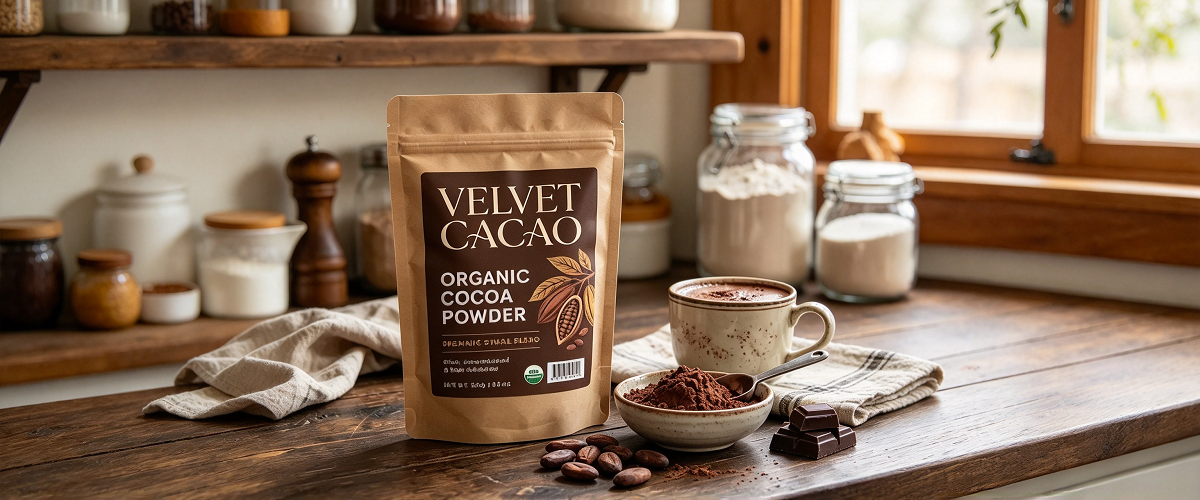
Cocoa powder packaging materials must provide a suitable balance of barrier performance, mechanical strength, sealing reliability, print quality, and cost. The best structure depends on the product's fat content, moisture sensitivity, intended shelf life, and distribution conditions.
Flexible packaging often uses multiple layers because no single material provides every desired property. An outer layer may support printing and mechanical strength, while an inner layer provides heat sealing. An intermediate layer may improve resistance to oxygen, moisture, or light.
The following materials and structures are common options to evaluate for cocoa powder packaging.
PET for Strength and High-Quality Printing
Polyethylene terephthalate, commonly known as PET, is frequently used as an outer layer in flexible packaging laminates. It offers good dimensional stability, mechanical strength, and print performance.
For cocoa powder, PET can support detailed branding, readable product information, and a durable exterior. It is commonly combined with other materials to provide sealing and barrier properties.
PET should not automatically be considered a complete high-barrier solution. Its suitability depends on the grade, thickness, laminate structure, and protection required by the product.
A PET-based laminate may be suitable when a brand needs an attractive printed exterior and the complete structure provides the necessary moisture and oxygen protection.
BOPP for Cost-Efficient Packaging
Biaxially oriented polypropylene, or BOPP, is used in many flexible packaging applications because it can provide stiffness, printability, and cost-efficient performance.
For mainstream cocoa powder products, BOPP-based structures may be worth evaluating when material cost and retail presentation are important. Some BOPP structures also provide useful moisture resistance.
However, barrier and sealing performance vary according to the specific film grade and construction. The package may require a separate heat-sealing layer or additional barrier materials to meet the intended application.
Buyers should request technical specifications for the complete structure rather than assuming that all BOPP films perform identically.
PE and LLDPE for Heat Sealing
Polyethylene, including linear low-density polyethylene (LLDPE), is commonly used as a heat-sealing layer in flexible packaging.
For cocoa powder, the inner sealing layer must form a reliable closure under the intended production conditions. Its performance depends on the material grade, film thickness, sealing temperature, pressure, dwell time, and machine speed.
A suitable PE-based layer can contribute to flexibility and resistance to handling damage. However, it should be selected as part of a complete laminate rather than treated as the only material needed for every cocoa powder application.
Where stronger oxygen or light protection is required, PE may be combined with other materials that provide those functions.
VMPET for Enhanced Moisture, Oxygen, and Light Protection
Vacuum-metallized PET, or VMPET, is PET film coated with a thin metallic layer. It is often used in multilayer flexible packaging to improve barrier performance and provide a metallic appearance.
In a suitable laminate, VMPET can reduce transmission of moisture and oxygen and limit light exposure compared with some uncoated film structures. This can make it useful for cocoa powder products requiring enhanced protection without necessarily using an aluminum foil layer.
VMPET-based structures may be appropriate for retail cocoa powder, drinking chocolate mixes, and selected foodservice products. Their actual suitability depends on the required shelf life and the performance of the complete package.
Metallization quality, flexing, abrasion, and damage during conversion can affect barrier performance. Manufacturers should therefore assess the finished laminate and test the bag under representative conditions.
Aluminum Foil for High-Barrier Cocoa Powder Packaging
Aluminum foil is commonly used when strong protection against moisture, oxygen, and light is required.
For cocoa powder, foil-based laminates may be appropriate for products with demanding shelf-life requirements, higher residual fat content, or long distribution routes. They can also be considered for premium products where maintaining aroma and quality is particularly important.
A foil laminate typically combines an outer printable layer, an aluminum foil layer, and an inner heat-sealing layer. The exact construction depends on the product, bag format, and filling process.
Foil can provide a very strong barrier when the laminate is manufactured correctly and the finished package remains intact. However, the package still needs reliable seals and protection from punctures, folds, and other mechanical damage.
Foil-based structures may cost more than simpler alternatives. Their use should be justified by the product's actual protection requirements rather than adopted automatically for every cocoa powder package.
Mono-Material PE or PP Structures for Recyclability-Oriented Designs
Some brands are exploring PE-based or PP-based mono-material structures to improve compatibility with selected recycling systems.
These structures may be attractive when a brand wants to reduce material complexity or respond to packaging regulations and customer expectations. However, mono-material packaging is not automatically recyclable in every market, and it may not provide the same barrier performance as every conventional multilayer laminate.
The final result depends on the film grades, barrier coatings, printing system, adhesives, closures, package design, and recycling infrastructure available in the destination market.
Before adopting a mono-material structure, brands should verify that it can:
- Meet the required moisture and oxygen barrier targets.
- Form reliable seals on the intended equipment.
- Withstand the expected handling and distribution conditions.
- Protect the cocoa powder for the intended shelf life.
- Meet applicable food-contact requirements.
- Support any recycling claims made for the complete package.
A sustainability-oriented structure should be validated against both product-protection needs and real end-of-life options.
Comparing Common Material Structures
| Material or Structure | Main Contribution | Potential Application | Important Consideration |
|---|---|---|---|
| PET-based laminate | Strength and print quality | Retail cocoa powder bags | Often requires additional layers for sealing and enhanced barriers |
| BOPP-based laminate | Stiffness and cost-efficient presentation | Mainstream retail products | Performance depends on film grade and construction |
| PE/LLDPE sealing layer | Heat sealing and flexibility | Inner layer of many laminates | Must match the rest of the structure and equipment |
| PET/VMPET/PE | Enhanced barrier in a multilayer structure | Products requiring improved moisture and oxygen protection | Metallization and finished-package integrity matter |
| PET/aluminum foil/PE | Strong barrier against moisture, oxygen, and light | Demanding shelf-life or distribution applications | May cost more and requires protection against mechanical damage |
| Mono-material PE or PP | Potential compatibility with selected recycling systems | Sustainability-oriented packaging programs | Must be validated for barrier, seals, and local recycling acceptance |
These structures are illustrative options, not universal specifications. The appropriate choice depends on the complete material construction, the actual cocoa powder formulation, and the performance targets.
How Does Cocoa Powder Fat Content Affect Material Selection?
Cocoa powder is available in different fat-content grades, and the residual cocoa butter can influence oxidation risk and sensory stability.
A lower-fat cocoa powder may have different packaging requirements from a higher-fat product, particularly when storage periods are long. Higher residual fat content can make oxygen protection more important, depending on processing conditions and the product's intended use.
However, fat content alone does not determine the packaging specification. Storage temperature, initial product quality, oxygen remaining inside the bag, light exposure, and the target shelf life also matter.
A practical material-selection process should therefore start with the product's technical specifications and expected storage conditions. The packaging supplier can then recommend candidate structures for validation.
Choosing Between Metallized Film and Aluminum Foil
Metallized film and aluminum foil are both used to improve barrier performance, but they are not interchangeable in every application.
VMPET may offer a useful balance between barrier performance, appearance, and cost for selected products. Aluminum foil can provide a stronger barrier where more demanding protection is required, although the final performance still depends on laminate integrity and package design.
The decision should consider:
- Required moisture and oxygen protection.
- Sensitivity of the cocoa powder to oxidation.
- Intended storage period.
- Expected temperature and humidity conditions.
- Bag size and mechanical stresses.
- Cost per finished package.
- Product positioning and market expectations.
For products with moderate protection requirements, metallized film may be sufficient if testing confirms acceptable performance. For demanding applications, a foil-based structure may be justified.
Why the Complete Laminate Matters More Than One Material Name
A flexible package functions as a system. The outer layer, barrier layer, sealing layer, adhesives, coatings, and finished seals all contribute to performance.
For example, a package may use PET for printing and strength, VMPET for improved barrier performance, and PE for heat sealing. The overall result depends on how these layers are combined and converted.
When comparing suppliers, buyers should request the complete material structure rather than relying on descriptions such as "premium film" or "high-barrier pouch."
A useful technical specification should identify:
- Layer composition and order.
- Material thickness or grammage, where applicable.
- Bag dimensions and format.
- Relevant WVTR and OTR data.
- Sealing-layer characteristics.
- Printing and surface-finish requirements.
- Food-contact documentation.
- Any recycling-related claims and their scope.
- Recommended testing procedures.
This information makes supplier quotations easier to compare and helps prevent a purchasing decision based solely on price.
Balancing Barrier Performance and Cost
The highest-barrier material is not necessarily the most economical solution for every cocoa powder product.
If a product has a short turnover period and moderate protection requirements, a simpler laminate may be adequate. Conversely, a low-cost package that allows the powder to absorb moisture or develop off-flavors before the end of its intended shelf life can create additional losses.
Total packaging cost should include:
- Material price per bag.
- Printing and conversion costs.
- Minimum order quantity.
- Filling-line efficiency.
- Reject rates and packaging waste.
- Freight and storage costs.
- Product loss associated with damaged packages.
- Quality-control and validation expenses.
- Customer expectations and brand positioning.
The objective is to identify a structure that meets the required performance at a commercially reasonable total cost.
4. What Packaging Features Help Prevent Cocoa Powder Clumping and Extend Shelf Life?
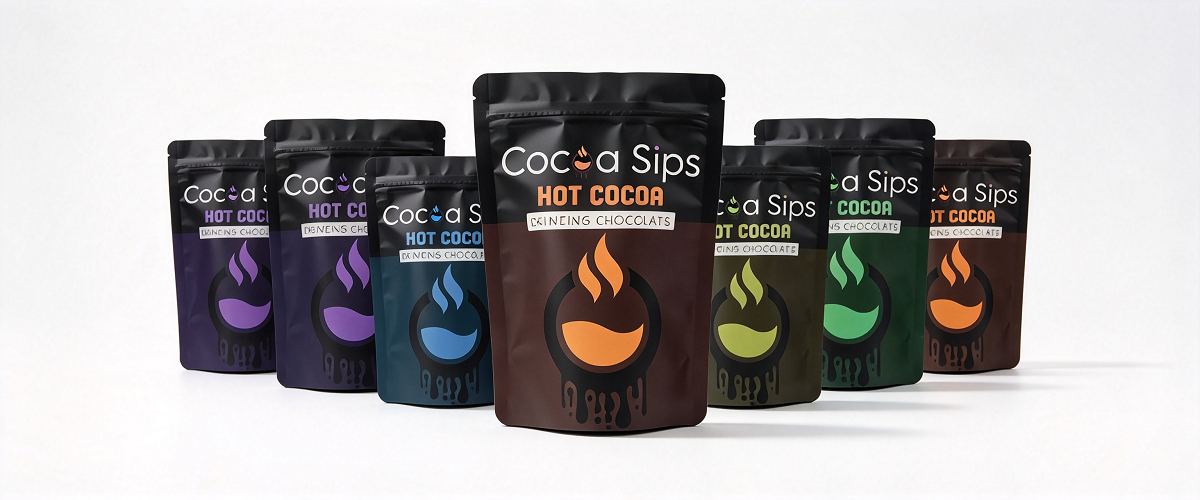
Cocoa powder clumping can be caused by moisture absorption, storage conditions, formulation characteristics, and the way the powder is handled. Packaging plays an important role by limiting moisture ingress and maintaining a reliable seal, but it cannot eliminate every cause of clumping.
The most effective strategy combines suitable material selection, good filling practices, reliable seals, appropriate storage, and packaging features that help consumers protect the powder after opening.
Resealable Zippers for Repeated Use
Resealable zippers are useful for household cocoa powder and drinking chocolate products that are used over several days or weeks.
After opening the original seal, consumers can close the zipper to reduce unnecessary exposure to humid air and external contaminants. This can help maintain product quality compared with leaving the bag open.
However, a zipper does not create a completely airtight or moisture-proof barrier under all conditions. Its effectiveness depends on the closure design, cleanliness, repeated use, and the condition of the package.
For cocoa powder, a zipper should be positioned above the main product area and designed so that powder does not easily accumulate in the closure track. A practical opening width also helps consumers dispense the powder without spilling it.
The zipper should be treated as a convenience feature that supports storage, not as a replacement for a suitable barrier laminate or reliable factory seal.
Tear Notches for Controlled Opening
A tear notch allows consumers to open the package without scissors. Correct placement can help create a clean opening that is easy to use and does not interfere with the zipper or remaining seal area.
Cocoa powder is fine and lightweight, so an excessively large or poorly controlled opening may cause dust or powder to escape. The package should allow users to access the product comfortably while maintaining control during pouring.
Manufacturers should test opening performance with the actual bag material and size. The notch must be strong enough to remain intact during distribution but allow controlled tearing when the consumer opens the package.
Wide Openings for Easier Scooping
A wide opening can make it easier to access cocoa powder with a measuring spoon or scoop. This is particularly useful for baking cocoa and household products used in repeated recipes.
However, a wider opening can also expose more powder to the environment after the package is opened. Its benefits should therefore be balanced against the need for convenient resealing and suitable storage.
A well-designed pouch can combine a practical opening width with a zipper positioned to allow effective closure after use.
For foodservice products, the opening should also support the way staff handle and measure the powder. A package that is easy to use can reduce spillage and help maintain a cleaner working area.
Moisture-Resistant Materials to Reduce Clumping Risk
The most fundamental packaging-related measure for reducing moisture-induced clumping is selecting a material structure with suitable water vapor resistance.
The correct barrier level depends on the powder formulation, intended shelf life, and storage environment. A product sold in humid regions or distributed over long distances may require stronger moisture protection than one intended for rapid use under controlled conditions.
Buyers should request relevant WVTR data and assess the finished package rather than selecting a material based only on its name or appearance.
Moisture protection should be considered together with:
- Initial powder moisture.
- Filling-room humidity.
- Seal quality.
- Package dimensions and surface area.
- Storage temperature and humidity.
- The frequency with which consumers reopen the package.
A strong barrier helps slow moisture transfer, but it cannot correct powder that is already unsuitable for packaging.
Controlling Powder Dust During Filling
Cocoa powder can produce fine dust during transfer and filling. If the dust accumulates around the sealing area, it may interfere with the formation of a reliable heat seal.
A contaminated seal can create a potential pathway for moisture ingress, reducing the effectiveness of the barrier material and increasing the risk of quality deterioration.
Manufacturers should assess the filling process to minimize powder accumulation near the sealing jaws. Suitable measures may include adjusting filling nozzles, controlling product flow, improving dust extraction, optimizing the filling sequence, and maintaining appropriate machine settings.
The exact solution depends on the equipment and product characteristics. The important objective is to maintain a clean sealing area while achieving consistent filling accuracy and production speed.
Nitrogen Flushing for Selected Products
Nitrogen flushing may help reduce residual oxygen inside the package. This can be useful when the cocoa powder's residual fat content or intended shelf life makes oxidation a significant concern.
However, nitrogen flushing does not directly prevent moisture from entering through a defective seal, and it does not guarantee that clumping will not occur.
If nitrogen flushing is used, the process should be validated to confirm that it achieves the intended residual oxygen level and remains compatible with the bag structure and production equipment.
Manufacturers should compare the benefits with the added equipment, operating, and quality-control costs.
Should Cocoa Powder Packaging Include a Desiccant?
A desiccant absorbs moisture within a defined environment, but its use in food packaging requires careful consideration.
For many cocoa powder products, selecting a suitable moisture-barrier laminate and maintaining a reliable seal may be more straightforward than adding a desiccant. A desiccant should not be included automatically or used as a substitute for proper product moisture control.
Where a desiccant is being considered, manufacturers should verify its suitability for the specific food application, package volume, moisture load, and intended storage conditions. The packaging design must also prevent accidental consumption and comply with relevant requirements.
The decision should be based on a documented technical assessment rather than the assumption that every powder product benefits from a desiccant.
Transparent Windows: Useful for Branding but Not Always Ideal for Shelf Life
A transparent window can show the cocoa powder's color and texture, helping consumers recognize the product. However, the window may provide less light protection than an opaque or metallized section of the package.
The suitability of a window depends on the powder's sensitivity, storage conditions, material properties, and intended shelf life.
If product visibility is important, a small window may provide enough information without making the entire package transparent. The window should be assessed as part of the complete package, including its barrier properties and seal integrity.
For products with demanding shelf-life requirements, an opaque design may be the safer option if testing indicates that light exposure is a concern.
Strong Seals to Maintain the Barrier
Reliable seals are essential for maintaining the intended moisture and oxygen protection.
A package can use an excellent barrier laminate and still fail if the seals are weak, contaminated, or damaged. Cocoa powder dust is especially relevant because particles can become trapped between the sealing surfaces.
Manufacturers should establish and monitor sealing conditions appropriate to the selected material. The process should be validated using the actual powder, bag dimensions, and production equipment.
Quality checks may include visual inspection, seal-strength testing, leak testing, and other suitable package-integrity methods.
Clear Storage Instructions for Consumers
Packaging can help maintain product quality after purchase by providing clear storage guidance.
Useful instructions may include keeping the package tightly closed after use, storing the powder in a cool and dry place, avoiding contact with moisture, and using a clean, dry spoon.
The wording should reflect the product's actual storage requirements and any relevant regulatory guidance. Brands should avoid making unsupported promises about freshness or shelf life.
For premium products, storage instructions can be printed on the back panel or linked to more detailed guidance through a QR code. The objective is to help consumers protect the powder throughout its use period.
Packaging Features and Their Contribution to Product Quality
| Feature | Main Function | Contribution to Cocoa Powder Quality | Important Limitation |
|---|---|---|---|
| High-moisture-barrier laminate | Slows moisture transmission | Helps reduce moisture-related clumping | Cannot correct excessive initial moisture |
| Resealable zipper | Supports repeated closure | Reduces unnecessary exposure after opening | Not a substitute for the original seal |
| Tear notch | Simplifies first opening | Supports controlled access | Poor placement may cause spills |
| Wide opening | Improves scooping and dispensing | Reduces handling difficulty | May increase exposure after opening |
| Nitrogen flushing | Reduces residual oxygen | May help limit oxidation | Does not solve moisture ingress |
| Transparent window | Shows product appearance | Supports consumer confidence | May reduce light protection |
| Reliable heat seals | Closes the package | Maintains the intended barrier | Requires suitable process control |
| Storage instructions | Guides consumer handling | Helps protect the powder after opening | Depends on consumer compliance |
Can Packaging Completely Prevent Cocoa Powder Clumping?
No. Packaging can reduce moisture exposure, but clumping can also be influenced by the powder's formulation, initial moisture, particle properties, storage temperature, and handling conditions.
A high-barrier bag is most effective when the powder is in suitable condition before filling, the sealing process is reliable, and the package is stored appropriately.
If a product repeatedly clumps despite adequate packaging, manufacturers should investigate the complete system. This may include reviewing raw-material moisture, processing conditions, formulation, filling-room humidity, seal integrity, storage conditions, and the packaging material's actual barrier performance.
The solution may involve changes to the product or process rather than simply choosing a thicker film.

5. Cocoa Powder Packaging Bags: Key Factors for Freshness, Branding, Convenience, and Distribution
A successful cocoa powder packaging strategy must balance product quality, retail presentation, manufacturing efficiency, and cost. The most attractive bag is not necessarily the most protective, and the highest-barrier structure is not automatically the best commercial choice for every product.
The following factors help brands and manufacturers make a more complete decision.
Product Formulation and Fat Content
Cocoa powder products differ in fat content, particle size, processing method, and intended use. These characteristics influence the packaging requirements.
For example, a low-fat cocoa powder intended for industrial baking may have different oxidation risks from a higher-fat cocoa powder sold as a premium beverage ingredient. A drinking chocolate mix containing sugar, milk powder, or other ingredients may also have different moisture-related behavior from pure cocoa powder.
Before selecting a package, manufacturers should establish:
- Product composition and fat content.
- Initial moisture condition.
- Particle size and flowability.
- Intended use and preparation method.
- Expected storage duration.
- Relevant sensory and quality specifications.
These details help the packaging supplier recommend candidate material structures and functional features.
Defining Shelf-Life Requirements
Shelf life should be established through product-specific validation. It should not be assumed from the bag type or material name alone.
The intended shelf-life period depends on the product formulation, initial quality, storage conditions, barrier properties, seal integrity, and distribution route.
A suitable shelf-life study should evaluate the powder and package at planned intervals. Relevant observations may include changes in odor, flavor, color, texture, flowability, moisture condition, and package integrity.
For products with demanding shelf-life targets, the study may also need to consider oxygen exposure, light, and temperature variation.
A practical validation process includes:
- Defining product specifications and acceptance criteria.
- Selecting candidate packaging structures.
- Producing representative finished bags.
- Establishing relevant storage conditions.
- Inspecting product and package performance at planned intervals.
- Reviewing results against the acceptance criteria.
- Documenting the approved material and packaging configuration.
Accelerated storage testing may help identify potential risks, but it does not always perfectly predict real-time performance. Where appropriate, it should be complemented by real-time storage data.
Distribution Conditions and Package Durability
Cocoa powder bags can experience compression, vibration, abrasion, punctures, and repeated handling during distribution.
Small retail bags may be damaged when packed with heavier products, while large ingredient bags may experience stress at their lower seals or gusset folds. Export products can also face longer transit times and changing temperature and humidity conditions.
Packaging should therefore be evaluated under conditions that reflect the intended supply chain.
Relevant considerations include:
- Drop and impact exposure.
- Compression and stacking loads.
- Vibration during road or sea transport.
- Puncture and abrasion risks.
- Seal integrity after handling.
- Carton design and movement within the carton.
- Pallet stability and load restraint.
For e-commerce, the primary bag should be evaluated together with the outer shipping package. A flexible pouch may provide the required food-contact barrier, while a carton or other secondary packaging protects it from impact and abrasion.
Food-Contact Compliance and Regulatory Requirements
Packaging materials intended for direct food contact must be suitable for the intended application and comply with the requirements of the destination market.
The relevant documentation may cover the film layers, adhesives, inks, coatings, and other components of the finished package. Requirements can vary according to the jurisdiction, product, and intended conditions of use.
Manufacturers should request appropriate technical specifications and declarations from their packaging suppliers. Where necessary, they should obtain qualified regulatory guidance to confirm the suitability of the complete structure.
For export products, compliance should be verified for the actual destination. Documentation or approval relevant to one market should not automatically be assumed to establish compliance in another.
Branding and Retail Differentiation
Cocoa powder is sold across several market segments, from economical baking ingredients to premium cocoa products and specialty drinking chocolate. Packaging helps brands communicate their position and distinguish their products from competing offers.
A clear design should make the product name, cocoa type, net weight, and relevant usage information easy to identify. Premium products may also communicate origin, processing method, flavor characteristics, or suggested applications, provided the claims are accurate and substantiated.
Effective branding can include:
- A recognizable logo and consistent visual identity.
- Clear product naming and ingredient information.
- Appropriate cocoa imagery and color choices.
- Readable preparation instructions.
- A finish that matches the target market.
- Consistent layouts across multiple package sizes.
- Clear differentiation between product variants.
The design should not sacrifice readability for decorative effects. Essential information must remain legible when the bag is filled and displayed, and labeling should comply with applicable regulations.
Printing Methods and Surface Finishes
Flexible packaging can support high-quality graphics and a variety of finishes, depending on the selected material and printing process.
Matte finishes may suit premium or minimalist products, while gloss finishes can create a brighter appearance. Metallic effects, selective gloss, and other decorative treatments may help brands establish a distinctive identity.
The choice of printing method depends on order volume, number of designs, artwork complexity, production schedule, and cost. Buyers should discuss these factors with their packaging supplier before finalizing the design.
Printing specifications should include artwork requirements, color expectations, registration tolerances, finish details, and any relevant information about the material structure.
Convenience for Consumers and Foodservice Users
Packaging convenience depends on how the powder is accessed, measured, and stored.
Household users may prefer a resealable pouch with an opening wide enough for a measuring spoon. Foodservice operators may need a larger bag that can be opened cleanly and emptied efficiently. Industrial users may prioritize package handling and compatibility with automated ingredient transfer systems.
Before adding functional features, manufacturers should identify the main use case. A zipper, handle, or special opening may improve the experience, but it can also increase cost or complicate production.
The best configuration is the one that solves a genuine user problem without compromising protection or production efficiency.
Cost Optimization and Total Packaging Cost
The lowest unit price does not necessarily represent the lowest total cost.
A simpler package may be appropriate when it meets the product's protection requirements and runs efficiently on the filling line. However, if a low-cost structure causes frequent leaks, product loss, or reduced shelf life, the overall cost may be higher.
Cost evaluation should consider:
- Film or laminate cost per finished bag.
- Printing and conversion expenses.
- Minimum order quantity.
- Filling-line efficiency.
- Material waste and rejection rates.
- Outer packaging and shipping requirements.
- Storage and freight costs.
- Product loss from package failure.
- Quality-control and validation expenses.
The appropriate material specification should be based on the product's real protection requirements and the commercial value of reliable performance.
Minimum Order Quantity and Inventory Management
Custom-printed packaging often has a minimum order quantity that depends on the bag format, printing process, number of designs, material structure, and supplier setup requirements.
A new cocoa powder brand may need smaller initial quantities to test market demand, while an established manufacturer may prioritize lower unit costs through larger orders.
Packaging inventory should be planned alongside sales forecasts and product development. Excess packaging can tie up working capital and become obsolete if the recipe, label, or branding changes.
Possible approaches include:
- Standardizing bag dimensions across related products where practical.
- Using a consistent brand layout for multiple cocoa powder variants.
- Evaluating digital printing for selected short runs.
- Planning orders around realistic sales forecasts.
- Reviewing artwork carefully before mass production.
- Confirming the approved material specification before placing repeat orders.
The best strategy depends on demand, unit economics, production schedules, and the flexibility offered by the packaging supplier.
Compatibility with Filling and Sealing Equipment
A packaging structure must work with the equipment used to fill and seal the cocoa powder. Material performance alone is not enough if the bag cannot be filled consistently or sealed reliably at the required production speed.
Important variables include the bag opening, film stiffness, powder flow, dust generation, sealing-layer properties, machine temperature, and production speed.
Before approving a large order, manufacturers should conduct a production trial using the actual powder and equipment. The trial should evaluate:
- Filling accuracy and consistency.
- Powder accumulation around the sealing area.
- Bag opening and forming performance.
- Seal consistency at the intended machine speed.
- Finished-package appearance and stability.
- Waste and reject rates.
- Package integrity after handling.
Early trials can identify incompatibilities before they affect a large production run.
Sustainability and Packaging End-of-Life
Sustainability is an increasingly important consideration in packaging development, but it must be evaluated alongside product protection and real recycling options.
Some brands are investigating mono-material PE or PP structures, reduced material thickness, and designs that simplify material separation. These approaches may improve compatibility with certain recycling systems, but their suitability depends on barrier performance, package design, and local infrastructure.
A package that uses less material is not automatically the best choice if it fails to protect the cocoa powder or creates higher levels of product waste. Likewise, a "recyclable" claim should not be made without verifying that the complete package meets the relevant requirements in the target market.
A responsible review should consider:
- Total packaging material used.
- Protection needed to maintain product quality.
- Availability of suitable recycling systems.
- Compatibility of inks, coatings, adhesives, and closures.
- Applicable environmental labeling rules.
- Evidence supporting any sustainability claims.
The objective is to reduce unnecessary packaging impact while maintaining the performance required for food safety and quality.
Preparing a Packaging Specification for Suppliers
A clear packaging specification helps suppliers propose appropriate structures and makes quotations easier to compare.
The specification should include the product's characteristics, target package size, required features, barrier needs, production equipment, destination market, and testing expectations.
| Specification Item | Information to Provide |
|---|---|
| Product type | Natural cocoa powder, alkalized cocoa powder, or drinking chocolate mix |
| Product characteristics | Fat content, particle size, flowability, and initial moisture condition |
| Net weight | Intended fill weight and relevant tolerances |
| Bag format | Stand-up, flat-bottom, pillow, side-gusseted, three-side-seal, or stick pack |
| Bag dimensions | Width, height, gusset depth, and opening requirements |
| Material structure | Proposed or required laminate construction |
| Barrier targets | Moisture and oxygen protection needs, where applicable |
| Features | Zipper, tear notch, window, handle, or other options |
| Printing | Artwork, colors, finish, and number of designs |
| Compliance | Destination market and required documentation |
| Production equipment | Filling and sealing method, where known |
| Order quantity | Initial order and expected repeat-order volume |
| Testing | Seal, leak, storage, and distribution validation requirements |
A complete specification helps the supplier understand the application and reduces the risk of selecting a bag based only on appearance or price.
A Practical Workflow for Selecting Cocoa Powder Packaging
A structured selection process can help purchasing, quality, production, and marketing teams reach a consistent decision.
Step 1: Define the product. Identify the cocoa powder type, fat content, formulation, particle characteristics, and intended application.
Step 2: Establish the market requirements. Determine the package size, target customer, distribution route, storage period, and destination market.
Step 3: Choose candidate formats. Compare stand-up pouches, flat-bottom bags, pillow bags, side-gusseted bags, and sachets based on capacity and usability.
Step 4: Set barrier targets. Determine the moisture, oxygen, and light protection required for the actual product.
Step 5: Select functional features. Decide whether zippers, tear notches, wide openings, or windows offer meaningful benefits.
Step 6: Confirm compliance. Check food-contact suitability and destination-market labeling requirements.
Step 7: Conduct production trials. Evaluate filling, dust control, sealing, and package integrity on the intended equipment.
Step 8: Validate storage and distribution. Test the finished package under relevant conditions.
Step 9: Compare total cost. Include material, printing, production efficiency, logistics, and potential product losses.
Step 10: Approve and monitor. Document the selected structure and review actual performance after launch.
This workflow encourages a balanced decision based on product protection, manufacturing practicality, and commercial requirements.
Frequently Asked Questions
What Is the Best Packaging Bag for Cocoa Powder?
There is no single best format for every cocoa powder product. Stand-up pouches are suitable for many retail applications, flat-bottom bags can support premium positioning, pillow bags work well for high-volume production, and side-gusseted bags may be more suitable for bulk ingredients. The final choice depends on product characteristics, pack size, barrier needs, and sales channel.
Which Material Is Best for Cocoa Powder Packaging?
The best material depends on the product's fat content, moisture sensitivity, shelf-life target, and storage conditions. PET- or BOPP-based laminates may be suitable for some applications, while VMPET or aluminum foil layers may be appropriate when stronger moisture, oxygen, or light protection is needed. The complete structure should be validated for the intended use.
Does Cocoa Powder Need High-Barrier Packaging?
Not every cocoa powder product requires the highest available barrier. A product with a shorter storage period and controlled distribution may perform adequately in a suitable moderate-barrier structure. Products with demanding shelf-life requirements or greater oxidation sensitivity may benefit from stronger protection.
How Can Packaging Help Prevent Cocoa Powder Clumping?
Packaging helps reduce clumping by limiting moisture ingress through the material and seals. A suitable moisture barrier, reliable heat seals, controlled filling conditions, and appropriate storage practices all contribute to product quality. Packaging cannot correct excessive initial moisture or every formulation-related cause of clumping.
Is Aluminum Foil Packaging Necessary for Cocoa Powder?
Not always. Aluminum foil can provide strong moisture, oxygen, and light protection, but a metallized or other suitable laminate may meet the requirements of some products at a different cost. The choice should be based on the actual barrier targets and validated shelf-life performance.
Are Resealable Zippers Recommended for Cocoa Powder Bags?
Zippers are useful for household and foodservice products that are opened repeatedly. They can reduce unnecessary exposure after opening, but they do not replace the original factory seal or eliminate the need for suitable barrier materials.
Is Nitrogen Flushing Suitable for Cocoa Powder?
Nitrogen flushing may be useful for products where residual oxygen and oxidation are important concerns. Its benefit depends on the cocoa powder's composition, barrier structure, filling process, and shelf-life target. It does not replace moisture control or seal integrity.
Can Cocoa Powder Be Packed in Transparent Bags?
Transparent bags can show the product's appearance, but their suitability depends on the required light protection and shelf life. For products where light exposure is a concern, an opaque or metallized structure may be more appropriate. A small window can be considered if testing supports its use.
What Is the Best Package Size for Cocoa Powder?
Package size should reflect the product's bulk density, intended use, consumer behavior, and distribution channel. Small sachets may suit samples or single servings, while stand-up pouches and flat-bottom bags can serve household retail. Larger gusseted bags may be suitable for foodservice or industrial applications.
How Can Manufacturers Extend Cocoa Powder Shelf Life?
Shelf life can be supported by using suitable raw materials, controlling product moisture, selecting an appropriate barrier structure, maintaining reliable seals, preventing contamination, and storing finished products under suitable conditions. The actual shelf life should be established through product-specific testing.
What Should Buyers Ask a Flexible Packaging Supplier?
Buyers should request the proposed material structure, relevant barrier data, bag dimensions, sealing specifications, food-contact documentation, printing options, minimum order quantity, lead time, and recommended testing. They should also provide details about the cocoa powder, intended shelf life, destination market, and filling equipment.
Conclusion
Selecting packaging bags for cocoa powder requires a clear understanding of the product's formulation, moisture sensitivity, oxidation risk, and intended use. Stand-up pouches and flat-bottom bags can support retail presentation, pillow bags can provide efficient high-volume production, side-gusseted bags can accommodate bulk ingredients, and sachets or stick packs can serve portion-controlled applications.
Material selection should be driven by actual barrier requirements rather than assumptions based on a material name. PET and BOPP can support strength and print quality, VMPET can improve barrier performance in suitable structures, and aluminum foil may be justified when demanding moisture, oxygen, and light protection is required. The complete package must also maintain reliable seals and withstand the intended filling and distribution conditions.
Features such as resealable zippers, tear notches, and practical openings can improve usability, while suitable moisture barriers and controlled filling processes help reduce the risk of clumping. Clear labeling, validated storage instructions, and a consistent visual identity can further strengthen the customer experience.
The most effective packaging solution is not necessarily the most elaborate or expensive option. It is the one that protects the actual cocoa powder, performs reliably on the production line, meets applicable food-contact requirements, and supports the brand's commercial goals.
By defining product and shelf-life requirements early, comparing suitable bag formats, requesting detailed material specifications, and validating finished packages through production and storage testing, cocoa powder brands can make better packaging decisions. Well-selected flexible packaging helps maintain product quality, improve convenience, support brand differentiation, and create a reliable foundation for domestic and international distribution.