Guide to Flexible Packaging for Sesame Products
Anna_Yu
Guide to Flexible Packaging for Sesame Products
Sesame products cover a surprisingly broad range of food applications, from raw sesame seeds and roasted sesame to tahini, sesame paste, sesame powder, sesame snacks, sesame brittle, sesame seasoning, and ready-to-use culinary ingredients. Although these products share the same basic ingredient, their packaging requirements can be very different. A dry roasted sesame seed may primarily require protection from moisture and oxygen, while tahini may require stronger resistance to oil migration, aroma loss, and leakage. Sesame snacks may also require puncture resistance and protection against breakage during transportation.
For manufacturers, exporters, private-label brands, and food processors, flexible packaging provides a versatile way to address these differences. Pouches, three-side-seal bags, pillow bags, flat-bottom bags, sachets, and other flexible formats can be customized according to the sesame product's physical form, serving size, shelf-life target, filling process, and distribution channel.
Sesame is also particularly sensitive to oxidation and aroma changes because sesame seeds contain a significant amount of natural oil. Exposure to oxygen, heat, light, and unsuitable storage conditions can gradually affect flavor and freshness. Moisture creates another challenge, particularly for roasted sesame and sesame-based dry snacks where crispness and free-flowing characteristics are important.
Packaging therefore has to do more than simply hold the product. A well-designed flexible package should help control moisture, oxygen, light, external odors, contamination, and mechanical stress, while also providing reliable sealing and an attractive surface for branding.
The right package also depends on how the sesame product will be sold. Retail products may require resealable zippers and strong shelf presentation, while industrial sesame ingredients may prioritize filling efficiency, larger pack sizes, and transportation durability. E-commerce products need additional attention to puncture resistance and parcel handling, while export products may require higher barrier performance and market-specific labeling.
This guide explains how manufacturers can select flexible packaging for sesame products by examining suitable bag formats, barrier requirements, material structures, functional features, shelf-life considerations, branding opportunities, and distribution requirements. Rather than treating every sesame product the same way, the goal is to match the packaging system to the actual characteristics and commercial requirements of the product.
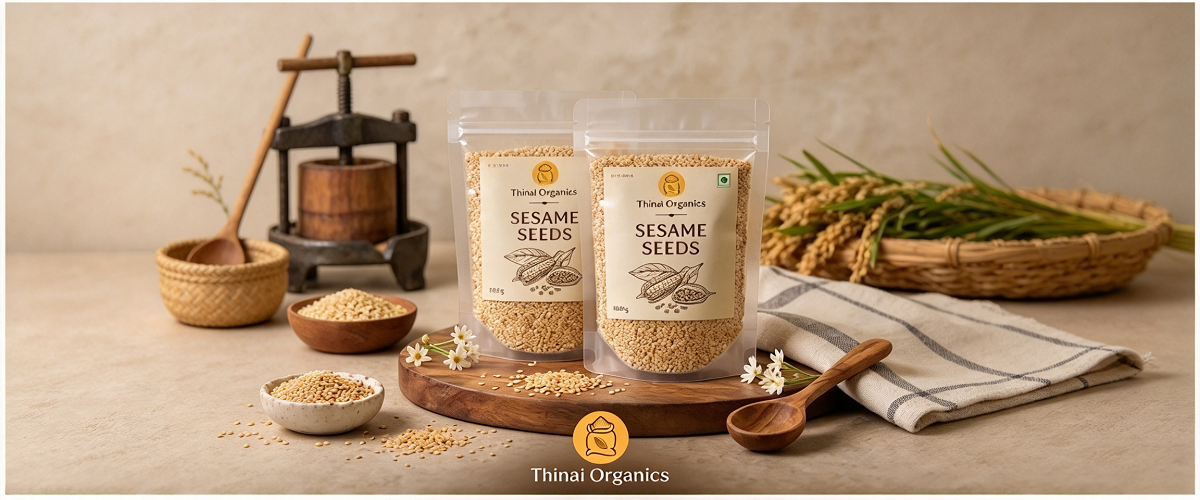
1. What Types of Flexible Packaging Are Best for Sesame Products?
The best flexible packaging for sesame products depends on product form, oil content, serving size, shelf-life requirements, filling equipment, and sales channel.
A package for dry sesame seeds does not necessarily need the same structure as a package for tahini or a sesame snack. Manufacturers should first identify how the product behaves during storage and transportation before selecting the bag format.
Stand-Up Pouches for Retail Sesame Products
Stand-up pouches are one of the most versatile formats for retail sesame products.
They can be used for:
- Roasted sesame seeds
- Raw sesame seeds
- Black sesame seeds
- White sesame seeds
- Sesame seasoning
- Sesame powder
- Sesame snacks
- Sesame granules
- Blended sesame products
Their upright structure creates a strong retail presentation while providing a relatively large printable surface.
A zipper can also be added when consumers are expected to use the product over multiple occasions.
For example, a 200 g or 500 g roasted sesame seed product may benefit from a stand-up pouch with a resealable closure because the consumer may use only part of the package at a time.
The package can then be designed around three main priorities:
Barrier protection + resealability + shelf presentation.
Three-Side-Seal Bags for Individual and Small Portions
Three-side-seal pouches are particularly useful when the sesame product is sold in smaller quantities.
Potential applications include:
- Sesame seasoning sachets
- Single-use sesame toppings
- Small portions of sesame seeds
- Foodservice sachets
- Sampling packs
- Promotional packs
- Individual sesame snacks
This format can be efficient for automated filling and sealing and can be produced in a wide range of dimensions.
For single-use applications, a zipper is usually unnecessary. Instead, manufacturers may prioritize:
- Easy-open tear notches
- Strong heat seals
- Compact dimensions
- Accurate filling
- High-quality printing
Pillow Bags for High-Volume Sesame Products
Pillow bags can be suitable for high-volume production where cost efficiency and fast packaging are important.
They may be used for:
- Sesame snacks
- Seasoned sesame products
- Small retail packs
- Foodservice products
- Promotional products
Pillow packaging is particularly relevant when the product is compatible with vertical or horizontal form-fill-seal equipment.
For high-speed production, the packaging material must not only provide adequate barrier performance but also run consistently through the machine.
Important considerations include:
- Film coefficient of friction
- Web handling
- Sealing temperature
- Machine speed
- Cutting accuracy
- Registration accuracy
- Seal contamination tolerance
Flat-Bottom Bags for Premium Sesame Products
Flat-bottom or box-style pouches provide a more structured appearance than conventional flexible bags.
They can be suitable for:
- Premium black sesame
- Organic sesame products
- Specialty roasted sesame
- Premium sesame snacks
- Gourmet seasoning products
- Export-oriented brands
The format offers multiple printable panels and a stable base, making it attractive for premium retail presentation.
It can also accommodate a zipper and other convenience features.
For premium products, the packaging itself can communicate quality through:
- Matte surfaces
- Metallic details
- Minimalist graphics
- High-resolution product photography
- Specialty finishes
- Carefully controlled color systems
Gusseted Bags for Larger Sesame Pack Sizes
Side-gusseted or quad-seal bags can be useful for larger quantities.
Potential applications include:
- Foodservice sesame seeds
- Restaurant packs
- Bakery ingredients
- Industrial food ingredients
- Wholesale sesame products
Larger packages place greater demands on mechanical strength and seal performance.
As package weight increases, manufacturers should evaluate:
- Drop resistance
- Handleability
- Bottom-seal strength
- Side-seal performance
- Puncture resistance
- Carton configuration
A package that works well for a 100 g retail pack may not be appropriate for a 5 kg foodservice pack.
Sachets for Sesame Seasonings and Toppings
Sachets are particularly useful when sesame is used as an ingredient rather than the primary product.
For example, a meal kit or ready-to-eat food product may include a small sesame seasoning sachet.
These applications often prioritize:
- Portion accuracy
- Compact size
- Easy opening
- Aroma retention
- Strong seals
- High-speed filling compatibility
Sachets can also support private-label foodservice programs where each serving requires a controlled amount of sesame seasoning.
Packaging Formats by Sesame Product
| Sesame product | Suitable flexible format | Main packaging priority |
|---|---|---|
| Raw sesame seeds | Stand-up pouch, three-side seal | Moisture and contamination protection |
| Roasted sesame | High-barrier pouch | Oxygen, aroma, and moisture protection |
| Black sesame | Stand-up or flat-bottom pouch | Light, aroma, and moisture protection |
| Sesame powder | High-barrier pouch | Moisture and caking control |
| Sesame seasoning | Sachet or small pouch | Portion control and aroma retention |
| Sesame snacks | Stand-up, pillow, or three-side seal | Crispness and oxidation control |
| Tahini | Specialized flexible pouch where suitable | Oil resistance and leakage control |
| Foodservice sesame | Gusseted or larger pouches | Strength and logistics |
| Premium sesame | Flat-bottom or high-quality stand-up pouch | Barrier performance and branding |
Choosing Between Single-Use and Resealable Packaging
One of the simplest decisions is whether the product will be consumed immediately after opening.
Single-use packaging is appropriate when:
- The package contains one serving
- The product is intended for immediate consumption
- The product is supplied as a foodservice sachet
- Resealing is unnecessary
Resealable packaging is more useful when:
- The product is consumed gradually
- The pack size is relatively large
- Aroma retention after opening matters
- The consumer stores the product between uses
For example, roasted sesame seeds sold in a 500 g retail package may benefit substantially from a zipper, while a 5 g seasoning sachet does not need one.
Packaging for Sesame Products Sold Online
E-commerce creates additional packaging requirements.
During online fulfillment, a pouch may experience:
- Compression
- Vibration
- Repeated handling
- Carton friction
- Drops
- Pressure from other products
Sesame seeds can move inside the package, creating repeated mechanical stress on the seals and film.
For e-commerce applications, manufacturers should therefore consider:
- Strong heat seals
- Appropriate puncture resistance
- Suitable bag dimensions
- Durable printing
- Secondary shipping protection
The retail pouch and the outer shipping carton should be considered together.
Packaging for Export Sesame Products
Export products may experience longer transportation and wider environmental variations.
Depending on the destination, packaging may need to tolerate:
- High humidity
- Temperature fluctuations
- Long transit periods
- Container transportation
- Multiple handling stages
- Warehouse storage
This makes barrier selection particularly important.
Export packaging should also provide sufficient space for:
- Ingredients
- Nutrition information
- Origin information
- Lot identification
- Expiration or best-before information
- Required certifications
- Destination-market regulatory information
Flexible Packaging for Different Sesame Business Models
Packaging requirements can also differ according to the business model.
| Business model | Typical packaging priority |
|---|---|
| Retail brand | Shelf appeal, convenience, barrier protection |
| Private label | Customization, compliance, cost control |
| Foodservice | Portion efficiency, durability, filling speed |
| Exporter | Barrier performance, transportation, compliance |
| E-commerce brand | Durability, compactness, product protection |
| Premium brand | High barrier, premium graphics, tactile finish |
| Industrial ingredient supplier | Large format, mechanical strength, efficient handling |
This is why there is no universal “best sesame pouch.”
The correct package is the one that matches the product and its supply chain.

2. How Does Flexible Packaging Protect Sesame Products from Moisture, Oxygen, and Contamination?
Sesame products can lose quality when exposed to unsuitable environmental conditions. The most important packaging functions are generally moisture control, oxygen control, aroma retention, contamination prevention, and seal integrity.
Moisture Protection for Sesame Seeds
Moisture is particularly important for roasted sesame seeds and sesame-based dry products.
When moisture enters the package, it can cause:
- Loss of crispness
- Texture changes
- Clumping
- Reduced flowability
- Caking in powdered products
- Potential quality deterioration
Roasted sesame is especially sensitive when the desired eating experience depends on a dry, crisp texture.
A strong moisture barrier helps isolate the product from external humidity.
However, manufacturers should distinguish between external moisture ingress and internal moisture migration.
The packaging can control the first problem, but product formulation and processing influence the second.
Sesame Powder Has Different Moisture Requirements
Ground sesame and sesame powder generally have a larger surface area than whole seeds.
This can make moisture management even more important.
If the powder absorbs moisture, it may:
- Form lumps
- Lose flowability
- Become difficult to dispense
- Develop texture changes
- Experience changes in aroma
For powdered sesame products, the package should therefore combine:
Strong moisture barrier + reliable seal + appropriate opening design.
A narrow opening or controlled pouring system may also be useful depending on the product format.
Oxygen and Sesame Oil Oxidation
Sesame seeds naturally contain oil, which makes oxidation an important consideration.
Oxygen exposure can gradually contribute to:
- Rancid or stale flavors
- Aroma loss
- Changes in sensory quality
- Oxidative deterioration of oils
This is particularly important for:
- Roasted sesame
- High-oil sesame products
- Sesame snacks
- Nut-and-seed blends containing sesame
- Products with long shelf-life requirements
A high oxygen barrier can slow oxygen transmission into the package.
However, oxygen protection should be considered together with:
- Initial package atmosphere
- Headspace
- Sealing quality
- Storage temperature
- Product oil content
- Light exposure
Simply selecting a high-barrier film does not guarantee a particular shelf life.
Light Protection Can Help Preserve Sesame Quality
Light can accelerate quality deterioration in products containing oils and sensitive flavor compounds.
This can be relevant to sesame products, particularly those intended for longer storage.
Opaque or metallized packaging can reduce light exposure significantly.
Manufacturers therefore need to decide whether the product requires:
- Full light protection
- Partial light protection
- A controlled transparent window
- Full transparency
For premium sesame products, an opaque package may also provide a more sophisticated visual appearance.
Aroma Retention
Sesame has a distinctive aroma, particularly after roasting.
Aroma is an important part of perceived freshness.
Packaging can help retain desirable volatile compounds while reducing the risk of external odor migration.
This is important because sesame products may be stored near:
- Spices
- Coffee
- Tea
- Strongly scented ingredients
- Cleaning materials
- Other food products
A package with appropriate barrier properties can help reduce unwanted aroma exchange.
Contamination Protection
A properly sealed flexible package creates a physical barrier against external contaminants.
It can help protect sesame products from:
- Dust
- Particles
- Handling contamination
- External moisture
- Unwanted odors
- Contact with other products
This becomes increasingly important as products move through complex supply chains.
A sealed pouch can provide consistent protection from the factory through distribution and retail.
Seal Integrity Is a Critical Part of Protection
The packaging film itself may have excellent barrier performance, but the finished package can still fail if the seal is poor.
Potential causes include:
- Sesame particles trapped in the seal
- Oil contamination
- Insufficient heat
- Excessive heat
- Incorrect pressure
- Wrinkled seals
- Mechanical damage
- Inconsistent sealing conditions
For sesame products, particles can be particularly relevant because loose seeds or powder may enter the sealing area during high-speed filling.
Manufacturers should therefore optimize:
- Filling accuracy
- Product positioning
- Seal width
- Sealing temperature
- Dwell time
- Pressure
- Machine speed
Seal Strength and Barrier Performance Work Together
A useful way to think about packaging protection is:
Barrier material protects the package from environmental transmission, while seal integrity protects the package from direct leakage and ingress.
Both are necessary.
A strong laminate with weak seals is not a reliable package.
Likewise, an excellent seal on a film with insufficient barrier performance may not provide the required shelf life.
Nitrogen Flushing for Oxidation-Sensitive Sesame Products
Nitrogen flushing can be considered for sesame products where oxidation is a major concern.
Reducing oxygen in the package headspace can help lower the initial oxygen exposure.
This may be particularly relevant to:
- Roasted sesame
- High-oil sesame snacks
- Long-shelf-life retail products
- Export products
However, nitrogen flushing should not be viewed as a replacement for a suitable barrier structure.
The complete preservation system is more accurately represented as:
Product formulation + barrier film + headspace management + sealing + storage conditions.
Vacuum Packaging Requires Product-Specific Evaluation
Vacuum packaging can reduce air inside a package, but it is not automatically appropriate for every sesame product.
For delicate sesame snacks, excessive vacuum may:
- Compress the product
- Damage the package appearance
- Cause breakage
- Change product presentation
For seeds or other products where appearance and physical integrity are important, modified atmosphere or conventional high-barrier packaging may be more appropriate.
The packaging process should therefore be selected based on the product's physical characteristics.
Testing the Finished Package
Packaging should be tested as a finished system rather than relying only on film specifications.
Useful evaluations can include:
| Test | Purpose |
|---|---|
| Water vapor barrier | Evaluate moisture protection |
| Oxygen barrier | Evaluate oxidation protection |
| Seal strength | Confirm sealing reliability |
| Leak testing | Identify package integrity problems |
| Drop testing | Assess transportation durability |
| Sensory testing | Monitor aroma and flavor |
| Storage testing | Evaluate real shelf-life behavior |
| Microbiological testing | Assess product safety where relevant |
Actual testing requirements should be determined according to the product and destination market.
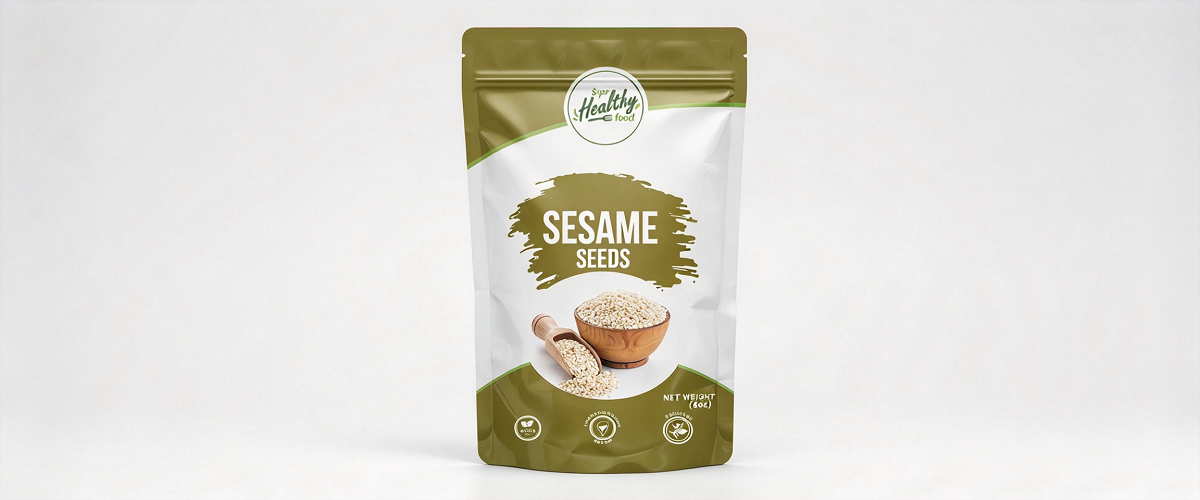
3. Which Packaging Materials Provide the Best Barrier Protection for Sesame Products?
Material selection for sesame products should focus on the required performance of the complete structure, rather than repeatedly comparing individual films in isolation.
The main objective is to balance:
Moisture barrier + oxygen barrier + mechanical strength + sealing performance + appearance + cost.
PET-Based Structures
PET is frequently used as an outer layer in flexible packaging because it can provide mechanical strength and a high-quality printable surface.
For sesame products, PET-based laminates can be suitable when the package requires:
- Good print quality
- Structural stability
- Reliable converting performance
- Moderate to high barrier protection when combined with a suitable barrier layer
A PET-based laminate can therefore provide a practical platform for many roasted sesame and retail seed products.
Metallized PET Structures
Metallized PET can significantly improve barrier performance compared with ordinary transparent film.
It can provide:
- Improved oxygen barrier
- Improved moisture barrier
- Strong light protection
- Metallic visual effects
This makes it particularly relevant to sesame products where oxidation and light exposure are important considerations.
Potential applications include:
- Roasted sesame seeds
- Black sesame products
- Sesame snacks
- Long-shelf-life retail products
- Export products
Aluminum Foil Laminates
Aluminum foil provides very high barrier performance against:
- Oxygen
- Moisture
- Light
- Aroma transmission
It may be appropriate when maximum protection is required.
Potential applications include:
- Long-distance export
- High-oil sesame products
- Premium products with demanding shelf-life targets
- Products exposed to challenging environmental conditions
However, foil is not automatically necessary for every sesame product.
A metallized structure may provide sufficient performance for many mainstream applications while potentially reducing material and cost requirements.
PE and Other Sealant Layers
The inner layer is responsible for forming the heat seal and, depending on the structure, may also provide direct food-contact functionality.
For sesame products, the sealant layer should be selected for:
- Food-contact suitability
- Reliable heat sealing
- Appropriate seal strength
- Compatibility with filling equipment
- Resistance to the product's oil content
- Consistent performance at production speed
This is particularly important for powdered sesame because particles can interfere with sealing.
BOPP-Based Structures
BOPP can be useful when manufacturers need:
- Good printability
- Stiffness
- Cost efficiency
- Suitable mechanical performance
It can be combined with appropriate barrier and sealing layers depending on the application.
For mainstream sesame snacks or roasted seed products, BOPP-based structures may provide an effective balance when the required barrier level is moderate.
Mono-Material Structures
Some brands are investigating mono-material structures to simplify packaging and support recycling goals.
For sesame products, a mono-material solution may be considered when it can provide the required:
- Moisture barrier
- Oxygen barrier
- Seal performance
- Mechanical strength
- Shelf-life performance
- Printability
The actual recyclability of a flexible package depends on the complete structure and the collection and recycling infrastructure in the target market.
Therefore, manufacturers should validate both technical performance and local end-of-life requirements.
Material Selection by Sesame Product
| Sesame product | Potential structure approach | Primary requirement |
|---|---|---|
| Raw sesame seeds | Barrier laminate | Moisture and contamination protection |
| Roasted sesame | High oxygen/moisture barrier | Oxidation and aroma control |
| Black sesame | Metallized or opaque high-barrier structure | Light, oxygen, and moisture protection |
| Sesame powder | High moisture-barrier laminate | Caking and flowability control |
| Sesame snack | High-barrier flexible structure | Crispness and oxidation protection |
| High-oil sesame product | Strong oxygen barrier | Oil oxidation control |
| Export sesame | High-barrier or foil-containing structure | Long transit and environmental protection |
| Premium sesame | High-barrier structure with premium printing | Product protection and brand presentation |
These structures should be treated as starting points for development rather than fixed specifications.
Avoid Choosing a Package Solely by Film Thickness
Thickness alone does not determine packaging performance.
Two films with similar thickness can have very different:
- Oxygen transmission
- Water vapor transmission
- Seal performance
- Mechanical properties
- Light protection
The barrier layer and complete laminate design are often more important than simply increasing total thickness.
For procurement teams, measured performance specifications are more useful than selecting a package solely because it is “thicker.”
Match the Structure to the Filling Process
A material must work on the production line as well as in the warehouse.
Manufacturers should evaluate:
- Machine speed
- Film tracking
- Friction
- Sealing temperature
- Seal contamination tolerance
- Cutting behavior
- Print registration
- Bag forming
- Filling accuracy
This is particularly important for high-volume sesame packaging operations.
Do Not Over-Specify the Packaging
A common packaging mistake is selecting the highest-barrier structure for every product.
Over-specification can increase:
- Material cost
- Packaging weight
- Production complexity
- Purchasing cost
The objective should be to identify the minimum practical packaging performance that reliably achieves the required shelf life and quality.
This approach can improve cost efficiency without compromising product protection.

4. What Packaging Features Help Preserve Sesame Freshness, Aroma, and Quality?
Barrier performance protects the product during storage, but functional packaging features determine how the consumer interacts with the product.
For sesame products, features should be selected based on whether the package is intended for single-use, repeated use, foodservice, retail, or premium presentation.
Resealable Zippers
Zippers are highly useful for multi-use sesame products.
They can help consumers:
- Close the package after opening
- Reduce repeated exposure to humidity
- Retain aroma
- Store unused sesame seeds more conveniently
They are particularly useful for:
- 200–500 g retail packs
- Roasted sesame seeds
- Black sesame seeds
- Sesame toppings
- Sesame snack mixes
For single-use sachets, a zipper is unnecessary and would add cost without meaningful benefit.
Easy-Open Tear Notches
Tear notches make the first opening easier and can reduce the need for scissors.
They are suitable for:
- Individual sesame packs
- Retail pouches
- Foodservice sachets
- Snack packaging
The notch should be positioned to provide controlled opening while maintaining package integrity during transportation.
Wide Mouth and Convenient Pouring
Sesame seeds and powder can be difficult to dispense from a narrow opening.
A wider opening can improve usability for larger retail pouches.
For powders, a controlled dispensing opening may be even more useful because it can help reduce:
- Spillage
- Dust
- Over-pouring
- Mess during preparation
The opening should be matched to the product's particle size and flowability.
Stable Stand-Up Base
A stand-up base can improve retail presentation and consumer storage.
It can provide:
- Better shelf visibility
- Larger front-facing display
- Easier cupboard storage
- More convenient handling
This is especially useful for resealable sesame pouches.
Flat-Bottom Construction
Flat-bottom bags can create a more structured and premium appearance.
They are suitable for:
- Specialty sesame
- Organic sesame
- Gourmet products
- Premium black sesame
- High-end sesame snacks
The larger printable surface can also support storytelling and detailed product information.
Controlled Transparent Windows
A transparent window allows consumers to see the sesame product.
This can be useful for products where appearance is a strong purchase factor.
However, manufacturers should consider whether the window compromises:
- Light protection
- Overall barrier performance
- Shelf-life targets
For products with high sensitivity to oxidation or light, a smaller window or fully opaque package may be preferable.
High-Quality Printing
Sesame products can be differentiated through packaging design even when the physical product looks relatively simple.
Packaging can communicate:
- Seed variety
- Roasting style
- Origin
- Organic positioning
- Culinary applications
- Recipe suggestions
- Brand story
For premium sesame products, the package can use restrained typography, high-quality photography, or specialty finishes to create a more sophisticated appearance.
Flavor and Product Color Coding
When a brand sells multiple sesame products, packaging can use a consistent color system.
For example:
| Product | Visual differentiation |
|---|---|
| White sesame | Light product-specific color |
| Black sesame | Dark contrasting color |
| Roasted sesame | Warm roasting-related visual theme |
| Sesame seasoning | Distinct seasoning color |
| Sesame snack | More energetic snack-oriented design |
The objective is to make SKU identification easy without losing overall brand consistency.
QR Codes for Product Information
QR codes can connect the package to:
- Recipes
- Serving suggestions
- Product origin
- Brand story
- Quality information
- Cooking instructions
- Promotional campaigns
This is especially useful for premium and specialty sesame products.
Custom Bag Sizes
Correct package sizing can improve both product protection and consumer convenience.
Oversized bags may create:
- Excess headspace
- More material consumption
- More movement during transportation
Undersized bags may cause:
- Difficult filling
- Product compression
- Seal problems
- Poor presentation
Custom dimensions allow the package to be designed around the actual fill weight and product density.
Puncture Resistance
Although sesame seeds are relatively small, hard ingredients and repeated movement can still create mechanical stress.
This is particularly relevant to:
- Sesame snack mixes
- Seed blends
- Large bags
- E-commerce shipments
A suitable structure should maintain integrity after handling and transportation.
Anti-Static Considerations for Sesame Powder
Powdered products can behave differently from whole seeds.
Depending on the formulation and filling equipment, static can affect:
- Powder movement
- Filling accuracy
- Seal contamination
- Equipment cleanliness
Packaging material selection and machine settings should therefore be considered together for powdered sesame products.
Tamper-Evident or Secondary Protection
Depending on the market and package format, manufacturers may consider additional tamper-evident features or secondary seals.
This can provide consumers with visible evidence that the package has not been opened before purchase.
The exact approach depends on the product category, market regulations, and retail environment.
Feature Selection by Product
| Packaging feature | Whole sesame | Roasted sesame | Sesame powder | Sesame snacks |
|---|---|---|---|---|
| Zipper | High | High | High | High |
| Tear notch | High | High | High | High |
| Wide opening | Medium | Medium | High | Medium |
| Transparent window | Optional | Selective | Less common | Optional |
| Stand-up base | High | High | High | High |
| QR code | Useful | Useful | Useful | Useful |
| Premium finish | Optional | Useful | Useful | Useful |
| Nitrogen flushing | Optional | Potentially useful | Product-dependent | Often considered |
The correct combination depends on the actual consumption pattern and preservation requirements.
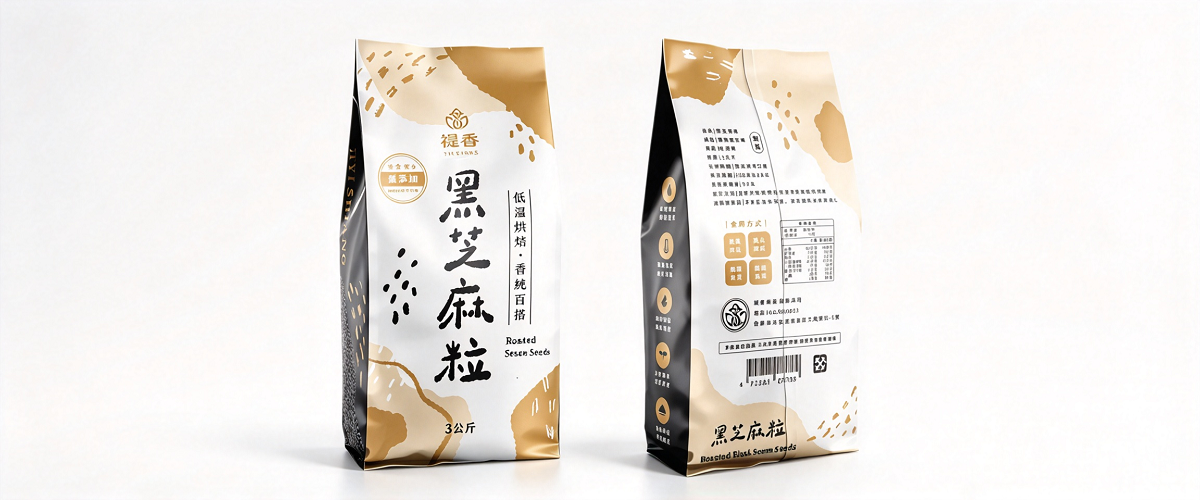
5. Flexible Packaging for Sesame Products: Key Factors for Shelf Life, Branding, Convenience, and Distribution
Selecting the right sesame packaging requires more than choosing a bag shape and film structure.
A successful packaging system must support the entire product lifecycle:
Manufacturing → Packaging → Storage → Transportation → Retail → Consumer Use.
Shelf-Life Requirements
Different sesame products can have very different shelf-life targets.
A raw sesame seed product may have different stability requirements from a roasted product because roasting changes the product's sensory characteristics and can influence oxidation behavior.
Likewise, sesame powder, sesame snacks, and sesame paste each require their own evaluation.
Before selecting packaging, manufacturers should define:
- Target shelf life
- Expected storage temperature
- Humidity conditions
- Oxygen sensitivity
- Product water activity
- Oil content
- Light sensitivity
The package should then be selected to meet these requirements.
Storage Temperature Matters
Packaging cannot compensate completely for unsuitable storage conditions.
High temperatures can accelerate oxidation and other quality changes.
Therefore, manufacturers should consider:
- Warehouse temperature
- Transportation temperature
- Retail storage
- Seasonal climate
- Export destination
A packaging structure that performs well under controlled conditions may require additional protection if the product will be stored in hot or humid environments.
Product Form Should Drive Packaging Design
The physical form of sesame products influences packaging decisions.
| Product form | Key packaging concern |
|---|---|
| Whole seeds | Moisture, oxidation, contamination |
| Roasted seeds | Oxidation, aroma, crispness |
| Powder | Moisture, caking, dispensing |
| Seasoning | Aroma, moisture, portion control |
| Snack | Crispness, oxygen, mechanical protection |
| Paste | Leakage, oil resistance, sealing |
| Sesame brittle | Moisture, breakage, stickiness |
This is why packaging should be developed at the product level rather than simply selecting a generic “sesame bag.”
Branding for Retail Sesame Products
Sesame products can sometimes look visually similar across competing brands.
Packaging is therefore an important differentiation tool.
A strong package design should quickly communicate:
- What the product is
- Whether it is roasted or raw
- Whether it is black or white sesame
- Flavor or seasoning
- Product quantity
- Key product attributes
- Brand identity
The front panel should prioritize the most important information rather than filling the entire surface with graphics.
Premium Sesame Packaging
Premium sesame products may use:
- Matte finishes
- Metallic effects
- Minimalist graphics
- Specialty printing
- High-quality product photography
- Structured flat-bottom formats
The packaging should support the product's positioning without creating unnecessary complexity.
Packaging for Foodservice
Foodservice packaging has different priorities.
Restaurants, bakeries, and commercial kitchens may value:
- Larger quantities
- Easy opening
- Reliable resealing
- Durable construction
- Efficient storage
- Clear product identification
A professional foodservice pouch should be easy to handle even when operators are working quickly.
Packaging for E-Commerce
Online sesame products need to survive a distribution environment that is less controlled than traditional retail.
Potential risks include:
- Parcel drops
- Compression
- Carton movement
- Abrasion
- Repeated handling
The flexible package should therefore be evaluated together with the outer shipping packaging.
Export Packaging Considerations
International distribution can expose sesame products to:
- High humidity
- Long transportation times
- Temperature fluctuations
- Port handling
- Container storage
- Multiple warehouse transfers
For these applications, manufacturers may choose stronger barrier structures and more durable package construction.
Export packaging should also be designed with destination-market requirements in mind.
Cost Efficiency
Packaging cost should be evaluated as a total system cost rather than simply the price per bag.
The calculation can include:
- Film cost
- Printing cost
- Bag-making cost
- Filling efficiency
- Storage cost
- Shipping cost
- Product loss
- Rework
- Returns
A slightly more expensive package may be economically preferable if it significantly reduces product deterioration or transportation damage.
Packaging Material Efficiency
Right-sizing the package can reduce unnecessary material use.
For example, a correctly sized pouch can:
- Reduce empty space
- Improve shelf presentation
- Reduce product movement
- Improve carton utilization
This can benefit both logistics and material efficiency.
Seasonal and Promotional Packaging
Sesame products may be associated with:
- Lunar New Year
- Mid-Autumn Festival
- Traditional celebrations
- Bakery promotions
- Seasonal gift collections
Flexible packaging can be customized for limited-edition campaigns without changing the fundamental product format.
Digital printing may be useful for shorter promotional runs where traditional plate-based printing is less economical.
Private-Label Sesame Packaging
Private-label buyers often need packaging that balances:
- Custom branding
- Flexible quantities
- Regulatory requirements
- Cost efficiency
- Consistent product presentation
Flexible packaging can support different brand identities using the same underlying technical structure.
Production Compatibility
Packaging should be tested on the actual filling line.
Important parameters include:
- Film feeding
- Bag forming
- Sealing temperature
- Machine speed
- Filling accuracy
- Print registration
- Tear-notch position
- Zipper alignment
- Cutting accuracy
A package that looks excellent but performs poorly on the production line can create significant operational costs.
Quality Control Specifications
Before mass production, buyers should establish packaging specifications covering the most important characteristics.
These may include:
- Film structure
- Thickness
- Bag dimensions
- Barrier requirements
- Seal strength
- Print quality
- Color tolerance
- Zipper performance
- Tear-notch position
- Package appearance
- Food-contact compliance
The exact specification should reflect the intended application.
Sustainability Considerations
Sustainability is becoming increasingly relevant to food packaging buyers.
For sesame products, potential approaches include:
- Lightweighting
- Right-sizing
- Simplified structures
- Recyclable structures where feasible
- Reduced secondary packaging
- Efficient shipping
- Digital printing for appropriate short runs
However, sustainability decisions should not compromise food protection.
If a lower-barrier structure causes substantially greater product waste, the environmental benefit may be reduced.
The best approach is to balance:
Protection + material efficiency + logistics efficiency + end-of-life considerations.
A Practical Development Process
A structured development process can reduce packaging mistakes.
Step 1: Define the Product
Identify:
- Product type
- Fill weight
- Oil content
- Moisture characteristics
- Water activity
- Expected shelf life
Step 2: Define Distribution
Determine whether the product will be sold through:
- Retail
- E-commerce
- Foodservice
- Export
- Wholesale
Step 3: Select the Package Format
Choose between:
- Stand-up pouch
- Three-side-seal bag
- Pillow bag
- Flat-bottom bag
- Gusseted bag
- Sachet
Step 4: Define Barrier Requirements
Evaluate:
- Oxygen
- Moisture
- Light
- Aroma
Step 5: Select Functional Features
Determine whether the product needs:
- Zipper
- Tear notch
- Window
- Wide opening
- Handle
- QR code
- Nitrogen flushing
Step 6: Test the Package
Evaluate the finished package with the actual product.
Step 7: Validate Production
Run packaging trials on the intended filling and sealing equipment.
Step 8: Confirm the Final Specification
Once performance is verified, establish a controlled packaging specification for mass production.
Five Questions to Ask Before Ordering Sesame Flexible Packaging
Before placing a packaging order, manufacturers should be able to answer:
- What is the exact sesame product and its oil/moisture profile?
- What shelf life is required under actual storage conditions?
- Will the product be sold as single-use or multi-use?
- What filling and sealing equipment will be used?
- What distribution environment will the package need to survive?
These questions can prevent many common packaging mistakes.

FAQ
What is the best flexible packaging for sesame seeds?
For many retail sesame seed products, a high-barrier stand-up pouch or three-side-seal bag can provide a practical combination of moisture protection, oxygen protection, branding space, and convenience. Roasted sesame may require stronger oxygen and aroma protection than raw seeds.
Do roasted sesame seeds need high-barrier packaging?
They often benefit from strong oxygen and moisture barriers because oxidation can affect the oils and sensory quality of roasted sesame. The final barrier requirement should be established through shelf-life testing with the actual product.
What packaging is best for black sesame?
Black sesame can be packaged in stand-up pouches, flat-bottom bags, or three-side-seal pouches. An opaque or metallized high-barrier structure may be useful when light protection is important.
Does sesame powder need moisture-barrier packaging?
Yes. Sesame powder can be particularly sensitive to moisture because moisture absorption may cause caking and reduce flowability. A strong moisture barrier and reliable seals are important.
Should sesame packaging have a zipper?
A zipper is useful for multi-use retail products where consumers open and close the package repeatedly. It is generally unnecessary for single-use sachets.
Is aluminum foil necessary for sesame packaging?
Not necessarily. Aluminum foil provides very high barrier performance, but many sesame products can be packaged using appropriately engineered metallized or other high-barrier laminate structures. The correct choice depends on shelf life, storage conditions, product sensitivity, and cost.
Can nitrogen flushing be used for roasted sesame?
Yes. Nitrogen flushing can reduce oxygen in the package headspace and may be useful for oxidation-sensitive roasted sesame products. It should be combined with appropriate barrier packaging and reliable sealing.
Can flexible packaging be used for tahini or sesame paste?
Flexible packaging can be considered for some sesame paste applications, but the package must be specifically designed for the product's viscosity, oil content, leakage risk, and dispensing requirements. A conventional dry-food pouch should not automatically be used for a liquid or semi-liquid sesame product.
What bag size should be used for sesame seeds?
Bag size should be determined by fill weight, product density, package dimensions, consumer usage, and distribution requirements. Common retail sizes can vary widely, so the package should be designed around the actual product rather than using a generic dimension.
Is flexible packaging suitable for sesame exports?
Yes. Flexible packaging can be well suited to export sesame products because it can provide strong barrier protection while remaining lightweight and space-efficient. Export applications should also consider humidity, transit duration, mechanical handling, and destination-market requirements.
How can sesame packaging maintain aroma?
Appropriate oxygen and aroma barriers, reliable seals, and controlled storage conditions can help retain the characteristic aroma of sesame. Roasted sesame generally deserves particular attention because aroma is a major part of its sensory appeal.
How should sesame packaging be tested?
The complete package should be tested with the actual product. Depending on the application, testing may include moisture and oxygen performance, seal integrity, leak resistance, transportation durability, sensory evaluation, and shelf-life testing.
Can sesame packaging be made more sustainable?
Potential strategies include right-sizing, lightweighting, simplified structures, recyclable structures where technically and locally feasible, and reducing unnecessary secondary packaging. Sustainability should always be evaluated alongside shelf-life and food-protection requirements.
Can flexible packaging be customized for private-label sesame brands?
Yes. Flexible packaging supports customized dimensions, graphics, finishes, closures, windows, and labeling areas, making it suitable for private-label sesame products ranging from commodity seeds to premium roasted products.
Conclusion
Flexible packaging provides sesame manufacturers with a versatile platform for protecting product quality while supporting modern retail, foodservice, e-commerce, and export requirements.
The most important consideration is that different sesame products require different packaging strategies. Raw sesame seeds, roasted sesame, black sesame, sesame powder, sesame snacks, seasonings, and sesame paste can have significantly different moisture, oxygen, mechanical, and storage requirements.
For dry retail products, high-barrier stand-up pouches, three-side-seal bags, flat-bottom pouches, and other flexible formats can provide an effective combination of protection and convenience. Roasted and oil-rich sesame products may require greater attention to oxygen and aroma barriers, while sesame powder needs particularly strong moisture protection. Larger foodservice products may prioritize mechanical strength and efficient handling.
Packaging features should then be selected according to how consumers use the product. Zippers can support repeated opening, tear notches simplify access, wide openings improve dispensing, controlled windows provide product visibility, and high-quality printing turns the package into a powerful branding tool.
For manufacturers, the best packaging decision is not necessarily the package with the thickest film or highest barrier. It is the structure that provides the right level of protection, reliable sealing, efficient production, convenient use, and commercially appropriate cost.
By evaluating the product, shelf-life target, storage environment, filling equipment, sales channel, and distribution conditions together, sesame brands can develop packaging that protects freshness and aroma while improving efficiency and market presentation.
In a category where oil stability, distinctive aroma, texture, and ingredient quality all influence consumer perception, flexible packaging is not simply a container for sesame products. It is an important part of the product's preservation system, logistics strategy, and brand experience.