How to Choose Packaging Bags for Your Muscle-Building Protein Powder
Anna_Yu
How to Choose Packaging Bags for Your Muscle-Building Protein Powder
Muscle-building protein powder is a performance-focused food product where freshness, powder stability, food safety, and convenient daily use all matter. Whether the product is whey protein, plant-based protein, casein, mass gainer, or a specialized protein blend, the packaging must do more than simply hold the powder. It needs to protect the product throughout filling, warehousing, transportation, retail display, and repeated opening at home or in a gym bag.
Protein powders are particularly sensitive to moisture, oxygen, contamination, odors, and poor seal integrity. Moisture can cause powders to absorb water, form lumps, lose flowability, and become difficult to measure. Oxygen may contribute to flavor deterioration and oxidation of sensitive ingredients, while weak seals can allow environmental contaminants to enter during distribution. For products containing flavors, sweeteners, fats, vitamins, minerals, or other functional ingredients, packaging performance becomes even more important.
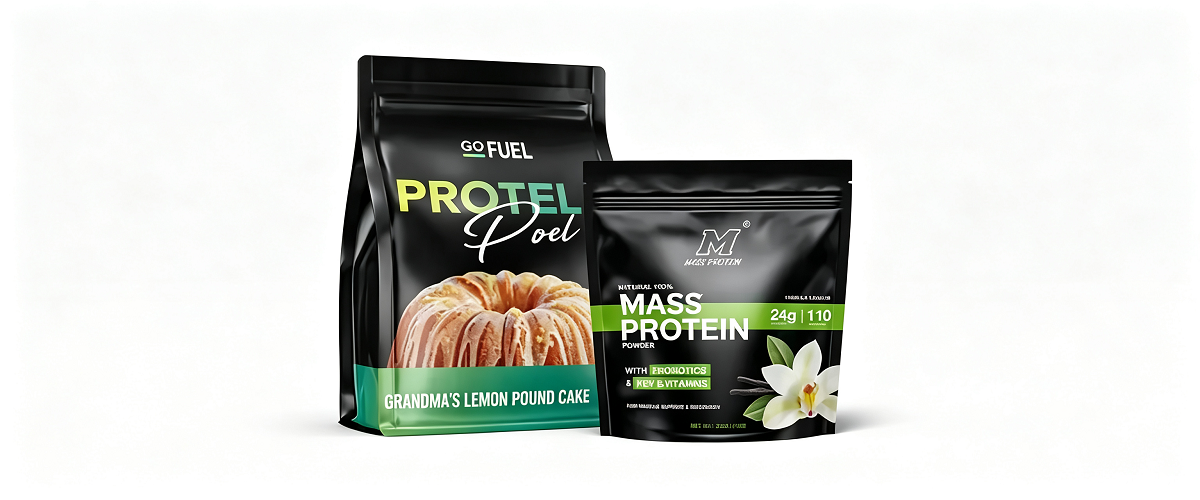
At the same time, protein powder packaging is highly visible to consumers. Large bags and pouches provide substantial space for nutrition information, serving instructions, flavor identification, brand storytelling, certifications, and product claims. A well-designed package can therefore serve two purposes at once: protecting product quality and communicating the positioning of the protein brand.
Flexible packaging has become increasingly attractive for protein powders because it combines high barrier performance with lower packaging weight, efficient transportation, flexible sizing, and extensive customization possibilities. Stand-up pouches, flat-bottom bags, gusseted bags, and other flexible formats can be configured for different serving sizes and consumer preferences.
However, the right package depends on more than appearance. Protein formulation, powder density, fill weight, shelf-life target, filling equipment, distribution conditions, opening frequency, and market requirements should all be considered before selecting the final structure.
This guide explains how to choose packaging bags for muscle-building protein powder, with a focus on bag formats, moisture and oxygen protection, barrier structures, functional features, shelf life, branding, logistics, and consumer convenience.
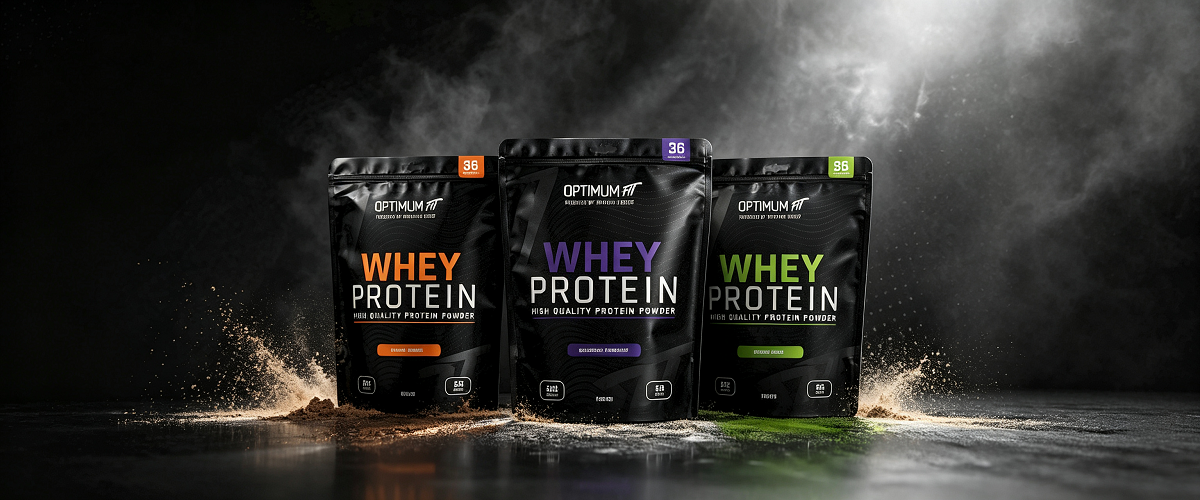
1. What Types of Packaging Bags Are Best for Muscle-Building Protein Powder?
The best packaging format for protein powder depends on fill weight, powder characteristics, consumption frequency, distribution channel, and brand positioning. A small single-serving product has very different requirements from a two-kilogram family-size protein bag.
For most retail protein products, the main flexible packaging options include stand-up pouches, flat-bottom bags, side-gusset bags, three-side seal bags, and single-serve sachets.
Stand-Up Pouches for Everyday Protein Powder
Stand-up pouches are a practical option for many retail protein powders because they provide a combination of shelf visibility, lightweight construction, convenient handling, and customization flexibility.
They are particularly suitable for:
- Whey protein
- Plant-based protein
- Casein powder
- Flavored protein blends
- Smaller and medium-sized retail packs
- Sports nutrition products sold through e-commerce
A stand-up pouch can be produced with a relatively large front panel for product branding while retaining enough space for nutrition information and usage instructions on the back.
For consumers who use protein powder several times per week, a zipper can make the pouch much more convenient than a package that must be discarded or folded after opening.
Flat-Bottom Bags for Premium and Larger Protein Packs
Flat-bottom bags, sometimes called box pouches, are particularly useful when the brand wants a stable package with a premium appearance.
They can be suitable for:
- Premium whey protein
- Specialty protein blends
- Large-volume protein powder
- Mass gainer products
- Private-label sports nutrition products
- Specialty or premium wellness brands
The flat base allows the package to stand securely on a shelf or countertop. It also provides multiple printable surfaces, which can be valuable for brands that want to communicate detailed product information.
For larger fills, the structural stability of a flat-bottom format can also make storage more convenient for consumers.
Side-Gusset Bags for Traditional Protein Packaging
Side-gusset bags provide a larger usable volume and can accommodate higher fill weights. They are often associated with traditional powdered food and beverage packaging.
They may be considered for:
- Large protein powder bags
- Bulk sports nutrition products
- Foodservice protein products
- Wholesale applications
- High-volume commercial packaging
The gusseted structure allows the bag to expand as powder is filled while maintaining a relatively compact footprint when empty.
Three-Side Seal Bags for Smaller Protein Products
Three-side seal bags are useful when a simpler package format is preferred.
They can be used for:
- Sample packs
- Trial-size protein powder
- Promotional products
- Single-use servings
- Smaller retail formats
Their relatively simple construction can work well with high-speed packaging operations. However, for products intended for repeated opening, a resealable stand-up or flat-bottom pouch may provide a better consumer experience.
Sachets for Single-Serving Protein Powder
Single-serving sachets are particularly useful for portable sports nutrition products.
They can be designed for:
- One-serving protein powder
- Gym and fitness samples
- Travel products
- Subscription boxes
- Promotional campaigns
- Convenience retail
The major advantage is portion control. Consumers can carry individual servings without measuring powder from a large container.
For a brand targeting gyms, athletes, travelers, or consumers who regularly consume protein outside the home, sachets can complement larger retail bags.
Comparison of Protein Powder Packaging Formats
| Packaging Format | Typical Application | Main Advantage | Consideration |
|---|---|---|---|
| Stand-up pouch | Retail protein powder | Convenient and highly customizable | Large fills require careful structural design |
| Flat-bottom bag | Premium and larger packs | Stable and premium appearance | May require more complex converting |
| Side-gusset bag | Large or bulk packs | High volume capacity | Less compact for some retail shelves |
| Three-side seal bag | Samples and smaller packs | Simple and efficient | Usually less convenient for repeated use |
| Sachet | Single servings | Portion control and portability | Higher packaging surface area per serving |
Choosing the Bag Format by Product Size
The relationship between package size and consumer usage pattern should not be overlooked.
A small 250–500 g package may be opened and consumed relatively quickly. A 1–2 kg package, however, may remain open for several weeks or months depending on serving frequency.
This makes resealability, seal durability, opening design, and moisture protection increasingly important as package size increases.
For example, a premium 2 kg whey protein package used daily may benefit from a robust zipper and strong top seal, while a 30 g sample sachet may prioritize easy opening and compact portability.
Protein Powder Packaging Should Also Match Filling Equipment
Packaging format should be compatible with the production line.
Before finalizing a custom bag, manufacturers should evaluate:
- Powder filling method
- Filling speed
- Bag opening behavior
- Powder dust generation
- Heat-sealing conditions
- Zipper compatibility
- Bag dimensions
- Tolerance requirements
- Automatic inspection systems
- Case packing requirements
Protein powder is a fine particulate product, so powder contamination around the seal area can create sealing problems. The packaging format should therefore be evaluated not only from a marketing perspective but also from a production engineering perspective.
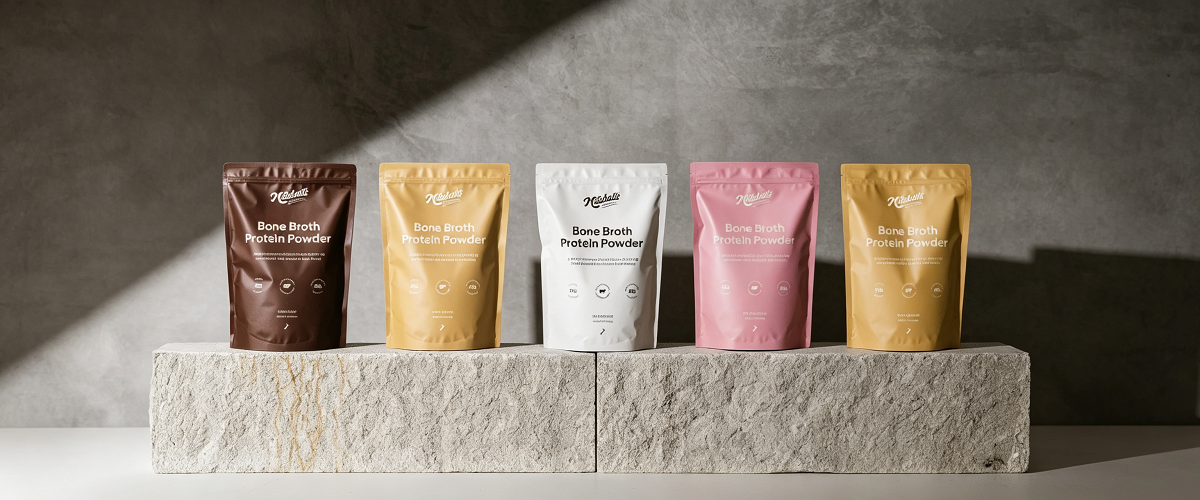
2. How Do Packaging Bags Protect Protein Powder from Moisture, Oxygen, and Contamination?
Protein powder packaging must maintain a controlled internal environment throughout its intended shelf life.
For muscle-building protein products, the most important protection factors are usually moisture control, oxygen control, contamination prevention, aroma protection, and seal integrity.
Moisture Protection Is Especially Important
Moisture is one of the biggest challenges for powdered nutritional products.
When protein powder absorbs moisture from the surrounding environment, several problems can occur:
- Powder clumping
- Reduced flowability
- Hardening
- Changes in texture
- Difficulty measuring servings
- Flavor deterioration
- Potential microbiological concerns under unsuitable conditions
Some protein formulations are particularly hygroscopic because of their ingredients. Flavored products containing sugars, sweeteners, minerals, or other components may behave differently from a simple protein concentrate.
The packaging therefore needs an effective moisture barrier that matches the formulation and expected storage environment.
Humidity During Transportation Matters
A protein powder package may be exposed to very different environments between production and consumption.
For example, the product may move through:
Manufacturing facility → warehouse → shipping container → distribution center → retail store → consumer home
During this process, temperature and relative humidity can fluctuate substantially.
Even if the package performs well in a controlled factory environment, inadequate moisture protection can become apparent during international transportation or storage in humid climates.
This is especially important for brands exporting protein powder to tropical or coastal markets.
Oxygen Protection Helps Preserve Product Quality
Oxygen can contribute to quality deterioration in protein powder, particularly when the formulation contains components that are sensitive to oxidation.
Potential effects include:
- Flavor changes
- Aroma loss
- Oxidation of fats
- Deterioration of sensitive ingredients
- Reduced sensory quality over time
The importance of oxygen protection depends on the specific formulation.
A simple protein powder and a complex nutritional formula containing fats, flavors, vitamins, and other active ingredients may not have identical oxygen-barrier requirements.
Headspace Management Is Also Important
Packaging performance is not determined solely by the film.
The amount and composition of air inside the package can influence shelf-life performance.
For larger protein bags, the package may contain a relatively large headspace after filling. If the formulation is oxygen-sensitive, manufacturers may consider process controls such as controlled gas flushing where appropriate.
The packaging system should therefore be evaluated as a combination of:
film structure + sealing + filling process + headspace management + storage conditions.
Seal Integrity Prevents Environmental Contamination
A high-barrier film cannot compensate for a poor seal.
The seal is the package's final protective barrier. Weak, incomplete, contaminated, or damaged seals can allow:
- Moisture ingress
- Oxygen ingress
- Dust contamination
- Odor migration
- Loss of product protection
Protein powder creates a particular challenge because fine particles can become trapped in the seal area during filling.
For this reason, manufacturers should pay close attention to:
- Seal temperature
- Dwell time
- Pressure
- Seal width
- Powder contamination
- Film compatibility
- Zipper construction
- Seal strength testing
Aroma and Odor Protection
Flavored protein powders may contain strong aromas such as chocolate, vanilla, coffee, strawberry, banana, or peanut butter.
Packaging needs to help prevent the product's aroma from escaping while also reducing the risk of external odors entering the package.
This becomes especially important during:
- Long-distance shipping
- Warehouse storage
- Container transportation
- Storage near strongly scented products
A good packaging structure helps maintain the intended sensory profile from manufacturing to consumption.
Protection from External Contamination
Protein powder should remain protected from external contaminants throughout its commercial life.
Flexible packaging can provide a continuous protective barrier when properly manufactured and sealed.
However, packaging alone cannot guarantee product safety. The final system also depends on:
- Hygienic filling conditions
- Food-contact-compliant materials
- Proper sealing
- Clean handling
- Suitable storage
- Transportation controls
- Quality inspection
This is why packaging selection should be integrated into the broader food-safety and quality-management process.
Packaging Performance Must Be Tested Under Real Conditions
Rather than selecting a film based only on its theoretical barrier properties, manufacturers should evaluate the finished package.
Useful tests may include:
| Test | What It Helps Evaluate |
|---|---|
| Water vapor transmission testing | Moisture protection |
| Oxygen transmission testing | Oxygen barrier performance |
| Seal strength testing | Resistance of sealed areas |
| Leak testing | Package integrity |
| Drop testing | Resistance to handling damage |
| Compression testing | Protection during stacking |
| Aging studies | Long-term performance |
| Sensory evaluation | Flavor and aroma retention |
For export products, simulated transportation and accelerated storage testing can provide additional information before commercial launch.

3. Which Packaging Materials Provide the Best Barrier Protection for Protein Powder?
There is no single material structure that is automatically best for every protein powder.
The appropriate structure depends on formulation sensitivity, shelf-life target, fill size, transportation conditions, packaging equipment, appearance requirements, and cost expectations.
Instead of choosing a structure solely by material name, manufacturers should define the required barrier performance first and then select the laminate that can achieve it.
PET-Based High-Barrier Structures
PET is commonly used as an outer layer in flexible packaging because it provides good mechanical performance and supports high-quality printing.
For protein powder applications, PET may be combined with a dedicated barrier layer and a suitable sealing layer.
A typical structure could be:
PET / VMPET / PE
This type of construction can provide strong protection against moisture, oxygen, and light while maintaining good print quality and mechanical durability.
It may be suitable for:
- Whey protein
- Plant protein
- Flavored protein blends
- Retail protein powders
- Products requiring strong overall barrier performance
Aluminum Foil Laminates
When maximum barrier performance is required, aluminum foil can be incorporated into the laminate.
A representative structure is:
PET / AL / PE
This provides very strong protection against:
- Oxygen
- Moisture
- Light
- Aroma transfer
Aluminum-based structures may be considered for products with demanding shelf-life targets, sensitive formulations, or challenging transportation conditions.
However, maximum barrier performance is not always necessary.
Using the highest-barrier structure for every product can increase material cost and may conflict with a brand's sustainability strategy.
Metallized Film Structures
Metallized films can provide a useful balance between barrier performance, appearance, weight, and cost.
For many mainstream protein powders, a metallized structure may provide sufficient protection when combined with appropriate sealing and filling controls.
This makes structures such as:
PET / VMPET / PE
attractive for applications where a strong barrier is required without moving immediately to a foil laminate.
PE-Based Sealing Layers
The inner sealing layer is particularly important because it comes into direct contact with the powder and forms the package seal.
For protein powder bags, the sealing layer should provide:
- Reliable heat sealing
- Appropriate seal strength
- Good compatibility with the filling line
- Suitable food-contact performance
- Resistance to the intended storage environment
The exact PE or polyolefin formulation should be selected based on the package design and production process rather than simply specifying a generic PE layer.
Mono-Material Structures
Sustainability goals have increased interest in recyclable mono-material flexible packaging.
For suitable applications, PE-based or PP-based structures may be engineered to provide a combination of:
- Barrier performance
- Heat sealing
- Mechanical strength
- Printability
- Recyclability potential
However, the actual recyclability of a package depends on its complete structure, additives, inks, adhesives, local collection systems, and applicable regulations.
A mono-material design should therefore be validated rather than treated as automatically recyclable in every market.
Material Selection Comparison
| Structure | Barrier Level | Typical Application | Key Consideration |
|---|---|---|---|
| PET/PE | Moderate | Less demanding formulations | Cost-efficient where barrier demand is lower |
| PET/VMPET/PE | High | Retail protein powders | Strong balance of barrier and cost |
| PET/AL/PE | Very high | Sensitive or long-shelf-life products | Maximum barrier but higher material complexity |
| PE-based mono-material | Application-dependent | Sustainability-focused products | Requires structure and recyclability validation |
Barrier Requirements Should Follow the Formula
Protein powder is not a single product category from a packaging perspective.
For example:
Plain whey protein may have different sensitivity from a flavored protein powder containing oils and flavor compounds.
Plant-based protein may have different aroma and moisture behavior from dairy-based protein.
Mass gainer powder may contain carbohydrates, fats, flavors, and other ingredients that create different packaging requirements.
Protein blends with added vitamins and functional ingredients may require additional consideration for oxygen and moisture sensitivity.
Therefore, the packaging specification should start with the actual formulation rather than using the same laminate for every SKU.
Avoid Choosing Packaging Solely by Thickness
A thicker film is not automatically a better package.
Barrier performance depends on the specific material structure, not simply total thickness.
A well-designed laminate with an effective barrier layer may outperform a thicker low-barrier structure.
For this reason, buyers should consider technical specifications such as:
- Oxygen transmission rate
- Water vapor transmission rate
- Seal strength
- Puncture resistance
- Tensile performance
- Overall thickness
- Temperature resistance
rather than comparing thickness alone.
A Practical Material Selection Framework
For protein powder packaging, a useful sequence is:
- Define the product formulation.
- Establish the required shelf life.
- Identify the expected climate and transportation conditions.
- Determine oxygen and moisture sensitivity.
- Define the package size and fill weight.
- Select the bag format.
- Establish target barrier performance.
- Select the laminate structure.
- Validate the finished package through testing.
- Confirm compatibility with the filling and sealing equipment.
This approach reduces the risk of over-specifying or under-protecting the package.
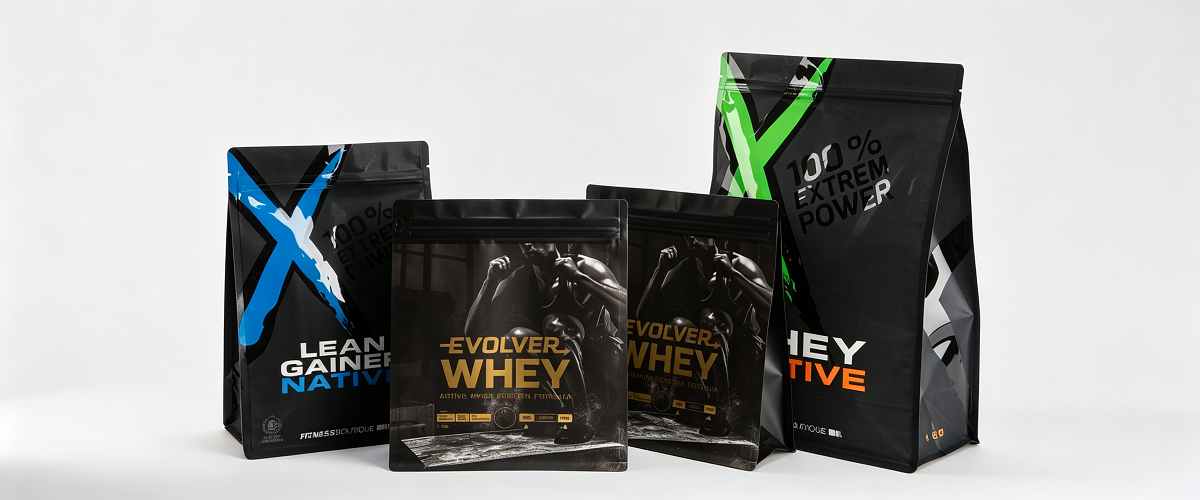
4. What Packaging Features Should You Consider for Protein Powder Products?
A protein powder package needs to work well both on the production line and in the consumer's kitchen, office, gym, or travel bag.
Functional features should therefore be selected according to actual usage behavior.
Resealable Zippers
For multi-serving protein powder, a zipper can significantly improve convenience.
A good zipper helps consumers:
- Open the package repeatedly
- Reseal the bag after each serving
- Reduce moisture exposure after opening
- Store the product more conveniently
However, a zipper should not be treated as the primary barrier. The overall package must still have a reliable primary seal and appropriate barrier structure.
Easy-Open Features
Protein powder bags should be easy to open without requiring scissors.
A tear notch can provide a controlled starting point for opening.
This is particularly useful for:
- First-time opening
- Gym use
- Travel
- Consumers with limited hand strength
The tear design should be balanced carefully. An opening that is too easy to initiate may compromise package integrity during transportation.
Large Opening Designs
Large protein bags may benefit from an opening that allows consumers to access the powder without excessive spillage.
The package geometry should make it easy to:
- Insert a measuring scoop
- Remove the scoop
- Pour powder
- Check remaining product
- Reseal the package
For high-volume packages, opening width and bag stiffness can have a surprisingly large effect on consumer satisfaction.
Scoop-Friendly Design
Protein powder is often consumed using a measuring scoop.
The packaging should therefore provide enough opening space for convenient scoop access.
A narrow opening may make it difficult to retrieve powder cleanly, while an overly flexible bag can collapse inward during use.
For larger bags, structural stability and opening geometry should be considered together.
Handles for Large Protein Bags
Large protein powder packages can become heavy and awkward to carry.
A handle may be useful for:
- Large retail packs
- Mass gainer products
- Gym users
- Family-size products
- Foodservice packaging
However, handle placement must be designed carefully so that the bag remains mechanically reliable during transportation.
Tear Notches and Controlled Opening
A tear notch can make the initial opening easier, but the notch should be positioned to prevent accidental tearing into the zipper or product area.
For resealable bags, the relationship between:
tear notch → zipper → top seal
should be tested as one system.
Flat Bottom and Stable Base
A stable base can make a large protein pouch easier to store.
This is especially useful for consumers who keep protein powder:
- In kitchen cabinets
- On countertops
- In gym storage areas
- In pantry shelves
Stable bags can also improve shelf presentation in retail environments.
Transparent Windows
A transparent window can allow consumers to see the powder inside, but it is not always necessary.
For protein powder, the product itself is usually less visually important than it is for snacks or coffee beans.
A window may therefore provide limited marketing value while reducing light protection.
For formulations sensitive to light, an opaque high-barrier design may be more appropriate.
Hanging Holes and Retail Features
For smaller sports nutrition products sold through convenience or specialty retail, hanging holes can improve merchandising flexibility.
These features may be useful for:
- Sample packs
- Small protein products
- Sports nutrition sachets
- Promotional packs
QR Codes and Digital Product Information
Protein brands can use packaging to connect consumers with digital information.
A QR code can potentially direct users to:
- Preparation instructions
- Workout information
- Ingredient information
- Product authentication
- Batch information
- Brand community content
- Subscription services
The printed packaging remains the primary physical information source, but digital features can extend the consumer experience.
Tamper-Evident Considerations
Depending on the market and package design, brands may consider additional tamper-evident features.
The exact approach depends on regulatory requirements, distribution conditions, and whether the packaging is intended for retail or other channels.
The important principle is that consumers should be able to recognize whether the package has been opened or compromised before use.
Printing and Branding Features
Protein powder is a highly competitive category, so packaging design plays an important commercial role.
Flexible packaging can support:
- High-resolution graphics
- Matte finishes
- Gloss finishes
- Metallic effects
- Spot effects
- Minimalist premium designs
- Large product photography
- Color-coded flavor systems
The design should make essential information easy to find.
For example, consumers should be able to identify:
protein type + flavor + serving size + key nutritional information
without having to search through decorative graphics.
Feature Selection by Consumer Use
| Feature | Best Suited For | Main Benefit |
|---|---|---|
| Zipper | Multi-serving bags | Resealability |
| Tear notch | Most retail bags | Easy opening |
| Wide opening | Large bags | Easier scooping |
| Handle | Large fills | Easier carrying |
| Flat bottom | Premium/large bags | Stable storage |
| Hanging hole | Small retail packs | Flexible merchandising |
| QR code | Brand-focused products | Digital engagement |
| Opaque barrier design | Light-sensitive products | Better light protection |
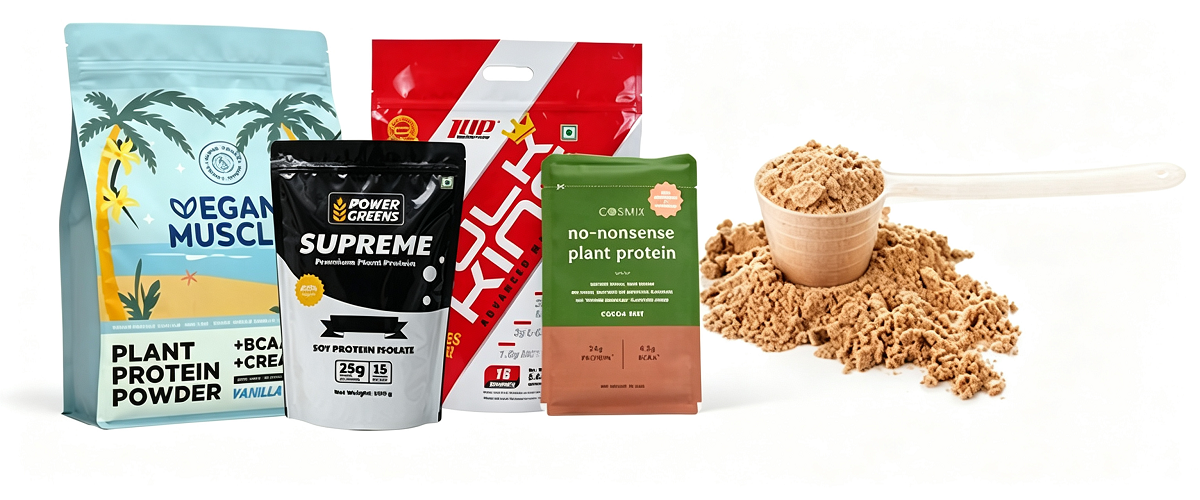
5. Protein Powder Packaging Bags: Key Factors for Freshness, Shelf Life, Branding, and Consumer Convenience
Selecting the correct protein powder packaging requires more than choosing a visually attractive pouch.
The final package should balance product protection, manufacturing efficiency, logistics, consumer usability, branding, regulatory requirements, and total cost.
Product Formulation Comes First
The packaging specification should begin with the product itself.
Important questions include:
- Is it whey, casein, plant-based, or a blended formula?
- Does it contain added fats?
- Does it contain flavors?
- Does it contain vitamins or minerals?
- Is it hygroscopic?
- How long will the product remain open after first use?
- Does it have a strong aroma?
- What is the target serving size?
These factors influence the required barrier level and functional design.
Shelf-Life Target
Shelf life should be established before selecting the final packaging structure.
A product intended for a relatively short domestic distribution cycle may not require the same packaging specification as a protein powder intended for:
- Long-distance export
- Ocean freight
- Hot climates
- Humid markets
- Extended warehouse storage
Shelf-life validation should consider both unopened and, where relevant, opened-package use conditions.
Storage Environment
Protein powder may be stored under a wide range of conditions.
Manufacturers should consider:
- Temperature
- Relative humidity
- Direct sunlight
- Warehouse ventilation
- Transportation duration
- Container conditions
- Retail storage
A package designed for a dry indoor environment may require additional protection when distributed in humid regions.
E-Commerce Requirements
Online sales create additional packaging challenges.
Protein powder packages may experience:
- Repeated handling
- Compression
- Drops
- Abrasion
- Long-distance transportation
- Parcel sorting
The package therefore needs sufficient puncture and seal strength to survive distribution.
For e-commerce, package appearance also matters because the consumer may first experience the brand through an online product page and then through the physical package delivered to the home.
Branding and Shelf Presence
A protein powder bag has a large printable surface, creating significant branding opportunities.
A strong design hierarchy should make the most important information immediately visible.
For example:
Brand → Product Type → Flavor → Key Benefit → Net Weight
can create a clear visual structure.
The back panel can then carry more detailed information such as:
- Ingredients
- Nutrition facts
- Preparation instructions
- Storage instructions
- Manufacturer information
- Regulatory information
- Batch or traceability information
Color Coding for Different Flavors
Protein brands often sell multiple flavors within one product line.
A consistent packaging architecture can make flavor recognition easier.
For example, a brand can maintain:
- The same logo position
- The same product hierarchy
- The same typography
while changing selected visual elements to distinguish flavors.
This creates a recognizable product family without making every SKU look identical.
Private Label and Contract Manufacturing
For private-label protein products, packaging often needs to accommodate different brands while maintaining efficient production.
The supplier should be able to support:
- Custom dimensions
- Custom printing
- Different fill weights
- Multiple SKUs
- Functional features
- Consistent color reproduction
- Repeat orders
This is particularly important for brands that launch several flavors simultaneously.
Packaging and Filling-Line Compatibility
A visually excellent bag can still fail commercially if it does not run efficiently on the production line.
Before mass production, manufacturers should confirm:
- Bag dimensions
- Filling tolerance
- Opening behavior
- Seal area
- Powder contamination risk
- Zipper alignment
- Machine speed
- Sealing temperature
- Bag stiffness
- Finished-package weight
Trial production is strongly recommended before finalizing large orders.
Transportation and Carton Packing
Flexible packaging reduces package weight, but the finished bags still need to be packed correctly for transportation.
Important considerations include:
- Carton dimensions
- Bag orientation
- Compression
- Pallet stacking
- Drop resistance
- Moisture exposure
- Warehouse handling
For larger protein bags, excessive compression can increase the risk of creasing or seal damage.
Sustainability Considerations
Sustainability is increasingly relevant to sports nutrition brands.
Potential approaches include:
- Lightweighting
- Material reduction
- Recyclable mono-material structures where technically and locally appropriate
- Efficient package dimensions
- Reduced secondary packaging
- Responsible printing and adhesive choices
However, sustainability should be evaluated together with product protection.
A package that uses less material but fails to maintain product quality may create greater overall waste through damaged or discarded product.
Cost Should Be Evaluated as Total Packaging Cost
The cheapest film is not necessarily the lowest-cost solution.
A better evaluation includes:
Material cost + printing + conversion + filling efficiency + transportation + product loss + shelf-life performance + consumer usability
For example, a slightly more expensive high-barrier structure may reduce product deterioration and customer complaints enough to provide better overall economics.
Recommended Decision Matrix
| Factor | Key Question |
|---|---|
| Product | What is the protein formulation and sensitivity profile? |
| Shelf life | How long must the package protect the product? |
| Barrier | What moisture and oxygen performance is required? |
| Format | Which bag shape suits the fill weight and usage pattern? |
| Closure | Does the consumer need repeated access? |
| Opening | Can the bag be opened and used without spillage? |
| Production | Is it compatible with the filling and sealing equipment? |
| Logistics | Can it withstand shipping and warehouse handling? |
| Branding | Does it provide enough printable space? |
| Sustainability | Can material use be reduced without compromising performance? |
| Cost | What is the total cost across the packaging lifecycle? |
A Practical Protein Powder Packaging Selection Process
For brands developing a new muscle-building protein product, the following workflow can help:
Step 1: Define the product
Document formulation, powder density, flavor, sensitivity, and target serving size.
Step 2: Define the market
Identify whether the product is intended for domestic retail, e-commerce, export, foodservice, or multiple channels.
Step 3: Establish shelf-life requirements
Determine the required unopened shelf life and expected consumer usage period after opening.
Step 4: Define barrier requirements
Set target oxygen and moisture performance based on the product rather than selecting a laminate first.
Step 5: Select the bag format
Choose between stand-up, flat-bottom, gusseted, three-side seal, or sachet formats.
Step 6: Add functional features
Evaluate zippers, tear notches, handles, wide openings, QR codes, and other features according to actual consumer needs.
Step 7: Test production compatibility
Run packaging trials on the intended filling and sealing equipment.
Step 8: Conduct finished-package testing
Evaluate seal strength, leakage, barrier performance, handling durability, and storage stability.
Step 9: Validate shelf life
Use appropriate real-time or accelerated studies to confirm that the final package protects the actual formulation.
Step 10: Finalize commercial specifications
Document the film structure, dimensions, tolerances, printing requirements, features, testing standards, and quality criteria before mass production.
Protein Powder Packaging Should Protect Both the Product and the Brand
For muscle-building protein powder, packaging is part of the product experience.
Consumers expect the package to:
- Open easily
- Stay securely closed
- Keep the powder dry
- Prevent contamination
- Remain attractive
- Be easy to store
- Survive shipping
- Communicate product information clearly
For brands, the package must also:
- Protect shelf life
- Support efficient filling
- Reduce logistics costs
- Maintain consistent appearance
- Differentiate products
- Meet applicable food-contact requirements
The strongest packaging solution is therefore not simply the package with the highest barrier or the most attractive appearance. It is the package that provides the right balance between product protection, production performance, consumer convenience, branding, sustainability, and cost.
Frequently Asked Questions
What is the best packaging bag for muscle-building protein powder?
For many multi-serving retail protein powders, high-barrier stand-up pouches or flat-bottom bags with reliable resealable closures are practical options. The final choice depends on fill weight, formulation, shelf-life requirements, production equipment, and distribution conditions.
Does protein powder need moisture-barrier packaging?
Yes. Moisture control is particularly important because protein powder can absorb humidity, resulting in clumping, hardening, reduced flowability, and changes in usability. The required moisture barrier should be determined according to the specific formulation and storage environment.
Should protein powder packaging include a zipper?
For multi-serving products, a zipper can significantly improve consumer convenience by allowing repeated opening and resealing. However, the zipper should complement—not replace—the package's primary barrier and sealing system.
Is aluminum foil necessary for protein powder packaging?
Not necessarily. Aluminum foil can provide very high barrier performance, but metallized or other high-barrier structures may be sufficient for many protein powder applications. The appropriate choice depends on formulation sensitivity, shelf-life requirements, transportation conditions, and cost objectives.
What is better for large protein powder bags: stand-up or flat-bottom packaging?
Both can work. Flat-bottom bags generally provide strong stability for larger fills, while stand-up pouches offer flexible sizing and a familiar retail format. The decision should consider package weight, shelf presentation, storage space, filling equipment, and consumer handling.
Can protein powder be packaged in recyclable mono-material bags?
Potentially, yes. Recyclable mono-material structures can be developed for suitable applications, but actual recyclability depends on the complete package construction and the recycling infrastructure and regulations in the target market. Barrier performance and shelf-life validation should remain part of the evaluation.
How can protein powder packaging prevent clumping?
The primary strategy is to control moisture exposure. This requires an appropriate moisture-barrier structure, reliable seals, clean filling conditions, suitable storage, and careful control of the package after opening. A zipper can help reduce environmental exposure during repeated use, but it does not compensate for an inadequate primary barrier.
Is flexible packaging suitable for protein powder sold through e-commerce?
Yes. Flexible pouches can be lightweight and space-efficient, but the finished package must be designed to withstand parcel handling, compression, drops, abrasion, and long-distance transportation. Seal strength and puncture resistance are particularly important.
What packaging size is suitable for protein powder?
There is no universal ideal size. Common commercial formats range from single-serving sachets to large multi-serving bags. The appropriate size depends on serving frequency, product positioning, price point, distribution channel, and consumer storage habits.
What should protein powder brands test before mass production?
Brands should evaluate the finished package for barrier performance, seal integrity, leakage, mechanical durability, filling-line compatibility, storage stability, and shelf-life performance. Testing the complete package under realistic conditions is more informative than selecting materials based only on theoretical specifications.
Conclusion
Choosing packaging bags for muscle-building protein powder requires a product-specific approach. The package must protect the powder from moisture, oxygen, contamination, odors, light, and physical damage while remaining convenient for consumers to open, use, reseal, and store.
For many retail applications, stand-up pouches and flat-bottom bags provide a strong combination of barrier protection, functionality, branding space, and convenience. High-barrier laminates such as metallized structures or aluminum-based constructions can be considered when the formulation and shelf-life target require stronger protection, while suitable mono-material options may be explored when recyclability is an important design objective.
The most important point is that packaging should be selected as a complete system rather than as a film specification alone. Formulation, barrier requirements, bag format, sealing technology, filling equipment, transportation conditions, shelf-life targets, branding, and consumer behavior all need to work together.
For muscle-building protein brands, the right flexible packaging can do much more than protect powder. It can help preserve product quality from production to consumption, simplify everyday use, strengthen brand recognition, support efficient distribution, and create a more professional consumer experience.