How to Choose the Right Flexible Packaging Bags for Rice
Anna_Yu
How to Choose the Right Flexible Packaging Bags for Rice
Rice is one of the world's most widely consumed staple foods, and its packaging plays an important role in maintaining product quality from processing and storage to transportation and final consumption. Whether the product is white rice, brown rice, jasmine rice, basmati rice, glutinous rice, organic rice, or a specialty premium variety, the right packaging needs to protect the grains from moisture, pests, contamination, mechanical damage, and unfavorable storage conditions.
Flexible packaging bags have become an increasingly popular choice for rice because they can combine lightweight construction, strong mechanical performance, moisture protection, customizable sizes, efficient transportation, and attractive printing. Compared with some traditional rigid packaging formats, flexible bags can also provide greater flexibility in package design and production.
However, rice packaging is not a one-size-fits-all application. A small retail bag may have very different requirements from a large foodservice or bulk rice bag. Similarly, brown rice and other higher-oil-content varieties may require different protection from highly polished white rice. Storage conditions, transportation distance, package weight, filling equipment, shelf-life expectations, and target market regulations should all be considered when selecting the packaging structure.
The most suitable rice packaging therefore needs to balance barrier performance, strength, sealing reliability, handling convenience, branding, sustainability, and cost. Choosing the right combination of materials and bag construction can help protect rice quality while improving the overall efficiency of the supply chain.
This guide explores the major flexible packaging options for rice, explains how different materials protect the product, and examines the features brands should consider when developing retail, bulk, and export rice packaging.
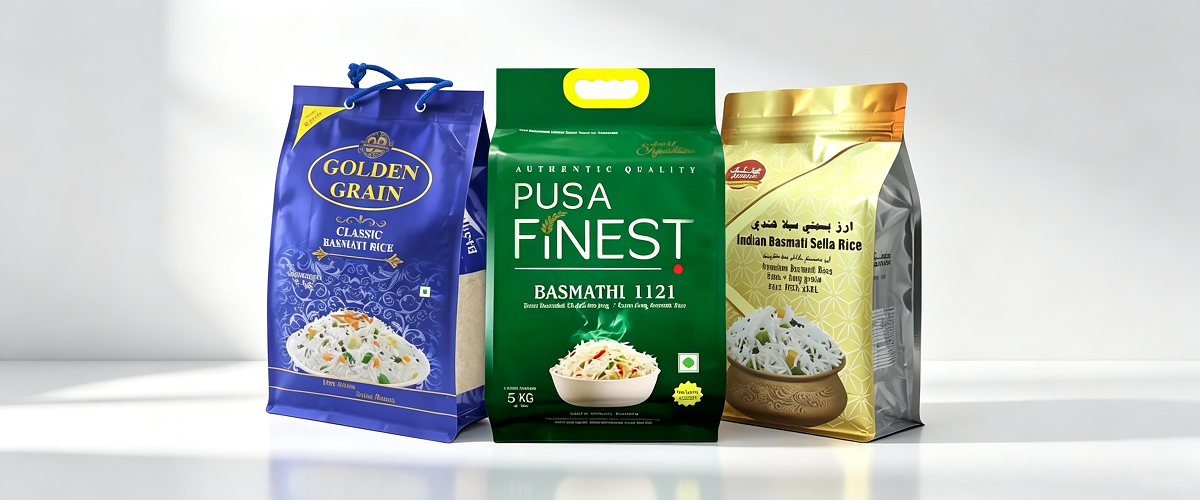
1. What Types of Flexible Packaging Bags Are Best for Rice Products?
The best flexible packaging bag depends on the rice variety, package size, distribution channel, and consumer requirements.
Rice can be sold in small retail quantities, family-size bags, foodservice packages, and large commercial formats. Each application places different demands on the packaging.
Stand-Up Pouches
Stand-up pouches are suitable for smaller retail rice packages where shelf presentation and consumer convenience are important.
They can be used for:
- Premium rice
- Organic rice
- Specialty rice
- Jasmine rice
- Basmati rice
- Ready-to-cook rice products
The bottom gusset allows the pouch to stand upright, improving shelf visibility and providing a convenient format for retail environments.
Stand-up pouches can also incorporate resealable closures for products that consumers may use over several meals.
Flat Bottom Bags
Flat bottom bags provide excellent stability and a relatively large printable surface.
They are suitable for:
- Premium rice
- Specialty rice
- Medium-volume retail products
- Private-label rice
- Export-oriented products
The structured bottom allows the bag to stand securely, while multiple printable panels provide space for branding, cooking instructions, nutritional information, and regulatory information.
Pillow Bags
Pillow bags are commonly used for efficient high-speed packaging applications.
They can be suitable for:
- Smaller rice packages
- Promotional packs
- Value-oriented products
- High-volume production
Their relatively simple construction can provide a cost-efficient solution when advanced features such as a zipper or stand-up structure are not necessary.
Three-Side Seal Bags
Three-side seal bags offer a simple and flexible format for rice products.
They can be customized in different sizes and material structures and are particularly useful when efficient filling and sealing are priorities.
Large Rice Bags
For bulk and foodservice applications, larger flexible bags can provide a practical alternative to smaller retail formats.
They may be designed for:
- Restaurants
- Catering companies
- Foodservice distributors
- Wholesale markets
- Commercial kitchens
Larger bags require greater attention to tensile strength, puncture resistance, seal strength, and handling.
Packaging Format Comparison
| Bag Type | Typical Application | Main Advantage |
|---|---|---|
| Stand-Up Pouch | Premium and retail rice | Shelf appeal and convenience |
| Flat Bottom Bag | Premium and specialty rice | Stability and large printing area |
| Pillow Bag | Value and high-volume products | Cost efficiency |
| Three-Side Seal Bag | Retail and specialty packs | Simple and versatile structure |
| Large Flexible Bag | Bulk and foodservice rice | Capacity and handling efficiency |
The right format should be selected based on package weight, retail environment, filling equipment, storage conditions, and consumer expectations.
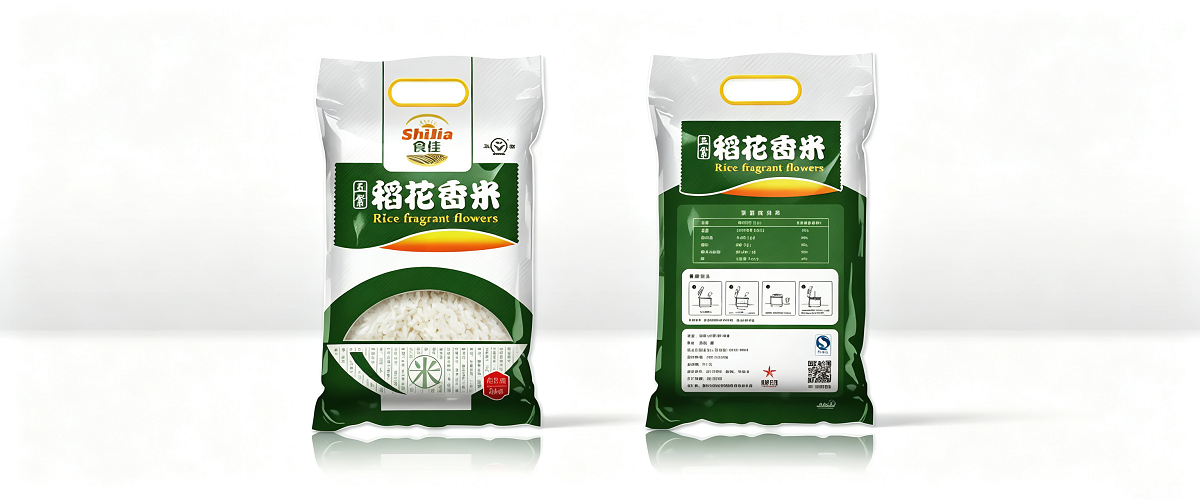
2. How Do Flexible Packaging Bags Protect Rice from Moisture, Pests, and Contamination?
Rice is relatively stable when properly dried and stored, but poor packaging can expose the grains to moisture, insects, dust, odors, and other contaminants.
A suitable flexible packaging bag creates a protective barrier between the product and the external environment.
Moisture Protection
Moisture is one of the most important considerations in rice packaging.
Excessive moisture can contribute to:
- Grain quality deterioration
- Mold development
- Changes in texture
- Reduced storage stability
- Unwanted odors
A suitable moisture barrier helps prevent water vapor from entering the package during storage and transportation.
This is particularly important in humid climates or when rice is transported through regions with significant temperature and humidity changes.
Pest Protection
Rice can be vulnerable to insects and other pests if packaging is damaged or inadequately sealed.
Packaging can help reduce exposure by providing:
- Strong seals
- Puncture resistance
- Tear resistance
- Appropriate film thickness
- Secure closures
The packaging itself should not be viewed as the only pest-control measure. Proper processing, sanitation, storage conditions, and supply-chain management remain essential.
Contamination Protection
A sealed flexible bag can help protect rice from:
- Dust
- Dirt
- Foreign particles
- Handling contamination
- External odors
The package should remain securely sealed throughout transportation and storage.
Oxygen Protection
Oxygen is generally less critical for highly polished white rice than moisture, but it can become more relevant for rice varieties containing more natural oils.
Brown rice, for example, contains more of the grain's natural germ and bran components and may be more susceptible to oxidation.
For products with longer shelf-life requirements, an enhanced oxygen barrier may therefore be considered.
Light Protection
Light can also affect product quality over extended storage periods.
Opaque or metallized structures can provide stronger protection when light sensitivity is a concern.
However, transparent packaging may be intentionally used for certain rice products because consumers want to see the grain quality.
The packaging design should therefore balance product visibility and protection.
Protective Function Comparison
| Risk | Packaging Protection |
|---|---|
| Moisture | High moisture-barrier film |
| Dust | Sealed package |
| Insects | Strong, intact packaging |
| Contamination | Secure seals and closures |
| Oxygen | Enhanced barrier when required |
| Light | Opaque or metallized layers |
| Mechanical damage | Strong outer film |
A complete rice packaging strategy should combine suitable packaging materials with proper filling, sealing, storage, and transportation practices.
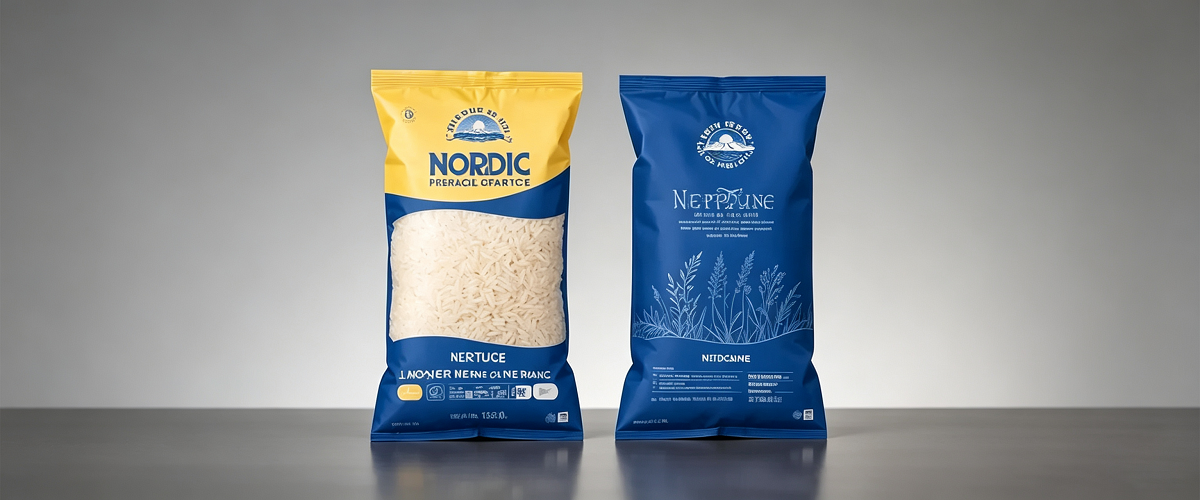
3. Which Packaging Materials Provide the Best Barrier Protection for Rice?
Material selection determines many of the package's most important performance characteristics.
Rice packaging structures commonly combine different layers so that each material performs a specific function.
PE and LLDPE
Polyethylene is widely used as an inner sealing layer.
It can provide:
- Good heat-sealing performance
- Flexibility
- Toughness
- Moisture resistance
- Good processability
LLDPE can also contribute to puncture and impact resistance, making it useful for packages that need to withstand transportation and handling.
BOPP
Biaxially oriented polypropylene can provide:
- Good stiffness
- Attractive appearance
- Good printability
- Moisture resistance
- Cost efficiency
BOPP-based structures can be suitable for a range of retail rice applications.
PET
PET is frequently used as an outer layer because of its:
- Mechanical strength
- Dimensional stability
- Print quality
- Surface durability
PET can be laminated with other materials to create a more comprehensive rice packaging structure.
BOPA / Nylon
Nylon can be considered when greater mechanical resistance is required.
It can improve:
- Puncture resistance
- Tear resistance
- Flexibility
- Overall package durability
This can be particularly useful for heavier rice bags or demanding distribution environments.
VMPET
Metallized PET can provide enhanced barrier performance against:
- Moisture
- Oxygen
- Light
It can be considered for rice products requiring greater protection or longer shelf-life performance.
Aluminum Foil
Aluminum foil provides a very strong barrier against:
- Moisture
- Oxygen
- Light
- External odors
It may be appropriate for premium or specialized rice products with demanding shelf-life requirements.
However, foil-based multilayer packaging may have greater material complexity than some recyclable mono-material structures.
Common Rice Packaging Structures
| Structure | Typical Benefit | Possible Application |
|---|---|---|
| BOPP/PE | Cost-efficient and flexible | Standard retail rice |
| PET/PE | Strength and printability | Retail and specialty rice |
| BOPP/LLDPE | Moisture resistance and toughness | Retail rice |
| PET/VMPET/PE | Enhanced barrier | Premium or longer shelf-life rice |
| PET/AL/PE | Very high barrier | Specialized and premium applications |
| BOPA/PE | Strong mechanical performance | Heavy or demanding packages |
The ideal structure should be determined according to the rice variety, package weight, shelf-life requirements, storage climate, and distribution conditions.
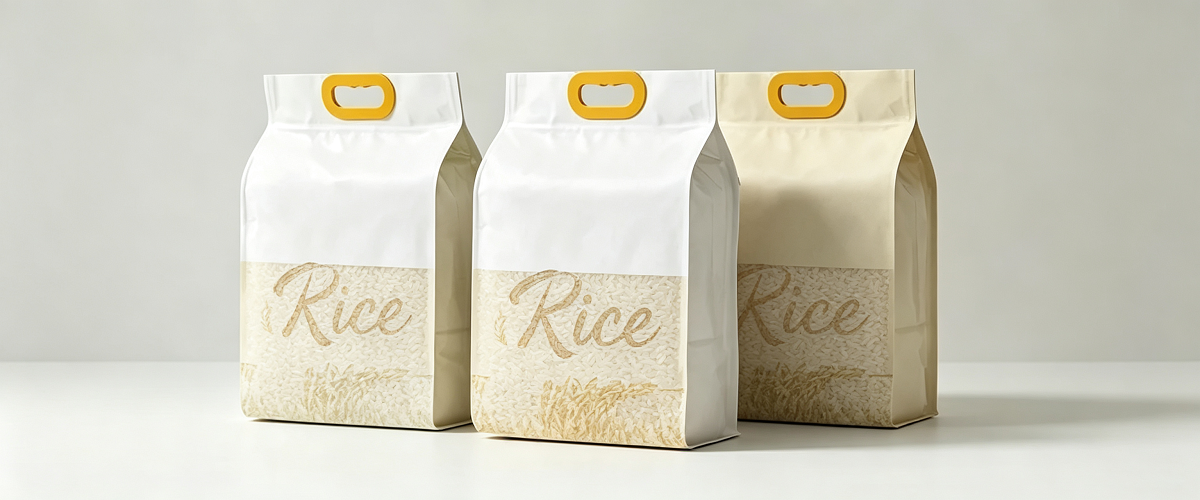
4. What Packaging Features Should You Consider for Retail and Bulk Rice Packaging?
Material selection is only one part of rice packaging design. Structural and functional features can also have a major impact on consumer convenience and package performance.
Resealable Zippers
For retail rice packages that are opened and used over multiple meals, a zipper can provide convenient resealing.
Benefits include:
- Easier storage after opening
- Reduced exposure to moisture
- Improved consumer convenience
- Better package organization
The zipper should be positioned appropriately according to the pouch size and filling level.
Easy-Open Features
Tear notches can make the package easier to open without scissors.
This is particularly useful for household rice bags.
Carrying Handles
Large rice bags may benefit from integrated handles.
Handles can make it easier for consumers or foodservice workers to:
- Lift the package
- Carry it from stores
- Move it into storage
- Pour rice into containers
The handle must be designed and tested according to the filled package weight.
Transparent Windows
Some rice brands use transparent windows to allow consumers to inspect the grains.
This can be valuable for premium products where visual grain quality is an important purchasing factor.
However, excessive exposure to light can reduce the protective performance of the package.
A small controlled window may provide a useful balance between product visibility and protection.
Gusseted Structures
Gussets can improve:
- Package stability
- Fill volume
- Shelf presentation
- Storage efficiency
They are particularly useful for stand-up and larger rice bags.
High-Quality Printing
Rice packaging has strong branding potential because the package surface can communicate:
- Rice variety
- Country or region of origin
- Cooking instructions
- Grain characteristics
- Quality information
- Brand story
- Certifications
High-resolution printing can help premium rice products differentiate themselves in competitive retail environments.
Functional Feature Comparison
| Feature | Main Benefit | Suitable Application |
|---|---|---|
| Zipper | Resealing | Retail rice |
| Tear Notch | Easy opening | Household packs |
| Handle | Easier carrying | Medium and large bags |
| Gusset | Stability and capacity | Stand-up and bulk bags |
| Window | Product visibility | Premium rice |
| High-Quality Printing | Branding | Retail and export |
| Strong Seals | Product protection | All package formats |
The best combination depends on package size, consumer usage, filling process, and distribution requirements.
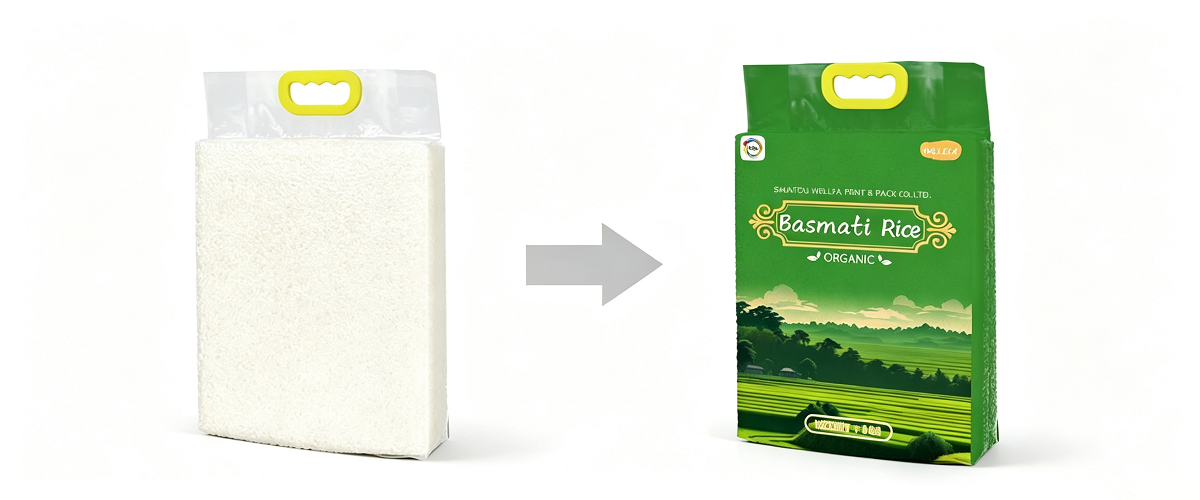
5. Flexible Rice Packaging Bags: Key Factors for Freshness, Durability, Branding, and Distribution
Selecting the right rice packaging requires a broader evaluation that considers the entire product life cycle.
Freshness and Shelf Life
The target shelf life should influence the material structure.
Factors to consider include:
- Rice variety
- Moisture content
- Oil content
- Storage temperature
- Humidity
- Oxygen exposure
- Light exposure
- Distribution duration
White rice may have different packaging requirements from brown rice because their susceptibility to quality deterioration can differ.
Durability
Rice is relatively dense, meaning that even a small package can place considerable stress on the bottom and side seals.
Packaging should therefore be evaluated for:
- Tensile strength
- Puncture resistance
- Tear resistance
- Seal strength
- Drop resistance
- Compression resistance
Large packages require particularly careful structural design.
Transportation
Rice can be transported domestically or internationally, and packaging may experience:
- Vibration
- Compression
- Impact
- Temperature changes
- Humidity
- Repeated handling
Export packaging should therefore be tested under realistic distribution conditions.
Branding
Flexible packaging provides a large surface for brand communication.
A rice brand can use packaging to communicate:
- Product origin
- Rice variety
- Cooking quality
- Premium positioning
- Organic or specialty attributes
- Sustainability messages
- Preparation instructions
Matte, gloss, metallic, and other finishing effects can also be used to create different visual identities.
Sustainability
Flexible rice packaging can be designed with material efficiency in mind.
Potential strategies include:
- Reduced film thickness
- Lightweight structures
- Recyclable mono-material films
- Optimized package dimensions
- Reduced secondary packaging
- Efficient transportation
However, sustainability should not come at the expense of necessary product protection.
The correct approach is to identify the minimum packaging performance needed to protect the product throughout its intended supply chain.
Retail vs. Bulk Packaging
| Factor | Retail Rice | Bulk Rice |
|---|---|---|
| Typical Size | Small to medium | Medium to large |
| Branding | Very important | Important |
| Resealability | Often useful | Application dependent |
| Handle | Optional | Often valuable |
| Mechanical Strength | Moderate to high | High |
| Shelf Display | Important | Less critical |
| Transportation | Retail distribution | Wholesale and foodservice |
| Cost Optimization | Important | Very important |
Rice Packaging Selection Checklist
| Factor | Question to Ask |
|---|---|
| Rice Type | What variety is being packaged? |
| Moisture | What moisture barrier is required? |
| Shelf Life | How long must the product remain stable? |
| Package Size | What fill weight is required? |
| Strength | Can the package withstand handling? |
| Seal | Are the seals strong enough for transportation? |
| Barrier | Is oxygen or light protection required? |
| Convenience | Is a zipper or handle necessary? |
| Branding | What printing and finishes are required? |
| Distribution | Domestic, retail, wholesale, or export? |
| Sustainability | Can material use be reduced without compromising protection? |
| Cost | Does the complete package meet the target cost? |
6. FAQ
What Is the Best Flexible Packaging for Rice?
Stand-up pouches, flat bottom bags, pillow bags, three-side seal bags, and larger flexible rice bags can all be suitable depending on package size, rice variety, distribution channel, and required performance.
Does Rice Packaging Need a Moisture Barrier?
Yes. Moisture control is one of the most important considerations for rice packaging because excessive moisture can affect product quality and storage stability.
What Material Is Commonly Used for Rice Packaging?
PE and LLDPE are commonly used as sealing layers, while BOPP, PET, nylon, metallized films, and aluminum foil may be incorporated depending on the required mechanical and barrier performance.
Should Rice Packaging Have a Zipper?
A zipper can be useful for retail rice packages that consumers open and use repeatedly. It provides convenient resealing and can help protect the remaining rice during household storage.
Is Transparent Rice Packaging a Good Choice?
Transparent packaging can allow consumers to inspect the rice grains, but it provides less protection from light than opaque structures. A controlled transparent window can provide a balance between visibility and product protection.
What Packaging Is Best for Bulk Rice?
Large, durable flexible bags with strong seals and sufficient puncture and tear resistance are generally appropriate for bulk and foodservice rice. Handles can also improve handling for heavier packages.
Is Flexible Packaging Suitable for Rice Export?
Yes. Flexible rice packaging can be designed for export applications, provided the material structure, seals, package strength, and secondary packaging are suitable for the expected transportation and storage conditions.
Can Rice Packaging Be Recyclable?
Some rice packages can be developed using recyclable mono-material structures, depending on the required barrier and mechanical performance. The final design should also consider local recycling infrastructure and applicable regulations.
7. Conclusion
Choosing the right flexible packaging bags for rice requires careful consideration of product characteristics, moisture protection, mechanical strength, package size, sealing performance, consumer convenience, branding, transportation, and cost.
Different rice products can benefit from different formats. Stand-up pouches and flat bottom bags can provide strong retail presentation, while pillow bags and three-side seal structures can support efficient high-volume packaging. Larger flexible bags can provide the durability and capacity required for wholesale and foodservice applications.
Material selection is equally important. PE, LLDPE, BOPP, PET, nylon, VMPET, and aluminum foil can each contribute different properties to a multilayer packaging structure. The final combination should be selected according to the rice variety, moisture sensitivity, shelf-life target, package weight, storage environment, and distribution requirements.
For retail products, features such as resealable zippers, tear notches, gussets, handles, controlled transparent windows, and high-quality printing can improve both functionality and consumer appeal. For bulk products, mechanical durability, seal strength, carrying convenience, and transportation performance generally become more important.
Flexible packaging can also provide opportunities for efficient material use and transportation. Recyclable structures, downgauged films, optimized package dimensions, and refill or reuse strategies can support sustainability goals when they are technically appropriate for the product and compatible with local recycling systems.
Ultimately, the best rice packaging is not necessarily the package with the most layers or the lowest initial material cost. It is the solution that provides the right balance of freshness protection, durability, convenience, branding, distribution efficiency, sustainability, and total cost throughout the product's intended life cycle.