How to Choose Vacuum Packaging Bags for Meat
Anna_Yu
How to Choose Vacuum Packaging Bags for Meat
Vacuum packaging is one of the most widely used packaging methods for fresh, chilled, frozen, and processed meat products. By removing a large proportion of the air from the package before sealing, vacuum packaging helps reduce oxygen exposure, improve product stability, and support efficient refrigerated or frozen distribution. It is used across a wide range of meat categories, including beef, pork, poultry, lamb, smoked meat, cooked meat, marinated products, and portion-controlled retail cuts.
However, choosing the right vacuum packaging bag is more complex than simply selecting a bag that can be vacuum sealed. Different meat products create very different packaging challenges. A fresh beef steak with sharp bone edges has different requirements from sliced cooked ham. A high-moisture marinated chicken product requires different sealing performance from a frozen pork product. Fat content, product shape, storage temperature, transportation distance, processing method, and target shelf life can all influence the required bag performance.
For meat manufacturers, processors, retailers, and food brands, packaging quality can directly affect product appearance, freshness, leakage rates, storage efficiency, and consumer confidence. A bag with insufficient puncture resistance may be damaged during handling. Poor sealing performance can allow air to enter the package. Inadequate barrier performance may reduce the effectiveness of the vacuum environment. Packaging that becomes brittle or unstable at low temperatures may create additional risks during frozen storage and transportation.
Vacuum packaging bags therefore need to be evaluated as part of the complete meat preservation system rather than as a simple container. The packaging must work together with product processing, hygiene controls, refrigeration or freezing, vacuum equipment, sealing conditions, and distribution practices.
This guide explains how to choose vacuum packaging bags for meat by examining suitable bag types, freshness protection mechanisms, material performance priorities, thickness and sealing considerations, and the key factors affecting food safety, storage, transportation, and final product quality.
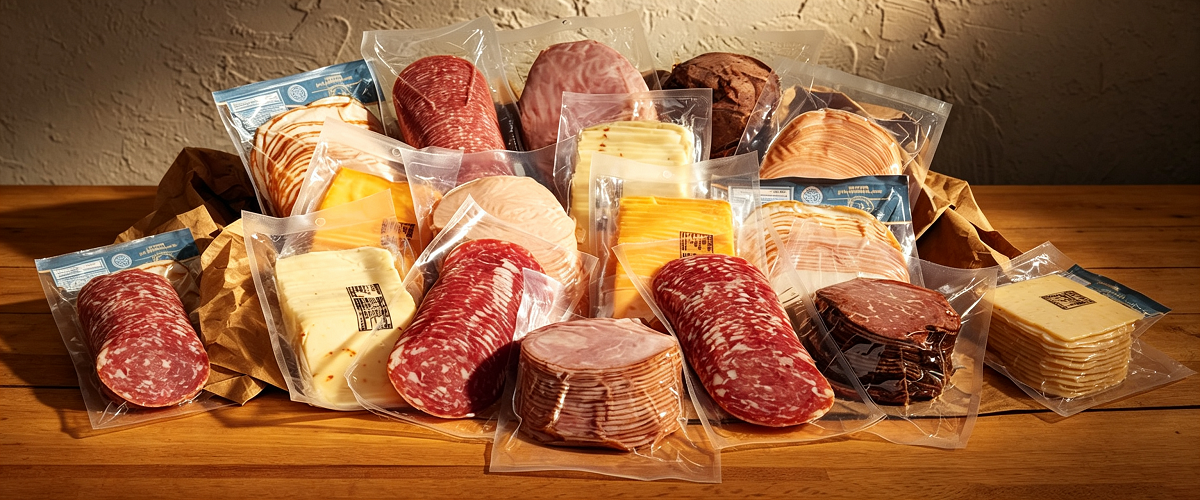
1. What Types of Vacuum Packaging Bags Are Best for Different Meat Products?
The best vacuum packaging bag depends on the type of meat, product shape, processing method, storage temperature, and distribution channel.
Vacuum packaging is used for both raw and processed meat, but the package design should match the physical and preservation requirements of the product.
Smooth Vacuum Bags
Smooth vacuum bags are commonly used with chamber vacuum packaging machines.
They are suitable for:
- Fresh meat cuts
- Steaks
- Pork portions
- Poultry products
- Lamb cuts
- Processed meat
- Marinated meat
These bags can provide a clean and professional appearance while supporting efficient vacuum removal and heat sealing in compatible equipment.
Embossed or Textured Vacuum Bags
Textured vacuum bags are often used with external suction vacuum sealers.
The textured surface helps create channels that support air removal.
They are commonly used for:
- Small-scale meat processing
- Butcher shops
- Specialty meat packaging
- Foodservice applications
- Household vacuum packaging
The bag should be selected specifically for compatibility with the vacuum equipment being used.
Vacuum Pouches for Fresh Meat Cuts
Fresh meat products often require packaging that combines:
- Oxygen barrier performance
- Moisture resistance
- Reliable sealing
- Mechanical durability
For boneless cuts, standard high-performance vacuum pouches may be sufficient. Products with irregular shapes or sharp edges may require stronger puncture resistance.
Vacuum Bags for Bone-In Meat
Bone-in meat creates additional packaging challenges because sharp bones can damage the package during:
- Filling
- Vacuuming
- Handling
- Transportation
- Frozen storage
For these products, puncture resistance should be treated as a primary requirement.
In some applications, bone guards, protective pads, or specialized package structures may also be considered.
Vacuum Packaging for Processed Meat
Processed products such as:
- Ham
- Bacon
- Sausages
- Smoked meat
- Cooked meat
may require different packaging properties depending on moisture level, fat content, product shape, and whether the package is used before or after further thermal processing.
Flat pouches are often suitable for sliced or portioned products because they can provide a compact retail presentation.
Vacuum Bags for Frozen Meat
Frozen meat packaging must maintain performance at low temperatures.
Important considerations include:
- Flexibility after freezing
- Puncture resistance
- Seal reliability
- Resistance to handling damage
Frozen products may experience mechanical stress during stacking and transportation, especially when packages become rigid.
Vacuum Packaging for Marinated Meat
Marinated meat products may contain:
- Salt
- Oil
- Acids
- Sugar
- Spices
- Sauces
These ingredients can influence the package selection process.
Marinades can also contaminate the sealing area if filling and packaging processes are not well controlled. Strong and reliable sealing performance is therefore particularly important.
Bag Type Selection Overview
| Meat Product | Suitable Vacuum Bag Type | Main Packaging Priority |
|---|---|---|
| Fresh boneless meat | Smooth vacuum pouch | Barrier and seal integrity |
| Bone-in meat | Reinforced vacuum pouch | Puncture resistance |
| Processed meat | Flat vacuum pouch | Product presentation and shelf stability |
| Frozen meat | Low-temperature-resistant pouch | Durability and flexibility |
| Marinated meat | Strong-sealing vacuum pouch | Leakage prevention |
| Small-batch products | Textured vacuum bag | Equipment compatibility |
| Retail portions | Custom-sized vacuum pouch | Presentation and convenience |
The correct bag type should always be selected according to both the product and the vacuum packaging equipment.
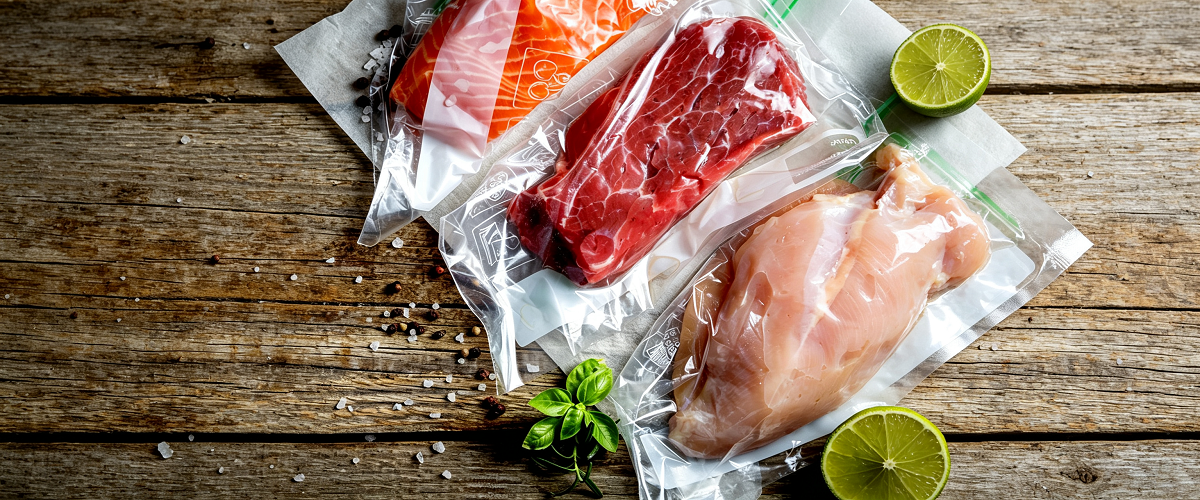
2. How Do Vacuum Packaging Bags Help Extend Meat Freshness and Shelf Life?
Vacuum packaging supports meat preservation by reducing the amount of air surrounding the product.
However, vacuum packaging does not replace proper food processing, sanitation, refrigeration, or freezing. It works as part of a complete preservation system.
Reducing Oxygen Exposure
Oxygen can contribute to several forms of product deterioration.
Reducing oxygen exposure can help slow:
- Oxidation of fats
- Certain flavor changes
- Color changes
- Surface drying
The degree of benefit depends on the specific meat product and its processing conditions.
Supporting Freshness Preservation
A properly sealed vacuum package creates a close-fitting environment around the meat.
This can help reduce exposure to the external atmosphere during:
- Refrigerated storage
- Frozen storage
- Transportation
- Retail distribution
The bag must maintain its barrier and seal performance throughout the intended storage period.
Moisture Retention
Vacuum packaging can help reduce moisture loss from meat products.
Maintaining moisture can support:
- Product weight retention
- Texture quality
- Appearance
- Consumer perception
This is particularly important for fresh cuts and products that may otherwise experience surface dehydration.
Reducing Freezer Burn Risk
Frozen meat can experience surface dehydration during long-term storage.
Vacuum packaging helps reduce the amount of air around the product and can therefore support strategies intended to reduce freezer-related quality deterioration.
However, package integrity remains essential. A damaged or leaking package may allow the protective environment to be lost.
Improving Storage Efficiency
Vacuum-packaged meat generally occupies less volume than packaging formats with significant headspace.
This can support:
- More efficient storage
- Improved freezer organization
- Reduced transport volume
- Compact retail presentation
Protecting Against External Contamination
A properly sealed package creates a physical barrier between the product and the external environment.
However, the effectiveness of this protection depends on:
- Hygienic processing
- Clean filling operations
- Seal integrity
- Appropriate storage temperatures
Packaging should support, not replace, established food safety controls.
Supporting Distribution
Vacuum packaging can help meat products maintain quality through complex supply chains.
Potential benefits include:
- Compact product dimensions
- Reduced exposure to air
- Improved protection during refrigerated distribution
- Efficient carton packing
Important Shelf-Life Consideration
The actual shelf life of vacuum-packed meat should not be determined by packaging alone.
It depends on factors including:
- Initial product quality
- Microbiological condition
- Processing method
- Storage temperature
- Cold-chain consistency
- Packaging barrier properties
- Seal integrity
Shelf-life validation should therefore be based on the actual product and intended distribution conditions.
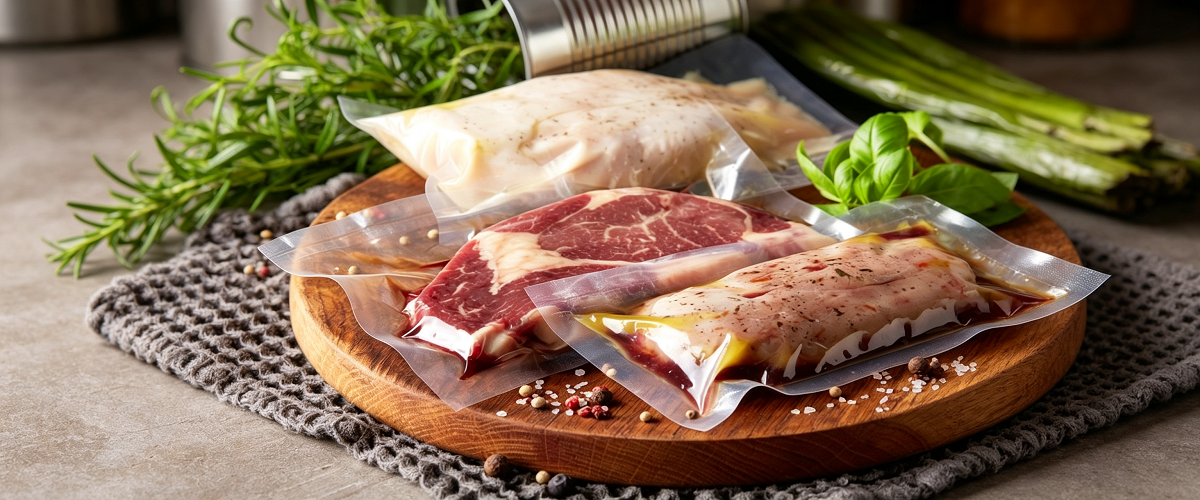
3. Which Materials Provide the Best Oxygen Barrier, Moisture Resistance, and Puncture Protection?
When selecting vacuum packaging bags for meat, the most useful approach is to focus on performance requirements rather than repeatedly focusing on individual material names.
Different meat products require different combinations of:
- Oxygen barrier
- Moisture resistance
- Puncture resistance
- Seal strength
- Flexibility
- Low-temperature performance
Oxygen Barrier Requirements
The vacuum environment is most effective when the packaging limits oxygen transmission.
The required barrier level may depend on:
- Product type
- Fat content
- Storage duration
- Processing method
- Distribution temperature
Higher barrier performance can be particularly important for products requiring extended refrigerated storage.
Moisture Resistance
Meat naturally contains moisture, and some products may also release juices during storage.
The package should help:
- Retain product moisture
- Prevent leakage
- Maintain package integrity
For high-moisture products, the sealing area becomes particularly important.
Puncture Protection
Puncture resistance is essential for products with:
- Sharp bones
- Hard edges
- Irregular shapes
Puncture performance should also be considered for frozen products because low temperatures and handling can increase mechanical stress.
Multi-Layer Packaging Structures
Many vacuum packaging bags use multiple layers because no single material necessarily provides the optimal combination of:
- Barrier performance
- Mechanical strength
- Flexibility
- Heat sealing
The exact structure should be selected based on the product's specific requirements.
High-Barrier Vacuum Packaging
Higher barrier structures may be suitable for:
- Longer shelf-life products
- Export applications
- High-fat meat products
- Extended refrigerated distribution
The packaging should be evaluated based on actual shelf-life requirements rather than automatically selecting the highest possible barrier.
Moisture and Liquid Management
For products containing significant liquid, the package should provide reliable performance around:
- Sealing areas
- Corners
- Bottom folds
- Stress points
A strong package structure alone cannot compensate for poor filling and sealing conditions.
Performance Selection Guide
| Product Requirement | Primary Packaging Focus |
|---|---|
| Long refrigerated storage | High oxygen barrier |
| High-fat meat | Oxidation protection |
| Bone-in products | High puncture resistance |
| Frozen storage | Low-temperature durability |
| Marinated meat | Strong seals and liquid resistance |
| Large cuts | Mechanical strength |
| Retail sliced products | Barrier and presentation |
Product Testing Is Essential
The selected packaging should be tested with the actual meat product.
Evaluation may include:
- Vacuum retention
- Leak detection
- Puncture resistance
- Seal strength
- Storage performance
- Product appearance
This provides more reliable information than selecting packaging based only on general material descriptions.
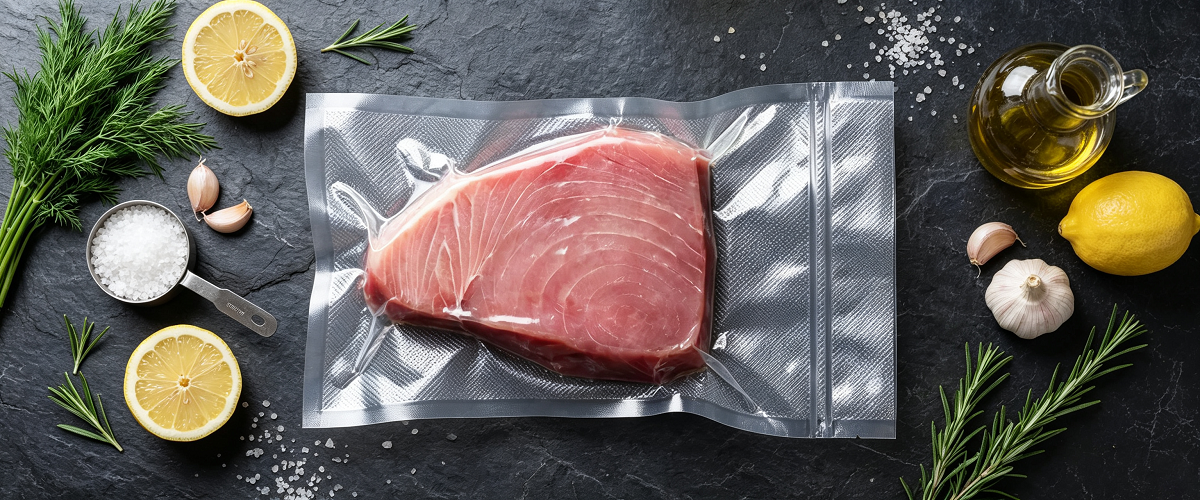
4. What Bag Thickness and Sealing Features Should You Consider for Vacuum-Sealed Meat?
Bag thickness is important, but thicker packaging is not automatically better.
The appropriate thickness depends on the product's physical characteristics and the required performance.
Choosing the Right Thickness
Thickness should be considered according to:
- Product weight
- Bone content
- Product shape
- Storage temperature
- Handling conditions
- Transportation distance
A thin pouch may be sufficient for smooth, boneless products. A product with sharp bones may require increased puncture protection.
Thickness vs. Puncture Resistance
Thickness alone does not determine puncture performance.
The overall structure, material orientation, and mechanical design can all influence how the bag performs.
Manufacturers should therefore evaluate:
- Actual puncture resistance
- Tear propagation
- Flexibility
- Performance at storage temperature
Seal Strength
The seal is one of the most important parts of a vacuum package.
A weak seal can lead to:
- Vacuum loss
- Leakage
- Product contamination
- Reduced shelf-life performance
The sealing layer should be compatible with the packaging equipment and production conditions.
Seal Width
A wider seal can provide additional security in some applications, particularly for:
- Heavy products
- Liquid-containing products
- Large vacuum packages
However, seal design should be optimized for the specific equipment and product rather than increased unnecessarily.
Double Seals
Some meat packaging applications may use additional sealing strategies to improve package security.
Double seals may be considered when:
- Leakage risk is high
- Products are heavy
- Long-distance transportation is required
The effectiveness should be verified through production testing.
Product Contamination in the Seal Area
Meat juices, marinades, oils, and small product particles can interfere with sealing.
Production controls should therefore minimize contamination of the seal area.
Potential solutions include:
- Improved filling accuracy
- Controlled product positioning
- Seal-area cleaning
- Suitable package design
Easy-Open Features
Some retail vacuum packages can include consumer-friendly opening features.
These may include:
- Tear notches
- Easy-peel designs
However, easy-open features must not compromise package integrity.
Bag Size and Product Fit
Vacuum bags should be sized appropriately for the product.
An oversized bag can create:
- Excessive material use
- Poor appearance
- Unnecessary folds
An undersized bag may create:
- Stress on seals
- Difficult filling
- Increased puncture risk
The product should fit the bag with sufficient space for effective vacuuming and sealing.
Thickness and Feature Selection Summary
| Consideration | Key Question |
|---|---|
| Product shape | Are there sharp edges or bones? |
| Product weight | Will the package experience high stress? |
| Storage temperature | Will the package remain flexible? |
| Liquid content | Is leakage prevention critical? |
| Transportation | How much handling will occur? |
| Equipment | Is the bag compatible with the vacuum machine? |
| Consumer use | Is easy opening required? |
The final bag specification should be based on performance testing rather than thickness alone.
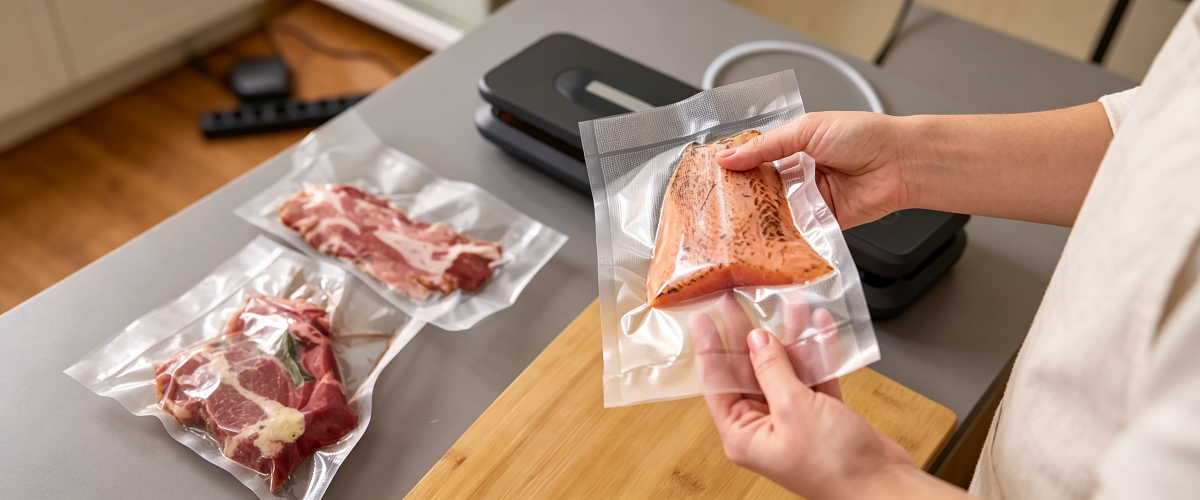
5. Vacuum Packaging Bags for Meat: Key Factors for Food Safety, Storage, Transportation, and Product Quality
Vacuum packaging should be viewed as part of a complete meat packaging system.
A successful solution must consider:
Product → Processing → Packaging → Cold Storage → Transportation → Retail → Consumer Handling
Food Safety Considerations
Vacuum packaging does not make meat automatically safe.
Food safety depends on multiple controls, including:
- Raw material quality
- Hygienic processing
- Temperature management
- Cleaning and sanitation
- Packaging integrity
- Proper storage
Packaging should be designed to support established food safety procedures.
Cold-Chain Management
Vacuum packaging performance depends heavily on storage conditions.
Temperature fluctuations can affect:
- Product quality
- Package stress
- Condensation
- Distribution stability
Maintaining an appropriate cold chain is essential for refrigerated and frozen meat products.
Transportation Durability
During transportation, vacuum packages may experience:
- Compression
- Vibration
- Impact
- Stacking pressure
Packaging should therefore be evaluated for realistic logistics conditions.
Frozen Storage
Frozen products may become more rigid and can experience increased mechanical stress.
The package should maintain:
- Flexibility
- Puncture resistance
- Seal integrity
through the intended frozen storage period.
Retail Presentation
Vacuum packaging can influence how consumers perceive product quality.
Important visual factors include:
- Package clarity
- Product appearance
- Seal quality
- Label placement
- Package shape
A well-designed vacuum package can communicate product quality while providing functional protection.
Branding Opportunities
Vacuum bags can support branding through:
- Printed graphics
- Labels
- Product information
- Traceability codes
- Storage instructions
Clear communication is particularly important for meat products because consumers often need information about:
- Product type
- Storage requirements
- Cooking instructions
- Use-by dates
- Origin
Export Considerations
Export packaging may require additional attention to:
- Extended transportation time
- Temperature variation
- Multiple handling stages
- Destination-market requirements
The packaging specification should be developed according to the actual export route rather than only the domestic shelf-life target.
Sustainability Considerations
Meat packaging requires a careful balance between material reduction and product protection.
Potential strategies include:
- Right-sizing bags
- Avoiding unnecessary thickness
- Reducing excess headspace
- Evaluating material-efficient structures
- Exploring recyclable solutions where suitable
Because meat products are resource-intensive, packaging decisions should also consider the value of preventing spoilage and product waste.
Cost vs. Performance
The lowest-cost vacuum bag is not always the most economical option.
A bag with insufficient performance can result in:
- Leakage
- Product loss
- Returns
- Quality complaints
- Shortened shelf life
Packaging cost should therefore be evaluated together with product protection and operational efficiency.
Recommended Selection Process
Step 1: Define the meat product
Identify whether it is fresh, processed, frozen, marinated, bone-in, boneless, or high-fat.
Step 2: Define the storage conditions
Determine whether the product will be refrigerated or frozen.
Step 3: Establish the shelf-life target
Identify how long the product must maintain acceptable quality.
Step 4: Analyze physical risks
Evaluate sharp edges, bones, weight, and product shape.
Step 5: Match the bag to the vacuum equipment
Confirm compatibility with the packaging machine.
Step 6: Define barrier priorities
Determine the required oxygen and moisture protection.
Step 7: Select appropriate bag durability
Evaluate puncture and tear resistance.
Step 8: Optimize thickness and size
Avoid unnecessary material while maintaining required performance.
Step 9: Test sealing conditions
Verify seal strength and resistance to contamination.
Step 10: Conduct shelf-life and transport testing
Validate the complete product-package system.
FAQ
What is the best type of vacuum packaging bag for fresh meat?
The best choice depends on the meat product and vacuum equipment. Smooth high-barrier pouches are commonly used for chamber vacuum packaging, while textured bags are often used with external suction vacuum sealers.
Do bone-in meat products need stronger vacuum bags?
Yes. Sharp bone edges can puncture standard packaging, so increased puncture resistance and additional protective measures may be required.
How does vacuum packaging help extend meat shelf life?
By reducing the amount of air surrounding the product, vacuum packaging can reduce oxygen exposure and support moisture retention. Actual shelf life also depends on product quality, hygiene, and temperature control.
Is a thicker vacuum bag always better for meat?
No. Thickness is only one factor. Puncture resistance, flexibility, seal strength, and overall package design are also important.
Can vacuum packaging prevent freezer burn?
Vacuum packaging can reduce the amount of air around frozen meat and help support strategies intended to reduce freezer-related dehydration. Package integrity remains essential.
What is the most important feature for marinated meat vacuum bags?
Reliable sealing is particularly important because liquids and oils can interfere with seal formation if filling conditions are not properly controlled.
Are vacuum bags suitable for frozen meat?
Yes, provided the package maintains appropriate durability and seal integrity at the intended frozen storage temperatures.
Can vacuum packaging replace refrigeration?
No. Vacuum packaging supports preservation but does not replace required refrigeration, freezing, sanitation, or food safety controls.
What should be considered when selecting vacuum bags for meat export?
Brands should evaluate transportation time, temperature conditions, handling stress, shelf-life requirements, and destination-market regulations.
Conclusion
Choosing vacuum packaging bags for meat requires a careful understanding of both the product and the complete distribution environment. Different meat products create different challenges, from the puncture risk of bone-in cuts to the sealing requirements of marinated products and the low-temperature durability needed for frozen meat.
The best packaging solution should balance oxygen barrier performance, moisture resistance, puncture protection, seal integrity, bag thickness, equipment compatibility, and storage conditions. Rather than selecting a bag based only on material names or thickness, meat processors should focus on the actual performance requirements of the finished product.
Smooth pouches, textured vacuum bags, reinforced structures, and product-specific formats can all serve different applications. The correct choice depends on factors such as meat type, product shape, weight, processing method, cold-chain conditions, and expected shelf life.
Packaging features such as strong seals, appropriate bag sizing, easy-open designs, and carefully selected thickness can further improve performance and consumer convenience. For export and long-distance distribution, transportation durability and real-world storage testing become especially important.
Ultimately, vacuum packaging is most effective when it is treated as part of a complete meat preservation strategy. When the packaging bag, vacuum process, food safety system, cold chain, and distribution conditions are properly aligned, vacuum packaging can help protect product quality, reduce leakage and damage, improve storage efficiency, and support a more reliable consumer experience.