Whey Protein Powder Packaging Guide
Anna_Yu
Whey Protein Powder Packaging Guide
Whey protein powder has become a major category in sports nutrition, fitness supplements, meal replacement products, and everyday nutritional foods. From standard whey protein concentrate and whey protein isolate to hydrolyzed whey protein, flavored protein blends, and premium performance formulas, manufacturers must deliver products that remain stable, easy to use, and visually appealing throughout their shelf life.
Although whey protein powder may appear relatively simple to package, it presents several important technical challenges. Its fine particle size can make filling and sealing difficult, while its sensitivity to moisture can lead to clumping, poor flowability, and changes in solubility. Oxygen exposure can also contribute to flavor deterioration, particularly in products containing added fats or oxidation-sensitive ingredients. At the same time, protein powder is often sold in large containers or multipurpose bags that consumers open repeatedly, making resealability and convenient dispensing important considerations.
Flexible packaging offers whey protein manufacturers a versatile alternative to conventional rigid containers. Stand-up pouches, flat-bottom bags, side-gusseted bags, and larger refill pouches can combine effective barrier protection with lightweight construction, customizable dimensions, high-quality printing, and efficient transportation. Functional features such as resealable zippers, tear notches, wide openings, carrying handles, and scoops can further improve the consumer experience.
However, the best packaging solution depends on more than the product category. Manufacturers need to consider the specific protein formulation, powder density, serving size, target shelf life, filling equipment, storage conditions, distribution channel, and brand positioning. A small pouch for individual protein servings has very different requirements from a large refill bag designed to hold several weeks of daily servings.
This guide explains how to choose flexible packaging for whey protein powder, covering suitable bag formats, moisture and oxygen protection, material selection, functional features, and the commercial factors that influence shelf life, branding, durability, and cost efficiency. By evaluating these factors together, manufacturers can develop packaging that protects product quality, supports efficient production, and meets the expectations of modern sports nutrition consumers.
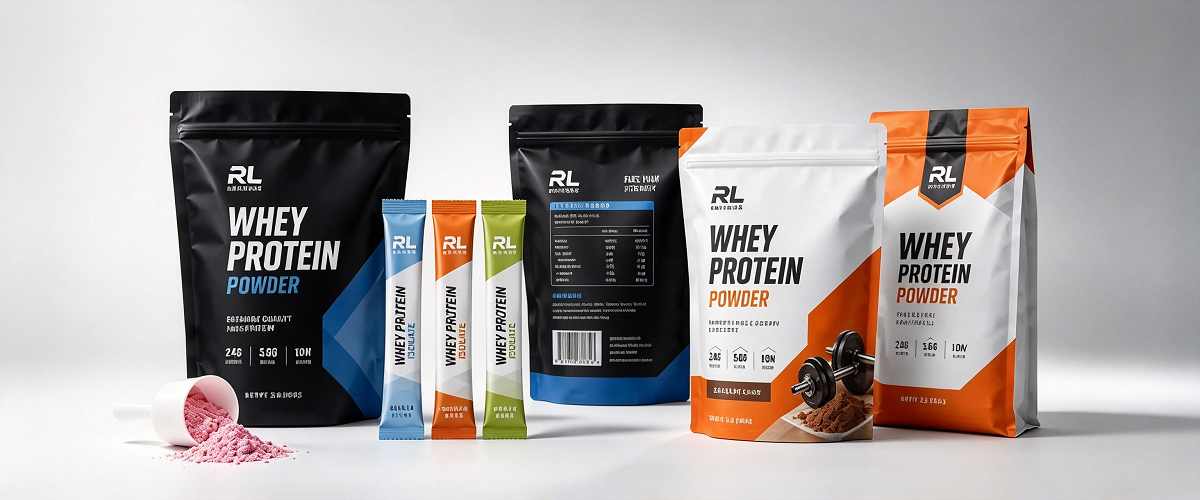
1. What Types of Packaging Bags Are Best for Whey Protein Powder?
The best packaging bag for whey protein powder depends on pack size, powder characteristics, consumption frequency, sales channel, and required shelf life. Manufacturers should first determine how the product will be filled, stored, transported, and used before selecting a packaging format.
Stand-Up Pouches for Retail Protein Powder
Stand-up pouches are a versatile option for retail whey protein powder. Their bottom gusset allows the package to stand upright, creating a clear display area for product information and branding.
They are suitable for:
- Whey protein concentrate
- Whey protein isolate
- Flavored protein powder
- Plant and whey protein blends
- Small and medium-sized retail packs
- Refill packs for home use
A stand-up pouch can be equipped with a resealable zipper, tear notch, and wide opening. These features are useful when consumers open the package repeatedly over several days or weeks.
For example, a 500 g whey protein pouch may be designed with a high-barrier laminate, a wide opening for convenient scooping, and a zipper positioned above the product fill level. This arrangement can improve usability while helping the consumer close the package after each use.
When developing this format, manufacturers should consider the pouch's filled weight, bottom-gusset dimensions, stability, and resistance to bulging during transportation.
Flat-Bottom Bags for Premium Whey Protein Brands
Flat-bottom bags, sometimes called box pouches, provide a more structured appearance than conventional stand-up pouches.
They are particularly suitable for:
- Premium whey protein isolate
- Specialty sports nutrition products
- High-value protein formulations
- Private-label fitness brands
- Products sold through premium retailers
- Larger retail packs requiring strong shelf presence
The flat base helps the bag stand upright, while multiple printable panels provide room for branding, product descriptions, nutrition information, usage instructions, and regulatory labeling.
Flat-bottom bags can also support premium finishes, including matte surfaces, metallic effects, and contrasting graphic elements.
However, the additional construction complexity may increase cost compared with simpler pouch formats. Manufacturers should assess whether the visual and structural advantages justify the additional expense for the intended market.
Side-Gusseted Bags for Large-Volume Protein Powder
Side-gusseted bags are useful when packaging larger quantities of whey protein powder.
Potential applications include:
- Family-size protein packs
- Bulk sports nutrition products
- Foodservice or institutional nutrition ingredients
- Refill packs for frequent users
- Larger commercial protein powder formats
The gussets allow the package to expand as it is filled, while the relatively compact shape can support efficient storage and transportation.
For larger packs, mechanical strength becomes increasingly important. Manufacturers should evaluate the bag's ability to withstand filling, lifting, stacking, and transportation without developing leaks or seal failures.
Important considerations include:
- Filled package weight
- Side-seal strength
- Bottom-seal performance
- Film puncture resistance
- Handling requirements
- Carton dimensions
- Consumer carrying convenience
A larger bag should not simply be produced by scaling up a small pouch. Its structure and dimensions need to be engineered for the increased load.
Sachets for Single-Serving Whey Protein Powder
Sachets and stick packs are suitable for consumers who want a portable, pre-measured serving of protein powder.
Typical applications include:
- Gym bags and workout kits
- Travel nutrition products
- Product sampling
- Subscription boxes
- Hotel or hospitality nutrition packs
- Promotional campaigns
- Trial-size flavor assortments
These formats provide portion control and eliminate the need for consumers to measure powder from a larger bag.
Stick packs are generally narrow and elongated, while sachets can accommodate a wider range of dimensions and powder quantities. The choice depends on the desired serving size, dispensing method, filling equipment, and consumer experience.
Because the packages are small, the material must provide suitable barrier protection without making the package unnecessarily difficult to open.
Refill Pouches for Repeat Purchases
Refill pouches are increasingly useful for brands that sell protein powder in reusable containers or want to offer a lighter alternative to rigid packaging.
They can be designed for:
- Replenishing protein powder canisters
- Subscription-based purchases
- Larger-volume retail sales
- E-commerce customers
- Cost-conscious consumers
A refill pouch may reduce packaging weight and shipping volume compared with certain rigid formats. However, its suitability depends on whether the brand can maintain sufficient protection, convenient handling, and a reliable opening and closure system.
For consumers who use protein powder daily, a resealable refill pouch can be particularly practical.
Comparison of Whey Protein Packaging Formats
| Packaging format | Best suited for | Main advantages | Key consideration |
|---|---|---|---|
| Stand-up pouch | Standard retail packs | Versatile, resealable, attractive | Base stability and opening size |
| Flat-bottom bag | Premium products | Structured shape, large print area | Higher construction cost |
| Side-gusseted bag | Larger quantities | Efficient volume utilization | Load-bearing and seal strength |
| Sachet | Single servings | Portion control and portability | Accurate filling and easy opening |
| Stick pack | Narrow single servings | Compact, convenient format | Powder flow and filling accuracy |
| Refill pouch | Repeat purchases | Lightweight and space-efficient | Closure performance and handling |
Choose the Package Size According to Consumer Usage
Whey protein powder is commonly sold in different serving and pack sizes, from single-use portions to large multipurpose bags.
The appropriate dimensions depend on the product's bulk density, serving weight, and intended usage.
A useful development process is to determine:
- The target net weight.
- The powder's bulk density and flow characteristics.
- The required headspace and filling tolerance.
- The opening size needed for scooping.
- The space required for the zipper and seals.
- The final dimensions needed for retail and shipping cartons.
The physical volume of the powder matters just as much as its weight. Two protein formulas with the same net weight can occupy different volumes because their bulk densities differ.
Consider the Filling Equipment Before Finalizing the Bag
Flexible packaging must work reliably on the intended production line.
For automated whey protein filling, manufacturers should confirm:
- Bag-opening performance
- Powder-dosing accuracy
- Filling speed
- Dust-control arrangements
- Seal contamination tolerance
- Heat-sealing conditions
- Bag stability
- Zipper alignment
- Cutting and handling accuracy
Fine powder can spread into the sealing area and interfere with the formation of a reliable seal. Equipment design and filling procedures should therefore be considered alongside the bag format.
The practical rule: select the bag format that matches the product's fill volume, shelf-life requirements, production process, and consumer usage—not simply the format that looks most attractive.
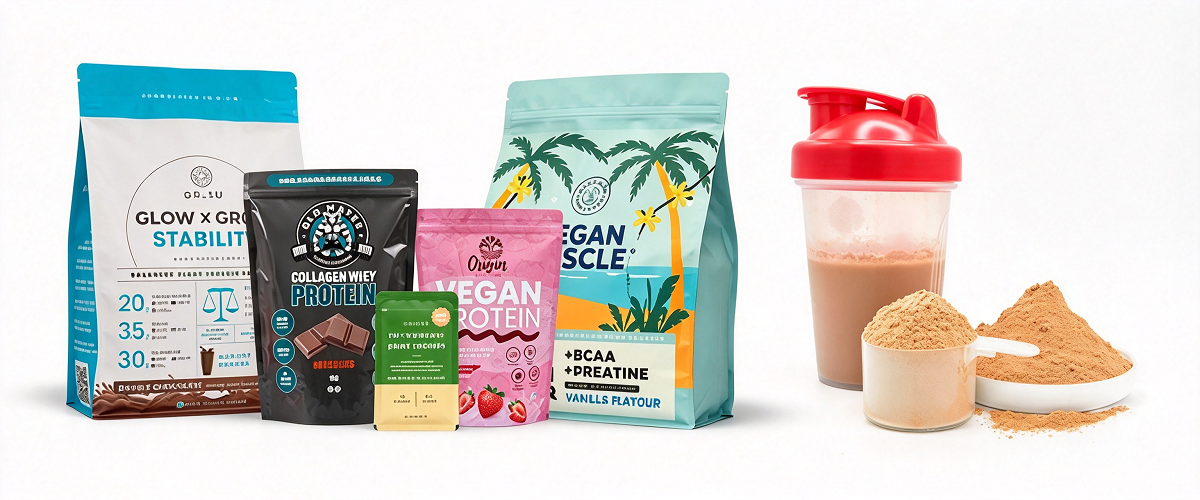
2. How Does Flexible Packaging Protect Whey Protein Powder from Moisture, Oxygen, and Contamination?
Whey protein powder needs packaging that helps maintain its physical properties, sensory quality, and intended shelf life. The main protection requirements generally involve moisture control, oxygen management, contamination prevention, aroma retention, and seal integrity.
Moisture Protection Prevents Clumping and Poor Flowability
Moisture is one of the most important concerns in whey protein powder packaging.
When powder absorbs moisture, particles may begin to stick together. Depending on the formulation and storage conditions, this can lead to:
- Clumping
- Reduced flowability
- Changes in texture
- Difficult dispensing
- Poorer powder handling
- Changes in reconstitution behavior
Moisture can also influence the stability of other ingredients in blended formulations, including flavors, sweeteners, vitamins, and minerals.
A suitable moisture barrier helps prevent external humidity from entering the package.
However, packaging is only one part of moisture control. Manufacturers should also manage the powder's initial moisture content, production environment, cooling conditions, and storage conditions.
Why Fine Protein Powder Requires Reliable Seals
Fine whey protein powder can easily become airborne during filling.
If powder particles become trapped between the film layers in the sealing area, they can prevent the seal from forming correctly.
Potential consequences include:
- Weak seals
- Small leaks
- Powder leakage during transportation
- Moisture ingress
- Reduced package integrity
To reduce these risks, manufacturers should coordinate filling equipment and packaging design.
Practical measures may include:
- Controlling filling dust
- Keeping the seal area clean
- Adjusting filling speed
- Optimizing the sealing temperature and pressure
- Confirming sufficient seal width
- Testing seals under actual production conditions
A high-barrier film cannot compensate for a defective seal. Reliable sealing is therefore essential to the complete protection system.
Oxygen Protection Helps Preserve Flavor
Oxygen can contribute to the deterioration of certain ingredients in whey protein formulations.
The level of sensitivity depends on the formula, including the presence of fats, flavoring ingredients, and other oxidation-sensitive components.
Possible quality changes include:
- Flavor deterioration
- Development of stale or undesirable notes
- Changes in aroma
- Deterioration of oxidation-sensitive ingredients
A high oxygen barrier helps limit the amount of oxygen that enters the package over time.
Manufacturers should consider oxygen protection alongside initial headspace oxygen, sealing performance, storage temperature, and target shelf life.
For products requiring longer storage, oxygen management may be an important part of the packaging specification.
Light Protection for Sensitive Formulations
Light exposure may contribute to the degradation of certain sensitive ingredients, depending on the formulation and exposure conditions.
Opaque or metallized packaging can reduce light exposure while also contributing to the package's visual appearance.
For whey protein powder, the decision to use an opaque structure should consider:
- Ingredient sensitivity
- Storage duration
- Expected retail conditions
- Desired package appearance
- Whether a transparent window is needed
A transparent window may help consumers see the powder, but it can reduce light protection and complicate barrier design.
For many products, a printed opaque package is a practical choice because it provides both branding space and controlled light exposure.
Contamination Prevention During Storage and Distribution
A sealed flexible package helps isolate whey protein powder from external contaminants.
It can protect the product against:
- Dust
- Foreign particles
- Unwanted odors
- Handling contamination
- External moisture
- Contact with other products
This is especially important when the product moves through several stages of distribution.
A typical supply chain may involve production, warehousing, palletization, transportation, retail handling, and final consumer storage.
The packaging should remain intact throughout this process.
Manufacturers must also maintain hygienic production conditions and appropriate ingredient handling. Packaging alone cannot correct contamination that occurs before filling or eliminate the need for food safety controls.
Aroma Retention and Odor Protection
Flavored whey protein products may contain vanilla, chocolate, strawberry, coffee, or other aroma ingredients.
A suitable barrier structure helps retain desirable aromas while reducing the risk of external odors entering the package.
This is particularly relevant when multiple products are stored or transported together.
Manufacturers should evaluate the complete laminate for aroma performance when flavor retention is a major product requirement.
Nitrogen Flushing for Selected Protein Powders
Nitrogen flushing can be considered when reducing oxygen in the package headspace is beneficial.
The process replaces part of the air inside the package with nitrogen before sealing.
Potential advantages include:
- Lower initial headspace oxygen
- Reduced oxygen exposure for sensitive formulations
- Support for longer-term quality preservation where validated
However, nitrogen flushing is not necessary for every whey protein product.
Its value depends on the formula, the desired shelf life, the package structure, and the filling process. It should be validated with the actual product rather than treated as a universal requirement.
How Barrier Properties Work Together
The final package should be considered as a complete system.
| Protection requirement | Packaging function | Why it matters |
|---|---|---|
| Moisture barrier | Limits water vapor transmission | Helps prevent clumping and moisture-related changes |
| Oxygen barrier | Limits oxygen transmission | Helps preserve flavor and oxidation-sensitive ingredients |
| Light barrier | Reduces exposure to light | Helps protect sensitive components |
| Seal integrity | Prevents leakage and ingress | Maintains the barrier in the finished package |
| Mechanical resistance | Reduces puncture and handling damage | Helps protect the package during transportation |
| Aroma barrier | Limits aroma loss and external odor transfer | Supports consistent sensory quality |
Test the Finished Package, Not Just the Film
Material specifications are useful, but they do not fully describe the performance of the final pouch.
The finished package should be evaluated under relevant production, storage, and distribution conditions.
Possible tests include:
- Water vapor transmission testing
- Oxygen transmission testing
- Seal-strength testing
- Leak testing
- Drop and compression testing
- Storage testing
- Sensory evaluation
- Powder flowability and reconstitution checks
Testing requirements should reflect the actual formula and shelf-life target.
For manufacturers, the objective is not to maximize every barrier value regardless of cost. It is to establish the minimum reliable protection level needed to preserve the product throughout its intended shelf life.
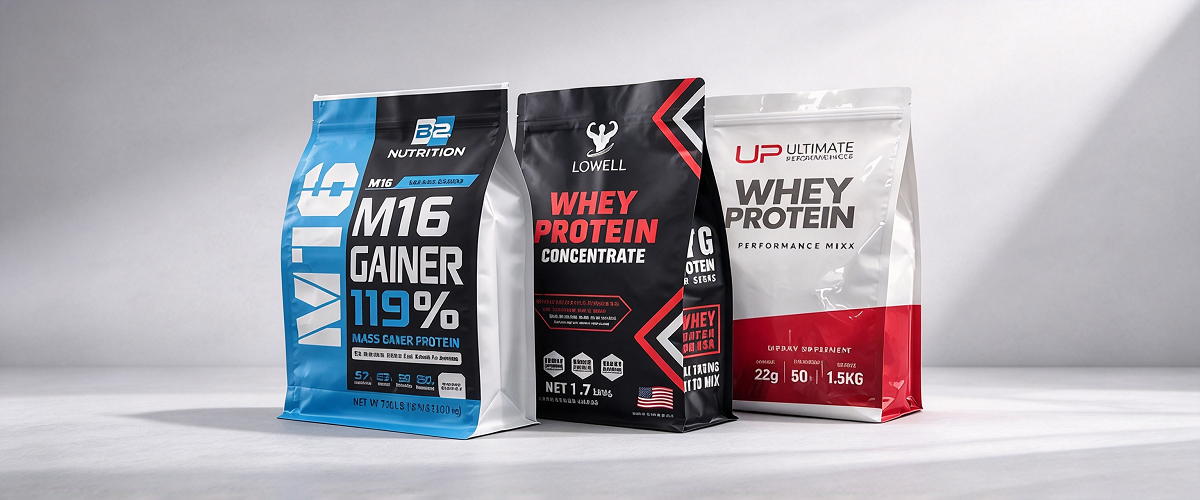
3. Which Packaging Materials Provide the Best Barrier Protection for Whey Protein Powder?
There is no single material structure that is best for every whey protein powder. The right choice depends on moisture sensitivity, oxygen requirements, formulation, pack size, production equipment, shelf life, and budget.
Rather than selecting a film based only on its name or thickness, manufacturers should evaluate the performance of the complete laminate.
PET-Based Laminates for Printing and Structure
PET is commonly used as an outer layer in flexible packaging because it provides good mechanical properties and a high-quality printing surface.
For whey protein powder, PET-based structures can support:
- Detailed product graphics
- Stable package construction
- Reliable converting performance
- Compatibility with different pouch designs
When combined with a suitable barrier layer and heat-sealing layer, PET-based laminates can be adapted to a wide range of retail protein powder applications.
Metallized PET for Enhanced Barrier Protection
Metallized PET can improve oxygen and moisture barrier performance compared with conventional transparent film structures.
It can also provide substantial light protection and a distinctive metallic appearance.
Potential applications include:
- Standard retail whey protein powder
- Flavored protein formulations
- Refill pouches
- Medium- and large-size packs
- Products requiring a balance between barrier performance and cost
The actual performance depends on the complete laminate, metallization quality, converting process, and finished-package integrity.
Aluminum Foil Laminates for High-Barrier Applications
Aluminum foil provides a very high barrier against oxygen, moisture, light, and aroma transmission.
It may be suitable for whey protein products that require particularly strong protection, including selected premium formulations or products intended for demanding distribution conditions.
Potential advantages include:
- Excellent moisture protection
- Very high oxygen barrier
- Strong light protection
- Good aroma retention
However, foil-containing structures may increase material cost and can affect the packaging's flexibility, appearance, and end-of-life options.
They should therefore be selected according to actual product requirements rather than automatically specified for every protein powder.
PE and Other Heat-Sealing Layers
The inner sealing layer is critical to package integrity.
For whey protein powder, it should provide:
- Appropriate food-contact suitability
- Reliable heat sealing
- Consistent seal strength
- Compatibility with filling equipment
- Suitable mechanical performance
- Resistance to the product and expected storage conditions
The sealing layer should be tested under actual production conditions, particularly where fine powder can contaminate the seal area.
Mono-Material Structures for Sustainability-Oriented Packaging
Some manufacturers are investigating mono-material flexible packaging to support material simplification and potential recycling benefits.
For whey protein powder, a mono-material structure may be considered when it can deliver the required:
- Moisture barrier
- Oxygen barrier
- Seal strength
- Mechanical durability
- Shelf-life performance
- Printing quality
However, high-barrier performance can be technically challenging for some simplified structures. Manufacturers should verify that the chosen solution performs adequately before transitioning away from a conventional laminate.
Recyclability also depends on the complete structure and the collection and recycling systems available in the target market.
Material Selection by Whey Protein Application
| Application | Potential material approach | Primary consideration |
|---|---|---|
| Standard whey protein | High-barrier laminate | Moisture and oxygen control |
| Whey protein isolate | High-barrier pouch structure | Formula-specific shelf-life requirements |
| Flavored protein powder | High-barrier structure with good aroma retention | Flavor stability |
| Large refill pouch | Durable high-barrier laminate | Seal strength and handling |
| Single-serving sachet | Barrier film suitable for small packs | Reliable seals and efficient filling |
| Premium protein powder | High-barrier structure with premium printing | Performance and brand presentation |
| E-commerce protein powder | High-barrier structure with suitable mechanical resistance | Shipping durability |
| Sustainability-focused product | Qualified mono-material structure where feasible | Barrier performance and end-of-life requirements |
These are starting points for packaging development, not fixed specifications. The actual formulation and storage conditions should determine the final structure.
Do Not Choose Materials by Thickness Alone
A thicker film does not automatically provide better protection.
Barrier performance depends on the properties of the materials, the presence and quality of the barrier layer, the laminate construction, and the integrity of the finished package.
Two structures with similar thickness can have significantly different oxygen and moisture transmission characteristics.
Manufacturers should request performance specifications and test data relevant to the intended application.
Balance Barrier Performance and Cost
The most expensive structure is not always the most suitable.
If a metallized laminate can meet the required shelf-life target, a foil-containing structure may not provide enough additional value to justify its cost.
On the other hand, choosing an insufficient barrier structure can lead to product deterioration, complaints, and waste.
The goal is to balance:
Required shelf life + product sensitivity + production reliability + distribution conditions + total packaging cost.
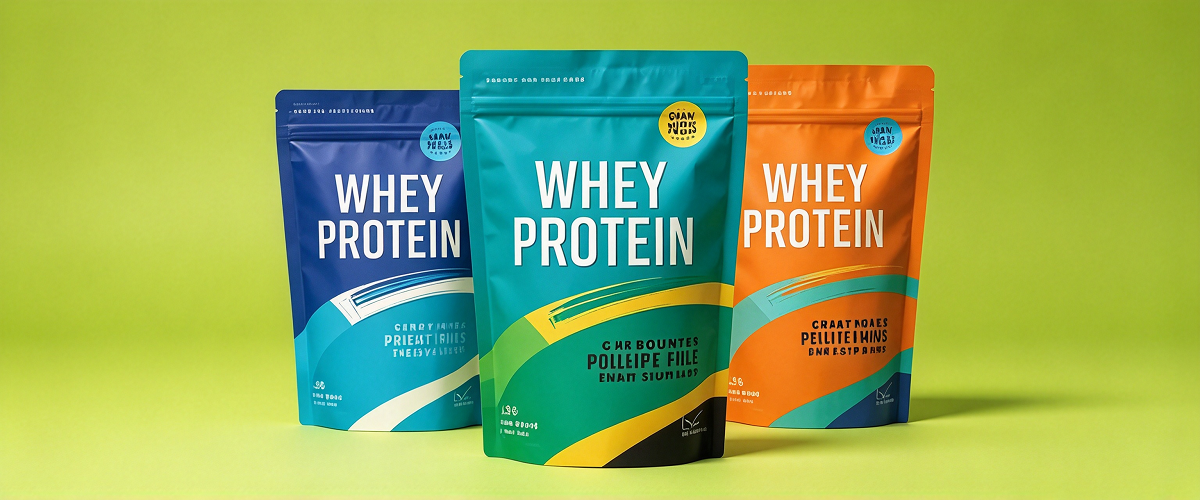
4. What Packaging Features Improve Whey Protein Powder Freshness, Storage, and Consumer Convenience?
Whey protein packaging is often used repeatedly, sometimes over several weeks. Functional features therefore influence both product handling and the consumer's ability to maintain product quality after opening.
The most useful features are those that make the package easy to open, easy to use, and easy to close reliably.
Resealable Zippers for Repeated Use
A zipper is one of the most useful features for multi-serving whey protein powder.
It allows consumers to close the pouch after each use, helping reduce exposure to ambient humidity and limiting powder spillage during storage.
Zippers are especially suitable for:
- Retail protein powder
- Refill pouches
- Family-size packs
- Premium sports nutrition products
- Multi-serving flavored powders
However, a zipper does not replace the original heat seal.
The initial factory seal provides protection before the package is first opened, while the zipper supports subsequent consumer use.
For the best user experience, the zipper should be easy to locate, operate, and close.
Wide Openings for Scooping
A wide opening makes it easier to insert a scoop and remove powder without spilling it.
This is particularly important for larger protein powder pouches.
A narrow opening may make scooping awkward, while an excessively wide opening can make it harder to control powder movement.
Manufacturers should consider:
- Scoop dimensions
- Powder density
- Package width
- Zipper position
- Consumer hand access
- Headspace above the powder
The opening should be designed around the intended scoop and serving size.
Tear Notches for Easy First Opening
A tear notch allows consumers to open the package without scissors.
This feature is useful for both multi-serving pouches and individual sachets.
The notch should be positioned so that consumers can open the package without accidentally damaging the zipper or removing too much of the top panel.
Easy opening can improve the first-use experience and reduce consumer frustration.
Handles for Large Protein Powder Bags
Larger pouches may benefit from a carrying handle or reinforced grip area.
This can be useful for:
- Large retail packs
- Family-size bags
- Bulk protein powder
- Products sold through warehouse retailers
Handle design should account for the package's filled weight and the stresses created during lifting.
The handle should be tested to confirm that it does not cause tearing or compromise the package's seals.
Rounded Corners and Handling Comfort
Package corners can affect both appearance and handling.
Rounded corners may reduce sharp edges and create a more polished design.
For larger bags, manufacturers should also consider whether the package is comfortable to hold and whether the material can withstand repeated handling without tearing.
Flat-Bottom Construction for Storage Stability
Flat-bottom bags can stand upright on shelves, countertops, or pantry surfaces.
This can improve:
- Retail presentation
- Home storage
- Product visibility
- Handling during use
For premium brands, the structured appearance may also help distinguish the product from conventional pouches.
Measuring Scoops and Storage Compatibility
Many protein powder products include a measuring scoop.
The package should allow enough internal space for the scoop to be inserted and removed conveniently.
Manufacturers should consider:
- Scoop size
- Scoop placement
- Powder volume
- Opening dimensions
- Consumer storage habits
The pouch should also be compatible with common home storage spaces where possible.
Nitrogen Flushing as an Optional Feature
Nitrogen flushing can be incorporated into selected packaging lines when reducing initial oxygen exposure is important.
It is more relevant when the product formulation and shelf-life target justify the additional process requirements.
The manufacturer should validate the complete package, including headspace management and sealing performance, rather than assuming that gas flushing automatically guarantees longer shelf life.
Transparent Windows: Useful but Not Always Necessary
A transparent window can allow consumers to see the powder, but it may reduce light protection and introduce a weaker barrier area.
For most protein powder brands, printed opaque packaging offers more room for branding and can provide a more consistent appearance.
If a window is desired, its size and location should be evaluated against the product's light sensitivity and shelf-life requirements.
QR Codes and Digital Product Information
QR codes can connect the package to useful digital resources, including:
- Preparation instructions
- Recipe ideas
- Product information
- Brand story
- Product authenticity checks
- Customer support
- Loyalty programs
For sports nutrition brands, digital content can help consumers understand how the product fits into their routine without overcrowding the package artwork.
Any nutrition or performance claims should be reviewed for compliance with the regulations in the intended market.
Packaging Feature Comparison
| Feature | Main benefit | Best suited for |
|---|---|---|
| Resealable zipper | Convenient repeated use | Multi-serving pouches |
| Wide opening | Easier scooping | Medium and large bags |
| Tear notch | Easier initial opening | Most pouch formats |
| Handle | Easier carrying | Larger packs |
| Flat bottom | Better standing stability | Retail and premium products |
| Measuring scoop | Portion convenience | Multi-serving products |
| QR code | Digital engagement | Retail and premium brands |
| Nitrogen flushing | Reduced initial oxygen | Selected sensitive formulations |
| Transparent window | Product visibility | Applications where visibility is valuable |
Features Should Not Compromise Barrier Performance
Every additional feature can influence the package design.
Zippers, windows, handles, and specialized openings may introduce additional production considerations or potential weak points.
Before mass production, manufacturers should confirm that the finished package still meets the required barrier and mechanical specifications.
The objective is to add features that improve the user experience without undermining product protection.
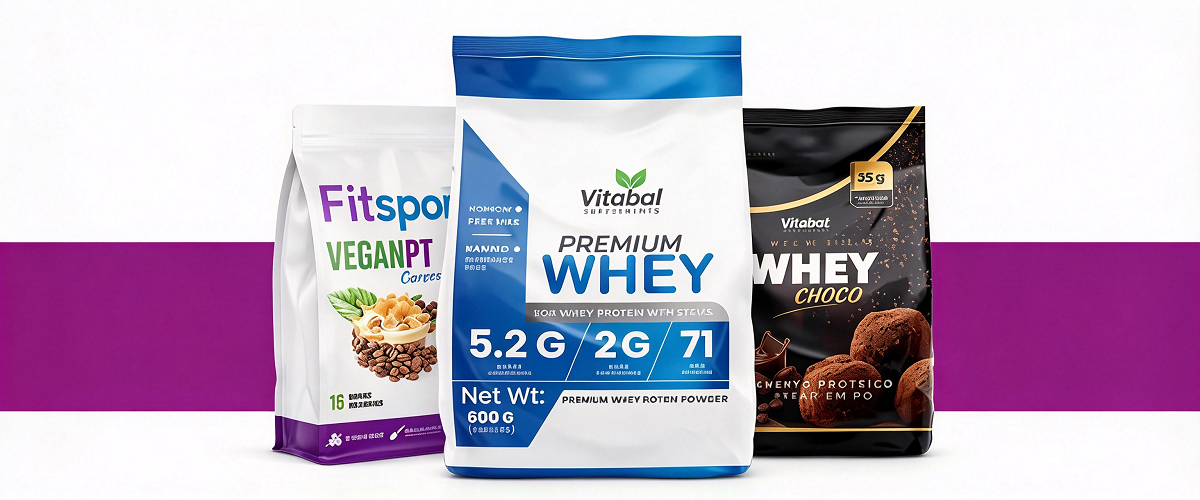
5. Whey Protein Powder Packaging: Key Factors for Shelf Life, Branding, Durability, and Cost Efficiency
A successful whey protein packaging strategy must balance preservation, visual identity, production efficiency, logistics, and cost.
The package should be developed around the complete commercial lifecycle rather than treated as a standalone purchasing item.
Shelf-Life Requirements and Product Stability
Whey protein powder shelf life depends on more than the packaging material.
Important variables include:
- Formulation
- Initial moisture content
- Water activity
- Oxygen sensitivity
- Processing conditions
- Storage temperature
- Humidity
- Package integrity
The packaging structure should be selected according to the stability requirements of the actual product.
Shelf-life claims should be supported by appropriate product testing rather than inferred from the material structure alone.
Storage and Distribution Conditions
Protein powder may be stored in warehouses, transported across regions, sold through retail stores, or delivered directly to consumers.
Each channel can create different stresses.
For example, e-commerce packages may experience parcel drops and compression, while export shipments may face longer storage periods and changes in temperature and humidity.
The package should be evaluated under conditions representative of the intended supply chain.
Branding and Shelf Differentiation
The sports nutrition market is competitive, and packaging is an important tool for distinguishing products.
A well-designed pouch should communicate the product's identity quickly.
Useful design elements include:
- Clear product naming
- Flavor identification
- Brand logo
- Net weight
- Nutrition information
- Preparation instructions
- Appropriate product claims
- Distinctive color systems
The front panel should prioritize the most important purchasing information.
Excessive graphic elements can make a package difficult to understand, so a clear information hierarchy is usually more effective than filling every available space.
Premium Printing and Finishes
Flexible packaging can support a wide range of visual treatments, including:
- Matte finishes
- Gloss finishes
- Metallic effects
- High-resolution graphics
- Spot effects
- Distinctive color combinations
Premium finishes can reinforce a high-end positioning, but the choice should be consistent with the product's target market.
A value-oriented protein powder may benefit more from a clear, functional design than from expensive decorative effects.
Durability During Shipping
Whey protein powder bags must withstand handling throughout the distribution process.
Potential risks include:
- Punctures
- Abrasion
- Compression
- Seal damage
- Corner stress
- Repeated movement inside shipping cartons
The package should be evaluated together with the outer carton.
A flexible pouch can provide barrier protection, while the shipping carton provides additional structural support.
For large bags, particular attention should be given to lifting stresses, filled-package weight, and seal strength.
Cost Efficiency Beyond the Unit Price
The cheapest pouch is not necessarily the lowest-cost packaging solution.
A complete cost evaluation should consider:
- Film and conversion cost
- Printing
- Filling speed
- Seal failures
- Material waste
- Shipping volume
- Storage requirements
- Product losses
- Returns and complaints
A slightly more expensive structure may offer better total value if it improves filling efficiency or reduces package failures.
Standardization Across Multiple SKUs
Brands that sell several flavors or formulations may be able to simplify procurement by standardizing some package specifications.
For example, multiple SKUs may share:
- Similar bag dimensions
- A common material structure
- Consistent zipper placement
- Standardized seal widths
- Common artwork dimensions
Flavor differentiation can then be handled through printing.
However, standardization should not override differences in product stability, fill weight, or barrier requirements.
Sustainability and Material Reduction
Sustainability is increasingly relevant to flexible packaging procurement.
Potential approaches include:
- Reducing unnecessary package dimensions
- Lightweighting where technically appropriate
- Exploring qualified mono-material structures
- Reducing secondary packaging
- Improving carton utilization
- Selecting printing methods appropriate to the production quantity
Sustainability claims should reflect the actual package construction and the recycling infrastructure available in the destination market.
A structure should not be described as universally recyclable simply because it contains a single polymer family.
Food-Contact Compliance and Labeling
Whey protein packaging must meet the applicable food-contact requirements in the intended market.
Manufacturers should also ensure that the package provides sufficient space for required information, which may include:
- Ingredient list
- Nutrition facts
- Allergen information
- Net quantity
- Storage instructions
- Lot identification
- Best-before or expiration information
- Manufacturer or distributor details
- Required warnings or regulatory statements
The exact requirements vary by jurisdiction and product classification.
For sports nutrition products, claims related to health, performance, or nutritional benefits should be reviewed carefully before printing.
Production Compatibility
Before ordering a large quantity of custom pouches, manufacturers should confirm that the design works with their filling and sealing equipment.
A practical production trial should assess:
- Bag opening
- Filling accuracy
- Powder dust
- Seal contamination
- Machine speed
- Heat-sealing conditions
- Print registration
- Cutting accuracy
- Finished-package appearance
This is especially important for fine powders, where filling dust can interfere with sealing.
A Practical Packaging Development Workflow
A structured development process helps reduce errors and unnecessary costs.
Step 1: Define the product
Identify the formulation, powder density, fill weight, serving size, and shelf-life target.
Step 2: Select the package format
Choose a stand-up pouch, flat-bottom bag, side-gusseted bag, sachet, stick pack, or refill pouch.
Step 3: Determine barrier requirements
Assess moisture, oxygen, light, and aroma sensitivity.
Step 4: Choose the material structure
Select a laminate that meets the required performance while remaining compatible with the filling line.
Step 5: Add functional features
Confirm the need for a zipper, tear notch, wide opening, handle, or other features.
Step 6: Develop the artwork
Prepare branding, nutrition information, ingredient details, and required regulatory labeling.
Step 7: Test samples
Evaluate package integrity, barrier performance, usability, and product compatibility.
Step 8: Conduct a production trial
Confirm that the pouch runs reliably on the intended equipment.
Step 9: Approve the final specification
Document the material structure, dimensions, seals, print requirements, and acceptance criteria before mass production.
Key Questions Before Ordering Whey Protein Packaging
| Decision area | Questions to answer |
|---|---|
| Product | What formulation and powder characteristics need to be considered? |
| Pack size | What net weight and volume will the pouch hold? |
| Shelf life | What storage period must the package support? |
| Barrier | What moisture and oxygen protection is required? |
| Format | Is the product a single serving, retail pouch, or refill pack? |
| Features | Does it need a zipper, handle, or wide opening? |
| Production | Will the pouch run on the existing filling line? |
| Distribution | Will it be sold in retail, e-commerce, or export markets? |
| Compliance | Which food-contact and labeling rules apply? |
| Cost | What is the total cost across production, storage, and logistics? |
Answering these questions before finalizing the package helps align packaging performance with commercial goals.
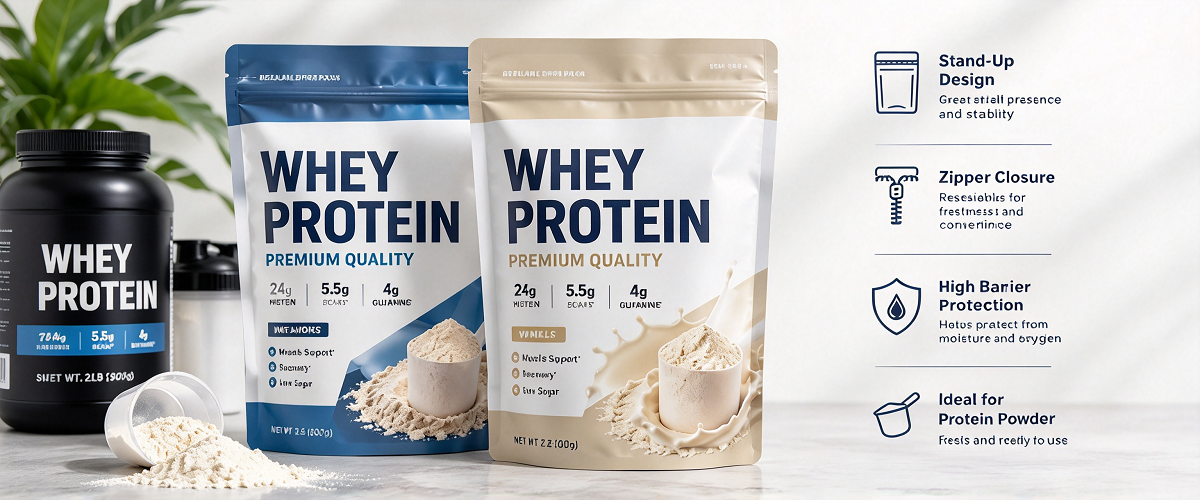
FAQ
What is the best packaging bag for whey protein powder?
For many retail applications, a high-barrier stand-up pouch with a resealable zipper is a practical option. Flat-bottom bags can suit premium products, while sachets and stick packs are useful for single servings. The best format depends on pack size, shelf life, filling equipment, and consumer usage.
Does whey protein powder need high-barrier packaging?
Whey protein powder generally benefits from effective moisture protection, while oxygen barrier requirements depend on the formulation and shelf-life target. The complete package should be validated using the actual product and intended storage conditions.
Is aluminum foil necessary for whey protein powder packaging?
Not always. Aluminum foil provides a very high barrier, but suitable metallized or other high-barrier laminates may meet the requirements of many products. The decision should balance product stability, storage conditions, and total cost.
Why is a resealable zipper important for protein powder bags?
A zipper allows consumers to close the pouch after opening, making repeated use more convenient and helping limit exposure to ambient humidity. It does not replace the original factory seal or the need for appropriate storage.
Are stand-up pouches suitable for large whey protein packs?
They can be suitable for medium-sized and some larger packs, provided the pouch dimensions, gusset, seals, and material structure are designed for the filled weight. Very large bags may require a different format or additional mechanical reinforcement.
Can whey protein powder be packed in stick packs or sachets?
Yes. Stick packs and sachets are suitable for pre-measured servings, sampling, travel, and promotional use. They require accurate powder dosing and reliable seals.
Is nitrogen flushing recommended for whey protein powder?
Nitrogen flushing can be useful when reducing oxygen exposure is important for the particular formulation. It is not essential for every product and should be validated alongside the film structure, sealing process, and shelf-life requirements.
What causes whey protein powder to clump inside the package?
Moisture absorption is a common cause of clumping. Poor storage conditions, insufficient moisture barrier, damaged seals, or moisture present before packaging can contribute. Formulation and processing conditions also influence powder stability.
Can flexible packaging replace rigid protein powder containers?
In many applications, flexible pouches can serve as primary retail packaging or refill packaging. Whether they can replace a rigid container depends on the product, brand positioning, required protection, consumer preferences, and distribution conditions.
What packaging is best for whey protein sold online?
A high-barrier pouch with suitable seal strength and puncture resistance can work well when paired with appropriate secondary shipping protection. The complete shipping configuration should be tested for drops, compression, vibration, and handling.
How should whey protein packaging be tested before mass production?
Testing may include moisture and oxygen barrier evaluation, seal strength, leak testing, package durability, production trials, and shelf-life studies with the actual formulation. The required test program depends on the product and market.
Can whey protein packaging use recyclable materials?
Potentially. Qualified mono-material structures may be suitable when they meet the required barrier and mechanical specifications. Recyclability depends on the complete package construction and the recycling systems available in the target market.
What information should be printed on whey protein packaging?
Depending on the market and product classification, required information may include the product name, ingredients, allergen declarations, nutrition information, net quantity, storage instructions, lot identification, date marking, and responsible business details. Applicable rules should be checked before artwork approval.
Conclusion
Choosing the right packaging for whey protein powder requires a balance between product protection, production efficiency, consumer convenience, brand presentation, and total cost.
Stand-up pouches offer a versatile option for retail products, flat-bottom bags can strengthen premium positioning, side-gusseted bags can support larger quantities, and sachets or stick packs provide convenient single-serving formats. The material structure should then be selected according to moisture sensitivity, oxygen requirements, target shelf life, and the demands of the filling and distribution process.
Functional features such as resealable zippers, wide openings, tear notches, and carrying handles can improve everyday usability, while well-designed printing helps brands communicate product identity and stand out in a competitive market.
Most importantly, packaging performance should be verified using the actual whey protein formulation and finished package. Barrier specifications, seal integrity, filling compatibility, storage conditions, and transportation durability all contribute to the final result.
The most effective solution is not necessarily the thickest material or the most expensive pouch. It is the packaging system that reliably preserves product quality, performs consistently on the production line, supports the brand's positioning, and delivers the required performance at an appropriate cost.
For whey protein manufacturers and sports nutrition brands, flexible packaging is more than a container. It is a practical part of the product's preservation strategy, consumer experience, and commercial success.