A Guide to Choosing Packaging for Dried Coconut Snacks
Anna_Yu
A Guide to Choosing Packaging for Dried Coconut Snacks
Dried coconut snacks have become increasingly popular among consumers looking for convenient, flavorful, and versatile snack options. From crispy coconut chips and toasted coconut flakes to dried coconut strips, coconut clusters, and sweetened coconut bites, these products offer a distinctive tropical flavor and a variety of textures. However, despite their relatively low moisture content, dried coconut snacks can be surprisingly sensitive to environmental conditions. Moisture absorption can reduce crispness, oxygen exposure can accelerate fat oxidation, and unsuitable packaging may allow coconut aroma to fade or unwanted odors to enter the package.
Coconut products present a particular packaging challenge because they naturally contain fat. Even after drying or roasting, coconut flakes and chips may undergo oxidative deterioration during storage, especially when exposed to oxygen, heat, and light. At the same time, their crisp or chewy texture must be preserved throughout transportation, retail display, and consumer use. A package that provides insufficient moisture protection may cause crispy coconut chips to become soft, while inadequate oxygen protection can contribute to rancid flavors and reduced product quality.
Flexible packaging has become an important solution for dried coconut snack manufacturers because it offers adaptable barrier performance, lightweight construction, efficient transportation, attractive printing, and flexible package formats. Stand-up pouches, flat bottom bags, pillow bags, and resealable snack pouches can all be customized according to product type, serving size, shelf-life expectations, and sales channel.
However, choosing the right packaging is not simply a matter of selecting an attractive bag. Different dried coconut products have different moisture levels, oil contents, textures, and processing methods. Crispy coconut chips may require stronger moisture and oxygen barriers than some chewy dried coconut strips. Products containing added sugar, chocolate, nuts, or other ingredients may also require additional protection.
This guide explains how to choose suitable flexible packaging for dried coconut snacks. It covers bag formats, moisture and oxygen protection, oil resistance, material structures, functional features, and the key considerations for shelf life, branding, convenience, and distribution. By matching packaging performance to the actual characteristics of the product, manufacturers can better preserve freshness, reduce quality deterioration, and create packaging that supports long-term brand growth.
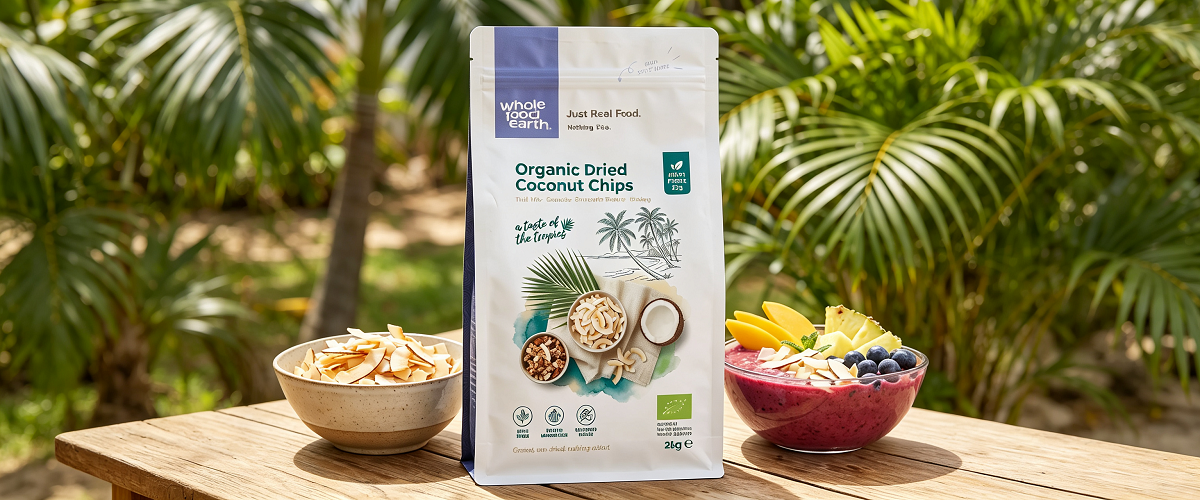
1. What Types of Flexible Packaging Are Best for Dried Coconut Snacks?
The most suitable flexible packaging format for dried coconut snacks depends on product texture, piece size, oil content, serving size, target shelf life, and distribution channel. A package designed for crispy coconut chips may not be the best option for chewy coconut strips or coconut clusters.
The right format should protect the product from moisture and oxygen while providing enough space to prevent excessive crushing. It should also support convenient filling, storage, transportation, and consumer use.
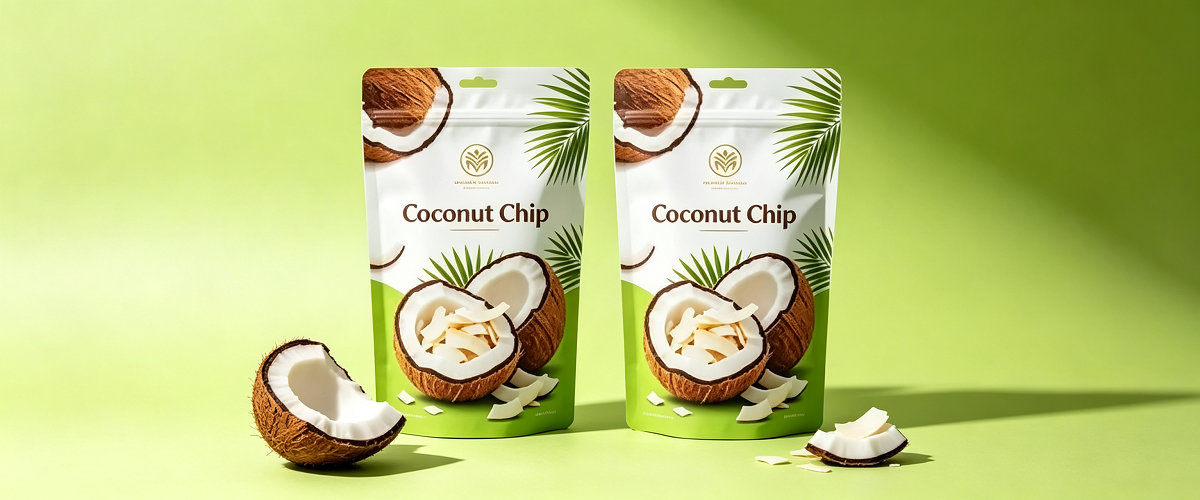
Stand-Up Pouches for Retail Dried Coconut Snacks
They are commonly used for:
- Crispy coconut chips
- Toasted coconut flakes
- Dried coconut strips
- Sweetened coconut bites
- Coconut clusters
- Coconut snack mixes
Stand-up pouches provide a relatively large printable surface, allowing brands to communicate product information, flavor variations, nutritional details, and brand identity.
Their main advantages include:
**Strong shelf presentation**
The upright structure improves product visibility and helps the package maintain a neat appearance on retail shelves.
**Flexible barrier options**
Stand-up pouches can be produced using different laminated structures, including PET/VMPET/PE and PET/AL/PE, depending on the required moisture and oxygen protection.
**Resealable functionality**
A zipper can be added to help consumers close the package after opening. This is especially useful for multi-serving coconut snacks.
**Customizable dimensions**
Manufacturers can adjust pouch width, height, and bottom gusset according to product weight and volume.
For crispy coconut chips, a stand-up pouch with a suitable high-barrier laminate and resealable zipper is often a practical starting point. If the product is fragile, the package dimensions should also provide sufficient room to reduce compression during filling and transportation.
### Flat Bottom Bags for Premium Coconut Snacks
Flat bottom bags, also known as box pouches, are frequently used for premium snack products because they offer excellent shelf stability and a structured appearance.
They are suitable for:
- Premium toasted coconut chips
- Organic dried coconut snacks
- Specialty coconut flakes
- Coconut and nut snack mixes
- Coconut clusters
- Gift-oriented tropical snack products
Their rectangular base allows the package to stand securely, while the front, back, side gussets, and bottom provide multiple printable surfaces.
Key advantages include:
- Strong shelf presence
- Large printable areas
- Good capacity for different snack weights
- Compatibility with resealable zippers
- Suitable presentation for premium product lines
For brands selling high-value dried coconut snacks, flat bottom bags can help communicate product quality through carefully designed graphics, matte finishes, metallic effects, and clear product information.
The material structure should still be selected according to the product's moisture sensitivity and fat content. A premium-looking package will not preserve freshness if its barrier performance or seal integrity is inadequate.
### Pillow Bags for Individually Packed Coconut Snacks
Pillow bags are commonly used for high-volume snack production and individually portioned products.
They are suitable for:
- Single-serving coconut chips
- Small packs of toasted coconut flakes
- Coconut snack samples
- Coconut bites
- Promotional snack packs
- Multipack products
Pillow bags are generally formed and sealed using automated packaging equipment, making them suitable for manufacturers with high production volumes.
Their advantages include:
- Cost-efficient packaging
- Flexible pack dimensions
- High-speed production compatibility
- Convenient single-serving portions
- Large areas for printed branding
For products such as crispy coconut chips, the film should provide sufficient moisture and oxygen protection. The bag should also have enough mechanical strength to withstand normal handling and distribution.
Because pillow bags are often used for smaller portions, resealable closures may not be necessary. The choice depends on whether the package is intended for single consumption or multiple servings.
### Three-Side Seal Bags for Small Portions and Sampling
Three-side seal bags are another practical format for dried coconut snacks, particularly when brands need compact packages for sampling, promotional campaigns, or portion-controlled products.
They can be used for:
- Small coconut chip packs
- Dried coconut samples
- Single-serving coconut flakes
- Trial-size snack packs
- Coconut snack ingredients
The format is relatively simple and can be customized according to the required weight and dimensions.
Its advantages include:
- Compact construction
- Flexible sizing
- Suitable for small portions
- Compatibility with laminated barrier films
- Efficient storage before filling
Three-side seal bags are particularly useful for brands introducing new coconut snack flavors or offering trial packs through retail and e-commerce channels.
For oil-rich coconut products, manufacturers should select a suitable inner sealing layer and ensure that the laminate is compatible with the product's ingredients.
### Quad Seal Bags for Larger Coconut Snack Packs
Quad seal bags feature four vertical seals that create a more structured package.
They can be considered for:
- Larger coconut chip packs
- Family-size dried coconut snacks
- Wholesale snack products
- Bulk coconut flakes
- Specialty coconut snack mixes
The four-seal structure provides a defined shape and can improve package stability compared with some simpler bag formats.
Quad seal bags also offer multiple surfaces for branding and product information.
For larger packs, manufacturers should pay particular attention to film strength, seal integrity, and the potential for product breakage during transportation. Fragile coconut chips may need additional headspace or secondary protective packaging to reduce crushing.
### Stick Packs and Sachets for Coconut-Based Powder Products
Some dried coconut products are sold in powdered or finely processed forms rather than as whole flakes or chips.
Stick packs and sachets may be suitable for:
- Coconut milk powder
- Coconut drink mixes
- Instant coconut beverage powders
- Coconut-based smoothie mixes
- Single-serving coconut powder products
These products have different packaging requirements from solid coconut snacks.
Moisture protection is particularly important because coconut powders can absorb humidity, form lumps, and lose their free-flowing properties. Products containing coconut fat may also require attention to oxygen exposure and aroma retention.
A suitable sachet structure should provide reliable heat sealing and appropriate barrier performance under the intended storage conditions.
### Choosing the Right Packaging Format for Different Dried Coconut Products
| Dried Coconut Product | Suitable Packaging Format | Main Packaging Considerations |
|---|---|---|
| Crispy coconut chips | Stand-up pouch or pillow bag | Moisture barrier, oxygen protection, crushing resistance |
| Toasted coconut flakes | Stand-up pouch or flat bottom bag | Crispness, oil oxidation, resealability |
| Dried coconut strips | Stand-up pouch or three-side seal bag | Moisture control, flexibility, product protection |
| Sweetened coconut bites | Stand-up pouch or pillow bag | Moisture management, sealing, ingredient compatibility |
| Coconut clusters | Flat bottom bag or stand-up pouch | Physical protection, barrier performance |
| Coconut and nut mixes | Stand-up pouch or flat bottom bag | Oxygen barrier, oil resistance, resealability |
| Bulk coconut flakes | Quad seal bag or larger pouch | Package strength, storage, transportation |
| Coconut milk powder | Sachet or stand-up pouch | Moisture barrier, aroma retention, powder protection |
There is no universal bag format for all dried coconut snacks. Manufacturers should first identify the product's texture, oil content, and intended consumption pattern before selecting the package structure.
---
[](https://sfpouch.com/wp-content/uploads/2026/11/修改图片比例生成-6-2.png)
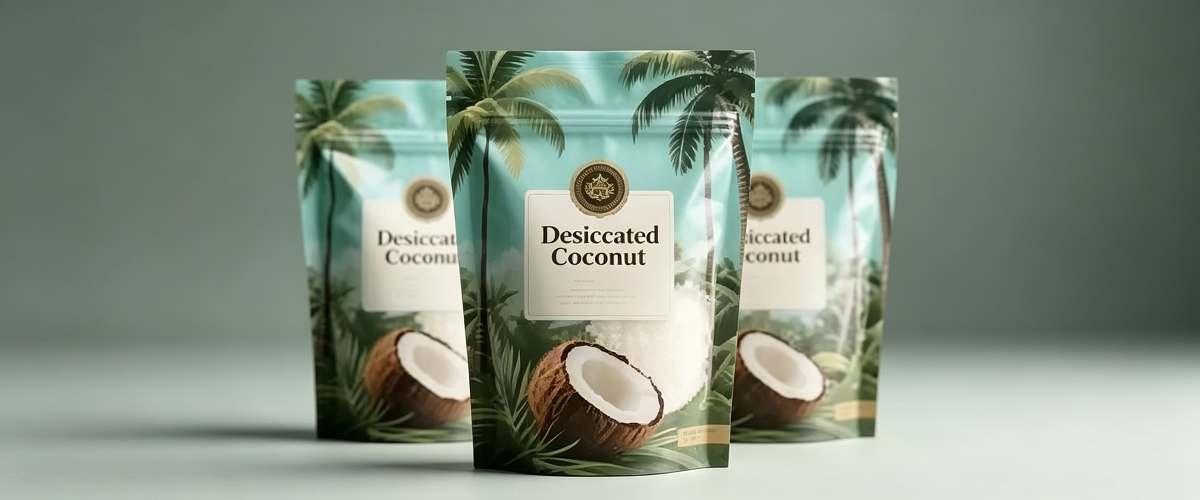
## 2. How Does Packaging Protect Dried Coconut Snacks from Moisture, Oxygen, and Flavor Loss?
Dried coconut snacks may contain less water than fresh coconut products, but they are still sensitive to environmental changes. Their crispness, flavor, and aroma can deteriorate when moisture enters the package or when coconut fats are exposed to oxygen.
The main purpose of suitable flexible packaging is to help control the exchange of moisture, oxygen, and external odors between the product and its surroundings.
### Moisture Protection: Preserving Crispness and Texture
Moisture is one of the biggest threats to crispy dried coconut snacks.
Coconut chips and toasted flakes are often processed to achieve a specific moisture level and texture. If they absorb water vapor from the surrounding environment, their crispness can gradually decline.
Common quality problems include:
- Loss of crispness
- Soft or chewy texture
- Clumping between pieces
- Changes in mouthfeel
- Reduced consumer acceptance
A suitable moisture barrier helps slow water vapor transmission through the packaging material.
Common materials used for moisture protection include:
- PET-based laminates
- Metallized PET
- Aluminum foil laminates
- PE-based sealing layers
- Other validated high-barrier film structures
For crispy coconut chips, the target is generally to maintain the product's intended low moisture condition throughout storage.
However, not every dried coconut snack should be treated as a crispy product. Some coconut strips are intentionally chewy and may have a different moisture specification. Their packaging should preserve the intended texture rather than simply minimize moisture to the greatest possible extent.
Manufacturers should therefore define the product's target moisture content or water activity before choosing the barrier structure.
### Water Activity and Its Importance in Dried Coconut Packaging
Moisture content and water activity are related but different measurements.
Moisture content describes the amount of water in a product, while water activity indicates how available that water is for chemical reactions and microbial growth.
For dried coconut snacks, water activity can help manufacturers evaluate product stability and determine suitable storage conditions.
A low water activity may reduce the potential for microbial growth, but it does not eliminate every quality risk. Oxidation, flavor deterioration, and texture changes may still occur.
Packaging should therefore be selected according to the product's measured properties, not simply its description as "dried" or "crispy."
Manufacturers should consider:
- Initial moisture content
- Water activity
- Desired crispness or chewiness
- Moisture sensitivity
- Storage humidity
- Expected shelf life
- Packaging material WVTR
The finished package should be tested under representative storage conditions to confirm that it maintains the intended product texture.
### Oxygen Barrier: Reducing Coconut Fat Oxidation
Coconut naturally contains a significant amount of fat, which makes oxidation an important consideration in dried coconut snack packaging.
Although coconut fat has a relatively high proportion of saturated fatty acids, dried coconut products can still experience oxidative and other quality changes depending on processing, storage conditions, ingredients, and exposure to oxygen.
Oxygen exposure may contribute to:
- Changes in flavor
- Development of stale or rancid notes
- Loss of fresh coconut aroma
- Deterioration of products containing nuts or seeds
- Reduced sensory quality during extended storage
Roasted coconut products may also contain compounds that contribute to their characteristic toasted aroma. Protecting these flavor characteristics is important for maintaining consistent product quality.
High oxygen barrier packaging can help reduce oxygen transmission into the package.
Potential material structures include:
- PET/VMPET/PE
- PET/AL/PE
- Other validated high-barrier laminates
For products containing additional ingredients such as almonds, cashews, seeds, or chocolate, oxygen protection may become even more important because those ingredients may have their own oxidation sensitivities.
### Nitrogen Flushing for Oxidation-Sensitive Coconut Snacks
Nitrogen flushing is a modified-atmosphere packaging technique that replaces some of the air inside the package with nitrogen gas.
It can be useful for dried coconut snacks that need improved protection against oxygen exposure.
Potential applications include:
- Crispy coconut chips
- Toasted coconut flakes
- Coconut and nut mixes
- Premium roasted coconut snacks
- Products intended for longer distribution periods
Nitrogen flushing may help:
- Reduce residual oxygen
- Slow oxidative deterioration
- Preserve flavor and aroma
- Support product quality during storage
For fragile coconut chips, nitrogen flushing may also create a protective gas cushion in the package, although the actual cushioning effect depends on package design, gas volume, and handling conditions.
However, nitrogen flushing should not be considered a replacement for a suitable barrier laminate. The packaging material must still prevent excessive oxygen ingress, and seals must remain reliable.
Manufacturers should evaluate residual oxygen levels, flushing efficiency, package headspace, and finished-package integrity during production trials.
### Aroma Retention: Protecting the Natural Coconut Flavor
Dried coconut snacks have a distinctive natural aroma that contributes significantly to their appeal.
Processing methods such as drying, roasting, toasting, and sweetening can create different flavor profiles. If these aromas escape or become contaminated by external odors, the product may lose its original sensory identity.
Suitable flexible packaging can help retain desirable aromas and reduce unwanted odor migration.
Important considerations include:
**Material odor characteristics**
Packaging films should have low unwanted odor and should be suitable for direct or indirect food contact as applicable.
**Lamination quality**
Adhesives and laminating processes should be properly selected and controlled to minimize the risk of undesirable odor or flavor transfer.
**Printing and curing**
Inks and coatings should be suitable for the intended packaging application, with appropriate curing and handling procedures.
**Storage conditions**
Packaging materials should be stored in clean environments away from strong odors before use.
For coconut products with added vanilla, fruit flavors, chocolate, or other aromatic ingredients, aroma retention may be especially important.
### Light Protection: Reducing Quality Deterioration
Light exposure can contribute to the deterioration of fat-containing foods, especially when combined with oxygen and elevated temperatures.
Dried coconut snacks may benefit from reduced light transmission because light can accelerate some oxidation reactions and affect product appearance.
Packaging options include:
- Metallized PET films
- Aluminum foil laminates
- Opaque printed films
- Specialized barrier structures
Metallized films offer a reflective appearance and can reduce light transmission while providing improved moisture and oxygen barriers compared with many uncoated films.
Aluminum foil provides a stronger light barrier when incorporated into a suitable laminate.
For brands that want consumers to see the product, a transparent window can be considered. However, window size and position should be evaluated carefully because transparent areas may provide less light protection than the surrounding laminate.
### Seal Integrity: Preventing Moisture and Oxygen Ingress
Even the best packaging material cannot deliver its intended performance if the package has weak seals or small leaks.
Seal integrity is especially important for dried coconut snacks because the product can gradually absorb moisture or experience oxygen exposure through poorly sealed areas.
Important sealing considerations include:
- Suitable sealing temperature
- Appropriate pressure
- Correct dwell time
- Compatibility of sealing layers
- Clean sealing surfaces
- Consistent production conditions
- Resistance to transportation stress
Coconut flakes and small pieces may become trapped in the sealing area during filling. Oil or fine particles can also interfere with seal formation.
Manufacturers should therefore optimize the filling process to keep the sealing area clean and test the finished package rather than relying only on film specifications.
### Environmental Factors and Their Effects on Dried Coconut Snacks
| Environmental Factor | Potential Product Effect | Packaging Consideration |
|---|---|---|
| Moisture | Loss of crispness, clumping, texture changes | Low WVTR |
| Oxygen | Flavor deterioration and oxidation | Low OTR |
| Light | Accelerated quality deterioration | Metallized or foil barrier |
| External odors | Unwanted aroma absorption | Suitable odor barrier and low-odor materials |
| High temperature | Faster quality deterioration and fat-related changes | Suitable storage and distribution controls |
| Weak seals | Moisture and oxygen ingress | Reliable heat-seal performance |
| Physical impact | Broken coconut chips and flakes | Appropriate film strength and secondary protection |
The best protection strategy combines suitable material barriers, reliable seals, controlled storage, and appropriate handling throughout distribution.
---
[](https://sfpouch.com/wp-content/uploads/2026/11/修改图片比例生成-7-2.png)
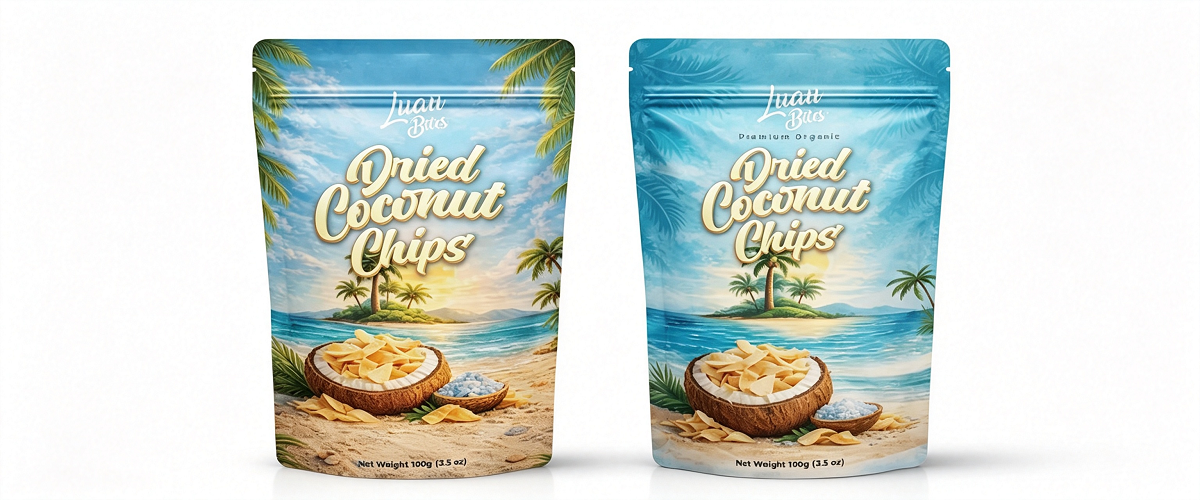
## 3. Which Packaging Materials Provide the Best Barrier and Oil Resistance for Dried Coconut Snacks?
Material selection is a critical part of dried coconut snack packaging because the product must be protected from moisture, oxygen, and potential oil-related quality problems.
Different films offer different combinations of barrier performance, flexibility, strength, printability, and heat-sealing properties. The best structure depends on the product's fat content, moisture sensitivity, shelf-life target, and packaging format.
### PET: Strength and Printing Quality
PET, or polyester film, is widely used as an outer layer in flexible packaging laminates.
Its main advantages include:
- Good mechanical strength
- Excellent printing performance
- Dimensional stability
- Resistance to handling damage
- Compatibility with different laminate structures
PET is commonly used for printed stand-up pouches, flat bottom bags, and other retail snack packaging.
For dried coconut products, PET provides a useful outer layer that supports high-quality graphics and helps the finished package withstand normal handling.
However, standard PET alone may not provide sufficient barrier performance for products requiring extended shelf life. It is often combined with metallized films, aluminum foil, or other functional layers.
### BOPP: Lightweight and Cost-Effective Film
BOPP, or biaxially oriented polypropylene, is commonly used in snack and confectionery packaging.
Its advantages include:
- Good stiffness
- Clear appearance
- Lightweight construction
- Good printing suitability
- Cost efficiency
It may be suitable for selected dried coconut snack applications, particularly where package appearance and production efficiency are important.
BOPP-based films can be used in pillow bags and other high-volume packaging formats.
However, the barrier properties of standard BOPP may not be sufficient for every coconut product. For crispy coconut snacks with demanding moisture and oxygen requirements, a higher-barrier structure may be necessary.
### PE and LLDPE: Flexible Sealing Layers
Polyethylene and linear low-density polyethylene are frequently used as inner sealing layers in flexible packaging.
Their main functions include:
- Providing heat-sealing performance
- Supporting package flexibility
- Contributing to puncture and tear resistance
- Creating a food-contact layer where appropriately specified
PE and LLDPE are commonly used in stand-up pouches and laminated snack bags.
For dried coconut products, the inner sealing layer should be compatible with the product and provide reliable seals under the actual packaging conditions.
Because coconut contains natural fats, manufacturers should also evaluate whether the selected film structure maintains its mechanical and sealing performance during contact with the product.
### VMPET: Enhanced Moisture, Oxygen, and Light Protection
VMPET, or vacuum-metallized PET, is a PET film coated with a thin metal layer, usually aluminum.
It is widely used in flexible snack packaging because it can provide improved barrier performance compared with many uncoated plastic films.
Its advantages include:
- Improved moisture barrier
- Improved oxygen barrier
- Reduced light transmission
- Metallic visual appearance
- Compatibility with common laminated structures
A typical structure for dried coconut snacks is:
**PET/VMPET/PE**
The layers provide different functions:
- PET supports printing and mechanical strength.
- VMPET provides enhanced barrier performance.
- PE provides the inner heat-sealing layer.
This structure can be suitable for:
- Crispy coconut chips
- Toasted coconut flakes
- Dried coconut strips
- Coconut snack mixes
- Products requiring improved storage protection
VMPET is often a practical balance between barrier performance and cost. However, it is not identical to aluminum foil, and its actual performance depends on film quality, metallization, lamination, and package handling.
### Aluminum Foil: Strong Barrier for Demanding Applications
Aluminum foil is one of the strongest barrier materials used in flexible packaging.
It provides excellent protection against:
- Oxygen
- Moisture vapor
- Light
- Many external odors
It may be considered for dried coconut snacks that require demanding shelf-life performance or are distributed over long distances.
A typical structure is:
**PET/AL/PE**
The layers serve different purposes:
- PET provides mechanical strength and printability.
- Aluminum foil provides the main barrier.
- PE provides heat-sealing performance.
Aluminum foil can be particularly useful for premium coconut snacks, products containing additional oxidation-sensitive ingredients, or applications where long-term protection is a priority.
However, it is not always necessary. For many products, metallized PET may provide sufficient protection at a lower cost.
Foil structures should also be evaluated for pinholes, flex cracking, and mechanical damage during converting and transportation.
### High-Barrier Coated Films
In addition to metallized films and aluminum foil, coated barrier films may be used in selected dried coconut packaging applications.
These may include:
- AlOx-coated films
- SiOx-coated films
- Specialized polymer barrier coatings
- Other functional multilayer films
Depending on the technology, coated films may offer combinations of transparency, moisture resistance, and oxygen barrier performance.
They can be considered when brands want a different balance of barrier protection and package appearance.
However, coating performance can be affected by flexing, lamination, sealing, and handling. Manufacturers should request technical specifications and evaluate the finished package rather than relying only on the coating name.
### Oil Resistance and Product Compatibility
Oil resistance is an important consideration for dried coconut snacks because coconut naturally contains fat.
Although packaging oil resistance and oxygen barrier performance are different properties, both can influence the long-term performance of the finished package.
Manufacturers should consider:
- Compatibility of the inner sealing layer with the product
- Resistance to oil-related staining or changes in appearance
- Seal strength after product contact
- Potential interaction with added oils or flavor coatings
- Mechanical performance during storage
- Suitability of the material for the intended food-contact conditions
For products containing added vegetable oils, seasonings, chocolate coatings, or nut ingredients, the packaging structure should be evaluated against the complete formulation.
The term "oil-resistant" should not be treated as a universal guarantee. Material performance should be confirmed through supplier specifications and application testing.
### Recommended Material Structures for Different Dried Coconut Products
| Dried Coconut Product | Potential Material Structure | Main Benefit |
|---|---|---|
| Crispy coconut chips | PET/VMPET/PE | Moisture and oxygen protection |
| Toasted coconut flakes | PET/VMPET/PE | Barrier performance and aroma retention |
| Premium dried coconut snacks | PET/AL/PE | Strong protection against environmental exposure |
| Coconut and nut mixes | PET/VMPET/PE or PET/AL/PE | Oxidation and moisture control |
| Sweetened coconut bites | PET/VMPET/PE or suitable PET/PE laminate | Moisture management and sealing |
| Dried coconut strips | PET/PE or PET/VMPET/PE | Flexible protection based on moisture target |
| Bulk coconut flakes | Suitable high-barrier PE or laminated structure | Storage protection and package strength |
| Coconut milk powder | PET/VMPET/PE or PET/AL/PE | Moisture protection and powder stability |
These structures are starting points for evaluation rather than universal specifications. The final choice should be based on measured barrier performance, product testing, and the required shelf life.
### How to Compare Barrier Performance
When selecting flexible packaging materials, manufacturers should request technical data rather than relying only on descriptions such as "high barrier" or "premium quality."
Important indicators include:
**Water Vapor Transmission Rate (WVTR)**
WVTR measures the amount of water vapor transmitted through a material under specified test conditions. A lower value generally indicates better moisture barrier performance.
For crispy coconut chips and toasted flakes, WVTR is especially important because moisture absorption can quickly reduce crispness.
**Oxygen Transmission Rate (OTR)**
OTR measures the amount of oxygen transmitted through a material under specified conditions. A lower value generally indicates stronger oxygen barrier performance.
For coconut snacks containing fats, nuts, or other oxidation-sensitive ingredients, OTR is an important specification.
**Seal Strength**
Seal strength indicates the mechanical strength of the sealed area. Strong, consistent seals help maintain the intended barrier performance.
**Puncture and Tear Resistance**
These properties help determine whether the package can withstand filling, handling, and transportation without damage.
**Oil Compatibility**
The packaging structure should be evaluated for its suitability with the actual product formulation, especially when the snack contains added oils or coatings.
Barrier values should be compared under equivalent test conditions because temperature and relative humidity can significantly influence performance.
### Balancing Barrier Performance and Packaging Cost
The highest-barrier material is not automatically the best choice for every dried coconut snack.
A product with a moderate shelf-life requirement and controlled distribution may perform well in a metallized PET laminate. A premium coconut snack intended for long-distance export may justify the additional protection of an aluminum foil structure.
Manufacturers should consider:
1. Product moisture content and water activity.
2. Coconut fat content and oxidation sensitivity.
3. Required shelf life.
4. Expected storage temperature and humidity.
5. Distribution distance and transportation conditions.
6. Packaging format and filling equipment.
7. Material cost per finished package.
The final material structure should be validated through finished-package testing and product shelf-life evaluation.
---
[](https://sfpouch.com/wp-content/uploads/2026/11/修改图片比例生成-8-2.png)
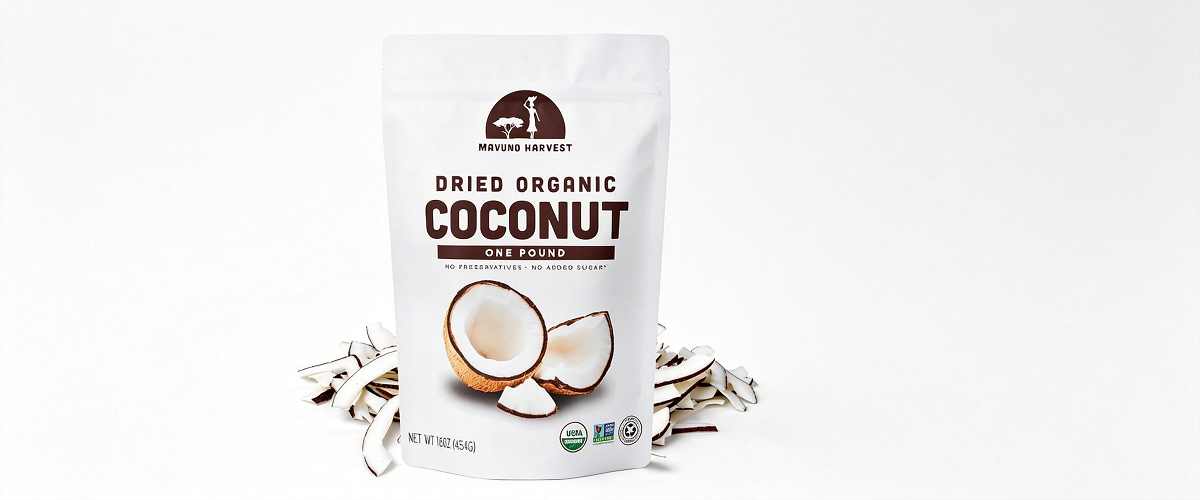
## 4. What Packaging Features Help Maintain Crispness, Freshness, and Extend Shelf Life?
Material selection provides the foundation for dried coconut snack packaging, but functional features also influence product protection and consumer experience.
The right combination of closures, sealing systems, gas flushing, and package design can help maintain product quality while improving convenience.
### Resealable Zippers for Multi-Serve Coconut Snacks
Resealable zippers are especially useful for dried coconut snacks sold in larger retail pouches.
They are commonly used for:
- Coconut chips
- Toasted coconut flakes
- Dried coconut strips
- Coconut and nut mixes
- Sweetened coconut snacks
- Premium snack assortments
Their main advantage is that consumers can reopen and close the package after removing a portion.
This can help reduce repeated exposure to ambient humidity and oxygen compared with leaving the package open.
Benefits include:
- Convenient repeated access
- Better portion management
- Reduced unnecessary exposure after opening
- Improved consumer experience
- Greater suitability for sharing packs
However, a zipper does not provide the same protection as the original heat seal. The initial package seal remains important for maintaining product quality before first use.
For crispy coconut chips, brands should also provide suitable storage instructions, such as closing the zipper securely and storing the product in a cool, dry place.
### Heat-Sealed Closures for Reliable Package Integrity
Heat sealing is one of the most important requirements for flexible packaging.
A reliable heat seal helps prevent moisture and oxygen from entering the package through the opening.
For dried coconut snacks, manufacturers should evaluate:
- Sealing temperature
- Sealing pressure
- Dwell time
- Inner sealing-layer compatibility
- Filling speed
- Product contamination around the seal
- Seal strength after storage
Coconut flakes and small snack pieces can become trapped in the sealing area during filling. Natural oils or seasoning residues may also interfere with seal formation.
To maintain consistent package integrity, manufacturers should optimize the filling process and conduct regular seal testing.
### Nitrogen Flushing for Freshness Protection
Nitrogen flushing can be useful for dried coconut snacks that are sensitive to oxygen exposure.
The process replaces part of the air inside the package with nitrogen, reducing residual oxygen.
Potential benefits include:
- Slower oxidative deterioration
- Improved flavor retention
- Better protection for fat-containing ingredients
- Support for longer storage periods
- Reduced oxygen exposure during distribution
For fragile coconut chips, nitrogen flushing may also provide some cushioning when the package contains an appropriate amount of gas.
However, nitrogen flushing is only effective when the complete packaging system is properly designed.
Important factors include:
- Initial oxygen level
- Gas flushing efficiency
- Package headspace
- Film oxygen barrier
- Seal integrity
- Product characteristics
A high-barrier laminate and reliable seals are still essential.
### Tear Notches for Easy Opening
Tear notches make it easier for consumers to open flexible snack packaging without scissors.
They are suitable for:
- Stand-up pouches
- Flat bottom bags
- Three-side seal bags
- Small coconut snack packs
The notch should be positioned to allow controlled opening without causing the package to tear through an unintended area.
For resealable coconut snack pouches, tear notches are often positioned above the zipper so that the consumer can open the initial seal and then use the zipper for repeated access.
### Transparent Windows for Product Visibility
Transparent windows allow consumers to see the dried coconut snacks before purchasing.
They can be useful for:
- Natural coconut chips
- Toasted coconut flakes
- Dried coconut strips
- Coconut clusters
- Specialty coconut snack mixes
Product visibility can help communicate texture, color, and ingredient quality.
However, a transparent window may provide less light protection than an opaque metallized or foil laminate.
Brands should consider:
- Window size
- Window position
- Product sensitivity to light
- Expected retail lighting
- Barrier properties of the transparent film
For products with demanding shelf-life requirements, a smaller window or a fully opaque package may be more appropriate.
### Matte, Glossy, and Metallic Finishes for Brand Differentiation
Dried coconut snacks are often positioned as natural, tropical, healthy, or premium snack products. Packaging finishes can reinforce these brand messages.
**Matte finish**
Matte packaging creates a clean and understated appearance. It may be suitable for organic coconut snacks, natural ingredient products, and premium snack lines.
**Glossy finish**
Glossy surfaces create stronger visual contrast and can make product photography and colors appear more vibrant.
**Metallic effects**
Metallic inks or metallized film can create a premium appearance while supporting certain barrier requirements, depending on the structure.
**Spot UV**
Spot UV adds a glossy effect to selected design areas, creating contrast between different finishes.
**Soft-touch coating**
Soft-touch finishes provide a distinctive tactile effect and may help reinforce premium brand positioning.
When selecting finishes, manufacturers should confirm their compatibility with the laminate structure, printing process, and applicable food-packaging requirements.
### Gussets and Package Dimensions for Better Product Protection
Gussets help flexible bags expand and accommodate larger product volumes.
They are particularly useful for:
- Family-size coconut snack packs
- Large coconut chip bags
- Coconut and nut mixes
- Bulk dried coconut flakes
Correct package dimensions can help reduce unnecessary compression and improve the appearance of the finished package.
For fragile coconut chips, manufacturers should consider:
- Product piece size
- Average fill weight
- Package width and height
- Bottom gusset depth
- Headspace
- Product fragility
- Secondary packaging requirements
A package that is too small may crush the product, while an oversized bag may allow excessive product movement and increase the risk of breakage.
### Oxygen Absorbers: When Are They Appropriate?
Oxygen absorbers may be considered for selected dried coconut products that require additional protection from oxidation.
They work by reducing oxygen inside a properly sealed package.
However, they should not be used automatically in every coconut snack package.
Before using an oxygen absorber, manufacturers should evaluate:
- Product water activity
- Product fat content
- Packaging barrier performance
- Required residual oxygen level
- Absorber capacity
- Consumer safety and labeling requirements
- Compatibility with the product and package size
Oxygen absorbers are not a substitute for appropriate barrier materials or good sealing practices. Their use should be validated for the specific product and packaging system.
### Secondary Packaging for Transportation Protection
Flexible pouches protect dried coconut snacks from environmental exposure, but they may not provide sufficient cushioning against heavy compression or rough handling.
This is especially important for crispy coconut chips, which can break during transportation.
Secondary packaging may include:
- Corrugated shipping cartons
- Dividers for fragile products
- Appropriate carton dimensions
- Protective inserts where necessary
- Palletized shipping arrangements
For e-commerce orders, manufacturers should also consider how individual pouches will be protected inside shipping boxes.
The objective is to reduce crushing, punctures, and excessive movement without adding unnecessary packaging material.
### Packaging Feature Recommendations by Product Type
| Packaging Feature | Suitable Applications | Main Benefit |
|---|---|---|
| Resealable zipper | Multi-serve coconut chips and flakes | Convenience after opening |
| Heat seal | All sealed retail pouch formats | Package integrity |
| Nitrogen flushing | Oxidation-sensitive coconut snacks | Reduced residual oxygen |
| Tear notch | Stand-up pouches and small snack bags | Easy opening |
| Transparent window | Selected natural coconut snacks | Product visibility |
| Matte or metallic finish | Premium coconut snack brands | Stronger shelf presentation |
| Oxygen absorber | Validated high-barrier applications | Additional oxygen reduction |
| Gusseted structure | Large or family-size packs | Improved capacity and stability |
| Protective cartons | Fragile coconut chips and export packs | Reduced physical damage |
The most effective packaging features are those that address actual product and distribution challenges. Adding features without a clear purpose can increase costs without improving product quality.
---
[](https://sfpouch.com/wp-content/uploads/2026/11/修改图片比例生成-9-2.png)
## 5. Dried Coconut Snack Packaging: Key Factors for Product Protection, Branding, Convenience, and Distribution
Choosing the right flexible packaging for dried coconut snacks requires more than comparing film prices or selecting a popular pouch format. Manufacturers need to consider the product's formulation, moisture sensitivity, fat content, shelf-life expectations, production equipment, distribution environment, and brand positioning.
A packaging structure that works for crispy coconut chips may not provide the right performance for chewy coconut strips or coconut-based snack mixes. A systematic evaluation helps avoid unnecessary material costs while maintaining product quality.
### Product Composition, Moisture Content, and Texture
The first step is to understand the exact characteristics of the dried coconut snack.
Different products have different moisture levels and texture requirements.
**Crispy coconut chips**
Crispy coconut chips are highly sensitive to moisture absorption. Their packaging should provide strong moisture protection to maintain crispness. Oxygen barrier performance is also important because coconut contains natural fat.
**Toasted coconut flakes**
Toasted coconut flakes have a characteristic roasted aroma and may contain exposed coconut fats. Packaging should help preserve aroma and reduce exposure to oxygen and moisture.
**Dried coconut strips**
Dried coconut strips may be intentionally chewy rather than crispy. Their packaging should maintain the desired texture without causing excessive drying or moisture uptake.
**Sweetened coconut snacks**
Products containing added sugar or syrup may have different moisture behavior from unsweetened coconut products. Their packaging should be evaluated according to the final formulation and potential stickiness.
**Coconut and nut mixes**
These products combine coconut with other fat-containing ingredients. Their packaging should account for the oxidation sensitivity of the entire mixture rather than focusing only on the coconut component.
**Coconut clusters**
Clusters may contain coconut, nuts, seeds, sweeteners, or binders. Their irregular shape and fragile structure may require additional physical protection and suitable pouch dimensions.
Manufacturers should measure moisture content and water activity and define the desired texture before selecting packaging materials.
### Shelf-Life Requirements and Storage Conditions
Shelf-life targets influence both material selection and package design.
Dried coconut snacks may be distributed through local retail stores, supermarkets, online platforms, specialty food shops, or international export channels.
Each channel creates different storage and transportation challenges.
Before choosing packaging, manufacturers should define:
- Target shelf life
- Product moisture content
- Water activity
- Oxygen sensitivity
- Storage temperature
- Relative humidity
- Retail display conditions
- Transportation duration
- Expected time after opening
A product stored in a controlled warehouse may not require the same packaging as one shipped internationally through several distribution centers.
High temperatures can accelerate quality deterioration, while humid environments increase the risk of moisture absorption if the package is not sufficiently protective.
Packaging should therefore be validated under realistic storage conditions rather than relying only on laboratory film specifications.
### Production and Packaging-Line Compatibility
The selected flexible packaging must work reliably with the manufacturer's production equipment.
Even a high-barrier laminate may create operational problems if it does not feed, form, seal, or cut properly on the packaging line.
Important considerations include:
**Film feeding and handling**
The film should run smoothly without excessive slipping, wrinkling, static, or tearing.
**Filling performance**
The pouch opening should be wide enough to accommodate the coconut product without excessive spillage.
**Sealing conditions**
The inner sealing layer should provide a suitable operating window for the machine's temperature, pressure, and speed.
**Product contamination**
Small coconut flakes, crumbs, and oil residues should be kept away from the sealing area.
**Package dimensions**
Pouch width, height, and gusset depth should match the product weight and volume.
**Production speed**
The packaging structure should support the manufacturer's required output without creating unnecessary downtime.
For fragile coconut chips, the filling process should also be designed to minimize dropping height and mechanical impact.
Manufacturers should conduct machine trials using actual product samples before approving a new material structure for mass production.
### Branding and Shelf Appeal for Dried Coconut Snacks
Packaging design plays an important role in communicating the identity of dried coconut snacks.
Consumers may associate coconut products with natural ingredients, tropical flavor, convenience, wellness, or premium snacking. Flexible packaging provides space to communicate these characteristics.
Important branding elements include:
**Product identification**
The package should clearly communicate whether the product is crispy coconut chips, toasted flakes, dried strips, or a coconut snack mix.
**Color strategy**
Natural tones, tropical colors, and carefully selected accent colors can help communicate product positioning. The design should remain consistent with the brand identity.
**Product photography**
High-quality images of coconut chips, flakes, or coconut pieces can help consumers understand the product's texture and serving style.
**Ingredient communication**
Information about added sugar, flavorings, nuts, seeds, or other ingredients should be clear and easy to read.
**Brand storytelling**
Brands may use packaging to communicate product origin, processing methods, ingredient sourcing, and other relevant product characteristics.
**Finishing effects**
Matte finishes, glossy coatings, metallic effects, and spot UV can create visual differentiation.
For premium coconut snacks, flat bottom bags and stand-up pouches offer particularly useful surfaces for branding and product information.
### Consumer Convenience and Portion Control
Dried coconut snacks are often consumed over multiple occasions, especially when sold in medium or large retail pouches.
Packaging should therefore make it easy for consumers to open, close, store, and portion the product.
Useful features include:
- Resealable zippers
- Easy-open tear notches
- Convenient pack sizes
- Clear storage instructions
- Durable package construction
- Product visibility where appropriate
Single-serving packs may be better suited to pillow bags or three-side seal bags, while multi-serve products may benefit from stand-up pouches with resealable zippers.
For products that lose crispness quickly after opening, clear storage instructions can encourage consumers to close the package properly and store it in a cool, dry location.
### Food-Contact Compliance and Packaging Safety
Dried coconut snack packaging must meet the applicable food-contact requirements in the destination market.
Depending on the sales region, relevant requirements may include:
- U.S. FDA food-contact requirements
- European Union food-contact legislation
- Applicable national food packaging regulations
- Requirements for inks, adhesives, coatings, and additives
Manufacturers should request relevant documentation for the complete packaging structure.
Useful supplier documents may include:
- Material technical data sheets
- Food-contact compliance statements
- Relevant migration test reports
- Information about inks and adhesives
- Laminate specifications
- Supporting documentation for the target market
It is important to assess the complete package rather than relying on a general statement that a material is food-grade.
For dried coconut products, sensory compatibility should also be considered. Packaging should not introduce unwanted odors or affect the natural coconut aroma.
### Sustainability and Material Efficiency
Sustainability is becoming increasingly important for snack brands, retailers, and consumers.
Flexible packaging can offer opportunities to reduce packaging weight and optimize material usage, but environmental performance depends on the complete structure and available end-of-life systems.
Potential strategies include:
**Downgauging**
Reducing film thickness may lower material consumption, provided the finished package continues to meet strength and barrier requirements.
**Right-sizing**
Selecting suitable pouch dimensions can reduce unnecessary material and improve product presentation.
**Mono-material packaging**
Some PE-based or PP-based structures may offer improved compatibility with recycling systems where appropriate collection and processing infrastructure exists.
**Recyclability evaluation**
A package should not be described as recyclable without assessing the complete laminate, local collection systems, sorting technology, and recycling availability.
**Reducing product waste**
Packaging should maintain adequate moisture and oxygen protection. If a lower-impact structure causes more product spoilage, the overall environmental benefit may be reduced.
For dried coconut snacks, sustainability decisions should balance material reduction with the need to preserve crispness, flavor, and shelf life.
### Cost Efficiency and Total Packaging Value
Packaging cost should be evaluated in relation to product protection, manufacturing efficiency, distribution, and brand value.
A low-cost film may appear attractive, but it may not be suitable if it allows moisture to enter or oxygen to reach the product too quickly.
Manufacturers should compare:
- Material cost per unit
- Film thickness
- Lamination and converting costs
- Printing and cylinder costs
- Minimum order quantities
- Production efficiency
- Packaging waste
- Transportation and storage costs
- Product breakage and rejection rates
For example, a mainstream dried coconut snack brand may choose PET/VMPET/PE because it offers a practical balance between barrier performance and cost.
A premium export product may justify PET/AL/PE if stronger protection is required by its shelf-life and distribution conditions.
A single-serving product may prioritize a simple pillow bag that runs efficiently on automated equipment.
The best solution is not necessarily the most complex laminate or the cheapest film. It is the packaging structure that meets the product's actual performance requirements at a commercially reasonable cost.
### How to Work with a Flexible Packaging Supplier
A reliable flexible packaging supplier should understand the dried coconut product and its storage requirements before recommending a material structure.
Before requesting a quotation, manufacturers should prepare the following information:
| Information to Provide | Why It Matters |
|---|---|
| Dried coconut product type | Determines texture and protection requirements |
| Product moisture content | Helps define moisture-barrier needs |
| Water activity | Supports product stability evaluation |
| Fat content and added oils | Helps assess oxidation and material compatibility |
| Product dimensions and piece size | Helps determine pouch dimensions |
| Fill weight | Influences package capacity |
| Target shelf life | Guides material selection |
| Storage conditions | Helps determine barrier requirements |
| Distribution destination | Identifies transportation and climate challenges |
| Packaging format | Determines converting and production requirements |
| Required features | Determines zipper, tear notch, window, or other options |
| Printing design | Supports artwork preparation and quotation |
| Order quantity | Influences production planning and unit cost |
| Target market | Helps identify compliance requirements |
Manufacturers should also request material samples, technical specifications, barrier test data, and food-contact documentation.
Before mass production, confirm:
- Material structure
- Film thickness
- Pouch dimensions
- Printing quality
- Zipper performance, if applicable
- Heat-seal performance
- Package integrity
- Compatibility with the filling machine
- Product shelf-life performance
A structured sample approval and testing process helps reduce the risk of packaging failures after large-scale production begins.
### Final Checklist for Choosing Dried Coconut Snack Packaging
Before finalizing a packaging solution, manufacturers can use the following checklist:
- [ ] Identify the exact dried coconut product and its intended texture.
- [ ] Measure moisture content and water activity.
- [ ] Evaluate fat content and oxidation sensitivity.
- [ ] Select a suitable bag format.
- [ ] Define the target shelf life.
- [ ] Evaluate WVTR and OTR requirements.
- [ ] Choose a suitable material structure and thickness.
- [ ] Consider oil compatibility and product contact.
- [ ] Confirm seal integrity and filling-line compatibility.
- [ ] Determine whether nitrogen flushing is beneficial.
- [ ] Decide whether a resealable zipper or tear notch is necessary.
- [ ] Evaluate the need for a transparent window.
- [ ] Confirm food-contact compliance.
- [ ] Test the finished package under realistic storage conditions.
- [ ] Compare total packaging cost rather than material price alone.
By evaluating these factors systematically, dried coconut snack manufacturers can choose packaging that protects product quality while supporting efficient production and competitive market positioning.
---
## FAQ
**What is the best flexible packaging for dried coconut chips?**
High-barrier stand-up pouches made from PET/VMPET/PE or PET/AL/PE are common options for dried coconut chips. They can help protect the product from moisture and oxygen while providing good printing and branding opportunities. The final choice depends on the required shelf life and distribution conditions.
**Do dried coconut snacks need high-barrier packaging?**
Many dried coconut snacks benefit from moisture and oxygen barrier protection because moisture absorption can reduce crispness and oxygen exposure can contribute to flavor deterioration. The required barrier level depends on product moisture, fat content, processing method, and shelf-life target.
**Why do crispy coconut chips become soft inside the package?**
Crispy coconut chips may become soft when they absorb moisture. This can happen if the packaging has insufficient moisture barrier performance, if seals are weak, or if the package is repeatedly exposed to humid air after opening.
**Is aluminum foil packaging necessary for dried coconut snacks?**
Not always. Aluminum foil provides excellent moisture, oxygen, and light protection, but metallized PET may provide sufficient performance for many applications at a lower cost. The best option should be determined through material testing and product shelf-life evaluation.
**Can nitrogen flushing extend the shelf life of coconut chips?**
Nitrogen flushing can reduce residual oxygen and may help slow oxidative deterioration. However, it must be combined with suitable barrier materials and reliable seals. Its effectiveness depends on the product, package design, and production process.
**Are resealable zippers recommended for dried coconut snack bags?**
Yes, particularly for multi-serving products such as coconut chips, toasted flakes, and coconut snack mixes. Zippers allow consumers to close the package after opening, helping reduce repeated exposure to humidity and air.
**What material structure is suitable for toasted coconut flakes?**
PET/VMPET/PE is a potential starting structure because it offers printing support, enhanced barrier performance, and a heat-sealing layer. PET/AL/PE may be considered when stronger protection is required. Final selection should be based on product testing and the required shelf life.
**Do dried coconut snacks need oxygen absorbers?**
Not every product needs an oxygen absorber. They may be considered for selected oxidation-sensitive products in properly sealed high-barrier packaging. The absorber's capacity, product water activity, and package conditions should be validated before use.
**Can transparent windows be used on dried coconut snack packaging?**
Yes. Transparent windows can help consumers see the product, but they may reduce light protection. Window size and position should be selected according to the product's sensitivity and shelf-life requirements.
**How should dried coconut snack packaging be tested before mass production?**
Manufacturers should evaluate moisture and oxygen barrier performance, seal strength, leak integrity, puncture resistance, oil compatibility, and machine performance. Product testing should also monitor crispness, aroma, flavor, and texture under representative storage conditions.
---
## Conclusion
Choosing the right packaging for dried coconut snacks requires a balance between **moisture protection, oxygen control, oil compatibility, product freshness, consumer convenience, and cost efficiency**. Different coconut products have different packaging needs, so manufacturers should select materials and bag formats according to the product's actual texture, composition, and shelf-life requirements.
Stand-up pouches and flat bottom bags are practical choices for retail coconut chips, toasted flakes, and snack mixes. Pillow bags and three-side seal bags are suitable for single-serving products and high-volume packaging, while larger gusseted structures can support family-size or bulk packs.
Material selection is equally important. PET/VMPET/PE can provide a useful balance of barrier performance, printing quality, and cost for many dried coconut snacks. PET/AL/PE may be more suitable when stronger protection against moisture, oxygen, and light is required. In every case, the final laminate should be evaluated for barrier performance, seal integrity, oil compatibility, and production-line suitability.
Functional features such as resealable zippers, tear notches, nitrogen flushing, and transparent windows can further improve product protection and consumer experience. However, these features should be selected according to actual product requirements rather than added unnecessarily.
Ultimately, the best dried coconut snack packaging is the structure that maintains the intended texture and flavor, protects the product throughout distribution, supports efficient production, and communicates the brand's value to consumers. With the right combination of materials, bag formats, and customized features, manufacturers can preserve product quality, improve shelf presentation, and build a stronger position in the competitive snack market.