Guide to Flexible Packaging for Protein Powder Supplements
Anna_Yu
Guide to Flexible Packaging for Protein Powder Supplements
Protein powder supplements have become an important category in the global health and nutrition market. From whey protein and casein to plant-based protein blends, collagen powders, and specialized sports nutrition formulas, consumers expect products to deliver consistent quality, nutritional value, convenient preparation, and reliable shelf life. While formulation and ingredient quality determine much of a supplement's performance, packaging plays an equally important role in protecting the product from environmental exposure and maintaining its usability throughout storage and distribution.
Protein powders are particularly sensitive to moisture. Even small amounts of moisture entering a package can cause powder clumping, reduced flowability, and changes in texture. Oxygen exposure can contribute to the oxidation of fats and other sensitive ingredients, potentially affecting flavor and product quality. Light, external odors, contamination, and poor closure performance can also undermine the overall consumer experience. For products containing flavors, vitamins, minerals, probiotics, or other functional ingredients, packaging requirements may become even more demanding.
Flexible packaging has become a popular solution for protein powder supplements because it combines barrier protection, lightweight construction, convenient storage, and extensive customization possibilities. Stand-up pouches, flat bottom bags, side gusset bags, and large-capacity refill pouches can accommodate different product volumes and sales channels. High-barrier laminated films, resealable zippers, tear notches, and custom printing also allow brands to develop packaging that balances product protection with retail presentation.
However, choosing the right flexible packaging for protein powder is not simply a matter of selecting a bag with sufficient capacity. Different protein formulations have different moisture sensitivities, fat contents, particle characteristics, and shelf-life requirements. A small single-serving sachet has very different requirements from a 5 lb family-size whey protein pouch or a premium plant-based protein supplement.
This guide explores the key considerations involved in selecting flexible packaging for protein powder supplements. It covers bag styles, barrier properties, material structures, functional features, storage requirements, branding opportunities, and cost considerations to help supplement brands and manufacturers make informed packaging decisions.
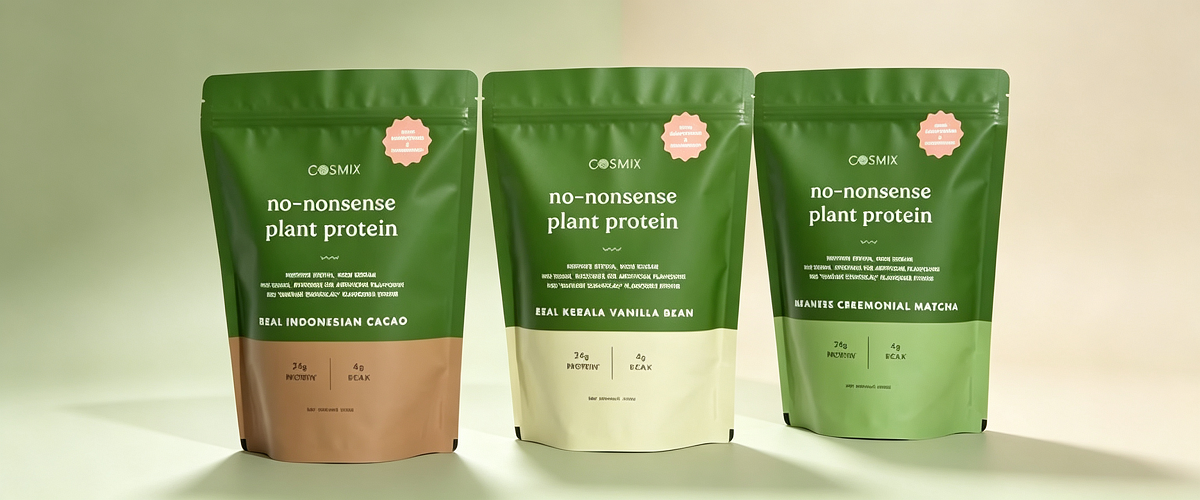
1. What Types of Flexible Packaging Are Best for Protein Powder Supplements?
The most suitable flexible packaging format for protein powder depends on product volume, formulation, sales channel, filling equipment, and consumer usage habits.
Protein powders are generally sold in single-serving portions, standard retail sizes, and larger refill or bulk packages. Each format requires a different balance of filling efficiency, barrier protection, storage convenience, and package appearance.
Stand-Up Pouches (Doypacks)
Stand-up pouches are one of the most popular flexible packaging formats for protein powder supplements.
Their bottom gusset allows the pouch to stand upright when filled, making them suitable for retail shelves, e-commerce product photography, and direct-to-consumer sales.
Common applications include:
- Whey protein powder
- Plant-based protein blends
- Collagen powder supplements
- Flavored protein formulas
- Smaller and medium-sized retail packs
Stand-up pouches offer several advantages:
- Good shelf visibility and product presentation
- Large printable surfaces for branding and nutrition information
- Compatibility with resealable zipper closures
- Flexible sizing for different fill weights
- Lightweight construction compared with many rigid containers
For supplement brands, stand-up pouches offer a practical way to combine functional packaging with attractive product design.
A typical retail protein powder pouch may include a high-barrier laminated structure, a wide opening for filling, a resealable zipper, and a tear notch for first-time opening.
However, pouch dimensions must be designed around the bulk density of the powder rather than weight alone. Two protein formulas with the same net weight may occupy different volumes depending on their ingredients, particle size, and processing characteristics.
Flat Bottom Bags (Box Pouches)
Flat bottom bags are often selected by premium supplement brands that want a stable, structured package with a distinctive retail appearance.
Their flat base and side gussets help create a box-like shape, allowing the package to stand upright and maintain a relatively consistent appearance after filling.
Key advantages include:
- Strong shelf stability
- Multiple printable panels
- Premium visual presentation
- Efficient use of shelf space
- Compatibility with resealable closures
Flat bottom bags are particularly suitable for:
- Premium whey protein products
- Specialty nutrition formulas
- Plant-based protein supplements
- Private-label sports nutrition products
- Larger retail packages
The additional panels provide more space for brand storytelling, product benefits, nutritional information, flavor identification, and regulatory labeling.
For brands selling several protein formulas, flat bottom bags can also support a consistent packaging system. Different flavors or formulations can use the same basic bag structure while changing the printed graphics and product information.
Because protein powder packages can become relatively heavy, the bottom construction and seal strength should be evaluated carefully. The pouch must support the filled weight during handling, transportation, and repeated consumer use.
Side Gusset Bags
Side gusset bags are commonly used for larger protein powder packages and products sold through wholesale or high-volume retail channels.
The side gussets expand when the bag is filled, providing additional capacity without requiring an excessively wide front panel.
Typical applications include:
- Large whey protein packs
- Bulk plant-based protein powder
- Sports nutrition ingredients
- Foodservice and commercial nutrition products
- Refill packaging for larger households
Their main benefits include:
- High filling capacity
- Efficient storage and transportation
- A familiar format for bulk powder products
- Good compatibility with high-barrier laminates
- Large printable front and back panels
Side gusset bags can be supplied with different closure and sealing configurations depending on the filling process and product requirements.
For larger packs, the bag structure should be designed to withstand the weight of the powder and repeated handling. The bottom seal, side seals, and overall film strength are particularly important.
Flat Pouches and Three-Side Seal Bags
Flat pouches and three-side seal bags are suitable for smaller protein powder quantities and single-serving applications.
They are widely used for:
- Individual protein servings
- Product samples
- Trial packs
- Promotional sachets
- Travel-size supplement portions
Their compact structure makes them economical for high-volume production and easy to distribute through gyms, fitness events, subscription boxes, and promotional campaigns.
For example, a supplement brand launching a new flavor may use individually packed samples to encourage consumers to try the product before purchasing a full-size pouch.
Three-side seal bags can be manufactured with different widths, lengths, and film structures. They can also be designed for easy tearing and convenient pouring.
However, single-serving sachets should be sized according to the powder's volume and intended mixing quantity. A package that is too small may make filling difficult or leave insufficient headspace for reliable sealing.
Stick Packs
Stick packs are narrow, elongated flexible packages designed for precise single-serving portions.
They are especially suitable for:
- On-the-go protein supplements
- Collagen powder
- Instant protein drink mixes
- Pre-measured nutritional blends
- Travel-friendly supplement products
Their advantages include:
- Convenient portion control
- Compact storage
- Easy distribution
- Reduced need for measuring scoops
- Compatibility with high-speed automated filling
Stick packs are useful for brands targeting consumers who want to carry protein supplements to work, the gym, or while traveling.
However, their narrow shape requires careful consideration of powder flowability and filling characteristics. Products with poor flow properties may require adjustments to the filling system and package dimensions.
Large-Capacity Refill Pouches
Refill pouches are increasingly relevant for supplement brands that want to offer larger quantities or reduce reliance on rigid containers.
They are often used for:
- Family-size protein powder
- Large whey protein packages
- Bulk plant-based protein
- Repeat-purchase products
- Refill systems designed to accompany reusable containers
Refill pouches can reduce packaging volume compared with some rigid alternatives, particularly when empty packaging is transported and stored before filling.
They can also support brand sustainability strategies when the complete packaging system is designed with material reduction and realistic end-of-life considerations in mind.
For larger refill bags, manufacturers should pay particular attention to film strength, bottom construction, closure performance, and the ability to withstand repeated handling.
Comparison of Flexible Packaging Types for Protein Powder
| Packaging Type | Main Advantages | Suitable Applications | Typical Market Positioning |
|---|---|---|---|
| Stand-up pouch | Shelf visibility, zipper compatibility, flexible sizing | Retail whey and plant protein | Mainstream to premium |
| Flat bottom bag | Stable structure, multiple printable panels | Premium supplements and larger retail packs | Premium |
| Side gusset bag | High capacity and efficient storage | Bulk protein powder | Mainstream and wholesale |
| Three-side seal bag | Economical and compact | Samples and small portions | Promotional and entry-level |
| Stick pack | Precise portioning and portability | Single-serving formulas | Convenience-focused |
| Refill pouch | Large capacity and flexible storage | Repeat-purchase and family-size products | Value-oriented and premium refill |
The best format should be selected according to the product's actual filling weight, bulk density, shelf-life target, and sales channel. For many retail protein powder brands, a high-barrier stand-up pouch with a reliable zipper is a practical starting point. Larger products may benefit from flat bottom or side gusset structures, while trial and travel products are better suited to sachets and stick packs.
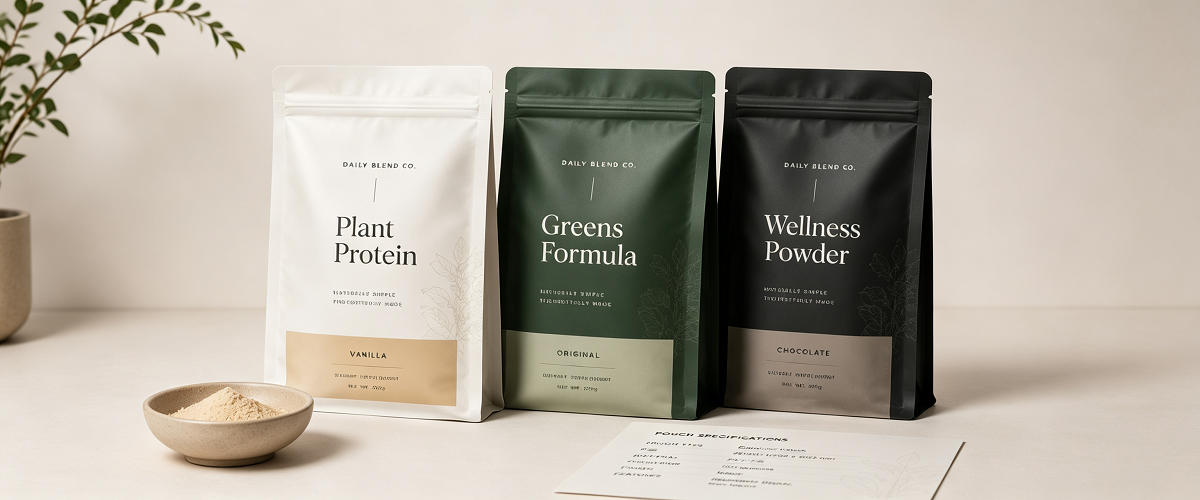
2. How Does Flexible Packaging Protect Protein Powder from Moisture, Oxygen, and Contamination?
Protein powder packaging must maintain product quality throughout manufacturing, warehousing, transportation, retail display, and consumer use.
Unlike many liquid supplements, protein powders are dry products with specific moisture and environmental stability requirements. Their performance depends on the formulation, water activity, ingredient composition, processing conditions, and storage environment.
Flexible packaging protects protein powder by creating a controlled barrier between the product and external conditions. However, the protection provided depends on the material structure, seals, closure system, and overall package design.
Moisture Barrier: Preventing Powder Clumping
Moisture is one of the most important factors to control in protein powder packaging.
Protein powders can absorb moisture from the surrounding environment. When moisture enters the package, particles may begin to stick together, resulting in clumping, reduced flowability, and changes in texture.
Moisture-related problems may include:
- Formation of hard or soft powder lumps
- Reduced solubility or dispersion performance
- Difficulty measuring accurate servings
- Changes in powder texture
- Potential deterioration of sensitive ingredients
- Increased risk of quality problems during extended storage
The degree of moisture sensitivity varies by formulation. Protein blends containing carbohydrates, minerals, flavoring systems, or hygroscopic ingredients may respond differently to humidity.
High moisture barrier films help slow moisture transmission through the package wall. PE-based sealant layers, metallized films, and aluminum foil laminates can be selected according to the required performance.
However, the material itself is only part of the protection system.
A package with excellent moisture barrier properties can still allow moisture to enter through weak seals, damaged film, or an improperly closed zipper. Therefore, seal integrity and closure performance should be evaluated together with film specifications.
Oxygen Barrier: Maintaining Flavor and Ingredient Stability
Oxygen exposure can contribute to the oxidation of fats and other sensitive ingredients in protein powder formulations.
This is particularly relevant for products containing:
- Whey protein with residual milk fat
- Plant-based protein blends containing oils
- Added essential fatty acids
- Fat-soluble vitamins
- Flavoring systems containing oxidation-sensitive components
Oxidation may contribute to unwanted flavor changes, stale notes, and deterioration of product quality.
High oxygen barrier packaging helps reduce oxygen transmission through the package wall and supports more stable storage conditions.
Common barrier options include:
- Metallized PET
- Aluminum foil laminates
- High-barrier coated films
- Specially engineered multilayer structures
The required oxygen barrier depends on the formulation and target shelf life. A standard protein powder may not require the same oxygen protection as a specialized formula containing oxidation-sensitive ingredients.
For products with demanding shelf-life requirements, manufacturers should evaluate oxygen transmission rate (OTR) under relevant testing conditions and confirm performance using the finished package.
Light Protection: Reducing Exposure to Light-Sensitive Ingredients
Light exposure can affect selected vitamins, flavors, colors, and other sensitive ingredients.
Some protein powder products contain added nutrients or functional ingredients that require additional protection from light.
Flexible packaging can provide different levels of light protection depending on its structure.
For example:
- Transparent films provide product visibility but limited light protection.
- Opaque printed films reduce direct exposure.
- Metallized films provide strong light shielding.
- Aluminum foil laminates offer very high light protection when properly constructed.
Brands should balance product visibility with protection requirements.
For a premium protein powder that needs strong light protection, an opaque or metallized package may be more appropriate than a fully transparent bag.
Protection Against External Contamination
Protein powder should be protected from dust, foreign particles, odors, and other contaminants during storage and distribution.
A sealed flexible pouch helps isolate the product from the external environment.
Important protective considerations include:
- Clean filling conditions
- Appropriate food-contact packaging materials
- Reliable heat seals
- Secure first-opening protection
- Proper storage and handling procedures
Packaging alone cannot guarantee product safety. Protein powder must be manufactured and filled under appropriate hygiene and quality-control conditions.
The packaging should also be designed to minimize contamination risks during opening and repeated use.
For example, a wide zipper opening can make scooping easier, but consumers should be advised to use a clean, dry scoop and close the package securely after each use.
Aroma Retention and Odor Protection
Protein powders are frequently available in flavors such as chocolate, vanilla, strawberry, coffee, and cookies and cream.
These flavor systems may contain volatile aroma compounds that can be lost during storage or affected by external odors.
A suitable flexible packaging structure helps:
- Retain desirable flavor aromas
- Reduce odor migration
- Protect the product from external smells
- Maintain a more consistent consumer experience
This is particularly important for flavored protein blends and premium formulas where sensory quality is a major selling point.
Seal Integrity: The Critical Part of Package Protection
Even a high-performance film structure cannot provide reliable protection if the package seals are weak.
Potential seal-related problems include:
- Incomplete heat sealing
- Powder contamination in the seal area
- Channel leaks
- Seal wrinkles
- Punctures near the package edge
- Poor closure alignment
Protein powder particles can interfere with heat sealing if they become trapped between the sealing layers. This can create leakage paths that allow moisture and oxygen to enter.
Manufacturers should therefore consider the following:
- Ensure that the filling process minimizes powder contamination around the seal area.
- Select a sealant layer compatible with the filling and sealing equipment.
- Establish appropriate sealing temperature, pressure, and dwell time.
- Conduct seal strength and leak testing.
- Inspect finished packages for visible defects.
For products with extended shelf-life requirements, seal performance should be validated using the complete package rather than relying only on flat-film specifications.
Nitrogen Flushing and Oxygen Management
Nitrogen flushing is sometimes used in protein powder packaging to reduce residual oxygen inside the package.
The process replaces part of the air in the package headspace with nitrogen before sealing.
Potential benefits include:
- Lower residual oxygen
- Reduced oxidation risk for sensitive ingredients
- Improved control of the internal package atmosphere
- Support for longer product quality retention when properly validated
However, nitrogen flushing is not necessary for every protein powder product. Its usefulness depends on the formulation, package size, headspace, target shelf life, and production economics.
The process must also be optimized for powder filling conditions. Excessive gas flow may disturb fine powders or create operational problems on the filling line.
Matching Barrier Requirements to Protein Powder Types
| Protein Powder Type | Main Packaging Concerns | Suggested Protection Strategy |
|---|---|---|
| Whey protein concentrate | Moisture, flavor stability, possible fat oxidation | High moisture barrier with appropriate oxygen protection |
| Whey protein isolate | Moisture uptake and product quality | Reliable moisture barrier and strong seals |
| Casein protein | Moisture and powder handling | Moisture-resistant structure and suitable closure |
| Plant-based protein | Moisture, flavor, and possible oxidation of added oils | High-barrier laminate based on formulation |
| Collagen powder | Moisture and storage convenience | Moisture-resistant packaging with reliable resealing |
| Protein blends with added vitamins | Moisture, oxygen, and light sensitivity | Barrier structure selected for sensitive ingredients |
| Flavored protein powder | Aroma retention and external odor protection | High-barrier structure with good seal integrity |
The most effective protection strategy is based on the complete formulation and its validated shelf-life requirements. Brands should avoid assuming that every protein powder requires the same barrier specification.
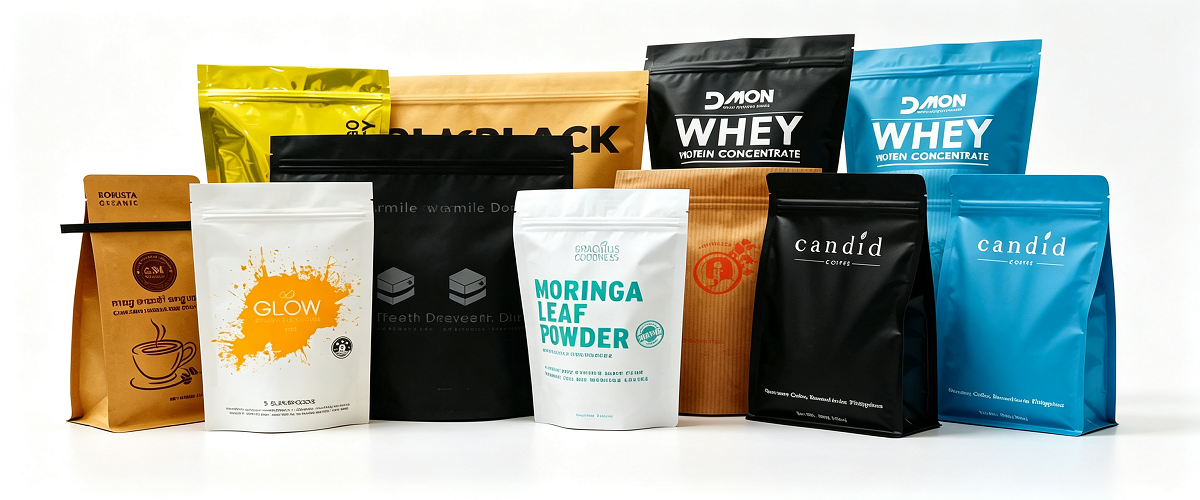
3. Which Packaging Materials Provide the Best Barrier Protection for Protein Powder Supplements?
Material selection has a direct impact on moisture resistance, oxygen barrier, light protection, mechanical strength, sealing performance, and package cost.
Protein powder packaging often uses multilayer flexible films because different materials provide different functional properties.
An outer layer may provide printing quality and mechanical strength, a middle layer may contribute barrier performance, and an inner layer may provide heat sealing and product-contact compatibility.
The correct structure depends on the protein formulation, target shelf life, filling equipment, and distribution conditions.
PET (Polyester)
PET is widely used as an outer layer in flexible packaging laminates.
Its main advantages include:
- Good mechanical strength
- Dimensional stability
- High-quality printing performance
- Good resistance to handling damage
- Compatibility with various laminate structures
PET is commonly used in printed stand-up pouches, flat bottom bags, and other branded supplement packaging.
For protein powder, PET is often combined with a barrier layer and a PE-based sealing layer.
A typical structure may be PET/VMPET/PE or PET/AL/PE, depending on the required protection level.
PET alone does not provide the same barrier performance as a complete high-barrier laminate. Its role should be considered as part of the overall structure.
PE and LLDPE
Polyethylene is commonly used as the inner sealing layer of flexible protein powder packaging.
Its key advantages include:
- Good heat-sealing properties
- Flexibility
- Moisture resistance
- Compatibility with pouch production
- Practical performance in a wide range of package sizes
LLDPE can provide useful toughness and puncture resistance in suitable film constructions.
For protein powder bags, the inner layer is particularly important because it contacts the product and forms the heat seals.
The material should be suitable for the intended food-contact application and compatible with the filling and sealing process.
VMPET (Metallized PET)
VMPET is a metallized polyester film that provides improved barrier performance compared with standard PET.
It is widely used in flexible packaging for products that require moisture, oxygen, and light protection at a competitive cost.
Its advantages include:
- Improved oxygen barrier
- Improved moisture barrier
- Strong light-blocking performance
- Good compatibility with laminated structures
- Attractive metallic appearance
A common protein powder packaging structure is PET/VMPET/PE.
In this construction:
- PET provides the outer printing and structural layer.
- VMPET contributes barrier performance and light protection.
- PE provides the inner sealing layer.
This structure can be suitable for many mainstream protein powder applications, provided its actual barrier performance meets the product's shelf-life requirements.
Metallized films should be evaluated carefully because barrier performance can be affected by film quality, flex cracking, lamination, and package conversion.
Aluminum Foil (AL)
Aluminum foil is used in high-barrier flexible packaging when strong protection against moisture, oxygen, and light is required.
Its main advantages include:
- Very high moisture barrier
- Very high oxygen barrier
- Excellent light protection
- Strong aroma retention when properly laminated
- Suitability for demanding storage conditions
A common structure is PET/AL/PE.
This laminate combines the printability and mechanical support of PET, the barrier properties of aluminum foil, and the sealing functionality of PE.
Aluminum foil structures may be suitable for:
- Premium protein powder supplements
- Formulas containing oxidation-sensitive ingredients
- Products with demanding shelf-life targets
- Long-distance export distribution
- Specialized nutrition blends
However, foil laminates are usually more expensive than some metallized alternatives and can be less compatible with certain recycling systems.
Brands should select foil based on actual performance requirements rather than automatically assuming it is necessary for every protein powder.
BOPP (Biaxially Oriented Polypropylene)
BOPP offers good stiffness, clarity, and printing performance.
It can be useful in selected powder packaging structures, particularly when presentation and cost efficiency are important.
However, BOPP alone may not provide sufficient barrier protection for protein powder products with demanding shelf-life requirements.
It is therefore more commonly considered as part of a multilayer structure or for applications where the product's storage requirements are less demanding.
High-Barrier Coated Films
Some flexible packaging applications use coated films to improve barrier performance.
Depending on the coating technology, these materials may provide improved resistance to oxygen, moisture, or other environmental factors.
Potential advantages include:
- Tailored barrier performance
- Compatibility with selected flexible structures
- Opportunities for material reduction
- Potential support for alternative packaging designs
However, coated films should be evaluated based on the finished structure, not just the coating description.
Coating integrity, lamination, conversion processes, sealing performance, and package handling can all influence final barrier performance.
Typical Material Structures for Protein Powder Packaging
| Material Structure | Main Characteristics | Suitable Applications |
|---|---|---|
| PET/PE | Basic protection, printability, and sealing | Products with moderate barrier requirements and validated shelf life |
| PET/VMPET/PE | Improved moisture, oxygen, and light protection | Mainstream protein powder |
| PET/AL/PE | Very high barrier protection | Premium and sensitive protein formulas |
| PET/High-barrier coated film/PE | Engineered barrier properties | Selected specialized packaging applications |
| BOPP-based laminate | Stiffness, presentation, and print performance | Suitable powder products with validated barrier needs |
These are representative structures rather than universal specifications. Actual performance depends on film thickness, material grade, adhesive system, lamination quality, seal design, and conversion conditions.
Understanding WVTR and OTR
Two important measurements used to evaluate flexible packaging barrier performance are water vapor transmission rate (WVTR) and oxygen transmission rate (OTR).
Water Vapor Transmission Rate (WVTR) measures the amount of water vapor that passes through a material over a specified area and time under defined testing conditions.
For protein powder, WVTR is particularly important because moisture uptake can lead to clumping and reduced powder flowability.
Oxygen Transmission Rate (OTR) measures the amount of oxygen passing through a packaging material under specified testing conditions.
OTR is relevant when a protein formula contains oxidation-sensitive fats, flavors, vitamins, or other ingredients.
In general, lower WVTR and OTR values indicate better barrier performance under the stated test conditions.
However, material test values should not be treated as direct guarantees of finished-product shelf life. The complete package, including seals and closures, must be evaluated under conditions representative of actual storage and distribution.
How to Select the Right Material Structure
The following approach can help supplement brands narrow down their material options:
| Product Requirement | Material Consideration |
|---|---|
| Standard retail whey protein | PET/VMPET/PE may be a suitable starting point |
| Protein with sensitive oils or fats | Evaluate a stronger oxygen barrier, potentially PET/AL/PE |
| Long-distance export | Consider high-barrier structures and complete-package testing |
| Premium formula with light-sensitive ingredients | Consider metallized or foil-based light protection |
| Cost-sensitive product | Compare metallized laminates with other validated structures |
| Refill pouch with frequent handling | Evaluate film toughness, closure strength, and seal durability |
The best material is the one that meets the product's required shelf life and handling conditions without unnecessary cost or complexity.
Food-Contact Compliance and Material Safety
Protein powder packaging must be suitable for its intended food-contact application.
Brands selling internationally should consider the applicable food-contact requirements in their destination markets, including relevant U.S. FDA requirements, European Union food-contact legislation, and local regulatory standards.
Important considerations include:
- Suitability of the inner sealing layer
- Compliance of inks and adhesives
- Migration testing where required
- Manufacturing quality controls
- Documentation and traceability
- Compatibility with the intended storage conditions
A packaging supplier should be able to provide relevant material specifications and compliance documentation for the intended application.
Brands should also confirm whether the packaging structure is suitable for direct contact with dry protein powder and whether any additional restrictions apply to the selected materials.
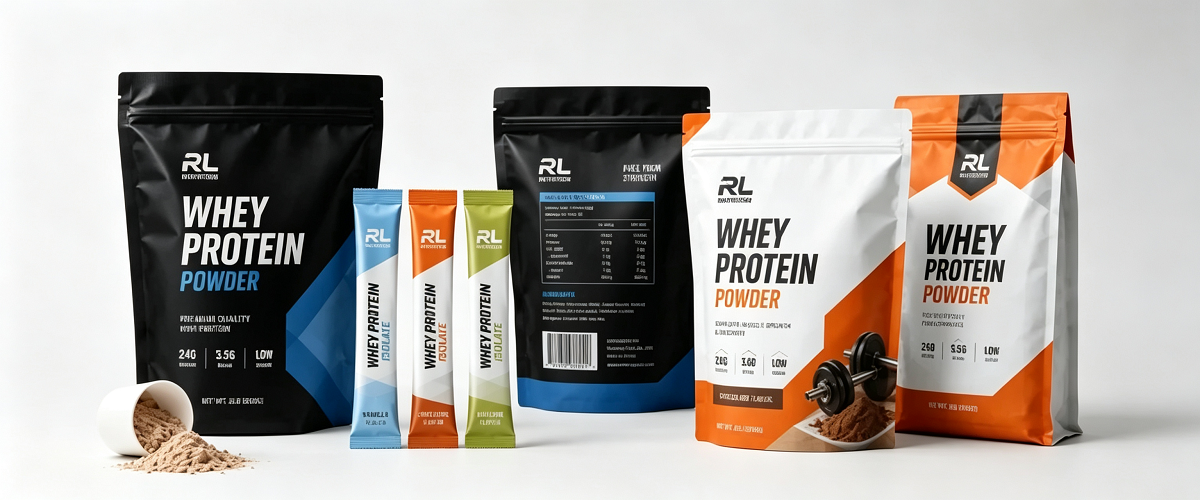
4. What Packaging Features Help Prevent Powder Clumping and Improve Storage Convenience?
Material selection is essential, but functional packaging features also play a major role in maintaining protein powder quality.
Protein powder is typically used over multiple servings. Consumers open the package repeatedly, remove powder with a scoop, and reseal it for storage.
Every opening creates an opportunity for moisture exposure. Packaging features should therefore support easy access while helping consumers close the package securely after use.
Resealable Zipper Closures
Resealable zippers are among the most useful features for multi-serving protein powder pouches.
They allow consumers to open the bag, remove the required quantity, and close it again without relying on the original heat seal.
Key advantages include:
- Convenient repeated opening and closing
- Reduced exposure between uses
- Improved storage experience
- Better suitability for larger protein powder packages
- Compatibility with stand-up and flat bottom pouches
For zipper performance, the following factors should be considered:
- Zipper engagement strength
- Opening and closing convenience
- Alignment with the pouch opening
- Resistance to powder contamination
- Compatibility with the package dimensions
One important consideration is that fine protein powder can accumulate around the zipper tracks. This may prevent the closure from engaging properly.
A suitable zipper design and sufficient space between the powder level and closure can help reduce this problem.
Consumers should also be encouraged to keep the zipper area clean and dry.
A zipper is a convenience feature, not a substitute for the original hermetic heat seal. The initial top seal should remain intact until the product is first opened.
Tear Notches and Easy-Open Design
A tear notch allows consumers to open the package easily without using scissors or other tools.
It is particularly useful for stand-up pouches, flat bottom bags, and other retail protein powder packages.
A well-designed tear notch should:
- Allow controlled opening
- Reduce the risk of uncontrolled tearing
- Avoid damaging the zipper
- Provide a convenient opening width
- Maintain adequate seal strength before first use
For larger protein powder pouches, the opening should be wide enough to allow convenient scooping and pouring.
Wide Openings for Easier Filling and Scooping
Protein powder packages often need larger openings than small snack bags because consumers may use measuring scoops.
A narrow opening can make it difficult to remove powder without spilling it around the package.
Wide-mouth pouch designs can improve:
- Scoop access
- Powder pouring
- Refill convenience
- Consumer handling
- Cleaning around the package opening
The opening width should be determined according to the pouch size, scoop dimensions, and intended serving method.
For larger bags, a wide opening can make the product easier to use while reducing the chance of powder spilling onto the zipper or outer package.
Degassing and Headspace Considerations
Unlike freshly roasted coffee, most protein powders do not normally require a one-way degassing valve.
Protein powder packages should instead be designed around powder volume, filling conditions, headspace, and the need for reliable sealing.
The correct headspace helps prevent powder from contaminating the seal area and allows sufficient space for closure features.
For nitrogen-flushed products, the headspace and gas-flushing process should be designed together to achieve the intended residual oxygen level.
A one-way valve should not be added to protein powder packaging without a specific technical reason.
Moisture Absorbers and Desiccants
Some protein powder products may use desiccants to help manage residual moisture inside the package.
Desiccants can be relevant for selected formulations or demanding storage environments, but they are not automatically required for every protein supplement.
Before using them, brands should consider:
- Product moisture sensitivity
- Initial moisture content
- Package barrier performance
- Target shelf life
- Storage temperature and humidity
- Desiccant compatibility and placement
If a desiccant is used, it must be suitable for the intended food packaging application and securely contained to prevent accidental consumption.
Desiccants should complement a suitable barrier package, not replace it.
Nitrogen Flushing Compatibility
For selected protein formulas, nitrogen flushing can help reduce residual oxygen inside the package.
Flexible packaging should be compatible with the gas-flushing equipment and sealing process.
Important considerations include:
- Film barrier performance
- Package headspace
- Gas flow and filling speed
- Powder behavior during filling
- Seal contamination
- Residual oxygen targets
The process should be validated using the actual formulation and package configuration.
Nitrogen flushing is most relevant when oxidation-sensitive ingredients or specific shelf-life targets justify the additional production step.
Bottom Gussets and Stable Storage
Stand-up pouches and flat bottom bags provide a stable base that helps protein powder packages remain upright.
This is useful for both retail display and consumer storage.
A stable pouch can reduce the likelihood of tipping over during use and make it easier to store the product in kitchen cabinets or pantry spaces.
For larger packages, the bottom structure must be designed to support the filled weight without excessive stretching or seal stress.
Scoops and Accessory Storage
Many protein powder products include a measuring scoop.
The packaging should accommodate the scoop without compromising sealing or consumer convenience.
Potential design considerations include:
- Sufficient internal space for the scoop
- A wide enough opening for scoop removal
- Appropriate headspace above the powder
- Easy-to-clean zipper areas
- Clear serving instructions
Some brands also consider attaching a scoop to an internal support or including it in a separate small package. The best approach depends on the filling process and product presentation.
Custom Printing and Product Information
Protein powder packaging needs to communicate more than brand identity.
Consumers often compare products based on protein content, serving size, flavor, ingredients, and nutritional information.
Custom printing can help present this information clearly.
Common printed elements include:
- Brand logo
- Product name and flavor
- Net weight
- Protein content per serving
- Nutrition facts
- Ingredient list
- Allergen declarations
- Usage instructions
- Storage instructions
- Batch and expiry information
- Barcode and QR code
- Required regulatory statements
Brands should ensure that all claims and label information comply with the applicable regulations in their target markets.
Functional Feature Comparison
| Packaging Feature | Main Benefit | Best Application |
|---|---|---|
| Resealable zipper | Convenient repeated use | Multi-serving protein pouches |
| Tear notch | Easy first opening | Retail pouches and sachets |
| Wide opening | Easier scooping and pouring | Large protein powder bags |
| Stable bottom gusset | Better storage and shelf display | Stand-up and flat bottom pouches |
| Desiccant compatibility | Additional moisture management | Selected moisture-sensitive formulas |
| Nitrogen flushing compatibility | Reduced residual oxygen | Products with oxidation-sensitive ingredients |
| Printed information panels | Clear product communication | Retail and export products |
| Scoop accommodation | Better consumer convenience | Standard and large retail packs |
The most effective package combines the right material structure with features that support the product's actual usage pattern. For many multi-serving protein powders, a high-barrier stand-up pouch with a wide opening, tear notch, and resealable zipper provides a practical combination of protection and convenience.
5. Flexible Packaging for Protein Powder Supplements: Key Factors for Product Protection, Shelf Life, Branding, and Cost Efficiency
Selecting flexible packaging for protein powder is a strategic decision that affects more than the appearance of the finished product.
Brands must consider formulation stability, storage conditions, filling equipment, consumer expectations, distribution channels, and packaging economics.
A suitable package should protect the powder throughout its intended shelf life while providing a convenient experience and supporting the brand's market positioning.
Formulation and Product Characteristics
The first step is to understand the protein powder formulation.
Different products can have different moisture sensitivities, fat contents, particle sizes, and ingredient combinations.
For example:
- Whey protein products may contain varying levels of milk fat.
- Plant-based protein blends may contain added oils, fibers, and flavoring ingredients.
- Collagen powders may have different powder flow and moisture characteristics.
- Protein formulas with added vitamins may require additional light or oxygen protection.
Brands should provide packaging suppliers with relevant product information, including:
- Protein powder type
- Ingredient composition
- Approximate bulk density
- Net weight
- Moisture sensitivity
- Fat content
- Target shelf life
- Intended storage conditions
This information helps suppliers recommend suitable bag dimensions, material structures, and closure systems.
Shelf-Life Requirements
Protein powder shelf life depends on formulation, processing, packaging, storage, and quality-control conditions.
Some products may target 12 months, while others may require 18–24 months or longer. These periods should not be assumed to apply universally.
Packaging must be designed around the product's validated shelf-life target.
Important considerations include:
- WVTR and OTR performance
- Light protection
- Seal integrity
- Closure performance after opening
- Storage temperature and humidity
- Compatibility with sensitive ingredients
The finished package should be evaluated through appropriate stability studies and shelf-life testing.
A material specification alone cannot guarantee a particular shelf life.
Storage and Distribution Conditions
Protein powder products may pass through multiple stages before reaching consumers:
- Filling and sealing
- Factory warehousing
- Domestic transportation
- Export shipping
- Distributor storage
- Retail warehousing
- Consumer storage
Each stage can expose the package to different temperatures, humidity levels, handling conditions, and stacking pressures.
For international shipments, brands should consider:
- Long transit times
- Temperature fluctuations
- Humid container environments
- Carton compression
- Vibration during transportation
- Warehouse storage conditions
The individual pouch should provide the required barrier protection, while secondary cartons should support the filled package and reduce the risk of puncture or deformation.
For large protein powder pouches, carton dimensions and stacking arrangements should be checked carefully to avoid excessive pressure on the bottom seals.
Package Size and Powder Bulk Density
Protein powder packages should be designed according to product volume rather than net weight alone.
Different formulas can have different bulk densities. A 2 lb whey protein product may require a different pouch volume from a 2 lb plant-based protein blend.
Manufacturers should consider:
- Net product weight
- Loose and tapped bulk density
- Powder settling during transportation
- Required headspace
- Scoop dimensions
- Filling method
- Consumer opening requirements
A pouch that is too small may be difficult to fill and seal. A pouch that is too large may look underfilled and create unnecessary material and shipping costs.
The best approach is to test actual filled samples before confirming final dimensions.
Brand Positioning and Retail Presentation
Protein powder packaging is a major part of product branding.
Consumers often make purchasing decisions based on product appearance, flavor, nutritional information, and perceived quality.
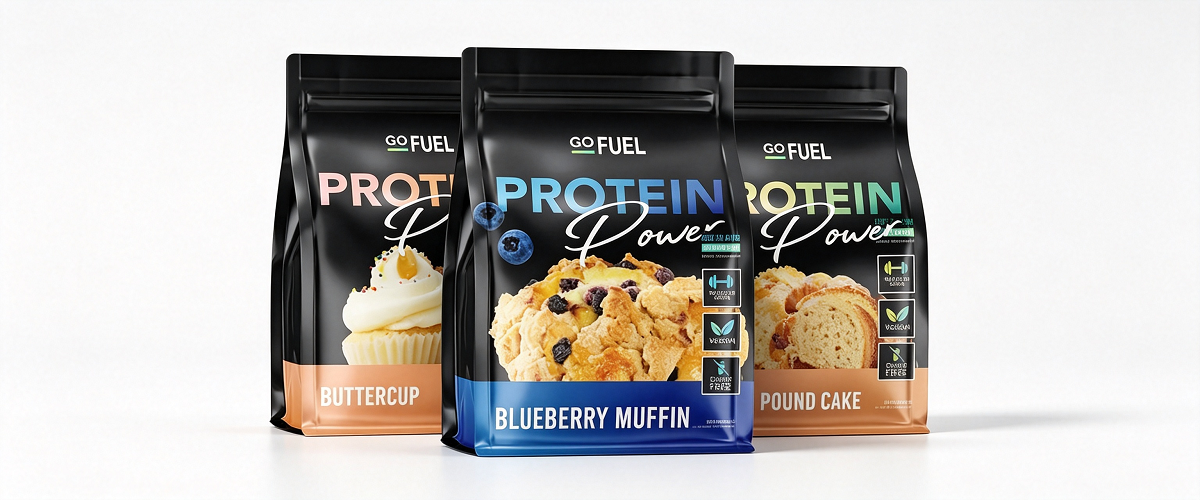
Flexible packaging provides extensive customization opportunities, including:
- Full-surface printing
- Matte or gloss finishes
- Metallic effects
- Custom color systems
- Brand storytelling panels
- Transparent windows where appropriate
- Distinctive pouch shapes
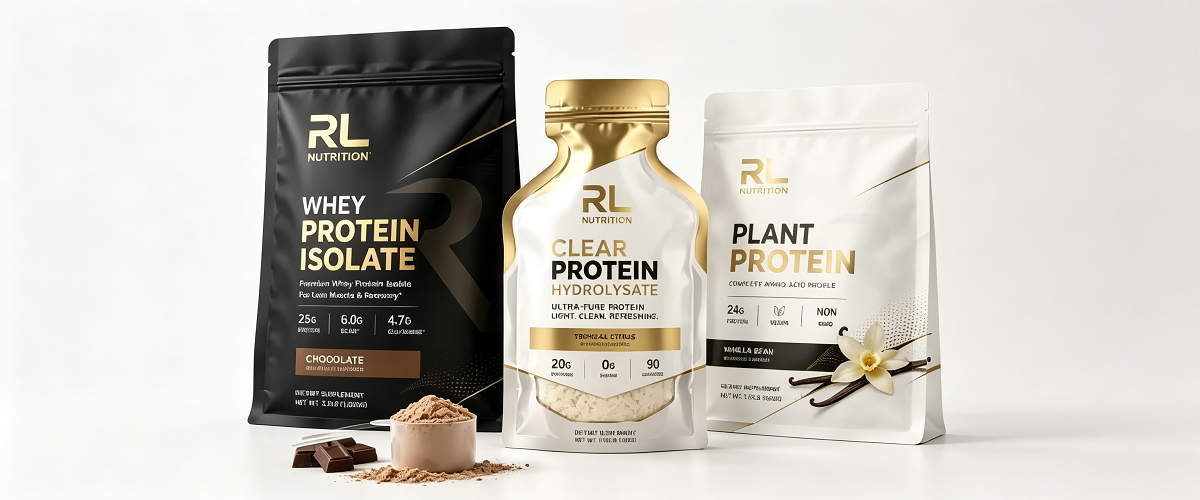
A premium supplement brand may choose a matte-finished flat bottom pouch with a structured appearance, while a value-focused brand may prefer a practical stand-up pouch with clear product information.
A consistent design system can also help consumers distinguish between product lines.
For example, a brand may use different colors for whey protein, plant protein, collagen, and recovery formulas while maintaining the same overall pouch structure.
Cost Efficiency and Material Optimization
Packaging cost is influenced by several factors:
- Film material and thickness
- Laminate structure
- Bag dimensions
- Pouch style
- Printing method
- Number of colors
- Zipper and other accessories
- Order quantity
- Production setup costs
- Transportation and storage efficiency
A high-barrier aluminum foil pouch may provide excellent protection, but it may be unnecessary for a formulation that can achieve its shelf-life target using a suitable metallized structure.
Likewise, reducing film thickness may lower material consumption, but only if the package continues to meet mechanical and barrier requirements.
Brands should evaluate the total cost of packaging performance rather than focusing only on the unit price of the empty bag.
A slightly more expensive package may be more economical overall if it reduces leakage, product loss, returns, or customer complaints.
Minimum Order Quantity and Customization Flexibility
Protein supplement brands often sell multiple flavors, sizes, and formulations.
This creates challenges when ordering printed packaging because each design may require a separate production setup or minimum order quantity.
Brands should clarify:
- MOQ per pouch size
- MOQ per printed design
- Printing setup costs
- Available material structures
- Sample and prototype availability
- Production lead time
- Reorder consistency
- Options for digital printing
For new product launches, smaller initial orders may be valuable because they allow brands to test market demand before committing to large packaging inventories.
For established products, larger production quantities may reduce unit costs.
The most suitable ordering strategy depends on sales forecasts, product lifecycle, and the likelihood of future design changes.
Filling Equipment and Production Compatibility
The selected pouch must be compatible with the filling and sealing equipment used by the supplement manufacturer.
Important factors include:
- Pouch opening width
- Filling speed
- Powder flow characteristics
- Sealant layer performance
- Sealing temperature
- Dwell time and pressure
- Zipper placement
- Powder contamination around seals
For automated filling operations, small variations in pouch dimensions or opening characteristics can affect production efficiency.
Manufacturers should conduct filling trials using actual production equipment before placing large packaging orders.
This is particularly important for fine protein powders, which can become airborne or accumulate around the sealing area.
Sustainability Considerations
Sustainability is becoming increasingly important in supplement packaging.
Brands may explore:
- Reduced material thickness
- Optimized pouch dimensions
- Mono-material PE or PP structures where technically suitable
- Recyclable packaging designs where local infrastructure supports them
- Reduced secondary packaging
- More efficient transportation and storage
However, high-barrier requirements can make protein powder packaging technically challenging.
A mono-material structure may offer recycling advantages in some markets, but its barrier performance, sealing behavior, mechanical durability, and suitability for the intended shelf life must be validated.
Similarly, a package should not be described as recyclable solely because it contains a single polymer. The complete structure and local recycling infrastructure must be considered.
Brands should work with packaging suppliers to evaluate sustainability goals alongside product protection requirements.
Quality Control and Packaging Testing
Before mass production, flexible protein powder packaging should undergo appropriate quality checks.
Useful tests include:
Barrier performance testing
Evaluate WVTR and OTR under specified conditions to confirm that the selected material structure meets the required performance.
Seal strength testing
Check whether the heat seals can withstand filling, transportation, and normal handling.
Leak testing
Identify weak seals, channel leaks, or punctures that could allow moisture and oxygen to enter.
Zipper functionality testing
Evaluate opening and closing performance, including the potential effect of powder contamination.
Drop and compression testing
Assess the complete package under handling conditions representative of distribution.
Film thickness and appearance inspection
Check material consistency, wrinkles, delamination, printing defects, and other visible issues.
Filling line trials
Confirm that the bag can be opened, filled, and sealed reliably on the actual production equipment.
Shelf-life and stability testing
Validate that the product maintains its required quality throughout the intended storage period.
These tests help ensure that the packaging performs reliably in real production and distribution environments.
Practical Packaging Selection Checklist
| Selection Factor | Key Question | Why It Matters |
|---|---|---|
| Product formulation | What type of protein powder is being packaged? | Determines barrier and compatibility requirements |
| Moisture sensitivity | How sensitive is the formula to humidity? | Helps determine WVTR requirements |
| Oxygen sensitivity | Does the product contain oxidation-sensitive ingredients? | Helps determine OTR requirements |
| Shelf life | What is the validated target shelf life? | Establishes packaging performance requirements |
| Bag style | Is the product a retail pouch, bulk bag, or sample? | Determines structure and dimensions |
| Net weight | How much powder does each package contain? | Influences bag size and mechanical strength |
| Bulk density | What volume does the powder occupy? | Prevents underfilled or undersized packaging |
| Closure | Does the product need a zipper or another resealable feature? | Improves repeated-use convenience |
| Filling equipment | Is the bag compatible with the production line? | Supports efficient filling and sealing |
| Distribution | Will the product be shipped domestically or internationally? | Influences barrier and transportation protection |
| Branding | What appearance and printing quality are required? | Supports product positioning |
| Budget | What is the target packaging cost? | Balances performance and commercial feasibility |
A clear specification makes it easier for brands and packaging suppliers to identify the right structure and avoid unnecessary revisions during sampling and production.
FAQ
What is the best flexible packaging for protein powder supplements?
High-barrier stand-up pouches with resealable zippers are a practical choice for many retail protein powder products. Flat bottom bags and side gusset bags are suitable for premium or larger packages, while stick packs and three-side seal bags work well for single-serving products.
Does protein powder need high-barrier packaging?
Protein powder generally requires effective moisture protection, because moisture absorption can cause clumping and changes in powder flowability. Oxygen and light protection may also be important depending on the formulation, fat content, added ingredients, and shelf-life target.
What material structure is commonly used for protein powder bags?
PET/VMPET/PE is a common high-barrier laminate for protein powder packaging. PET/AL/PE can provide stronger moisture, oxygen, and light protection for more demanding applications. The final selection should be based on validated product requirements.
Are aluminum foil bags better for protein powder?
Aluminum foil laminates generally provide very high barrier protection against moisture, oxygen, and light. However, they may cost more than metallized alternatives. A foil structure is most appropriate when the product's formulation and shelf-life requirements justify the additional protection.
Why are resealable zippers important for protein powder packaging?
Zippers allow consumers to open and close multi-serving packages repeatedly. They improve storage convenience and help limit environmental exposure between uses. However, consumers should still keep the zipper area clean and dry and close the package securely after each use.
Can protein powder be packaged in stand-up pouches?
Yes. Stand-up pouches are widely used for retail protein powder because they provide good shelf presentation, flexible sizing, and compatibility with resealable zippers. They can also be customized with high-barrier laminates and printed graphics.
Is nitrogen flushing necessary for protein powder?
Not for every product. Nitrogen flushing may be useful for formulas containing oxidation-sensitive ingredients or when a specific residual oxygen target is required. Its use should be determined through formulation and shelf-life evaluation.
Do protein powder bags need desiccants?
Some products may benefit from desiccants, but they are not universally required. Their use depends on the formulation's moisture sensitivity, package barrier performance, storage environment, and target shelf life. Any desiccant must be suitable for the intended food packaging application.
How do I prevent protein powder from clumping inside the package?
Use a suitable moisture barrier, maintain reliable heat seals, control moisture during manufacturing and filling, and choose a closure that can be resealed properly. Consumers should store the package in a cool, dry place and use a clean, dry scoop.
What should I consider when ordering custom protein powder packaging?
Important factors include bag style, material structure, WVTR and OTR requirements, pouch dimensions, net weight, zipper design, printing, MOQ, filling equipment compatibility, and destination-market food-contact requirements. Testing samples with the actual protein powder is strongly recommended before mass production.
Conclusion
Choosing the right flexible packaging for protein powder supplements requires a careful balance between moisture protection, oxygen barrier performance, product convenience, branding, and cost efficiency. Different protein formulations have different storage requirements, so packaging should be selected according to the actual product rather than relying on one standard structure for every supplement.
Stand-up pouches provide a versatile solution for many retail protein powders, while flat bottom and side gusset bags are suitable for premium and larger-volume products. Stick packs and three-side seal bags offer convenient options for single-serving applications. When it comes to materials, PET/VMPET/PE provides a practical high-barrier option for many products, while PET/AL/PE can be considered for formulations that require stronger protection.
Functional features also influence the overall package performance. Resealable zippers, wide openings, tear notches, and stable bottom gussets can improve the consumer experience and support proper storage after opening. At the same time, reliable seals and compatibility with filling equipment are essential for maintaining product quality throughout distribution.
Ultimately, the best protein powder packaging is not necessarily the most complex or expensive solution. It is the structure that meets the product's validated shelf-life requirements, protects sensitive ingredients, works efficiently on the production line, and supports the brand's market positioning.
By working with an experienced flexible packaging supplier, protein supplement brands can develop customized pouches that combine suitable barrier performance, reliable functionality, attractive printing, and practical production economics. In a competitive nutrition market, well-designed flexible packaging is not just a container—it is an important part of product quality and brand value.