How to Choose Flexible Packaging Bags for Phone Cases
Anna_Yu
How to Choose Flexible Packaging Bags for Phone Cases
Phone cases are lightweight accessories, but their packaging plays an important role in protecting product appearance, supporting retail presentation, and creating a positive first impression. Whether a brand sells transparent TPU cases, flexible silicone covers, rugged protective cases, leather-style phone cases, or customized printed designs, the right packaging helps keep products clean, organized, and ready for sale. Even minor packaging problems—such as dust accumulation, surface scratches, deformation, moisture exposure, or poor sealing—can affect the perceived quality of a phone case before a customer even uses it.
As the smartphone accessory market continues to expand across e-commerce platforms, electronics retailers, wholesalers, and international distribution channels, flexible packaging bags have become a practical solution for many phone case manufacturers and brands. Compared with rigid boxes and bulky plastic containers, flexible bags are lightweight, space-efficient, easy to customize, and compatible with different product sizes and shapes. They can also provide clear product visibility, attractive printing, and convenient opening and closing options.
However, choosing packaging for phone cases requires more than selecting a bag that fits the product. Different phone case materials and designs have different packaging requirements. A transparent TPU case may need protection against dust, scratches, and unwanted surface contact, while a silicone case may require packaging that prevents contamination and maintains its appearance. Premium leather-style or textured cases may benefit from packaging that improves presentation and prevents surface abrasion during transportation.
Packaging decisions also depend on sales channels, shipping conditions, retail display requirements, order quantities, and budget. A simple transparent bag may be sufficient for a low-cost replacement case, while a premium branded pouch may be more appropriate for a high-end accessory collection.
This guide explains how to choose flexible packaging bags for phone cases by examining suitable bag styles, protective materials, functional features, customization options, and cost considerations. It will help phone case manufacturers, distributors, and accessory brands select packaging that balances product protection, presentation, convenience, and commercial value.
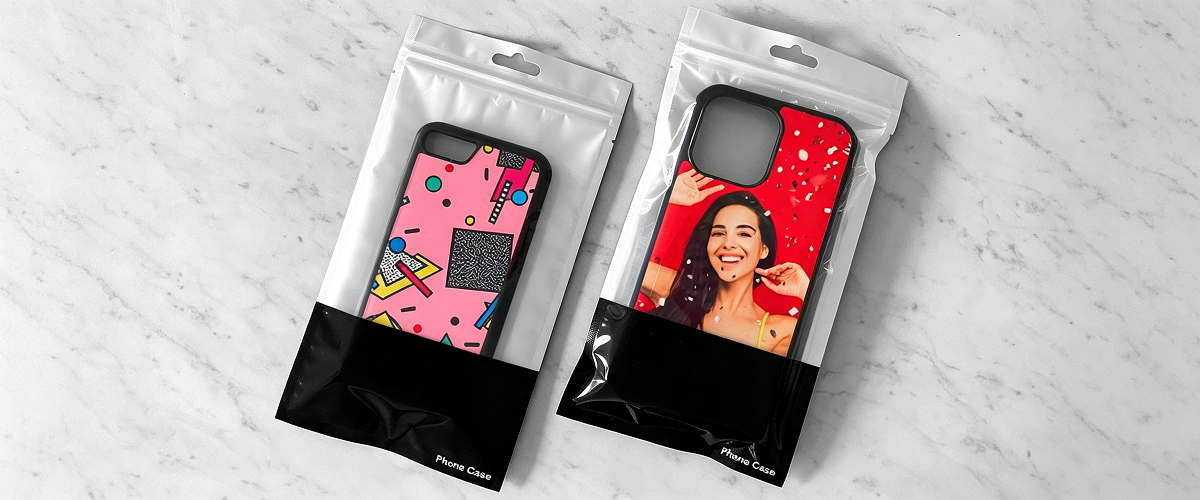
1. What Types of Flexible Packaging Bags Are Best for Phone Cases?
The best flexible packaging bag for a phone case depends on its material, shape, thickness, retail positioning, and distribution method. A slim transparent case may require a different packaging solution from a rugged multi-layer protective case or a premium leather-style phone cover.
The main objectives are to keep the product clean, prevent unnecessary surface contact, make identification easy, and ensure that the package fits efficiently into storage cartons and shipping boxes.
Flat Poly Bags
Flat poly bags are among the simplest and most economical packaging formats for phone cases. They are commonly used for standard TPU, silicone, and plastic phone covers.
Their main advantages include:
- Lightweight construction that adds minimal shipping weight
- Simple loading and unloading during packing operations
- Flexible sizing for different phone models
- Transparent options for easy product identification
- Compatibility with adhesive flaps, heat sealing, and other closure methods
Flat poly bags are particularly suitable for high-volume production and wholesale distribution. Manufacturers can produce different dimensions to accommodate phone cases for various smartphone models without changing the basic packaging format.
For example, a thin TPU case can fit into a compact flat bag, while a thicker protective case may need additional width and gusset space. Choosing the correct dimensions helps prevent excessive movement inside the package without making insertion difficult.
However, a basic poly bag provides limited cushioning. It can protect against dust and light surface contamination, but it should not be treated as a substitute for protective cushioning when cases are shipped in bulk or exposed to rough handling.
Self-Seal Bags with Adhesive Flaps
Self-seal bags are a convenient option for phone case brands that want a clean package appearance and efficient packing operations.
These bags usually feature a pressure-sensitive adhesive strip that allows the opening flap to fold over and seal the package. They are particularly useful for:
- E-commerce phone case orders
- Retail-ready replacement cases
- Small-batch accessory packaging
- Product sets containing a phone case and additional accessories
- Warehousing and inventory organization
The adhesive closure makes packaging faster because workers do not need to heat-seal every individual bag. It also allows consumers to open the package without cutting through the main product area.
Self-seal bags can be manufactured from transparent or printed films. Clear versions make product inspection easy, while printed versions can display brand logos, product model numbers, barcodes, and handling information.
For products that may be returned or inspected before purchase, the brand should consider whether the adhesive closure needs to be resealable or tamper-evident. A standard adhesive flap is convenient, but it does not automatically provide strong tamper evidence.
Stand-Up Pouches
Stand-up pouches are suitable for phone case brands that prioritize retail presentation and premium branding.
Unlike simple flat bags, stand-up pouches have a bottom gusset that allows the package to stand upright. This makes them useful for countertop displays, accessory shelves, promotional sets, and selected e-commerce products.
Their advantages include:
- Stronger shelf presentation
- Larger printable surfaces for brand communication
- Compatibility with transparent windows
- Options for resealable zippers
- Space for product descriptions and compatibility information
Stand-up pouches are especially appropriate for premium phone case collections, gift sets, and products bundled with accessories such as screen protectors, camera lens protectors, or cleaning cloths.
For example, a brand selling a phone case with a matching screen protector could use a custom stand-up pouch to hold the components together. The package can display the product collection, compatibility details, and key selling points in one coordinated design.
However, stand-up pouches may be unnecessarily expensive for basic low-cost phone cases. Their structure and additional material can increase packaging costs compared with flat bags.
Zipper Pouches
Zipper pouches provide a reusable packaging option for phone cases and accessory sets.
The zipper allows consumers to open and close the bag multiple times, making it useful for products that customers may want to store when not in use. This is particularly relevant for spare phone cases, interchangeable designs, and accessory collections.
Key benefits include:
- Repeated opening and closing
- Convenient storage after purchase
- Better organization of small accessories
- A more substantial package appearance
- Compatibility with printed branding and transparent windows
Zipper pouches can be made from PE, PP, PET-based laminates, or other suitable flexible film structures, depending on the required transparency, durability, and appearance.
For phone cases, the zipper itself does not need to provide a high-performance hermetic seal in most applications. Instead, its main function is convenient reuse and storage. The overall bag material and closure quality should still be selected according to the intended protection level.
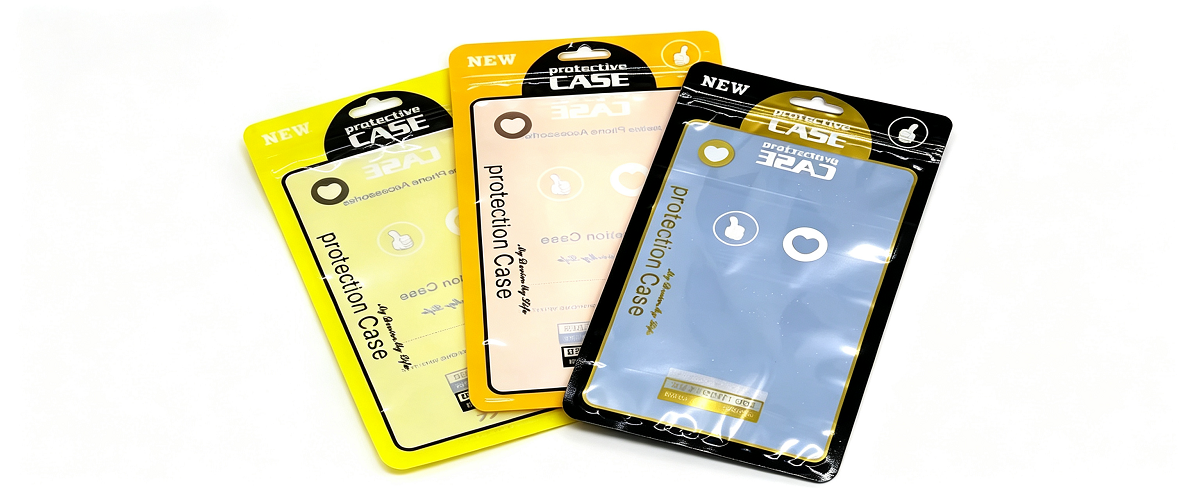
Header Bags and Hang-Hole Bags
Header bags are useful for phone cases sold in physical retail stores, electronics shops, and convenience outlets.
They typically include a reinforced header area with a punched hanging hole. This allows the package to be displayed on hooks or pegboards, helping retailers organize different models and designs.
Common applications include:
- Basic phone covers
- Transparent TPU cases
- Printed fashion phone cases
- Small accessory bundles
- Promotional products
The header section can include a brand logo, product name, compatibility information, and barcode. This helps consumers identify the product without removing it from the display.
For heavier or thicker phone cases, the header area should be reinforced to reduce the risk of tearing during display. The hanging hole should also be positioned to maintain package balance and prevent the product from leaning excessively.
Vacuum and Protective Film Packaging
Vacuum packaging is not usually necessary for ordinary phone cases, but selected protective film or close-fitting packaging solutions can be useful for specific products.
For example, a manufacturer may use a protective film or sleeve around a phone case to reduce friction between the product and other surfaces during storage. This can be particularly helpful for glossy, transparent, or easily marked finishes.
However, vacuum packaging should be evaluated carefully. Applying excessive vacuum pressure may deform soft silicone or flexible TPU cases, especially when products are stacked or stored for long periods.
For most phone case applications, a protective inner sleeve combined with an appropriately sized outer bag is more practical than full vacuum packaging.
Comparison of Common Flexible Packaging Bags for Phone Cases
| Packaging Type | Main Advantages | Suitable Applications | Cost Level |
|---|---|---|---|
| Flat poly bag | Lightweight, economical, easy to customize | Standard TPU and silicone cases | Low |
| Self-seal bag | Fast packing and convenient opening | E-commerce and retail packaging | Low to medium |
| Stand-up pouch | Strong shelf presence and large print area | Premium cases and accessory sets | Medium to high |
| Zipper pouch | Reusable and convenient for storage | Premium and multi-accessory products | Medium |
| Header bag | Easy hanging display and product identification | Retail and electronics stores | Low to medium |
| Protective sleeve | Reduces surface contact and friction | Glossy, transparent, or delicate finishes | Low to medium |
There is no single packaging format suitable for every phone case. For high-volume standard products, flat poly bags or self-seal bags are often practical. For premium retail products, stand-up pouches, zipper pouches, or header bags can provide stronger presentation and branding opportunities.
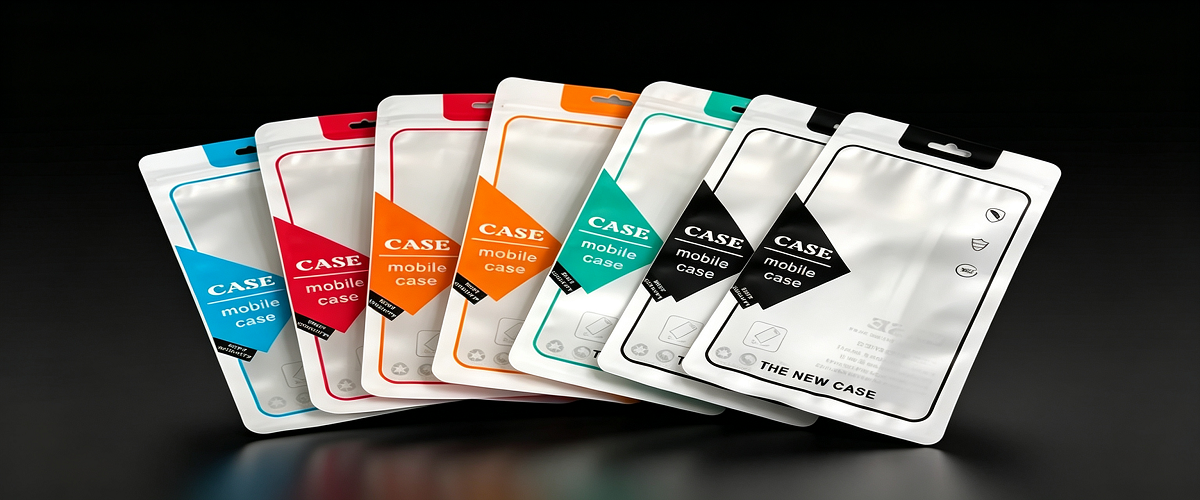
2. How Do Packaging Bags Protect Phone Cases from Dust, Moisture, Scratches, and Damage?
Phone cases do not usually require the same barrier performance as food, pharmaceutical, or highly moisture-sensitive products. Nevertheless, their appearance and material condition can be affected by environmental exposure and physical handling.
A suitable flexible packaging bag creates a protective layer between the phone case and its surroundings. The level of protection depends on the film material, thickness, closure design, package dimensions, and whether additional protective components are used.
Dust and Surface Contamination Protection
Dust is one of the most common problems during phone case storage and distribution.
Transparent cases, especially those with glossy surfaces, can easily show dust particles, fingerprints, and other visible contamination. Silicone and textured cases may also collect dust during handling and storage.
Flexible packaging helps reduce this risk by enclosing the product and limiting direct exposure to the surrounding environment.
For effective dust protection, manufacturers should consider:
- Selecting bags with suitable film thickness
- Using self-seal or heat-seal closures where appropriate
- Keeping the packaging area clean during filling
- Avoiding oversized bags that allow excessive product movement
- Ensuring that the bag opening is properly closed
For retail products, an adhesive flap can provide a simple and effective closure. For products requiring more controlled sealing, heat-sealed bags may be preferable.
It is also important to remember that packaging cannot remove dust already present on the phone case. Products should be cleaned or inspected before packing.
Moisture Protection
Most phone cases are not highly sensitive to short-term exposure to ordinary indoor humidity. However, prolonged moisture exposure can affect certain materials, finishes, labels, and accessory components.
Moisture may cause problems such as:
- Water spots on glossy surfaces
- Damage to paper inserts or printed cards
- Corrosion of metal accessory components
- Changes in the appearance of some coatings
- Condensation inside poorly managed shipping environments
The level of moisture protection required depends on the product and distribution conditions.
Polyethylene (PE) films generally provide useful moisture resistance and are widely used for simple protective bags. Laminated structures may be appropriate when a stronger combination of mechanical durability, printing quality, and barrier performance is required.
For international shipping, packaging should be evaluated against the expected transportation environment. Products moving through tropical regions, coastal warehouses, or containers exposed to temperature fluctuations may need additional moisture-management measures.
Desiccants can be considered for selected shipments, particularly when a package includes metal components, paper accessories, or products with special storage requirements. However, desiccants should not be added automatically to every phone case package. Their use should be based on actual moisture risks and the compatibility of the product and packaging.
Scratch and Abrasion Prevention
Surface scratches are a major concern for phone cases with glossy, transparent, polished, or decorative finishes.
Even when the case itself is durable, repeated contact with other products, packaging materials, or hard particles can create visible marks.
Flexible packaging can reduce direct surface contact, but not all films offer the same level of scratch protection.
For products with delicate surfaces, manufacturers can consider:
- Smooth inner film surfaces
- Individual protective sleeves
- Non-abrasive packaging materials
- Correct bag dimensions to limit unnecessary movement
- Separate compartments for bundled accessories
A simple PE bag may be sufficient for many standard cases. However, a premium case with a polished surface may benefit from an individual protective sleeve before being placed inside the retail bag.
The packaging should also avoid sharp edges, exposed adhesive, or rough internal components that could come into contact with the phone case.
Protection Against Deformation
Soft TPU and silicone phone cases can be flexible, but they may still become distorted if stored under excessive pressure or packed incorrectly.
For example, tightly compressed cases may lose their intended shape temporarily or develop unwanted folds. Thin cases may also bend when heavy cartons are stacked on top of them.
Flexible packaging can help organize products, but it does not provide substantial structural support by itself.
To reduce deformation risks, manufacturers should:
- Avoid excessive compression during packing
- Select a bag size that accommodates the case naturally
- Use backing cards or inserts when additional shape support is needed
- Prevent heavy products from being stacked directly on delicate cases
- Choose suitable carton dimensions for bulk shipments
For thicker protective cases, a slightly larger bag may be needed to accommodate raised camera edges, reinforced corners, and textured surfaces.
Protection During Transportation
Transportation exposes phone cases to vibration, friction, compression, and repeated handling.
A flexible bag provides a basic protective enclosure, but its performance depends on the complete packaging system. For example, an individual poly bag may protect against dust and scratches, while an outer carton protects the products from compression and impact during shipment.
A practical packaging arrangement may include:
- Cleaning and inspecting each phone case.
- Placing the product in an individual protective sleeve or bag.
- Adding a backing card or insert when required.
- Grouping individual packages into an inner carton.
- Using suitable cushioning or dividers to prevent excessive movement.
- Packing the inner cartons into an appropriately sized shipping carton.
This layered approach is especially useful for large wholesale orders and international shipments.
Choosing the Right Protection Level
Not every phone case needs premium protective packaging. The correct solution should match the product's surface, material, selling price, and distribution environment.
| Product Type | Main Risk | Suggested Packaging Approach |
|---|---|---|
| Transparent TPU case | Dust, fingerprints, surface scratches | Clear PE bag or smooth protective sleeve |
| Soft silicone case | Dust, deformation, surface contamination | PE bag with suitable dimensions |
| Glossy plastic case | Abrasion and visible scratches | Individual protective sleeve and outer bag |
| Rugged protective case | Bulk and pressure during shipping | Larger bag with carton support |
| Leather-style phone case | Surface abrasion and moisture exposure | Smooth protective sleeve and suitable outer packaging |
| Case with metal accessories | Moisture and component contact | Individual bag with appropriate separation and moisture management |
The most effective packaging strategy combines suitable film selection with proper packing procedures and secondary shipping protection. A stronger bag alone cannot compensate for poor carton design or careless handling.
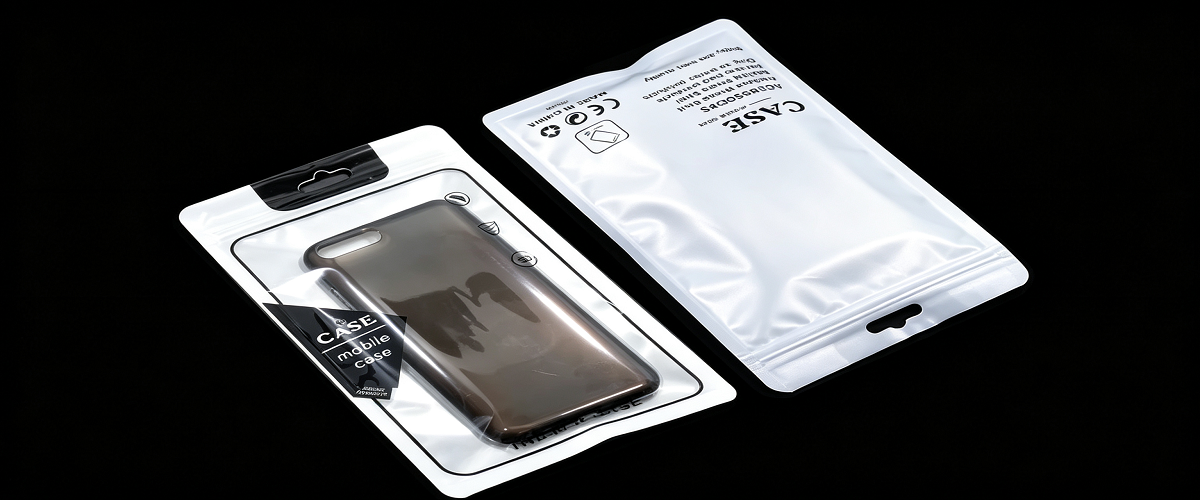
3. Which Packaging Materials Are Best for Durable and Transparent Phone Case Packaging?
Material selection determines the appearance, strength, transparency, flexibility, printability, and cost of phone case packaging.
Unlike food packaging, phone case bags generally do not require extremely high oxygen or moisture barriers. Instead, the most important considerations are often clarity, surface quality, puncture resistance, sealing performance, and compatibility with the product.
Polyethylene (PE)
Polyethylene is one of the most widely used materials for flexible phone case packaging.
PE films are flexible, lightweight, and suitable for producing flat bags, self-seal bags, and protective sleeves.
Their main advantages include:
- Good flexibility and impact resistance
- Useful moisture resistance
- Good heat-sealing properties
- Compatibility with transparent packaging
- Cost-effective production
- Availability in different thicknesses
PE is particularly suitable for standard phone case packaging where basic protection and economical production are the main priorities.
Different PE grades offer different performance characteristics. LDPE is commonly associated with flexibility and softness, while LLDPE can provide improved toughness and puncture resistance in suitable film structures.
For phone cases with sharp camera rings, raised corners, or textured edges, film toughness should be considered rather than choosing material based on thickness alone.
Polypropylene (PP)
Polypropylene is another common material for clear packaging bags.
PP films can offer good transparency, stiffness, and surface appearance. Depending on the grade and manufacturing process, they may be suitable for retail packaging where product visibility is important.
BOPP (biaxially oriented polypropylene) is particularly useful for packaging applications that require a clear, smooth, and visually appealing surface.
Its advantages include:
- High clarity and gloss
- Good stiffness
- Attractive product presentation
- Suitable printing performance
- Lightweight construction
BOPP is often used for retail bags, printed packaging, and applications where the package needs to maintain a relatively crisp appearance.
However, PP films generally have different sealing characteristics from PE. The material structure and sealing method should therefore be selected according to the packaging equipment and production requirements.
Polyester (PET)
PET is widely used in flexible packaging because of its strength, dimensional stability, and printability.
For phone case packaging, PET may be used as an outer layer in laminated structures, particularly when the package needs high-quality printing or a more substantial feel.
Its key advantages include:
- Good tensile strength
- Good dimensional stability
- Excellent printing surface
- Good resistance to handling damage
- Compatibility with various laminated structures
PET is especially relevant for branded packaging, premium pouches, and multi-layer structures where appearance and mechanical performance need to be balanced.
However, PET is not always necessary for simple phone case bags. For basic transparent sleeves, PE or PP may provide sufficient performance at a lower cost.
Laminated Film Structures
Laminated films combine two or more materials to achieve a balance of properties that may be difficult to obtain from a single film.
For example, a PET/PE structure can combine the printability and stiffness of PET with the flexibility and heat-sealing properties of PE.
Typical applications include:
- Premium printed pouches
- Branded accessory packaging
- Multi-product phone case kits
- Packaging that requires improved mechanical durability
- Retail-ready packages with custom graphics
The exact laminate should be designed around the intended bag structure and production process.
For example, a printed outer layer may provide branding and abrasion resistance, while the inner layer supports sealing and product contact. Adhesives and inks should be suitable for the intended packaging application and properly controlled during production.
Material Comparison for Phone Case Packaging
| Material | Transparency | Flexibility | Main Strength | Common Applications |
|---|---|---|---|---|
| LDPE | Good | High | Softness and flexibility | Simple protective bags |
| LLDPE | Good | High | Toughness and puncture resistance | Durable protective bags |
| PP | Good to very good | Medium | Stiffness and presentation | Retail packaging |
| BOPP | Very good | Medium to high stiffness | Clarity and print appearance | Clear retail bags |
| PET | Good to very good | Lower flexibility than PE | Strength and printability | Printed outer layers |
| PET/PE laminate | Depends on construction | Medium | Combined print and sealing performance | Custom branded pouches |
Actual performance varies according to film grade, thickness, additives, coatings, and manufacturing conditions. Brands should request samples and test the final bag rather than relying only on general material descriptions.
Transparent vs. Opaque Packaging
Transparency is an important consideration for phone case packaging because consumers often want to see the actual product before purchasing.
Clear packaging is particularly useful for:
- Transparent TPU cases
- Colored silicone cases
- Patterned and printed phone covers
- Products sold through physical retail channels
- E-commerce products requiring quick warehouse identification
Clear bags allow consumers and warehouse staff to identify the product without opening the package. They also reduce the need for product photographs on simple packaging formats.
However, transparent packaging is not always the best option.
Premium brands may prefer matte, metallic, or opaque printed packaging to create a more distinctive appearance. Opaque bags also provide space for stronger graphic design and can conceal the product when the brand wants to emphasize its visual identity rather than the case itself.
A practical compromise is to use a printed pouch with a transparent window. This allows the brand to communicate its identity while still showing the phone case.
Selecting Film Thickness and Durability
Film thickness affects package stiffness, handling characteristics, and material consumption. However, thicker film does not automatically mean better packaging.
An excessively thin film may tear during packing or transportation, while an unnecessarily thick film may increase cost and reduce flexibility.
The right thickness depends on:
- Phone case weight and dimensions
- Product edges and surface texture
- Bag size and closure type
- Packing speed and handling conditions
- Whether the package is used alone or inside a carton
- Desired appearance and tactile feel
Manufacturers should evaluate actual samples through insertion tests, sealing tests, drop tests, and transportation simulations where appropriate.
For large orders, packaging trials should be performed using the real phone case models rather than relying on generic sample dimensions.
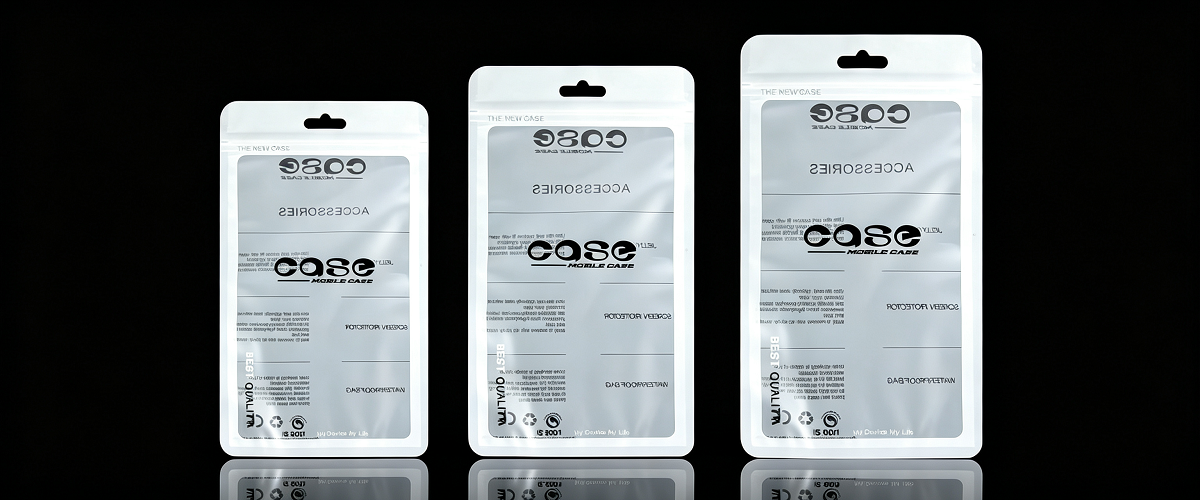
4. What Packaging Features Improve Product Display, Storage, and Consumer Convenience?
A well-designed phone case package should do more than hold the product. It should help customers identify the right model, allow retailers to display products effectively, and make storage convenient after purchase.
The most useful features depend on whether the product is sold online, in electronics stores, through wholesalers, or as part of a premium accessory collection.
Resealable Zippers
Resealable zippers allow consumers to open and close the packaging repeatedly.
They are especially useful for:
- Spare phone cases
- Interchangeable phone covers
- Multi-case bundles
- Accessory kits
- Products that consumers may want to store after opening
A zipper pouch can become a secondary storage solution after purchase. Consumers may use it to keep an unused phone case clean or organize small accessories.
For brands, zipper pouches can also create a more premium impression than simple disposable bags.
However, zippers increase material and production costs. They should be used when reusable storage provides a meaningful benefit rather than added to every low-cost product.
Easy-Open Features
Consumers should be able to open phone case packaging without damaging the product or struggling with the closure.
Useful easy-open options include:
- Tear notches
- Perforated opening lines
- Easy-peel adhesive flaps
- Convenient zipper openings
Tear notches are particularly useful for heat-sealed bags. They help consumers open the package without using scissors or knives.
The notch position should be carefully designed so that opening the package does not damage the phone case or any accessories inside.
For premium products, easy-peel structures may provide a cleaner unboxing experience than aggressive tearing.
Hang Holes for Retail Display
Hang holes allow phone case packages to be displayed on retail hooks and pegboards.
This feature is useful in electronics stores, mobile phone accessory shops, supermarkets, and convenience stores.
Common designs include:
- Euro-slot hang holes
- Round punched holes
- Reinforced hanging headers
The correct design depends on the weight and dimensions of the packaged phone case.
For heavier products, the header area should be strong enough to withstand repeated handling. The hole should also be positioned so that the package hangs straight and the product remains visible.
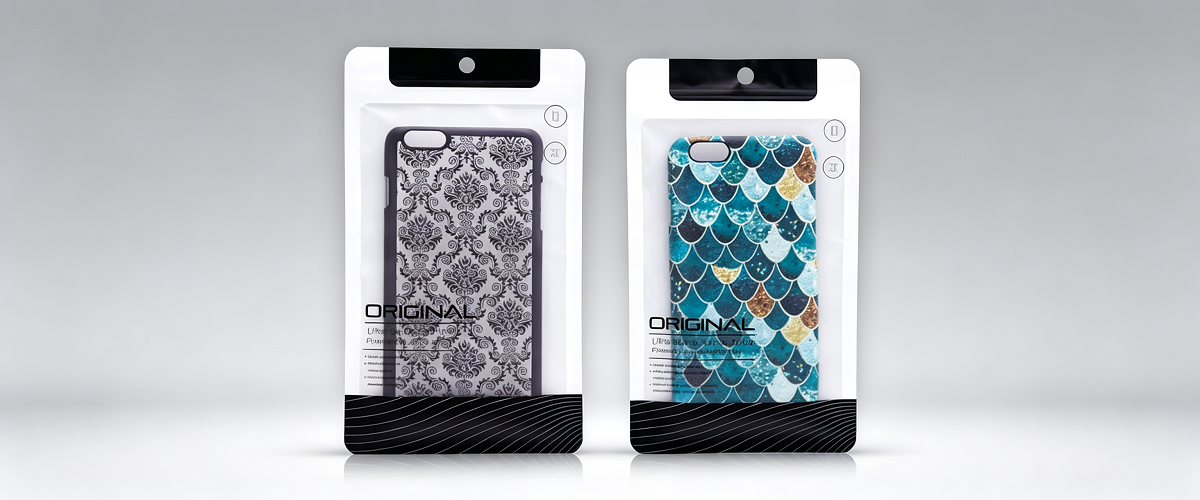
Transparent Windows
Transparent windows are useful when brands want to combine attractive printing with product visibility.
For example, a printed stand-up pouch can display the brand logo, product specifications, and compatibility information while allowing consumers to see the phone case through a clear window.
Window design should consider:
- Product visibility
- Window size and position
- Overall graphic layout
- Film clarity
- Resistance to scratches and handling marks
A window that is too small may not show enough of the product, while an excessively large window may reduce the available space for branding and product information.
The window should be positioned to show the most recognizable part of the phone case, such as its color, camera opening, texture, or decorative design.
Custom Printing and Branding
Packaging is often the first physical interaction between a customer and a phone case brand.
Custom printing can help communicate product quality, differentiate product lines, and create a consistent visual identity across different phone models.
Common printing and finishing options include:
- Flexographic printing
- Gravure printing
- Digital printing for suitable production quantities
- Matte finishes
- Gloss finishes
- Spot UV effects
- Metallic design elements
Brands can use packaging graphics to communicate:
- Brand logo and name
- Compatible smartphone models
- Product material
- Color and design
- Key protection features
- Product series or collection
- Barcode and SKU information
For phone cases, compatibility information is especially important. A package should clearly identify the smartphone model it is designed for, helping customers avoid purchasing an incompatible case.
The text should remain readable and accurate. If a brand sells cases for many phone models, standardized information zones can make packaging easier to update and manage.
Product Inserts and Backing Cards
Backing cards and inserts can improve package structure and product presentation.
They are particularly useful for:
- Thin phone cases
- Products sold in hanging bags
- Premium retail packaging
- Phone case and screen protector bundles
- Packages requiring additional product information
A backing card can help keep the phone case positioned neatly inside the bag. It also provides a printable surface for instructions, compatibility information, brand messaging, and promotional content.
For transparent packaging, a printed backing card can make the product more visible by creating a contrasting background.
The card should be sized carefully to avoid unnecessary material use or excessive package thickness.
Custom Sizes and Shapes
Phone cases vary significantly in dimensions and thickness. A package designed for a slim case may not fit a rugged case with reinforced corners or raised camera protection.
Custom sizing helps ensure that the bag:
- Fits the phone case securely
- Allows easy insertion and removal
- Avoids excessive unused space
- Supports efficient carton packing
- Maintains a neat retail appearance
For brands selling multiple phone models, it may be more efficient to create several standardized bag sizes rather than designing a completely different package for every product.
Custom-shaped pouches can also help premium products stand out, although the additional tooling or production complexity should be evaluated against expected order volume.
Packaging Feature Comparison
| Feature | Main Function | Best Use Case | Cost Impact |
|---|---|---|---|
| Zipper closure | Repeated opening and closing | Reusable storage and accessory sets | Medium |
| Tear notch | Easy opening | Heat-sealed retail bags | Low |
| Hang hole | Retail display | Electronics stores and pegboards | Low |
| Transparent window | Product visibility | Printed retail pouches | Low to medium |
| Custom printing | Brand recognition | Branded phone case collections | Medium |
| Backing card | Product support and information | Retail-ready packaging | Medium |
| Custom dimensions | Better fit and presentation | Multiple case sizes and shapes | Low to medium |
The best combination is the one that supports the product's actual sales environment. A wholesale phone case may only need a clear protective bag and barcode, while a premium retail product may benefit from a printed pouch, backing card, and hang hole.
5. Flexible Packaging Bags for Phone Cases: Key Factors for Product Protection, Branding, Presentation, and Cost Efficiency
Selecting the right flexible packaging requires balancing product protection, brand positioning, production efficiency, and total packaging cost.
A package that looks attractive but is difficult to fill may slow down production. A low-cost bag that tears during shipping may increase replacement and customer service costs. A highly customized pouch may create a strong brand impression but become uneconomical for a small product range.
The following factors can help manufacturers and accessory brands make more practical packaging decisions.
Product Material and Surface Characteristics
The phone case itself should be the starting point for packaging design.
Different materials and finishes have different requirements.
| Phone Case Type | Packaging Priority | Suggested Solution |
|---|---|---|
| Transparent TPU | Clarity and scratch prevention | Clear PE bag or protective sleeve |
| Silicone | Dust control and suitable fit | Flexible PE bag |
| Hard PC case | Abrasion and edge protection | Smooth protective bag |
| Glossy or polished case | Surface protection | Individual sleeve and outer pouch |
| Leather-style case | Surface contact and presentation | Smooth inner sleeve and printed outer bag |
| Rugged case | Space and transportation protection | Larger bag with carton support |
Brands should also consider whether the case includes decorative coatings, printed patterns, metallic elements, or attached accessories. These details can influence the choice of inner film and package dimensions.
Retail Presentation and Brand Positioning
Packaging should reflect the intended market position of the phone case.
A basic replacement case sold through a wholesale channel may not need extensive printing. A premium designer case, however, may require a more sophisticated presentation to support its price positioning.
For example:
Economical product line
- Transparent flat poly bag
- Simple adhesive flap
- Printed barcode or product label
- Minimal packaging material
Mid-range retail product line
- Printed self-seal bag or header bag
- Clear product visibility
- Compatible smartphone model information
- Brand logo and product features
Premium product line
- Custom printed stand-up pouch
- Matte or gloss finish
- Zipper closure where useful
- Backing card or product insert
- Carefully designed product window
A consistent packaging system across product tiers can also help brands create a recognizable identity while controlling the number of packaging specifications they need to manage.
E-Commerce and International Distribution
Phone cases are commonly sold through online marketplaces, brand websites, and international distributors. Packaging must therefore work across multiple handling environments.
For e-commerce, important considerations include:
- Package dimensions and shipping weight
- Resistance to tearing during order fulfillment
- Protection against dust and surface abrasion
- Compatibility with mailer bags and shipping cartons
- Clear SKU and barcode identification
For wholesale and export shipments, the focus may shift toward efficient carton packing, inventory identification, and protection during longer transportation periods.
A practical solution is to separate the primary product packaging from the secondary shipping packaging.
The individual flexible bag protects the phone case from direct environmental contact and surface friction. The outer carton provides the structural protection required for stacking and transportation.
Brands should test the complete packaging system rather than evaluating the individual bag alone.
Packaging Cost and Total Cost of Ownership
Packaging cost is not determined by material price alone.
Other factors include:
- Film thickness
- Bag dimensions
- Material structure
- Printing colors and coverage
- Closure type
- Additional inserts or accessories
- Order quantity
- Production setup costs
- Packing labor
- Storage and transportation efficiency
A basic transparent PE bag may have a lower unit price than a custom printed stand-up pouch. However, if a premium pouch improves retail presentation and supports a higher selling price, the additional packaging investment may be commercially justified.
Similarly, a slightly stronger bag may reduce damage or replacement costs during distribution.
Brands should evaluate total packaging cost per sellable product rather than comparing only the quoted price per bag.
Minimum Order Quantity and Customization Flexibility
Minimum order quantity (MOQ) is an important consideration for phone case brands with multiple smartphone models and frequent design updates.
A brand may need different bags for:
- Different phone models
- Different colors
- Different product collections
- Different retail channels
- Seasonal promotions
Ordering a large quantity of one printed design may reduce the unit cost but create inventory risks if the phone model becomes outdated or the product design changes.
For smaller brands or frequent product launches, digital printing or standardized bag sizes with product labels may offer greater flexibility, depending on supplier capabilities and production economics.
Before confirming an order, brands should clarify:
- Minimum order quantity per size and design
- Printing setup costs
- Available material options
- Production lead time
- Sample availability
- Tolerance for bag dimensions
- Reorder consistency
A reliable packaging supplier should be able to explain which customization options are practical at the requested order volume.
Production Efficiency and Packing Compatibility
The packaging should fit the manufacturer's actual packing process.
For manual packing, simple flat bags or self-seal bags may be sufficient. For automated production, bag dimensions, opening characteristics, sealing performance, and film consistency become more important.
Packaging suppliers should understand whether the customer uses:
- Manual filling
- Semi-automatic bagging
- Automatic bagging equipment
- Heat-sealing machines
- Labeling and barcode systems
The bag should be tested on the actual equipment before large-scale production.
For example, a film that performs well in manual packing may not open consistently on an automated line. Similarly, a bag with an unsuitable sealant layer may not achieve reliable sealing at the required machine settings.
Sustainability and Material Reduction
Sustainability is becoming an increasingly important consideration in consumer accessory packaging.
Phone case brands can explore ways to reduce packaging waste without compromising product protection.
Potential approaches include:
- Using appropriately downgauged films
- Reducing unnecessary package dimensions
- Avoiding excessive secondary packaging
- Using mono-material structures where practical
- Selecting recyclable packaging formats where local collection and recycling systems support them
- Using paper inserts only when they provide a clear functional or communication benefit
However, a package should not be described as recyclable simply because it contains one type of plastic. Actual recyclability depends on the complete structure, additives, inks, adhesives, local collection systems, and available recycling infrastructure.
Brands should request clear material specifications and supporting information from their packaging suppliers before making environmental claims.
Quality Control and Packaging Testing
Before mass production, phone case packaging should be evaluated under realistic conditions.
Useful quality checks include:
Dimension inspection
Confirm that the bag fits the phone case and allows convenient insertion and removal.
Film appearance inspection
Check for haze, uneven thickness, wrinkles, scratches, contamination, and printing defects.
Seal strength testing
For heat-sealed or adhesive-sealed bags, verify that the closure remains secure during handling.
Insertion and removal testing
Confirm that the product can be packed and removed without damaging the bag or phone case.
Abrasion assessment
Evaluate whether the inner film or package structure causes marks on delicate product surfaces.
Transportation simulation
Where appropriate, test the complete packed product under vibration, compression, and drop conditions representative of its distribution route.
Printing and barcode verification
Check color consistency, text readability, barcode scanning, and smartphone compatibility information.
A structured testing process can identify problems before they affect large production orders.
A Practical Checklist Before Ordering Phone Case Packaging
| Question | Why It Matters |
|---|---|
| What material is the phone case made from? | Determines surface protection and flexibility requirements |
| Does the case have a glossy or delicate finish? | May require a smoother inner film or protective sleeve |
| Does the product need to be visible? | Helps determine transparent, windowed, or opaque packaging |
| Will the package hang on retail hooks? | Determines whether a reinforced header and hang hole are needed |
| Does the consumer need reusable storage? | Helps decide whether to include a zipper |
| Is the product sold online or in stores? | Influences package dimensions and presentation |
| Will the package be used on automated equipment? | Determines film and bag compatibility |
| What is the target packaging budget? | Helps balance customization and cost |
| How many sizes and designs are required? | Affects MOQ, inventory, and printing costs |
| Has the complete package been tested? | Reduces production and transportation risks |
The right packaging supplier should be able to discuss these questions and recommend a solution based on the actual product rather than simply offering a standard bag.
FAQ
What is the best flexible packaging bag for phone cases?
Flat PE bags, self-seal bags, and clear protective sleeves are suitable for many standard phone cases. Premium brands may prefer printed stand-up pouches, zipper pouches, or header bags to improve product presentation and retail display.
Are transparent packaging bags suitable for phone cases?
Yes. Transparent PE and PP bags allow consumers and warehouse staff to identify the phone case without opening the package. They are particularly useful for clear TPU cases, colored silicone covers, and printed phone cases.
Can flexible packaging protect phone cases from scratches?
Flexible packaging can reduce dust exposure and direct surface contact. For glossy or delicate finishes, a smooth protective sleeve or individual inner bag can provide additional protection against abrasion.
Should phone case packaging include a zipper?
A zipper is useful when consumers may want to reuse the package for storage or when the product is sold as part of an accessory set. For low-cost phone cases that only need basic protection, a simple adhesive flap or heat-sealed bag may be more economical.
What material is best for durable phone case packaging?
PE is a practical choice for flexible protective bags because of its flexibility, moisture resistance, and sealing performance. PP and BOPP are useful when clarity and stiffness are priorities, while PET-based laminates can support premium printing and more complex pouch structures.
Can phone case packaging be customized with a brand logo?
Yes. Flexible packaging bags can be customized with logos, product information, compatibility details, barcodes, and other graphics. Printing methods and minimum order quantities depend on the material, bag structure, and supplier's production capabilities.
Are stand-up pouches suitable for phone cases?
Yes. Stand-up pouches are suitable for premium phone cases, gift sets, and accessory bundles. Their bottom gusset provides upright display, while their larger printable surface supports branding and product information.
How do I choose the correct bag size for a phone case?
Measure the phone case's width, height, and maximum thickness, including raised camera edges or other protruding features. Then allow sufficient space for easy insertion and removal without leaving excessive unused material. Always confirm the dimensions with a physical sample.
Do phone case packaging bags need moisture absorbers?
Not usually for ordinary phone cases. Desiccants may be considered for products with metal accessories, paper components, or specific moisture-sensitive finishes, especially during long-distance transportation. Their use should be based on actual storage conditions and product requirements.
What should I consider when ordering custom phone case packaging?
Important factors include bag type, material, dimensions, film thickness, transparency, closure, printing, MOQ, production lead time, and packing method. Testing samples with the actual phone case before mass production is strongly recommended.
Conclusion
Choosing the right flexible packaging bags for phone cases requires a balance between product protection, visual presentation, consumer convenience, and cost efficiency. Flat poly bags and self-seal bags are practical solutions for standard phone cases, while stand-up pouches, zipper pouches, and header bags can provide additional branding and retail display value.
Material selection is equally important. PE offers flexibility and practical protection for everyday applications, PP and BOPP provide attractive clarity and stiffness, and PET-based laminates support more sophisticated printed packaging designs. For phone cases with delicate finishes, smooth protective sleeves and carefully controlled package dimensions can help reduce surface scratches and abrasion.
Beyond the individual bag, brands should also consider how packaging performs throughout storage, packing, retail display, and international distribution. Proper sizing, suitable closures, reliable sealing, and appropriate secondary cartons all contribute to a more effective packaging system.
Ultimately, the best phone case packaging is not necessarily the most expensive or complicated option. It is the solution that protects the product adequately, communicates the brand clearly, fits the production process, and delivers a consistent experience from the factory to the customer.
For phone case manufacturers and accessory brands, working with a flexible packaging supplier that can provide customized materials, bag structures, printing, and dimensions makes it easier to develop packaging that meets both product requirements and commercial goals.